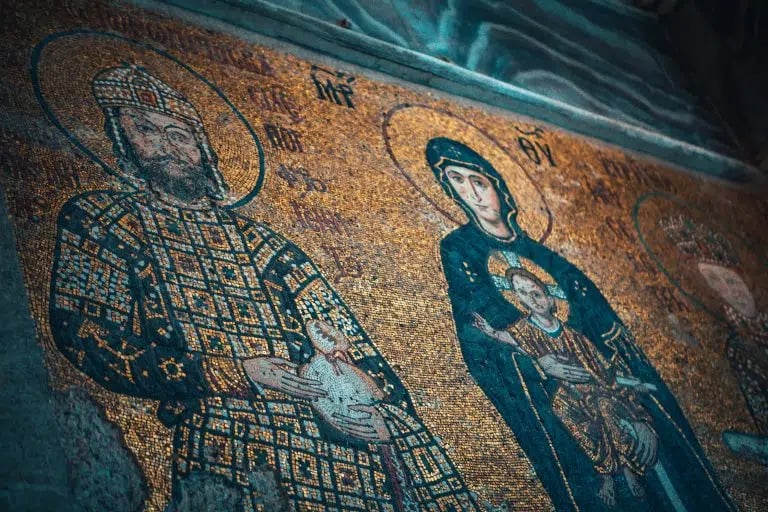
Period: 476 – 1453
Characteristics: Divine radiance, geometric abstraction, sacred writing, architectural innovation
Events: Fall of Rome (476), Birth of Islam (610), Iconoclasm Controversy (726 – 843), Fall of Constantinople (1453)
Two Empires, Two Visions: Art After Rome
As the Western Roman Empire collapsed in the late 5th century, two remarkable civilizations emerged to shape the medieval world. The Byzantine Empire preserved and transformed Roman traditions, infusing them with Eastern influences and Christian spirituality. Meanwhile, the rapid expansion of Islam across North Africa, the Middle East, and Europe created a new artistic vision embracing abstraction, geometry, and divine writing.
Byzantine and Islamic artistic traditions flourished for nearly a millennium, creating breathtaking monuments and artifacts. Despite different faiths and cultural contexts, they shared commonalities: expressing spiritual truths visually, balancing figuration and abstraction, and developing sophisticated architecture. As neighbors and rivals, they influenced each other through trade, cultural exchange, and artist movement across imperial boundaries.
These traditions fascinate through their approaches to representing the divine. Byzantine artists created radiant icons and mosaics as windows to heaven, using gold and brilliant color to evoke transcendent realms. Islamic artists, working within traditions discouraging figurative religious imagery, developed repeating geometric patterns and elevated calligraphy, expressing divine order and sacred text beauty. Both traditions used art for spiritual communication rather than mere decoration.
Exploring these parallel artistic worlds reveals how creative approaches reflected and shaped societies, responded to theological debates and political upheavals, and continue influencing contemporary art and architecture. From Constantinople's golden domes to Córdoba's intricate mihrabs, from illuminated manuscripts to monumental spaces, Byzantine and Islamic art offer windows into civilizations placing beauty and spiritual meaning at their creative center.
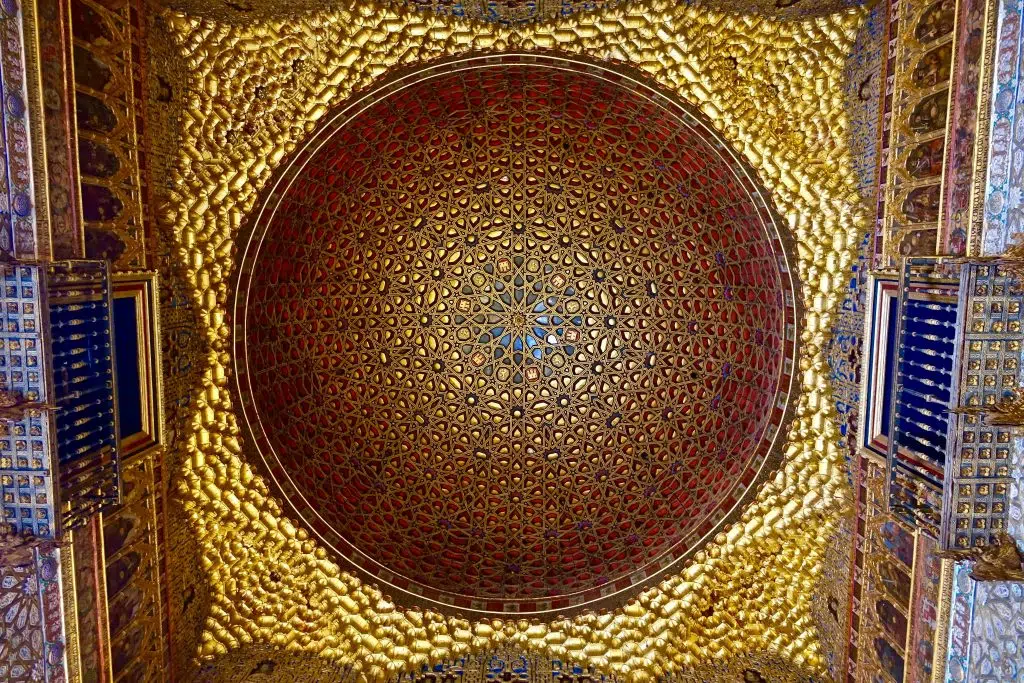
Photo by Pixabay on Pexels
The Byzantine Vision: Windows to Heaven
When Emperor Constantine moved the Roman capital to Byzantium in 330 CE, renaming it Constantinople, he created a civilization that flourished for over a thousand years. The Byzantine Empire preserved Roman administrative structures and legal traditions while developing distinctive artistic vision connected with Orthodox Christianity. Byzantine art emerged from Roman technique, Greek aesthetics, Oriental influences, and Christian theology, creating visual language designed to transport viewers toward divine contemplation.
Byzantine aesthetics centered on theological understanding of images (icons) as channels between earthly and heavenly realms. Icons were presences rather than mere depictions, windows for divine communication. This understanding informed every aspect of Byzantine art, from solemn, frontal gazes to luminous gold backgrounds negating earthly space and suggesting divine radiance. Byzantines perfected techniques creating images that seemed to emit rather than reflect light, using gold leaf, glass tesserae, and polished stones.
Mosaic was Byzantine art's most characteristic medium, composed of thousands of tiny colored glass cubes (tesserae) set into wet plaster, often against gold backgrounds transforming architectural spaces into shimmering heavenly visions. Ravenna's San Vitale mosaics (c. 547) exemplify this approach, particularly panels depicting Emperor Justinian and Empress Theodora with courtiers. These works combine portraiture with sacred symbolism, presenting the imperial couple suggesting both earthly authority and divine sanction. Stylized, frontal figure presentation, almond-shaped eyes gazing at viewers, and rich embedded symbolism are Byzantine aesthetic hallmarks.
Byzantine art was deeply hierarchical with strict conventions governing sacred figure representation. Christ, the Virgin Mary, and saints were depicted according to established formulas identifying them through specific attributes, gestures, and clothing. This visual language allowed viewers to "read" images easily, reinforcing religious teachings visually. Unlike later Western European art prioritizing naturalism and emotional expression, Byzantine art maintained deliberate abstraction and formalism emphasizing subjects' otherworldly nature. Figures were elongated, facial features standardized, and spatial depth minimized for symbolic presentation.
Despite formal conventions, Byzantine art achieved remarkable emotional and spiritual expression. The 12th-century Virgin of Vladimir demonstrates how Byzantine artists infused formalized representations with profound tenderness as the Christ Child presses his cheek against his mother's face. Similarly, the Pantocrator mosaic from Cefalù Cathedral (c. 1148) combines awesome majesty with compassionate humanity. These works exemplify how Byzantine artists created images functioning as devotional objects facilitating direct connections between viewers and divine reality.
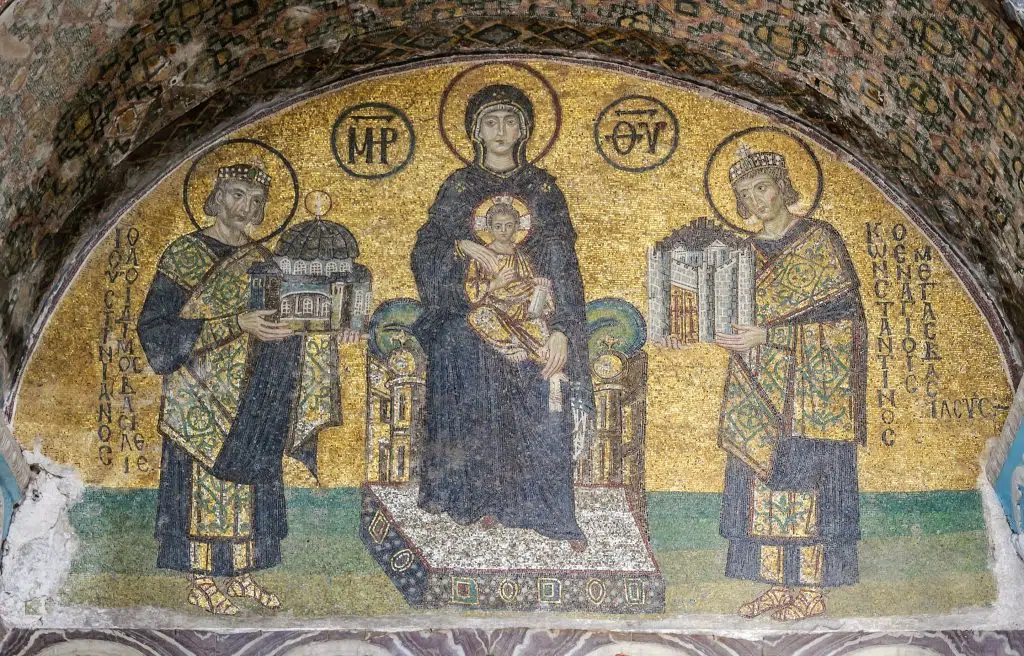
Mosaic from Hagia Sophia (Source)

Hagia Sophia: Architecture as Theology
Byzantine art's architectural masterpiece is the Hagia Sophia (Holy Wisdom) in Constantinople. Commissioned by Emperor Justinian I and completed in 537 CE, this monumental church represented Byzantine architectural achievement's pinnacle and served as the empire's religious center until the Ottoman conquest of 1453. The Hagia Sophia's revolutionary innovation solved placing a circular dome over a square base.
Architects Anthemius of Tralles and Isidorus of Miletus solved this through pendentives, curved triangular sections transitioning from square base to circular dome. This engineering breakthrough allowed an unprecedented dome scale (over 100 feet diameter) that seems to float above interior space. Visitors' eyes are drawn upward to this magnificent dome appearing to hover weightlessly, supported by forty windows allowing light to stream in. The effect creates transcendence as the massive stone structure seems dematerialized by light, described by contemporaries as the dome being "suspended from heaven by a golden chain."
The Hagia Sophia's interior originally included extensive mosaics depicting Christ, the Virgin Mary, saints, and imperial figures. While many were covered or destroyed following Ottoman conquest (when converted to a mosque), surviving examples and historical accounts attest to their splendor. Light playing across golden mosaics created constantly changing luminosity throughout the day, reinforcing Byzantine aesthetic of transcendent radiance.
The Hagia Sophia's design carries profound theological implications. Its vast central space, unified under the heavenly dome, embodied Orthodox Christian conception of the universe as cohesive whole under divine authority. The interior was conceived as divine order microcosm, material space transformed through light, color, and sacred imagery into heaven on earth manifestation. When Emperor Justinian first entered the completed church, he reportedly exclaimed, "Solomon, I have surpassed thee!"—referencing Jerusalem's original Temple and claiming to have created worthy divine dwelling.
The Hagia Sophia's cultural and historical significance extends beyond architectural innovations. As the Byzantine Empire's primary church for nearly a millennium, it witnessed imperial coronations, patriarch excommunications, and church schism reconciliations. Its later mosque conversion following Ottoman conquest added new meaning layers and decoration, creating complex palimpsest reflecting the region's multicultural history. Today, as a museum, it testifies to Byzantine civilization's artistic and spiritual aspirations and their enduring world culture influence.
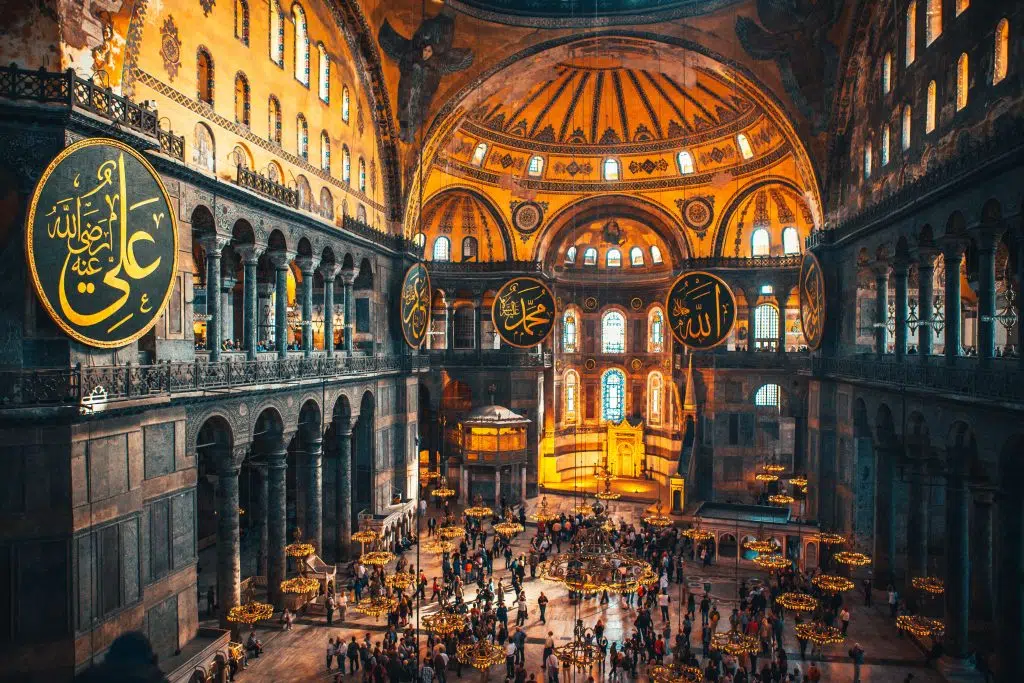
Photo by Raimond Klavins on Unsplash
The Iconoclasm Controversy: Faith and Image
The Iconoclasm Controversy (726-843 CE) best illustrates images' central importance in Byzantine culture. This tumultuous period saw the empire torn apart by fundamental disagreement over religious art. The controversy began when Emperor Leo III issued edicts against icon veneration, initiating campaigns to remove and destroy religious images throughout the empire. This iconoclastic ("image-breaking") movement combined theological concerns with political considerations.
Theologically, iconoclasts argued that depicting Christ and saints in material form risked idolatry and violated biblical prohibition against graven images. They referenced the Second Commandment and questioned how human-made images could adequately represent Christ's divine nature without diminishing or misrepresenting it. Some scholars suggest Islam's rise, with strict religious imagery prohibition, may have influenced Byzantine thinking, especially as the empire faced Muslim military pressure.
Politically, controlling religious imagery let emperors assert church authority and appropriate church wealth during military and economic challenges. By attacking practices deeply embedded in popular devotion, emperors unleashed decades of bitter conflict dividing families and communities throughout the Byzantine world.
Icon defenders, known as iconodules or iconophiles, developed sophisticated theological arguments countering iconoclasts. Led by figures like John of Damascus and Theodore the Studite, they argued that because Christ took human form in the Incarnation, he could and should be depicted in art. They distinguished between worship (latria), due to God alone, and veneration (dulia), properly offered to sacred figure images. The image was not an idol but a channel, through venerating the image, one honored the represented prototype.
The controversy unfolded in waves with intense persecution periods followed by temporary icon restorations. The Seventh Ecumenical Council (787) declared icon veneration orthodox, but iconoclasm returned under later emperors until final image restoration in 843—an event still celebrated in Orthodox churches as the "Triumph of Orthodoxy." Theological arguments developed during this period profoundly shaped Byzantine sacred art understanding and continue informing Eastern Orthodox practices.
The Iconoclasm Controversy had lasting Byzantine art effects. When icon production resumed after 843, artists worked within more rigorously defined conventions ensuring theological correctness. Having sacred art questioned fundamentally led to more self-conscious and theoretically grounded religious imagery approaches. Some of the most spiritually powerful Byzantine icons date from this "post-iconoclastic" period, as artists sought creating works justifying the church's sacred image defense through transcendent beauty and spiritual presence.
Islamic Art: Divine Order and Sacred Writing
As Byzantine artists perfected sacred imagery visions, a different but equally profound artistic tradition developed within the Islamic world. Following Prophet Muhammad's death in 632 CE, Arab armies carried the new faith across vast territories from Spain to Central Asia. Within these lands, Islamic art emerged as distinctive tradition drawing from various cultural influences while establishing its own aesthetic principles and spiritual concerns.
Unlike Byzantine art centering on holy figure representation, Islamic art generally avoided figural imagery in religious contexts. This approach rooted in idolatry concerns similar to Byzantine iconoclasts led Islamic artists in different creative directions. Rather than developing theological justifications for religious images, Islamic art embraced alternative expression modes: geometric abstraction, stylized vegetation, and most importantly, calligraphy, the art of beautiful writing.
Arabic calligraphy became Islamic culture's supreme art form as the vehicle for recording the Quran, God's direct revelation received by Muhammad. The divine word, rendered in increasingly refined and beautiful scripts, adorned mosques, palaces, and daily objects. Calligraphic inscriptions served multiple purposes: conveying semantic meaning through content, aesthetic pleasure through formal beauty, and spiritual blessing (baraka) through sacred associations. Various calligraphic style development, from angular Kufic to flowing Naskh and elaborate Thuluth, demonstrates how seemingly restrictive art forms could generate endless creative possibilities through proportion, rhythm, and composition variations.
Alongside calligraphy, geometric design became Islamic art's hallmark. Drawing on mathematics and astronomy principles, fields where Islamic scholars made significant advances, artists created intricate patterns based on regular polygons, stars, and interlacing lines. These patterns, expandable indefinitely in all directions, embodied cosmological principles of unity and multiplicity central to Islamic thought. Endlessly repeating geometric designs in mosques, palaces, and decorative arts suggested divine creation's infinite nature and the universe's underlying mathematical order.
The third major element in Islamic art's visual vocabulary was the arabesque, stylized vegetal designs based on scrolling vines, leaves, and flowers. These organic forms complemented more rigorous geometrical patterns, creating visual rhythm that could be both soothing and mesmerizing. Together, these three elements, calligraphy, geometry, and arabesque, formed integrated decorative systems applicable to architecture, textiles, ceramics, metalwork, and manuscripts, creating unified visual culture across diverse Islamic world regions.
While religious spaces like mosques typically avoided figural imagery, secular Islamic art included human and animal representations, particularly in manuscript illustrations, palace decorations, and luxury objects. Persian miniature painting developed sophisticated narrative techniques and exquisite detailed representations of court life, hunting scenes, and literary episodes. These works demonstrate that relative figure absence in religious contexts resulted from deliberate aesthetic and theological choices about appropriate sacred expression forms rather than inability.
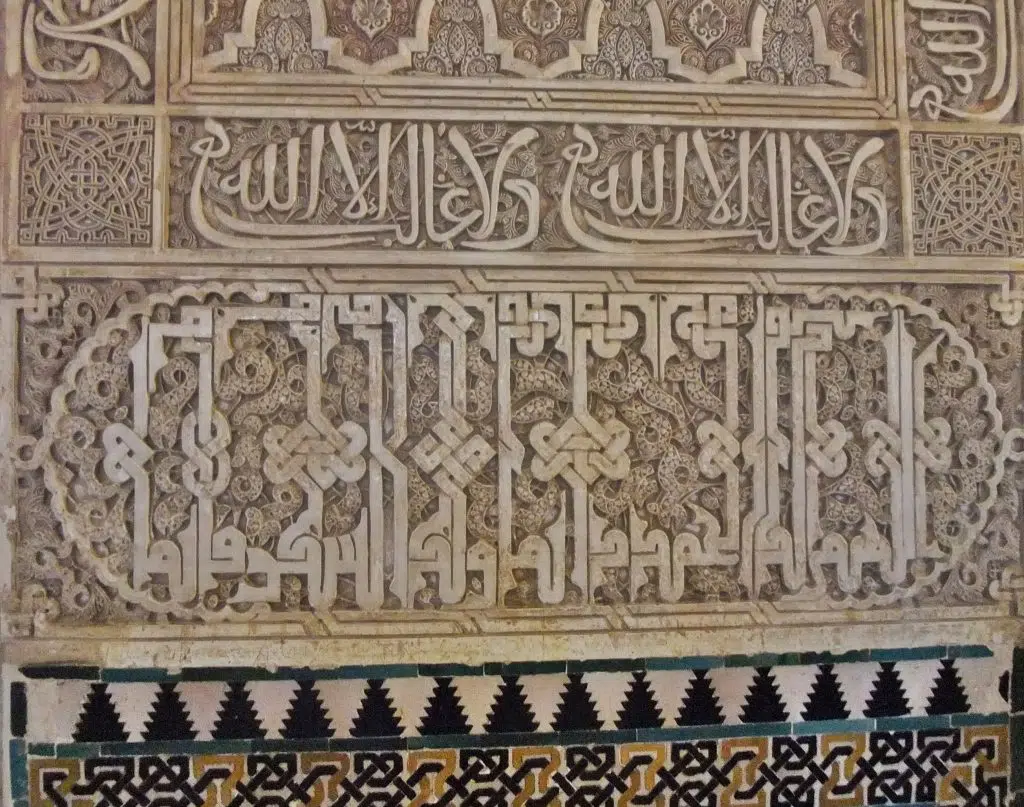
Calligraphy in the Hall of Ambassadors in Alhambra (Source)

The Alhambra: Poetry in Stone
Just as the Hagia Sophia represents Byzantine aesthetic architectural expression, the Alhambra palace complex in Granada, Spain, represents one of Islamic visual culture's most complete and sophisticated examples. Built primarily during the 13th and 14th centuries by the Nasrid dynasty, Spain's last Muslim rulers, the Alhambra combines architectural innovation, decorative splendor, and poetic sensibility creating spaces of unparalleled beauty and refinement.
The Alhambra's architecture employs simple structural elements, columns, arches, and domes, transformed through ornamentation into spaces of extraordinary visual complexity. Slender columns support horseshoe and muqarnas (stalactite) arches, creating rhythmic sequences guiding visitors through interconnected courtyards, halls, and gardens. Unlike Byzantine architecture's massive, space-enclosing approach, Islamic buildings like the Alhambra create more permeable boundaries between interior and exterior spaces, using light, water, and vegetation as architectural elements.
The Court of the Lions exemplifies this approach with its central fountain supported by twelve stone lions, surrounded by slender white marble column colonnades. The proportions are human-scaled rather than monumental, creating intimate atmosphere contrasting with awesome grandeur of spaces like the Hagia Sophia. Water flows from the fountain along four channels dividing the courtyard, symbolizing Paradise's four rivers described in the Quran. This architecture, decoration, and symbolic meaning integration creates multisensory environments engaging visitors at multiple levels.
The Alhambra's decorative program represents Islamic ornamental tradition culmination. Its walls are covered with intricate plasterwork featuring geometric patterns, arabesques, and calligraphic inscriptions arranged in bands and panels. Many inscriptions are poems composed specifically for the palace, creating literal architecture and literature interweaving. One famous poem inscribed around the Court of the Lions compares the fountain to clouds raining down over white marble columns like "melting silver." These poetic texts add another space experience dimension, linking visual beauty with literary expression.
Alhambra color use would originally have been much more vibrant than today's remains. Research reveals that many currently white plaster surfaces were once painted in bright blues, reds, and golds. Similarly, wooden ceilings featured intricate inlay work and painted designs creating celestial overhead effects. This colorful approach differs from Byzantine interiors' gold-dominated palette but shares concern with creating environments transporting visitors beyond ordinary experience.
The Alhambra's particular significance lies in embodying Islamic aesthetic principles in comprehensive environments engaging all senses. Running water sounds, light playing through pierced screens (mashrabiya), flower scents in adjoining gardens, and tactile contrasts between smooth marble and intricate plasterwork create immersive experiences exemplifying Islamic Paradise concepts as sensory delight gardens. This holistic environmental design approach influenced not only later Islamic architecture but also Western traditions, particularly through Spanish architecture and design impact.
Cultural Exchange and Artistic Dialogue
While Byzantine and Islamic art developed distinct visual languages shaped by respective religious traditions, their relationship was characterized by dialogue and mutual influence rather than isolation. Geographic proximity of the Byzantine Empire and various Islamic states, combined with active trade networks and diplomatic exchanges, created numerous artistic cross-fertilization opportunities. This interaction was particularly evident in regions like Sicily, Spain, and the Levant, where Christian and Muslim populations lived in close contact for extended periods.
In techniques and materials, both traditions drew from shared sources and influenced each other's development. Byzantine silk textiles, highly prized throughout the medieval world, incorporated Persian and Islamic tradition motifs. Similarly, Islamic metalworkers and ceramicists absorbed Byzantine decorative patterns while developing distinctive styles. Artist and craftspeople movement between territories facilitated technique transmission like cloisonné enamelwork, glass production, and architectural methods across cultural boundaries.
Shared aesthetic values sometimes transcended religious differences. Both traditions prized technical perfection, sumptuous materials, and all-over decorative richness. Both employed light as transformative architectural element and developed sophisticated mathematical design approaches. Even where approaches diverged, such as figural representation, interesting contact points existed. Some Islamic secular art, particularly in Persian and Turkish contexts, developed figural traditions showing Byzantine model awareness while adapting them to different cultural preferences.
The Hagia Sophia's fate illustrates this complex relationship. When Constantinople fell to Ottoman forces in 1453, the great church was converted into a mosque. Rather than destroying Byzantine mosaics, Ottoman authorities covered them with plaster, unintentionally preserving them for later generations. Islamic architectural elements like minarets and mihrab (prayer niche) were added, creating hybrid structures embodying historical dialogue between these traditions. Similar processes occurred at countless Mediterranean sites where churches became mosques or mosques became churches as political fortunes shifted.
This artistic dialogue continues resonating in contemporary art and architecture. Modern architects draw inspiration from both Byzantine dome structural innovations and Islamic courtyard environmental sensitivity. Contemporary artists engage with Islamic design geometric abstraction and Byzantine art icon tradition, finding in these historical sources relevant approaches to representation, spirituality, and cultural identity questions. Rich visual languages developed by Byzantine and Islamic artists continue offering creative possibilities transcending their original cultural and religious contexts.
Conclusion: Legacies of Light and Pattern
Byzantine and Islamic art, emerging from classical antiquity's aftermath, developed distinctive visual languages expressing profound theological ideas and cultural values. Byzantine art, with radiant icons, golden mosaics, and transcendent architecture, created earth-heaven windows guiding viewers toward divine mystery contemplation. Islamic art, with magnificent calligraphy, infinite geometric patterns, and sensory-rich environments, expressed divine order and sacred text beauty through abstraction and mathematical harmony.
Despite approach differences, both traditions shared fundamental concern with transforming material reality into spiritual truth expressions. Both developed comprehensive visual systems applicable across media, from monumental architecture to portable objects. Both combined technical virtuosity with theoretical sophistication, producing works rewarding both immediate sensory appreciation and deeper intellectual engagement.
These artistic tradition legacies extend far beyond original historical contexts. Byzantine aesthetics continue informing Orthodox Christian art and have influenced modernist abstraction and spiritual expression explorations. Islamic geometric design and calligraphy have experienced renewed appreciation both within contemporary Islamic contexts and in global design practices. Both traditions' architectural innovations, from Byzantine church massive domed spaces to Islamic palace environmentally sensitive courtyard designs, continue inspiring contemporary architects seeking meaningful and sustainable built environment creation.
Looking back across centuries at these remarkable artistic achievements, we appreciate how Byzantine and Islamic artists transformed classical antiquity heritage into entirely new visual languages capable of expressing their societies' deepest spiritual and cultural values. Their work reminds us of art's power to transcend material limitations and create experiences engaging both senses and soul, a lesson as relevant in our time as theirs.
Related Resources
Related in this topic
More from Occult Art History & Symbolism — Start Here.
Symbolism
Discover the meaning of symbolism! Learn its origins, art and famous symbolist painters. Find hidden emotions in art.
Naïve Art
Naïve art: untrained artists created startling originality through simplified forms, vivid colors, and unfiltered imagination.
Art Informel
Art Informel: the European parallel to Abstract Expressionism. Dubuffet, Tàpies, and the art of the unformed and the raw.
Street Art
Street Art: from subway tags to gallery walls. Banksy, Keith Haring, and the art that reclaims public space.
You Might Also Like
Art Informel
Art Informel: the European parallel to Abstract Expressionism. Dubuffet, Tàpies, and the art of the unformed and the raw.
Street Art
Street Art: from subway tags to gallery walls. Banksy, Keith Haring, and the art that reclaims public space.