Attributes
- •Challenges
- •Competition
- •Conflict
- •Growth
Five of Wands Tarot Card Meaning
Five of Wands Keywords
| Upright | Reversed |
|---|---|
| conflict, competition, disagreement, rivalry | harmony, cooperation, avoiding conflict |
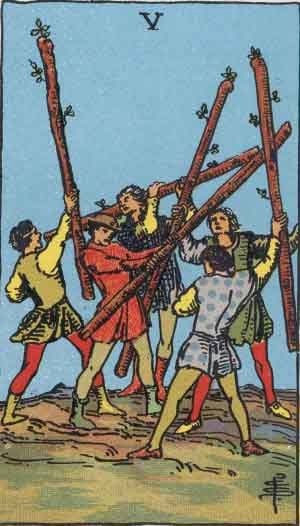
Staffs clash in midair as five figures engage in what might be combat, competition, or perhaps a vigorous training exercise. The Five of Wands embodies the chaotic energy of creative discord, that necessary developmental stage where comfortable patterns shatter against the invigorating impact of opposing forces. Here we witness neither destruction nor harmony but the messy middle ground where growth happens: the brainstorming session where ideas collide, the team where different approaches create sparks, the relationship where authentic differences finally emerge into the open. The participants' colorful garments suggest not mortal enemies but diverse energies whose differences, when properly engaged, might generate something stronger and more resilient than any single approach could produce alone.
Symbolism and Imagery
The Five of Wands typically depicts five individuals engaged in what appears to be either combat or a vigorous training exercise with staffs or wands. What makes this image striking is the sense of dynamic movement and interaction, bodies in motion, energies intermingling, forces meeting and challenging each other. Unlike scenes of outright warfare or violence, this engagement suggests spirited competition rather than harmful conflict, with no clear winners or losers yet emerging from the fray.
The figures are usually dressed in varied colors and positioned in different stances, symbolizing diverse perspectives, approaches, and energies coming together in a lively exchange. There's often a sense that while they appear to be fighting, they might be engaged in a practice drill, tournament, or some form of challenging play that builds skill through opposition. The background usually appears relatively benign, not a battlefield but an open space where this energetic confrontation can safely unfold.
The raised wands create a visual pattern of intersecting lines and dynamic tension, resembling the way ideas or initiatives might clash and interweave in creative collaboration or market competition. The five wands, matching the card's number, represent the challenge of maintaining order when multiple elements interact simultaneously. Unlike the stability of four or the harmony of three, five brings an element of unpredictability and dynamic change.
Meanings and Interpretations
When the Five of Wands appears upright in your reading, it often signals a period where you're experiencing the productive but challenging tension that comes from competing demands, perspectives, or energies in your life. This card acknowledges that you're navigating a situation with multiple voices or agendas in play, perhaps a project with differing viewpoints, a relationship with competing needs, or an internal conflict between various aspects of yourself seeking expression.
This card speaks to the necessary role of competition and challenge in growth and development. It suggests examining whether you tend to avoid all forms of confrontation or competition, potentially missing the strengthening and clarifying benefits these dynamics can provide when approached with the right mindset. The Five of Wands indicates that meaningful progress often requires engaging with opposing views and competing ideas rather than prematurely harmonizing differences.
The card also carries messages about diversity and the creative potential of plurality. It reminds you that homogeneous environments, while comfortable, rarely produce innovation or growth at the same rate as those where different approaches and perspectives regularly challenge each other. The Five of Wands suggests developing greater comfort with the dissonance and energy that emerges when varying viewpoints coexist without immediate resolution.
The Five of Wands in Daily Life
In everyday situations, the Five of Wands energy appears when you find yourself navigating environments where multiple strong personalities, perspectives, or priorities create a sense of lively competition or challenging engagement. Perhaps you're participating in a brainstorming session where everyone eagerly contributes ideas, working on a team project where different approaches clash productively, or even engaging in friendly rivalry that pushes you to develop new skills and capabilities.
Consider how this card's energy might manifest in your approach to collaborative projects and group dynamics. You might notice that the most innovative solutions often emerge not from polite agreement but from the creative tension of differing viewpoints respectfully challenging each other. The Five of Wands suggests that effective collaboration involves not suppressing disagreement but creating containers where conflicting ideas can engage constructively without dissolving into personal attacks.
For personal development and skill mastery, this card appears as the necessity of challenge and competition for growth. The Five of Wands suggests that meaningful advancement in any domain, whether artistic, intellectual, physical, or professional, typically requires engaging with challenges that push beyond comfortable competence. It encourages seeking environments where your abilities meet appropriate resistance that stretches without overwhelming your current capacities.
In managing multiple priorities or internal conflicts, this card's energy appears as the dynamic process of negotiating competing aspects of yourself or your life. The Five of Wands suggests that having multiple important values or goals isn't necessarily a problem to solve through elimination but a rich complexity to navigate through conscious prioritization and integration.
The Five of Wands and Relationships
In relationships, the Five of Wands highlights the creative potential of constructive conflict and the importance of engaging differences directly rather than avoiding them. It often appears when examining how opposing needs or perspectives within a relationship can either strengthen connection through honest engagement or weaken it through avoidance or dominance. This card reminds you that genuine intimacy doesn't mean the absence of disagreement but rather the capacity to navigate differences with respect and curiosity.
For those in established relationships, this card appears as an invitation to examine patterns of conflict engagement. The Five of Wands suggests that relationships benefit when disagreements are approached not as problems to eliminate but as opportunities to deepen understanding and create more nuanced solutions. It encourages developing communication that allows for spirited exchange of differing views without descending into personal attacks or withdrawal.
When navigating new relationships or social dynamics, this card emphasizes discerning between productive friction and destructive conflict. The Five of Wands suggests that some tension or disagreement in forming connections can actually strengthen them, revealing important information about values, communication styles, and conflict resolution approaches. It encourages noticing whether potential friends or partners can engage differences with respect and curiosity rather than immediately seeking to dominate or withdraw.
The card also speaks to group dynamics and team relationships. The Five of Wands suggests that effective teams require both psychological safety and the willingness to challenge each other's ideas. It encourages creating environments where members feel secure enough to express disagreement while maintaining respect for each other as people.
Practical Applications of the Five of Wands Card
The Five of Wands offers useful guidance for harnessing conflict and competition constructively. If you're navigating a situation with competing perspectives or priorities, this card encourages creating structured processes that allow different viewpoints to be fully expressed and considered. It suggests activities like devil's advocate exercises, formal debates on important decisions, or brainstorming sessions where critical evaluation follows only after all ideas have been gathered.
For developing innovation and creative problem-solving, this card provides insight into the value of constructive tension. The Five of Wands suggests that breakthrough solutions often emerge when diverse approaches and perspectives challenge each other, creating a synthesis stronger than any single viewpoint could produce alone. It encourages deliberately incorporating varied expertise, backgrounds, and thinking styles when tackling complex challenges.
In professional and competitive environments, this card highlights the importance of balancing cooperative and competitive energies. The Five of Wands suggests that healthy competition, whether between individuals, teams, or organizations, often drives everyone to higher performance levels than would be achieved without this motivating tension. It encourages approaching competitive situations not with a win-at-all-costs mentality but with appreciation for how the challenge itself develops your capabilities.
For personal development and internal conflicts, this card emphasizes productive engagement with opposing aspects of yourself. The Five of Wands suggests that genuine growth often involves holding the tension between competing values, desires, or self-concepts rather than prematurely resolving this complexity through simplistic either/or choices.
Reversed Meaning: When Conflict Becomes Destructive
When the Five of Wands appears reversed, it often signals imbalance in your relationship with conflict and competition. This position suggests examining whether current tensions have become unproductive, perhaps escalating into harmful conflict, remaining unresolved for too long, or being avoided entirely through artificial harmony.
Sometimes this reversal indicates destructive conflict patterns. You might be experiencing disagreements that have crossed from productive tension into personal attacks, power struggles where winning has become more important than finding optimal solutions, or environments where conflict is expressed in passive-aggressive ways rather than direct engagement.
The reversed card sometimes points to conflict avoidance and artificial harmony. Perhaps you're suppressing important differences to maintain superficial peace, working in an environment where conformity is valued over honest feedback, or remaining in situations where your authentic voice is consistently silenced.
In creative contexts, the reversal might indicate creative blocks stemming from either excessive internal criticism or insufficient challenge. You might be experiencing so much self-doubt that it paralyzes action, or alternatively, working in such comfortable routines that growth has stagnated without the stimulation of appropriate challenge.
Embracing the Lessons of the Five of Wands
The Five of Wands teaches lessons about the essential role of creative tension and constructive challenge in growth and development. It reminds us that meaningful progress rarely emerges from comfortable agreement or isolated effort but from the dynamic engagement of diverse energies, perspectives, and approaches within appropriate containers.
This card encourages developing a nuanced relationship with challenge and opposition, recognizing that these forces, while sometimes uncomfortable, often provide the necessary resistance that strengthens capabilities and refines ideas. The Five of Wands suggests that just as physical training requires appropriate resistance to build strength, meaningful growth in any domain typically involves engaging with challenges that stretch your current capacities.
The Five of Wands reminds us that diversity, whether of ideas, approaches, or perspectives, creates a natural and potentially productive tension that, when engaged constructively, generates more robust and innovative outcomes than homogeneity ever could. The card invites creating more environments where different viewpoints can challenge and refine each other within contexts of mutual respect and shared purpose.
Related in this topic
More from Tarot Meanings & Reading — Start Here.
Page of Cups Tarot Card Meaning
Page of Cups: intuitive messages and creative beginnings. Guides you toward emotional openness.
Queen of Cups Tarot Card Meaning
Queen of Cups: emotional wisdom and intuitive depth. Embrace compassion and inner knowing.
The Moon Tarot Card Meaning
The Moon: illusion and subconscious depths. Reveals hidden fears and intuitive messages.
The High Priestess Tarot Card Meaning
High Priestess: intuition and subconscious wisdom. Reveals hidden knowledge and inner guidance.