Attributes
- •Endings
- •Renewal
- •Transformation
Death Tarot Card Meaning
Death Keywords
| Upright | Reversed |
|---|---|
| endings, transformation, change, release, rebirth | resistance to change, stagnation, fear |
Death Yes or No?
Maybe. Transformation is coming. The answer depends on whether you embrace necessary change.
Misunderstood and feared, yet ultimately liberating, Death rides the thirteenth position of the Major Arcana not as harbinger of doom but as nature's transformer. Where lesser cards might suggest minor adjustments or temporary pauses, Death arrives with the finality that makes genuine rebirth possible. This card speaks not through whispers but through the unmistakable sound of a closing door, the decisive moment when one chapter completes so another may begin. When this energy enters your reading, it acknowledges that something essential has completed its natural cycle.
Symbolism and Imagery
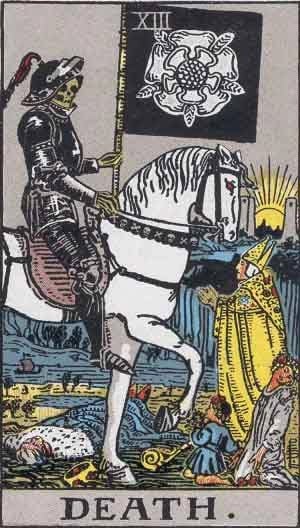
Look at the Death card and you'll notice a figure that doesn't hide its message behind gentle metaphors. Typically depicted as a skeleton in armor, sometimes riding a white horse, Death appears as the great equalizer that comes to all regardless of status or circumstance. This isn't meant to frighten but to remind you of life's impermanence and the liberation that comes with accepting this truth.
The skeleton doesn't wear the tattered black robe of the Grim Reaper from popular culture but often appears in black armor, suggesting that endings have their own kind of strength and protection. The horse is frequently white, representing purity and the cleansing nature of necessary transitions. In many decks, figures of all stations, from peasants to kings, appear before Death, reinforcing that transformation is the one constant that touches every life regardless of worldly position.
Look closer and you'll notice details easily missed at first glance. A rising sun often appears on the horizon, promising new beginnings after the darkness. Flowers may grow where the horse has passed, suggesting that destruction fertilizes future growth. A flag or banner might wave, carrying symbols of infinity or rebirth. These visual cues tell you that Death isn't the end of the story but a turning of the page.
The landscape itself tells a story of transition, perhaps a river flows nearby, representing the passage between states of being, or mountains stand in the distance, representing the challenges you must face to reach new perspectives. Every element reinforces that this card speaks not of final endings but of necessary transitions that, while sometimes difficult, ultimately serve your growth and renewal.
Meanings and Interpretations
When Death appears in your reading, it signals that something in your life has reached its natural conclusion. This card often shows up during major life transitions, the end of a relationship, career change, moving to a new place, or any situation where you're being asked to release what's familiar to make room for new experiences. Unlike more gentle cards, Death doesn't suggest gradual evolution but a clean break, a clear line between what was and what will be.
The card speaks to the liberating power of acceptance. When you stop fighting against inevitable endings, you free up enormous energy previously spent on resistance. Think of those moments when you finally accepted that something was over, perhaps a relationship that had run its course or a job that no longer fit. The initial pain of acknowledgment quickly gives way to a sense of clarity and space. Death appears when it's time to stop clinging to the shore and allow yourself to be carried by the current toward new horizons.
This card also acknowledges the grief that often accompanies significant transitions. Unlike some spiritual perspectives that encourage bypassing difficult emotions, Death honors the natural mourning process that follows meaningful endings. The skeleton doesn't rush you through your feelings but is a witness to both the pain and potential of major life changes. The card suggests that fully feeling the impact of an ending actually helps you move through it more completely than trying to skip ahead to the next chapter.
For those struggling with letting go, Death offers clear perspective. It appears when half-measures and partial commitments no longer serve you, when it's time to make a definitive choice rather than trying to keep all options open. The card asks: "What must be completely released for your next chapter to begin? What are you trying to keep alive past its natural conclusion?" These questions might feel uncomfortable, but they create the clarity necessary for authentic transformation.
The Death Card in Daily Life
We encounter Death energy in everyday life whenever we face endings and transitions. It's there when you clean out your closet, finally discarding clothes you never wear but kept "just in case." It shows up when you delete old files from your computer, making space for new projects and ideas. It appears when you say a firm "no" to an invitation that doesn't match your current priorities, creating boundaries that protect your energy for what truly matters.
Consider how this energy might help with a current situation. Are you holding onto something out of habit or fear rather than genuine connection? Death suggests that clean endings, while sometimes painful, ultimately cause less suffering than prolonged situations that have lost their vitality. This might mean having the difficult conversation you've been avoiding, submitting that resignation letter, or finally canceling the subscription you never use but keep paying for month after month.
Death also appears during those threshold moments that mark the passage from one life stage to another. The last day of school, retirement from a long career, becoming a parent, or moving from your hometown, these transitions involve not just practical changes but shifts in identity. The card reminds us that during these passages, something of our former self must be released for our new self to emerge fully. This isn't about rejecting your past but integrating its lessons while creating space for who you're becoming.
In daily decisions, Death encourages periodically evaluating what no longer serves your growth or happiness. This regular practice of conscious completion prevents the buildup of stagnant energy in your life. Consider creating seasonal rituals of release, perhaps with each change of season, you reflect on what can be thanked for its service and then consciously released. These deliberate endings create fertile ground for what wants to emerge next.
The Death Card and Relationships
In relationships, Death represents necessary endings and transformations. When this card appears in relationship readings, it often highlights patterns or dynamics that have reached their natural conclusion. The healthy expression of Death energy in relationships involves both the courage to release connections that have completed their purpose and the willingness to allow existing relationships to transform into entirely new forms.
For couples, Death may indicate a phase where a significant aspect of your relationship needs to end so something new can emerge. Perhaps you've outgrown old patterns of relating, communication styles that once worked but now create distance, or roles that have become limiting rather than supportive. The card doesn't necessarily predict a breakup but suggests that some fundamental aspect of how you connect needs to transform completely rather than just be adjusted or improved.
The card can also highlight how attachment to past versions of a relationship prevents growth. Are you trying to recreate the excitement of early dating years in a long-term partnership? Are you measuring current connections against an idealized past relationship? Death reminds us that each phase of connection has its own gifts, and clinging to what was prevents us from discovering what could be. True intimacy requires allowing both yourself and others to change rather than trying to preserve a moment in time.
For singles, Death often appears when it's time to release past relationship patterns or expectations that limit new connections. This might mean letting go of a "type" that has repeatedly led to similar disappointing outcomes, releasing lingering attachment to an ex-partner, or shedding beliefs about relationships formed during earlier life experiences. The card suggests that creating space through conscious completion actually attracts more aligned connections than continuously seeking without first clearing outdated patterns.
Death as Feelings
When Death appears in a "how do they feel" reading, it suggests this person is going through significant emotional transformation regarding you. They may be releasing old attachments or patterns that once defined the relationship. Upright, they likely feel that something has reached its natural end and are ready to move toward new emotional territory. Reversed, they may be resisting necessary change or clinging to what no longer serves either of you.
Practical Applications of the Death Card
In work and creative projects, Death offers practical guidance about completion and transition. Its approach emphasizes clean endings that honor what has been accomplished while creating clear space for what comes next. When facing professional changes, Death suggests that decisive action creates less extended suffering than drawn-out transitions where you have one foot in the old situation and one in the new.
For those making career decisions, this card encourages evaluating when a chapter has reached its natural conclusion. Death represents professional transitions characterized by clear endings followed by new beginnings rather than gradual evolution. It might indicate careers that involve helping others through major life transitions, hospice work, divorce mediation, career counseling, or any field where you guide people through completions and new beginnings.
The card also speaks to creative blocks and how they resolve. When projects stall or no longer generate energy, Death suggests that sometimes the most creative act is knowing when to end something rather than forcing its continuation. Many writers describe the liberation of abandoning a project that's not working to begin something fresh rather than continuously trying to revive what lacks natural momentum.
For anyone struggling with decision paralysis or feeling overwhelmed by too many commitments, Death offers a clarifying question: "What can I completely release to create space for what matters most?" This might mean dropping a committee position that no longer matches your values, ending a business offering that doesn't generate sustainable income, or completing a long-standing project just to get it off your plate.
Reversed Meaning: When Death Is Resisted
When Death appears reversed, it often points to resistance against necessary endings or fear of significant change. This reversal might indicate situations where you're clinging to circumstances, relationships, or identities that have outlived their purpose. Perhaps you know something needs to end but can't bring yourself to take the final step, or maybe you're trying to breathe life into situations that have naturally completed their cycle.
A common theme with reversed Death is the suffering created by resisting inevitable transitions. This resistance doesn't prevent the change but often makes it more painful and drawn out. You might recognize this in situations where you stayed in a job or relationship long after knowing it wasn't right, only to find that the ending happened anyway but with added complications.
This reversal can also indicate feeling trapped in a state of partial transition, having initiated a change but not fully committed to it. Perhaps you've mentally left a situation but physically remain, creating an uncomfortable limbo where you can neither fully engage with what is nor move toward what could be. The card suggests that this middle ground, while seemingly safer than complete release, actually drains more energy than a clean break would require.
For those experiencing this reversal, the path forward often involves identifying and addressing the fears that prevent completion. This might mean examining beliefs about what an ending means about you, processing grief you've been avoiding, or finding rituals that help you honor and release what's complete.
Welcoming Transformation
Whether appearing upright or reversed, Death invites us to develop a healthy relationship with endings and beginnings. Its wisdom lies not in avoiding necessary transitions but in approaching them with awareness and courage, understanding that completion is not failure but a natural part of life's cycles.
Try approaching a current ending with Death energy. Instead of viewing it as something to be avoided or rushed through, can you honor what this completion represents? Create a small ritual to acknowledge what this chapter has given you, what lessons you're carrying forward, and what you're now releasing. Sometimes marking transitions consciously helps us move through them with greater grace and less resistance.
The card also reminds us that our most significant transformations often don't happen gradually but through decisive moments of release. Consider a time when you finally let go of something you'd been clinging to, perhaps a situation, relationship, belief, or aspect of identity. The initial release may have felt frightening or painful, but what freedom or new growth followed?
Remember that Death represents a natural process, not a punishment. Just as forests need periodic fires to clear undergrowth and activate certain seeds, our lives require moments of significant release to create space for new growth. By recognizing endings as a necessary part of life's cycles rather than something to be feared or avoided, we develop greater resilience through transitions.
Death teaches us that in a world of constant change, our power lies not in preventing endings but in how we move through them. When we trust that completions serve our evolution rather than diminish it, we discover that every significant ending creates the exact conditions needed for our next beginning.