Introduction to Elemental Magic: Understanding the Foundations of Magical Practice
The Ancient Wisdom of Elemental Magic
Elemental magic is one of the oldest systems of magical practice in human history. Throughout the ages, civilizations across the globe have recognized the forces of nature shown through the four classical elements: Fire, Water, Earth, and Air. These primal energies form the building blocks of existence, both in the material world we perceive with our senses and in the subtle realms that practitioners of magic seek to influence.
The concept of working with elemental forces predates written history, appearing in archaeological evidence from prehistoric shamanic traditions to the magical systems of ancient Egypt, Greece, and beyond. Understanding the elements provides a framework for magical operations and offers insight into the fabric of reality itself.
The elements serve as a language through which we can communicate with the natural world, using its power for transformation, healing, protection, and manifestation. By developing relationships with these forces, modern practitioners connect to a lineage of magical wisdom that spans cultures and millennia.
The Four Elements: Cornerstones of Magical Practice
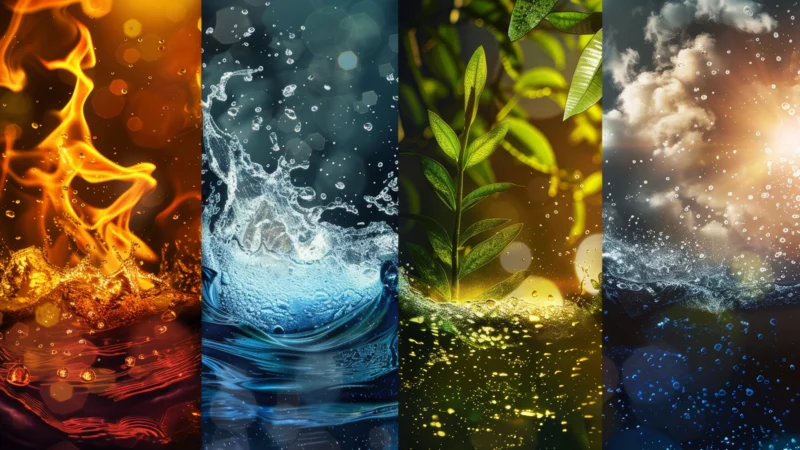
At the heart of elemental magic lies the recognition of four primary forces that flow through all of creation. Fire embodies transformation, passion, will, and energy in its most active form, consuming and changing whatever it touches. Water represents emotion, intuition, healing, and the subconscious mind, flowing and adapting to any container while maintaining its essential nature.
Earth symbolizes stability, abundance, fertility, and physical manifestation, grounding magical work in tangible reality and providing the substance from which all forms emerge. Air encompasses intellect, communication, movement, and the world of thought, connecting all things through invisible currents.
These four elements do not exist in isolation but interact in constant dynamic balance, each influencing and being influenced by the others in an eternal dance of creation and dissolution. The skilled practitioner learns to discern the unique qualities of each element, developing relationships with their energies and intelligences to create harmony and effect change in accordance with will and intent.
This fourfold system provides a complete map for understanding not only magical forces but also human psychology, spiritual development, and the natural cycles that govern our world. By working with the elements, we gain access to a universal language of energy that transcends cultural boundaries.
Historical Perspectives on Elemental Magic
The idea of the four elements as cosmic principles emerged independently across various cultures, suggesting a universal perception of these forces in human consciousness. In ancient Greece, the pre-Socratic philosopher Empedocles first formalized the concept of the four elements around 450 BCE, proposing that all matter consisted of various combinations of fire, water, earth, and air.
This theory was later expanded by Aristotle, who associated qualities such as hot, cold, wet, and dry with each element, creating a system that influenced Western thought for centuries. Ancient China developed a similar but distinct five-element system (wu xing) comprising Wood, Fire, Earth, Metal, and Water, which formed the foundation of Chinese medicine, divination, and magic.
In India, the classical elements (mahābhūta) included Space/Ether as a fifth element alongside the four. Medieval alchemists built upon these ancient systems, viewing the elements as both physical substances and spiritual principles that could be manipulated to achieve the Great Work of transformation.
The Hermetic tradition, with its principle of correspondence ("as above, so below"), recognized that elemental forces operated on multiple levels simultaneously, connecting the microcosm of the individual with the macrocosm of the universe. This historical background demonstrates how elemental magic has endured and evolved across cultures and epochs, remaining relevant to magical practitioners today.
The Elements in Modern Magical Systems
Contemporary magical traditions continue to place the elements at the center of their practices, adapting ancient wisdom to modern contexts while preserving the qualities of elemental forces. In Wicca and many forms of Neo-Paganism, the four elements correspond to the four directions and are invoked at the beginning of rituals to create sacred space and balance energies.
The Golden Dawn magical system associates the elements with the suits of the tarot, specific angels, godforms, and tools, creating a complete framework for ceremonial magic. Chaos magicians might work with the elements as psychological archetypes or energy patterns that can be accessed and directed through focused intention and altered states of consciousness.
New Age approaches often emphasize the elements as healing modalities or tools for personal growth, recognizing their influence on physical and emotional wellbeing. Despite these varying interpretations, all contemporary systems acknowledge the nature of elemental forces as gateways to magical power and cosmic understanding.
Modern practitioners benefit from access to diverse cultural perspectives on the elements, allowing for personalized approaches that draw from multiple traditions while honoring the core principles of elemental correspondence and balance. This adaptability ensures that elemental magic remains a living, evolving tradition rather than a fossilized system.
Elemental Correspondences: A Map of Magical Connections
One of the most practical aspects of elemental magic lies in understanding the network of correspondences associated with each element. These correspondences provide a map for magical work, allowing practitioners to amplify elemental energies through aligned tools, colors, times, and substances.
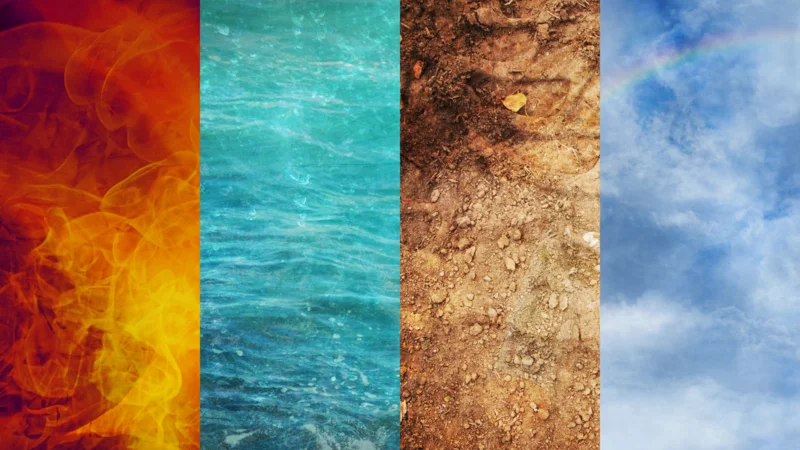
Fire corresponds to the direction South (in many Western traditions), the colors red and orange, summer, noon, rubies and garnets, dragons and lions, Mars and the Sun, and herbs like cinnamon and chili. Water aligns with the West, blue and silver, autumn, twilight, moonstones and aquamarine, dolphins and fish, the Moon and Venus, and herbs such as jasmine and water lily.
Earth connects to the North, green and brown, winter, midnight, emeralds and moss agate, bulls and bears, Saturn and Venus, and herbs like oak and vetiver. Air associates with the East, yellow and white, spring, dawn, clear quartz and mica, eagles and butterflies, Mercury and Jupiter, and herbs such as lavender and frankincense.
These correspondences extend to cover tarot cards, astrological signs, chakras, musical notes, deities, and other magical and mundane aspects of existence. By working with these connections, magicians create coherent spells and rituals that draw upon multiple channels of the same elemental force, enhancing their magical efficacy.
The study of correspondences represents a lifetime pursuit, with practitioners continually discovering new connections and refining their understanding of elemental relationships. This web of associations creates a coherent magical framework that connects seemingly disparate aspects of reality.
Perceiving and Sensitizing Yourself to Elemental Energies
Before effectively working with the elements in magical practice, one must develop the ability to perceive and distinguish their unique energetic signatures. This sensitivity forms the foundation of all elemental work, transforming theoretical knowledge into lived experience and intuitive understanding.
Beginning practitioners can start by observing elements in their natural state: meditating beside a bonfire to absorb the dynamic, transformative qualities of Fire; sitting beside a stream or ocean to attune to the flowing, emotionally resonant nature of Water; walking barefoot on soil or stone to connect with the grounding, nourishing aspects of Earth; and standing in an open field during a breeze to sense the intellectual, communicative properties of Air.
More structured exercises involve visualization and breathing techniques, such as imagining each element filling your body during inhalation and experiencing its qualities throughout your being. Creating elemental altars with appropriate colors, symbols, and natural objects helps establish a tangible focus for elemental exploration and communion.
Many practitioners find that certain elements align more strongly with their personal temperament and energy, while others may present challenges for integration and balance. This natural affinity or resistance provides insight into one's magical and psychological makeup, highlighting areas for growth and aspects of strength.
Through consistent practice and mindful attention, anyone can develop the sensitivity needed to work effectively with elemental forces, opening doorways to deeper magical understanding and more potent practical results. The ability to sense and direct elemental energies is a skill that improves with dedicated practice.
Elemental Tools and Magical Implements
Throughout magical history, practitioners have created and blessed specific tools to represent and channel elemental energies. These implements serve as physical anchors for elemental forces, bridging the gap between material reality and subtle magical currents.
In many Western magical traditions, the wand represents Fire, embodying directed will and transformative power. The cup or chalice corresponds to Water, holding emotional energies and serving as a vessel for psychic reception. The pentacle or disk symbolizes Earth, grounding magical work and manifesting results in the physical realm. The athame (ritual knife) or sword connects with Air, cutting through illusion and defining magical boundaries with intellectual precision.
In addition to these primary tools, magicians work with element-specific substances such as candles and incense for Fire, bowls of water and seashells for Water, crystals and salt for Earth, and feathers and incense smoke for Air. The process of creating, consecrating, and regularly working with these tools develops a magical resonance that makes them increasingly powerful over time.
Many practitioners choose to craft their own elemental tools, incorporating personal symbolism and materials that enhance their connection to each element. Whether elaborate or simple, ornate or minimalist, the effectiveness of elemental tools lies not in their material value but in the deliberate attention and consistent magical current invested in them by their user.
Elemental Beings: Working with the Intelligence of the Elements
Beyond their manifest physical qualities, magical traditions across cultures recognize that each element possesses its own form of consciousness or intelligence, often personified as elemental beings. These entities embody the pure essence of their respective elements and can serve as allies for the magical practitioner who approaches them with respect and understanding.
Fire elementals, known as salamanders in the Western tradition, embody the creative, passionate, and sometimes destructive aspects of flame. Water elementals, called undines, represent emotional depth, intuitive wisdom, and the flowing nature of the subconscious mind. Earth elementals, termed gnomes, personify stability, abundance, and the slow, patient work of manifestation. Air elementals, known as sylphs, embody intellectual clarity, communication, and the swift movements of thought.
Working with these beings involves developing relationships through meditation, offering appropriate gifts, and learning to sense their distinctive presence during magical operations. Some practitioners perceive elementals through altered states of consciousness, while others experience them as shifts in energy or mood.
Advanced magicians may formalize relationships with specific elemental beings through pacts or agreements that establish mutual obligations and benefits. While some traditions view elementals as literal entities with independent existence, others interpret them as personifications of natural forces or aspects of human consciousness projected onto the natural world.
Regardless of one's metaphysical position, engaging with the intelligent aspect of the elements adds depth and power to magical practice, opening channels of communication with the living energies that permeate our world. These relationships can become some of the most rewarding aspects of elemental practice.
Elemental Balancing: The Key to Magical Harmony
At the core of elemental magical practice lies the principle of balance, not simply equal representation of all elements, but rather their harmonious integration according to the specific needs of the practitioner and the situation at hand. Most individuals naturally gravitate toward certain elements while finding others challenging to work with, reflecting both psychological temperament and spiritual development.
The fiery person may excel in motivation and action but struggle with emotional sensitivity (Water) or practical follow-through (Earth). The airy individual might possess ideas and communication skills while lacking the emotional depth (Water) or passionate drive (Fire) to fully realize their visions.
Magical development involves honest self-assessment to identify elemental imbalances, followed by deliberate work to strengthen underrepresented elements in one's life and practice. This balancing process occurs through meditation, ritual, spending time in element-specific environments, working with elemental tools, and incorporating the qualities of challenging elements into daily activities.
True magical potency emerges not from maximizing strengths but from achieving integration and wholeness across all elemental expressions. The balanced practitioner can draw upon multiple elemental qualities as circumstances require, adapting their approach rather than applying the same techniques regardless of context.
Beyond individual development, elemental balancing extends to spaces, relationships, communities, and magical workings themselves, with practitioners learning to assess elemental ratios and make adjustments for optimal energy flow and effectiveness. This ongoing process of observation, adjustment, and integration forms the foundation of mature magical practice and personal evolution.
Creating Your First Elemental Magic Ritual
With a basic understanding of elemental principles, correspondences, and tools, beginners can create simple yet effective rituals to experience elemental forces directly. An excellent starting point involves a ceremony to acknowledge and honor all four elements, establishing a foundation for more specialized work later.
Begin by setting up a sacred space with representations of each element at the appropriate directional points: a candle in the South for Fire, a bowl of water in the West, a crystal or plant in the North for Earth, and incense or a feather in the East for Air. Purify yourself and your space through methods that work for you, such as smudging with sage or visualizing cleansing light.
Ground and center through breath awareness, feeling your connection to the earth beneath you and the sky above. Moving clockwise from East to South to West to North, formally acknowledge each element through words, gestures, and lighting or activating its representation. When facing East, light incense and say: "Powers of Air, bringers of wisdom and clarity, I honor your presence and invite your balanced energy into this sacred space and into my being. Be welcome here."
After acknowledging all elements individually, stand in the center and feel the balanced presence of all four forces within and around you, noting any sensations, images, or insights that arise. Express gratitude for this experience and state your intention to deepen your relationship with the elements through ongoing practice.
Thank each element in reverse order (North to East) and formally close your space. Regular practice of this basic ritual develops elemental awareness and prepares the foundation for more complex magical operations involving specific elemental forces for particular purposes.
Conclusion: The Lifelong Journey of Elemental Magic
Elemental magic opens a doorway to one of the most ancient and enduring magical systems known to humanity, offering both theoretical depth and practical applications for modern practitioners. Beginning with the basic recognition of the four classical elements, Fire, Water, Earth, and Air, this system expands into an intricate web of correspondences, techniques, and relationships that can occupy a lifetime of study and practice.
The elements provide not only tools for external magical operations but also a framework for understanding ourselves, our strengths, challenges, and evolutionary paths. Through elemental work, practitioners develop heightened sensitivity to natural energies, greater self-awareness, and the ability to effect change in alignment with cosmic principles rather than against them.
The beauty of elemental magic lies in its accessibility, the elements themselves are freely available to all, requiring no expensive tools or esoteric knowledge to begin experiencing their qualities and influences. The system offers complexity and depth to challenge even the most advanced magical practitioners, with new insights and connections continually emerging through dedicated work.
Whether your interest lies in practical spellcraft, spiritual development, psychological integration, or connecting more deeply with the natural world, elemental magic offers perspectives and techniques to support your journey. By treating the elements with respect, approaching their study with consistency and an open mind, and allowing their wisdom to unfold gradually through direct experience, you establish a magical foundation that will serve you throughout your practice, regardless of which traditions or specialized techniques you may explore in the future.
Explore the Elements in Depth
To deepen your understanding and practice with each of the four classical elements, explore our detailed guides:
-
Fire Magic: Harnessing the Transformative Element of Will and Passion - Learn about fire's transformative power, candle magic, solar workings, and connecting with fire elementals.
-
Water Magic: Flowing with the Element of Emotion and Intuition - Discover water's connection to emotions, intuition, divination, and healing practices.
-
Earth Magic: Grounding with the Element of Stability and Abundance - Explore earth's grounding properties, crystal magic, herbalism, and prosperity workings.
-
Air Magic: Soaring with the Element of Intellect and Communication - Understand air's connection to the mind, breath work, sound magic, and thought-form creation.
Related in this topic
More from Witchcraft Practice — Start Here.
Embracing Shadow Work with Lilith
Shadow integration guided by Lilith, the primal feminine rebel. Practical rituals for modern practitioners.