Ancient Art and Symbolism
The earliest human art carries profound ritual and symbolic significance. From cave paintings to temple reliefs, ancient cultures used visual language to communicate with the divine, record myth, and assert political and religious authority. This lesson surveys prehistoric, Egyptian, and Mesopotamian art and the symbolic systems that shaped them.
Prehistoric Art: Caves and Ritual
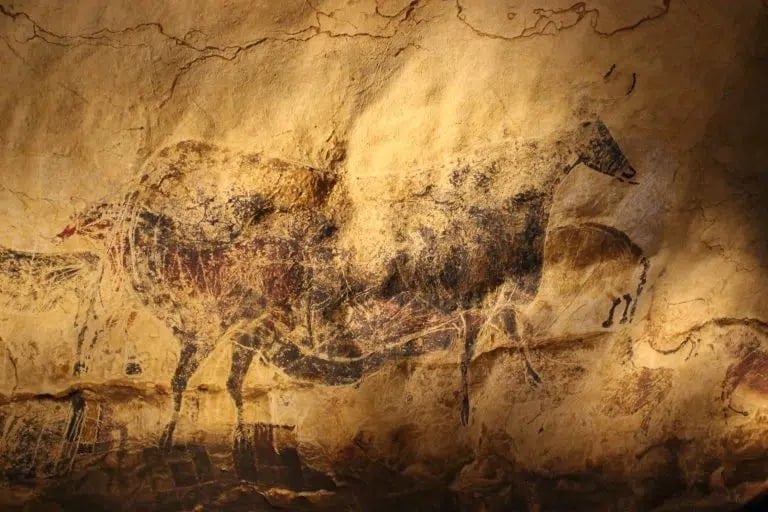
Prehistoric cave paintings, such as those at Lascaux and Chauvet in France, date back tens of thousands of years. The Chauvet cave contains images from approximately 30,000 BCE; Lascaux from around 17,000 BCE. Scholars debate their exact purpose, but many interpretations link them to ritual: altered states of consciousness (possibly induced by the darkness and acoustics of deep caves), animal spirit guides, and journeys between worlds. The overlap of human and animal forms, the depiction of hybrid beings (such as the "Sorcerer" at Les Trois-Frères), and the placement of images in deep, inaccessible caves suggest ritual contexts rather than simple decoration.
These images likely served as part of shamanic or communal rites. The animals depicted (bison, horses, reindeer) may have been species central to survival and therefore to spiritual relationship. For modern practitioners interested in ancestor work or animistic spirituality, prehistoric art offers a glimpse into how early humans engaged the sacred through visual form. The caves themselves were liminal spaces: thresholds between the everyday world and the realm of spirit.
Ancient Egyptian Art: Order and Eternity
Ancient Egyptian art served religious and funerary goals. Tombs, temples, and papyri were filled with images of gods, goddesses, and the journey of the soul through the afterlife. Key symbols carried precise meanings within a cosmology oriented toward ma'at (order, truth, justice) and the assurance of safe passage beyond death.
The ankh: Symbol of life, often held by deities to confer immortality. It appears in temple reliefs, jewelry, and tomb painting.
The eye of Horus: Protection, royal power, and restoration. The myth of Horus's wounded eye and its healing underlies its use as an amulet.
The scarab: Transformation and rebirth, linked to the sun god Ra and the cycle of the sun. Scarabs were placed on mummies to ensure resurrection.
The lotus: Rebirth and purity, rising from mud to bloom. Associated with the sun and with creation myths.
Egyptian art followed strict conventions: frontal and profile views combined in the same figure (composite view), hierarchical scale (larger figures for greater importance), and consistent use of color (green for fertility, black for the afterlife, gold for divinity). These conventions persisted for millennia and influenced later Mediterranean and Western art. For those working with Egyptian deities today, understanding these symbols and conventions deepens devotional practice.
Mesopotamian Art: Power and Divination
In Mesopotamia (Sumer, Babylon, Assyria), art expressed divine kingship, cosmic order, and the relationship between gods and humans. Relief sculptures showed deities, winged beings (apkallu or genii), and mythic creatures such as the lamassu (protective guardians with human heads and bull or lion bodies). Cuneiform tablets recorded omens, astrology, and ritual practice: early forms of divination and magical text that would influence later traditions.
The Code of Hammurabi stele shows the king receiving authority from the sun god Shamash. Palace reliefs from Assyria depict conquest, tribute, and the king's role as mediator between humans and gods. Mesopotamian art emphasized narrative and power: the ruler's legitimacy rested on divine favor, and art made that favor visible. The lamassu, placed at palace entrances, protected the king and symbolized the boundary between profane and sacred space. For practitioners interested in ancient divination or spirit work, Mesopotamian art offers early evidence of how cultures visualized and invoked supernatural forces.
Connections to Modern Practice
Ancient art does not prescribe modern practice, but it informs it. The symbols, myths, and ritual contexts of prehistoric, Egyptian, and Mesopotamian cultures continue to resonate. Whether you work with Egyptian deities, draw on animistic worldviews, or simply seek to understand the roots of Western esoteric symbolism, this art provides a foundation. The next lessons trace how these threads evolved through medieval, Renaissance, and modern periods.
Further Reading
Explore More
Continue learning with related content from The Esoteric Witch: