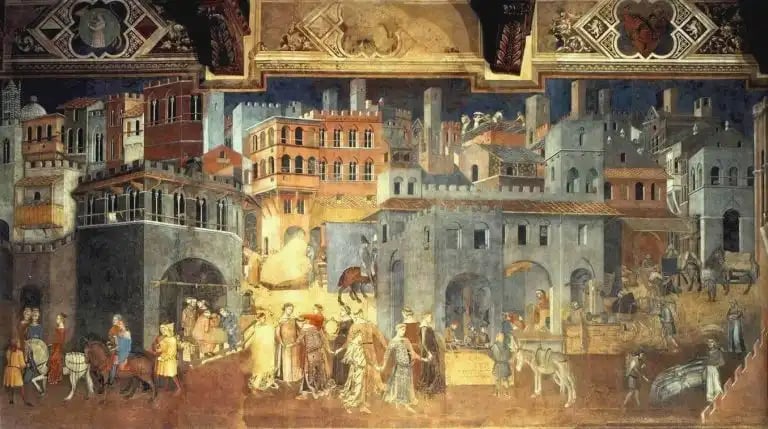
Medieval to Renaissance
The period from the early medieval era through the Renaissance saw profound shifts in how art expressed spiritual and philosophical ideas. Byzantine, medieval, and Renaissance art each developed distinct visual languages and contributed to the vocabulary of Western art. This lesson traces that evolution.
Byzantine and Medieval Art: Icon and Allegory
Byzantine art (centered in Constantinople from the 4th to 15th centuries) emphasized the sacred through stylization, gold backgrounds, and iconic representations of Christ, the Virgin, and saints. Figures were often flat, elongated, and front-facing. Gold symbolized divine light and the heavenly realm. Icons were understood as windows to the divine, not merely decorative. The iconoclastic controversy (8th–9th centuries) debated whether images could legitimately represent the sacred; those who supported icons argued that matter could convey the divine.
Medieval Western art continued this tradition while developing elaborate allegorical programs. In cathedrals and illuminated manuscripts, every color, gesture, and object could carry theological meaning. Bestiaries combined natural history with moral symbolism: the lion represented Christ, the pelican self-sacrifice. Illuminated manuscripts such as the Book of Kells wove elaborate patterns and figures into sacred text. The same period produced grimoires and astrological texts whose illustrations influenced later book arts and print culture. Medieval art was a dense symbolic language, legible to those trained in its codes.
The Renaissance: Humanism and Naturalism
The Renaissance (roughly 14th to 17th centuries) revived classical learning and placed the human experience at the center of artistic concern. Linear perspective (pioneered by Brunelleschi and developed by artists such as Masaccio) created the illusion of three-dimensional space on a flat surface. Anatomical study (notably by Leonardo da Vinci) allowed more naturalistic rendering of the human body. Oil painting, which replaced tempera in many workshops, permitted finer detail and richer color.
At the same time, Renaissance thinkers rediscovered Hermetic, Neoplatonic, and Kabbalistic texts. Marsilio Ficino translated the Corpus Hermeticum; Pico della Mirandola sought to synthesize Kabbalah with Christian theology. Artists began to incorporate these ideas into their work. Botticelli's Primavera and Birth of Venus draw on Neoplatonic ideas about beauty and the soul's ascent. Albrecht Dürer produced engravings that combined Christian symbolism with esoteric geometry and magic squares. The Renaissance forged a synthesis of Christian, classical, and humanist thought that shaped Western art for centuries.
Key Artists and Works
Giotto (c. 1267–1337): Transitional figure between medieval and Renaissance; introduced greater naturalism and emotional expressiveness into fresco painting.
Botticelli (c. 1445–1510): Primavera, Birth of Venus; myth and Neoplatonism in service of beauty and spiritual allegory.
Leonardo da Vinci (1452–1519): Anatomical studies, sfumato (soft blending), and the integration of art and science. The Mona Lisa and Last Supper remain iconic.
Albrecht Dürer (1471–1528): Engravings and woodcuts that combined Northern European detail with Italian perspective; interest in proportion, magic squares, and esoteric symbolism.
Michelangelo (1475–1564): Sculpture and painting that emphasized heroic human form; the Sistine Chapel ceiling; Neoplatonic themes of ascent and divine beauty.
The transition from medieval to Renaissance art was not sudden or uniform. Regional variations (Italian vs. Northern European styles), patronage (Church, nobility, merchant class), and individual genius all played a role. Jan van Eyck in the North perfected oil technique and meticulous detail; Fra Angelico in Florence combined piety with early Renaissance space and light. Hieronymus Bosch created fantastical, moralizing visions (The Garden of Earthly Delights, The Temptation of Saint Anthony) that drew on folk belief and esoteric symbolism. His hybrid creatures and elaborate hellscapes influenced later artists and remain potent in the collective imagination.
But the overall direction was toward a more naturalistic, human-centered, and symbolically rich visual culture that would influence occult and esoteric art for centuries. The Renaissance established that art could serve both devotion and intellectual inquiry, and that the visible world could point toward invisible truths. This fusion of material skill and spiritual ambition would shape Western art for centuries and create a lasting link between visual culture and esoteric thought. The Renaissance human who could depict the divine while studying Neoplatonism and Kabbalah set a precedent for the artist-magician that recurs in Symbolism, Surrealism, and beyond.
Further Reading
Explore More
Continue learning with related content from The Esoteric Witch: