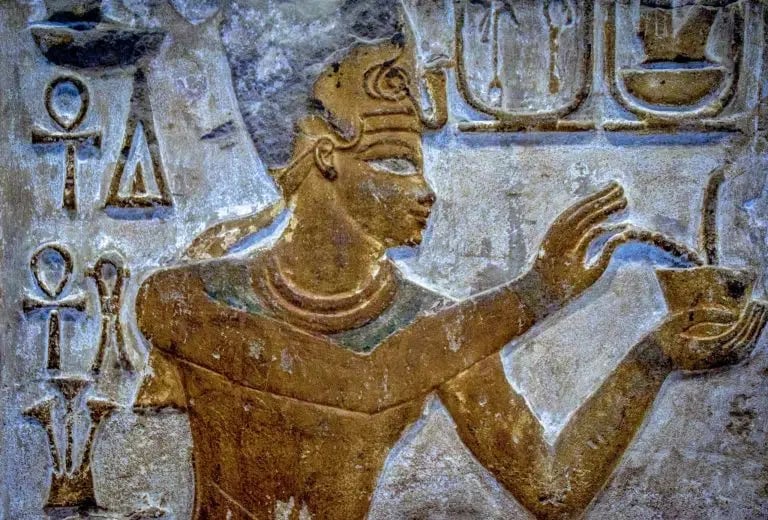
Period: 3100 BCE - 30 BCE
Characteristics: Art focused on afterlife, egyptian perspective
Events: Egypt is united (3100 BCE), War with the Hittites (1274 BCE), Cleopatra dies (30 BCE)
The Eternal Artists: An Introduction to Ancient Egyptian Art
For nearly three millennia, the civilization that flourished along the Nile River created one of humanity's distinctive and enduring artistic traditions. Ancient Egyptian art captivates us not merely through its technical achievements or monumental scale, but through its consistency of vision - a visual language so coherent that we can recognize it instantly, even across the vast distance of time. While many ancient artistic traditions have been lost or survive only in fragments, Egyptian art presents us with a continuum of creative expression spanning from the Early Dynastic Period through the Roman occupation, allowing us to trace the development of a civilization through its visual culture.
Egyptian art emerged from the particular environmental, religious, and political circumstances of life along the Nile. The river's predictable annual flooding created agricultural abundance that supported a complex, stratified society with resources to devote to monumental building projects and artistic production. The harsh desert environment, with its stark contrast between fertile river valley and barren wasteland, influenced Egyptian conceptions of life, death, and the afterlife, themes that would dominate their artistic expression. The political unification of Upper and Lower Egypt around 3100 BCE established a centralized state under divine kingship, creating systems of patronage and production that would sustain artistic traditions for millennia.
Unlike modern Western concepts of art that often emphasize innovation and individual expression, Egyptian art operated within a stable framework of conventions and beliefs. This consistency of approach created a visual language of symbolic power and technical refinement. Through carefully codified forms, hieroglyphic writing integrated with visual representation, and a sophisticated understanding of materials and techniques, Egyptian artists created works that communicated complex religious and political ideas while achieving aesthetic harmony. In exploring this artistic tradition, we encounter not primitive attempts at naturalism but a fully realized visual system designed to represent eternal truths and support the journey from this world to the next.
In last week's Mesopotamia post, we saw how the first civilizations emerged from nomadic tribes, with art becoming increasingly woven into society at both symbolic and practical levels. The differences between Mesopotamian and Egyptian artistic styles reveal much about their respective worldviews and social structures. While Mesopotamian art often depicted rulers and their military conquests in a narrative style, Egyptian art created a timeless, symbolic representation of an ordered cosmos where pharaohs mediated between the divine and human realms. This fundamental difference in approach, narrative versus symbolic, temporal versus eternal, reflects deeper distinctions in how these civilizations understood their place in the universe and their relationship to divine power.
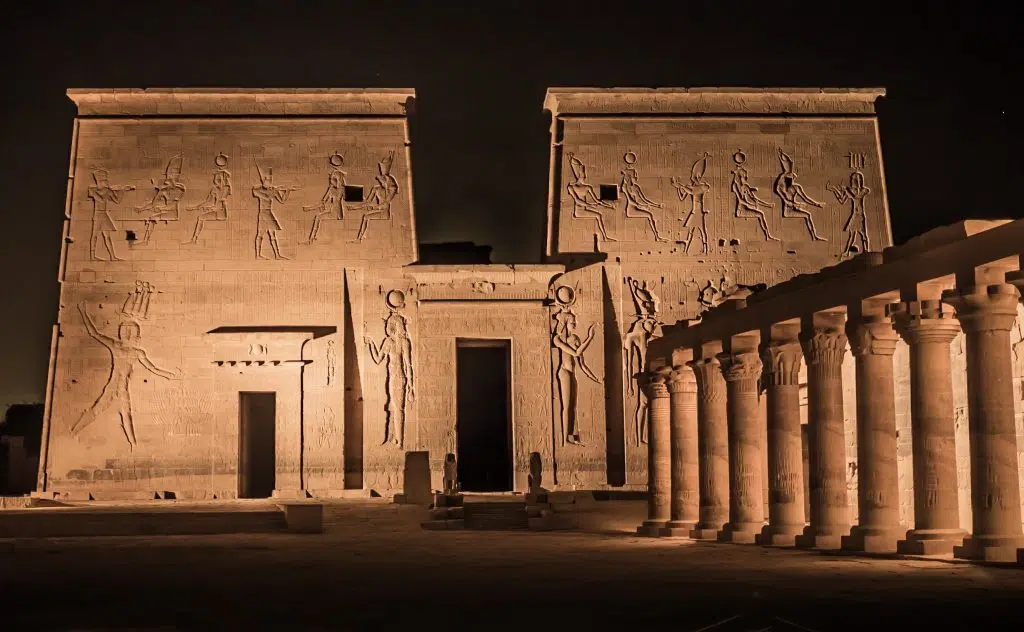
Temple of Isis (Source)

The Art of Eternity: Fundamentals of Egyptian Visual Culture
Egyptian art represented far more than mere decoration or documentation, it served as an active force within a complex religious and political system. The Egyptians believed that representation had magical power; depictions of offerings in tombs could provide sustenance in the afterlife, while images of the deceased could serve as alternative vessels for the ka (life force) should the mummified body be destroyed. Similarly, images of pharaohs performing ritual acts actually helped maintain cosmic order (ma'at), while depictions of enemies being trampled symbolically neutralized threats to Egypt. This belief in the magical effectiveness of representation meant that Egyptian art was deeply purposeful, with forms and conventions developed to maximize symbolic power rather than mimic visual appearances.
The distinctive visual language of Egyptian art developed from this magical understanding of representation. Artists employed a system sometimes called "conceptual representation," depicting subjects not as they might appear from a single viewpoint but combining different perspectives to show the most complete and essential aspects of each element. Human figures typically displayed the head and legs in profile while presenting shoulders and eye frontally, not because artists couldn't render natural appearances, but because this composite view provided the most complete representation of the subject. Similarly, size indicated importance rather than physical proximity, with pharaohs and gods depicted at larger scales than ordinary mortals. Hierarchical scaling, composite viewpoints, and standardized poses all formed part of a sophisticated visual system designed to convey essential truths rather than optical impressions.
The remarkable consistency of Egyptian artistic conventions across millennia stemmed partly from the social organization of artistic production. Artists worked not as independent creators but as specialized craftsmen within workshop traditions, often passing techniques and conventions from father to son across generations. They followed established pattern books and canonical proportions, working within a system that valued precision, consistency, and symbolic clarity over individual expression or innovation. Major workshops were attached to temples and palaces, where artists worked under the patronage of the pharaoh and religious institutions. This system of training and production ensured stylistic continuity while allowing for subtle evolution in response to changing religious and political circumstances throughout Egypt's long history.
The Art of the Kingdoms: Continuity and Change
Ancient Egyptian history spans an extraordinary timespan, traditionally divided into major periods of political unity (Old, Middle, and New Kingdoms) alternating with intermediate periods of decentralization. While maintaining remarkable stylistic continuity throughout these political shifts, Egyptian art nonetheless displays subtle evolution and changing emphases that reflect broader historical developments. Understanding these periods helps us appreciate both the enduring conventions and the dynamic adaptations within Egyptian artistic tradition.
The Old Kingdom (ca. 2686-2181 BCE) represents the first great flowering of Egyptian art and architecture. During this period of strong central authority under divine kingship, monumental structures like the Great Pyramids at Giza demonstrated unprecedented engineering precision and resource mobilization. Sculptural traditions were formalized, establishing canons of proportion and representation that would endure for millennia. Old Kingdom portrait sculptures of pharaohs and nobles balanced idealization with individualized features, creating a tension between specific identity and timeless dignity. The remarkable wooden statue of Ka-Aper (the "Sheikh el-Beled") and the seated scribe from Saqqara show how artists could create works of striking naturalism within conventional frameworks. Relief sculptures from mastabas (tomb structures) depict scenes of daily life with vivid attention to detail, providing invaluable information about Old Kingdom society while adhering to established representational conventions.
Following the decentralization of the First Intermediate Period, the Middle Kingdom (ca. 2055-1650 BCE) saw a renewed emphasis on royal authority accompanied by subtle shifts in artistic representation. Middle Kingdom royal portraits often display more naturalistic features, sometimes verging on somber intensity, perhaps reflecting new conceptions of kingship that emphasized the pharaoh's humanity alongside his divine aspects. This period also saw innovations in private portraiture and funerary practices, with the first anthropoid coffins emerging alongside more accessible versions of funerary texts previously reserved for royalty. The democratization of afterlife beliefs created new markets for funerary art among broader social classes, expanding artistic production beyond royal and elite commissions. The remarkable painted wooden models from tombs like that of Meketre provide detailed three-dimensional representations of daily activities from bread-making to weaving, created to magically provide these services to the deceased in the afterlife.
The New Kingdom (ca. 1550-1069 BCE) marked perhaps the height of Egyptian political power and artistic achievement. Imperial expansion brought unprecedented wealth and exposed Egypt to greater foreign influence, reflected in artistic innovations and occasionally more naturalistic styles. The reign of Amenhotep IV/Akhenaten (ca. 1353-1336 BCE) saw a dramatic, though temporary, break with artistic traditions in the Amarna Period, when the king's religious reforms were accompanied by revolutionary artistic changes, elongated figures with swelling hips, spindly limbs, and exaggerated features replaced traditional idealized forms. While this artistic revolution was largely reversed after Akhenaten's death, subsequent royal art retained certain softer, more naturalistic elements. The magnificent treasures from Tutankhamun's tomb, though from a relatively minor reign, provide an unparalleled glimpse of New Kingdom royal artistry, preserved through the fortunate accident of the tomb's discovery in nearly intact condition in 1922.
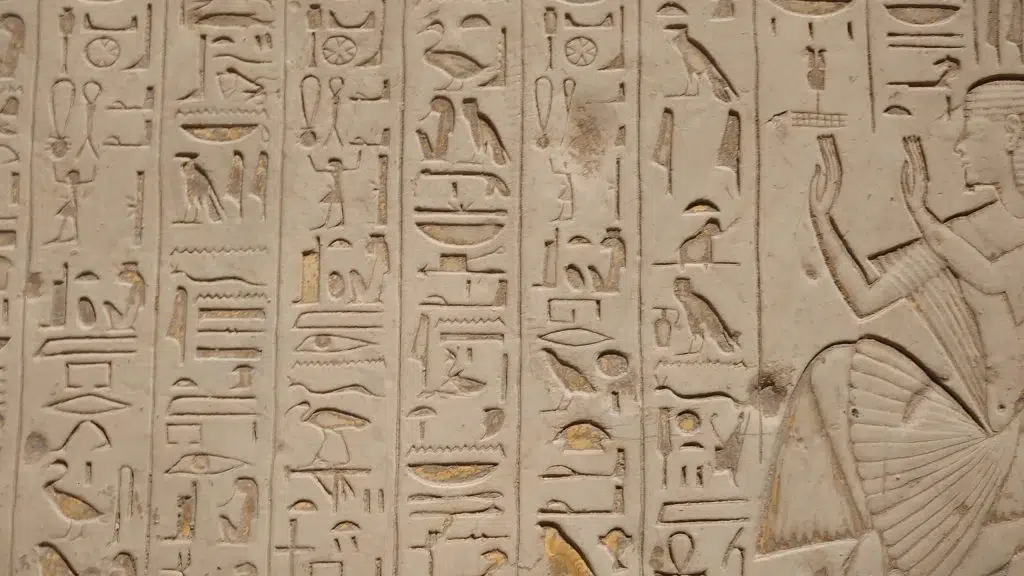
Photo by Amador Loureiro on Unsplash
The Visual Language of Egyptian Art
Egyptian art developed a sophisticated visual language that integrated writing, symbolism, and representation into a coherent system for communicating with both divine and human audiences. Hieroglyphic writing—one of the world's earliest writing systems, was itself a visual art form, composed of pictographic elements that retained their representational quality even as they functioned phonetically. The integration of text and image was fundamental to Egyptian visual culture; temple walls and tomb chambers typically combined both, with scenes accompanied by explanatory texts and texts framed by decorative and symbolic elements. This integration reflected the Egyptian view that writing (mdw nṯr—"divine words") was a sacred gift from the gods, specifically Thoth, that enabled communication with divine realms.
The principle of ma'at—cosmic order, balance, and justice, found visual expression in the symmetry and proportional harmony of Egyptian art. From monumental architecture to the smallest amulet, Egyptian artists employed careful proportional systems based on grid patterns that ensured consistency across scales and materials. Human figures were typically constructed according to canonical proportions, for example, a standing male figure might be 18 units tall, measured from the feet to the hairline. This mathematical approach to representation created a sense of stability and permanence that aligned with Egyptian concerns for eternal order. The characteristic frontality of figures, with bodies shown in composite view, further emphasized stability and completeness. Unlike Greek art's exploration of movement through contrapposto poses, Egyptian figures typically appear in stable, timeless postures with both feet firmly planted, emphasizing enduring presence rather than momentary action.
Symbolism permeated every aspect of Egyptian visual culture, creating layers of meaning accessible to viewers with appropriate knowledge. Colors carried specific connotations, black representing fertility and regeneration (associated with the soil deposited by the Nile's annual flooding), green symbolizing new life and resurrection, gold indicating divinity and the flesh of the gods. Specific poses, attributes, and animal forms identified particular deities: the falcon for Horus, the ibis for Thoth, the lioness for Sekhmet. Even seemingly decorative elements like border patterns often incorporated symbolic components such as the shen ring (symbol of eternity) or the ankh (symbol of life). This rich symbolic vocabulary allowed Egyptian artists to create works that functioned simultaneously as beautiful objects, religious instruments, and repositories of cultural knowledge.
The distinctive Egyptian approach to perspective, sometimes called "Egyptian perspective" or "aspective"—represented another sophisticated aspect of their visual system. Rather than depicting objects as they might appear from a single viewpoint with optical distortions (as in later Western perspective systems), Egyptian artists showed each element from its most characteristic and complete angle. This approach prioritized clarity and completeness over optical accuracy. In scenes of offering tables, for example, all items are clearly displayed from above rather than being partially obscured as they would be in natural vision. This method of representation wasn't a failure to achieve "realistic" perspective but a deliberate choice to communicate essential information clearly, a solution perfectly aligned with the magical and religious functions of Egyptian art.
Masterpieces of Egyptian Art
The Great Sphinx of Giza stands as one of humanity's enduring and mysterious monuments - a colossal limestone sculpture with a lion's body and a human head wearing the nemes headdress of the pharaoh. Created during the Old Kingdom reign of Pharaoh Khafre (ca. 2558-2532 BCE), the Sphinx measures approximately 73 meters in length and 20 meters in height, making it one of the world's largest monolithic statues. Carved from the natural limestone of the Giza plateau, with masonry blocks added in places, the sculpture represents a remarkable feat of engineering and artistic vision, transforming the natural landscape into a symbolic guardian figure.
The Sphinx's meaning and purpose continue to be debated by scholars, though most agree it served as a guardian figure associated with royal power and solar symbolism. The combination of human head and lion's body created a composite being of extraordinary power, uniting human intelligence with leonine strength and connecting the pharaoh to the sun god, as lions were associated with solar deities. The positioning of the Sphinx along the causeway to Khafre's pyramid suggests its role in the king's funerary complex, perhaps guarding the approach to his tomb. The monument has suffered significant erosion and damage over millennia of exposure, with various restoration attempts throughout ancient and modern times. Despite this deterioration, the Sphinx retains its haunting power as a symbol of ancient Egyptian civilization's monumental ambition and spiritual vision.
The Great Pyramid of Giza, built for Pharaoh Khufu (ca. 2589-2566 BCE), represents the pinnacle of Egyptian architectural achievement and one of the most notable structures in human history. Standing originally at 146.5 meters tall (now slightly shorter due to the loss of its casing stones), the pyramid contains an estimated 2.3 million stone blocks averaging 2.5 tons each, fitted together with remarkable precision. The monument's measurements incorporate sophisticated mathematical relationships, with the base forming an almost perfect square aligned precisely to the cardinal directions. The interior contains the King's Chamber with its massive granite beams, the Queen's Chamber (despite its name, not actually intended for a queen), and the Grand Gallery, a masterpiece of engineering with its corbelled vault rising to a height of 8.6 meters.
Beyond its technical brilliance, the Great Pyramid served profound religious and political purposes. As a royal tomb, it protected the king's mummified body and provided a platform for his journey to join the gods in the afterlife. Architecturally, the pyramid form symbolized the primeval mound that emerged from chaos at the beginning of creation and the rays of the sun descending to earth, connecting the king to solar deities. The massive scale and precision of the monument demonstrated the absolute power of the pharaoh, who could command the labor and resources needed for such an unprecedented project. Though stripped of its original polished limestone casing and summit capstone, which would have made it gleam brilliantly in the sunlight, the Great Pyramid remains a testament to Egyptian civilization's extraordinary combination of technical prowess, religious vision, and organizational capacity.
The golden mask of Tutankhamun represents perhaps the most famous individual artwork from ancient Egypt and one of archaeology's notable discoveries. Found by Howard Carter in 1925 within the nearly intact tomb of the young pharaoh in the Valley of the Kings, the mask lay over the head and shoulders of the mummified king within a nest of three coffins. Created from solid gold weighing 10.23 kg and inlaid with colored glass, obsidian, lapis lazuli, turquoise, and carnelian, the mask combines extraordinary material richness with sophisticated craftsmanship and profound symbolic meaning.
The mask portrays Tutankhamun with the traditional attributes of kingship, the nemes headdress with royal uraeus serpent and vulture (representing Lower and Upper Egypt), the false beard of divinity, and the protective vulture and cobra at his brow. The king's idealized face combines youthfulness with divine serenity, creating a powerful image of eternal life. More than merely a portrait, the mask functioned as a magical object ensuring the king's eternal existence; the gold (considered the flesh of the gods) provided an incorruptible form, while the obsidian and quartz inlays of the eyes allowed the deceased to "see" in the afterlife. Though Tutankhamun was a relatively minor king who died young (around age 19) after a brief reign (ca. 1332-1323 BCE), his funerary equipment represents the pinnacle of New Kingdom craftsmanship. The mask's survival while thousands of similar royal treasures were looted in antiquity makes it an invaluable window into the artistic sophistication and religious beliefs of ancient Egypt at its height.


All Giza Pyramids


The Living Legacy of Egyptian Art
The artistic tradition of ancient Egypt stands as one of humanity's cultural achievements, a visual language that maintained its essential character across three millennia while evolving subtle variations in response to changing historical circumstances. This extraordinary continuity reflects the deep connection of art with Egyptian religious and political systems, where artistic conventions served not aesthetic fashion but cosmic order. From monumental temples and colossal statues to intimate amulets and illustrated papyri, Egyptian artists created works of remarkable technical skill and symbolic sophistication, designed to bridge the gap between human and divine realms and ensure the continuation of life beyond death.
Egyptian art's influence extends far beyond its original cultural context, having shaped the visual language of numerous subsequent civilizations. The Greeks and Romans admired and collected Egyptian antiquities, adapting elements of Egyptian style while transforming them according to their own aesthetic values. The "rediscovery" of Egypt by European travelers and scholars from the Renaissance onward, culminating in Napoleon's Egyptian expedition of 1798-1801, introduced Egyptian forms into Western design, architecture, and the emerging field of archaeology. The decipherment of hieroglyphics by Jean-François Champollion in 1822 made the textual dimension of Egyptian art accessible to modern scholars, transforming our understanding of these works from purely aesthetic objects to integrated systems of text and image. From the "Egyptomania" of the 19th century to Art Deco's geometric patterns to contemporary architectural citations, Egyptian visual forms continue to resonate in modern visual culture.
What gives Egyptian art its enduring power is not merely its formal beauty or technical achievement but its profound engagement with humanity's most essential concerns, the relationship between life and death, the human and the divine, order and chaos. Through a visual language of extraordinary consistency and sophistication, Egyptian artists created a world where the ephemeral could become eternal, where the gap between human and divine could be bridged, and where death represented not an ending but a transformation. The hieroglyphic writing that often accompanies Egyptian visual representation was called mdw nṯr—"divine words"—and perhaps this term best captures the aspiration of all Egyptian art: to create a form of communication that could transcend ordinary human limitations and connect with the eternal. In this aim, as the enduring fascination of Egyptian art attests, they succeeded remarkably.
Related in this topic
More from Occult Art History & Symbolism — Start Here.
Symbolism
Discover the meaning of symbolism! Learn its origins, art and famous symbolist painters. Find hidden emotions in art.
Naïve Art
Naïve art: untrained artists created startling originality through simplified forms, vivid colors, and unfiltered imagination.
Art Informel
Art Informel: the European parallel to Abstract Expressionism. Dubuffet, Tàpies, and the art of the unformed and the raw.
Street Art
Street Art: from subway tags to gallery walls. Banksy, Keith Haring, and the art that reclaims public space.
You Might Also Like
Art Informel
Art Informel: the European parallel to Abstract Expressionism. Dubuffet, Tàpies, and the art of the unformed and the raw.
Street Art
Street Art: from subway tags to gallery walls. Banksy, Keith Haring, and the art that reclaims public space.