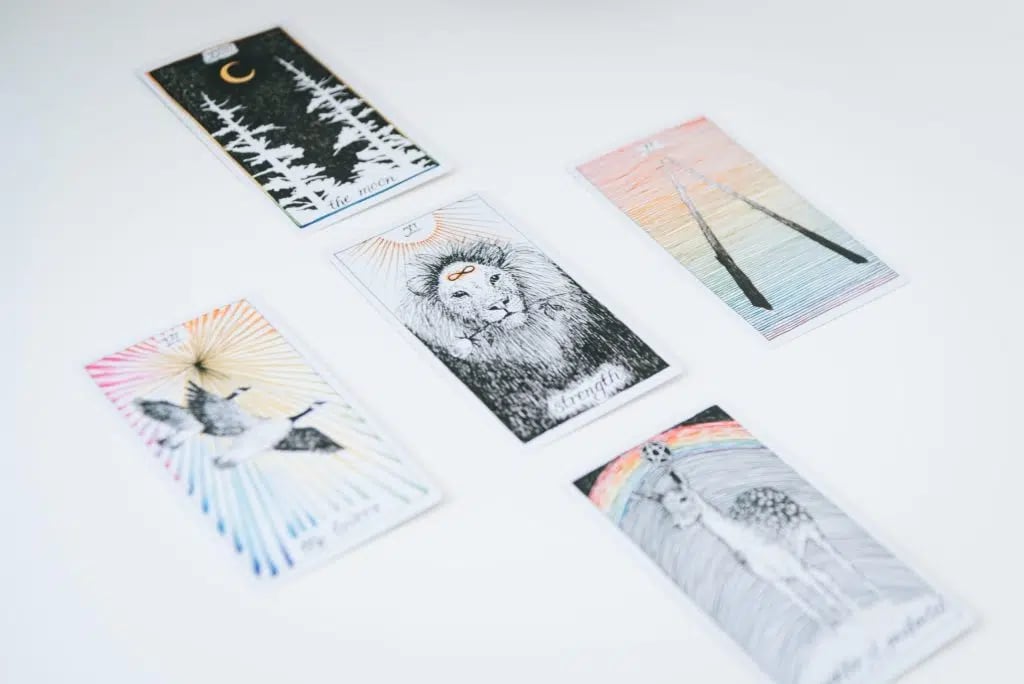
Exploring the 78 Cards
Once you understand the tarot's structure (major arcana, minor arcana, and court cards), the next step is to explore each of the 78 cards in depth. This lesson gives you a map of the deck and points you toward resources for continued study.
The Four Suits at a Glance
The 56 minor arcana cards fall into four suits. Each suit has its own character; the numbered cards (Ace through 10) often show that energy at different stages.
Wands (Fire): Creativity, inspiration, ambition, and spirit. Wands are about doing, initiating, and the life force that drives action. The Ace of Wands is a seed of new energy; the Ten of Wands can mean burden or completion. The numbered cards often trace a journey: early spark (2–3), growth and challenge (4–7), integration or overwhelm (8–10).
Cups (Water): Emotions, relationships, intuition, and the unconscious. Cups flow with feeling. From the Ace (new feeling, inspiration) to the Ten (emotional fulfillment or overflow), Cups track the flow of feeling through a situation. They address love, grief, creativity, and the inner life.
Swords (Air): Thought, communication, conflict, and truth. Swords can cut through confusion or cause pain. They address decisions, arguments, clarity, and mental challenge. The imagery in each card (storms, bound figures, victory) shapes how we read conflict and clarity. Swords are not inherently negative, but they often appear when there is tension to resolve.
Pentacles (Earth): Money, work, health, and the material world. Pentacles ground the reading in practical reality. They address career, finances, the body, and the physical environment. From the Ace (new opportunity, seed of prosperity) to the Ten (wealth, legacy, completion), Pentacles track material manifestation.
The Numbered Cards: A Pattern
Across suits, card numbers often carry shared themes:
- Aces: New beginning, seed, pure potential.
- Twos: Choice, partnership, balance (or imbalance).
- Threes: Growth, expression, first fruits.
- Fours: Stability, structure, consolidation (or stagnation).
- Fives: Conflict, loss, challenge.
- Sixes: Integration, harmony, sharing.
- Sevens: Evaluation, reflection, inner work.
- Eights: Movement, mastery, near completion.
- Nines: Culmination, refinement, almost there.
- Tens: Completion, fullness, cycle's end.
Combine the number with the suit: the Five of Cups is emotional loss or grief; the Five of Swords is mental conflict or winning at a cost; the Five of Pentacles is material hardship. This pattern helps you build meanings even when you have not memorized every card.
Learning the Cards
Different approaches work for different readers. Some memorize keyword lists; others spend time with each card's imagery and journal their impressions. Many find that combining both (studying traditional meanings while trusting intuition) produces the richest readings.
Daily draws: Pull one card per day. Live with it. Notice how its themes appear in your life. Over time, you develop a personal relationship with each card.
Card study: Go through the deck suit by suit or number by number. Look at the imagery. What story does it tell? How does it differ from the traditional meaning? Your observations are valid.
Upright and reversed: Reversed meanings add nuance. A reversed card often suggests blocked, delayed, or internalized energy rather than the opposite of the upright meaning. Some readers use reversals; others do not. Experiment to find what resonates for you.
Your Next Step: The Full Reference
This Academy path has given you the foundations: history, structure, spreads, and court cards. To go deeper, explore the Esoteric Library's tarot card reference, which offers detailed meanings for all 78 cards (upright and reversed) along with correspondences, symbolism, and practical interpretation tips. Use it as a companion as you build your personal relationship with the deck. The goal is not to memorize every word but to develop a living, intuitive connection with the cards.
Different decks: The Rider-Waite-Smith imagery underlies many modern decks, but not all. Thoth, Marseille, and diverse contemporary decks use different symbolism. If you read with a non-RWS deck, adapt meanings to its imagery. The structure (78 cards, four suits, major arcana, courts) is largely consistent; the visual language may vary.
Further Reading
Explore More
Continue learning with related content from The Esoteric Witch: