Period: 1890 – 1910
Characteristics: Organic flowing lines, nature-inspired motifs, integration of fine and decorative arts
Events: Paris Exposition Universelle (1900), Glasgow School of Art completed (1909), Decline after World War I
The New Art: Nature in Every Curve
Art Nouveau emerged in the final decade of the 19th century as a sweeping international response to industrialization and the rigid historicism of the Victorian era. Meaning "new art" in French, the movement sought to create a cohesive visual language that would unite fine art, architecture, and decorative arts into a total aesthetic experience. At its heart lay a deep reverence for the natural world: organic forms, flowing curves, and motifs drawn from plants, flowers, and the female form.
The movement arose simultaneously across Europe under different names: Art Nouveau in France and Belgium, Jugendstil in Germany and the Nordic countries, Secession in Austria, and Modernisme in Catalonia. Despite regional variations, shared principles emerged: a rejection of academic tradition, an embrace of new materials and technologies, and the belief that beauty should permeate everyday life rather than reside only in museums and palaces.
Those drawn to nature-based spirituality, herbalism, or the symbolism of plants and seasons will recognise Art Nouveau's visual vocabulary. Its integration of organic forms with spiritual and mythological themes created imagery that continues to fit contemporary esoteric and pagan aesthetics.
Origins and Philosophy
Art Nouveau's roots extend into multiple 19th-century currents. The Arts and Crafts movement, led by William Morris in Britain, had already rejected industrial mass production in favour of craftsmanship and the unity of design. The Aesthetic Movement emphasized "art for art's sake." Japanese woodblock prints, which flooded Europe after trade opened in the 1850s, introduced flattened perspectives, asymmetrical compositions, and a celebration of natural forms that would profoundly influence Art Nouveau aesthetics.
The movement's philosophy held that the artificial distinction between "fine" and "applied" arts should be dissolved. A building, its furniture, its fixtures, and its graphic design should form a harmonious whole. This total design approach, Gesamtkunstwerk or "total artwork," sought to transform the environments in which people lived, creating beauty in railway stations, metro entrances, and middle-class homes.
Art Nouveau emerged at a moment when mass production had made cheap, poorly designed goods widely available. The movement's leaders argued that good design need not be a luxury; it could be integrated into objects that ordinary people used daily. The Paris Exposition Universelle of 1900 gave the style a major platform. Mucha designed the Bosnia-Herzegovina pavilion; Lalique exhibited jewellery; and the new Métro entrances by Guimard introduced Parisians to Art Nouveau on their daily commute.
Alphonse Mucha and the Poster Revolution
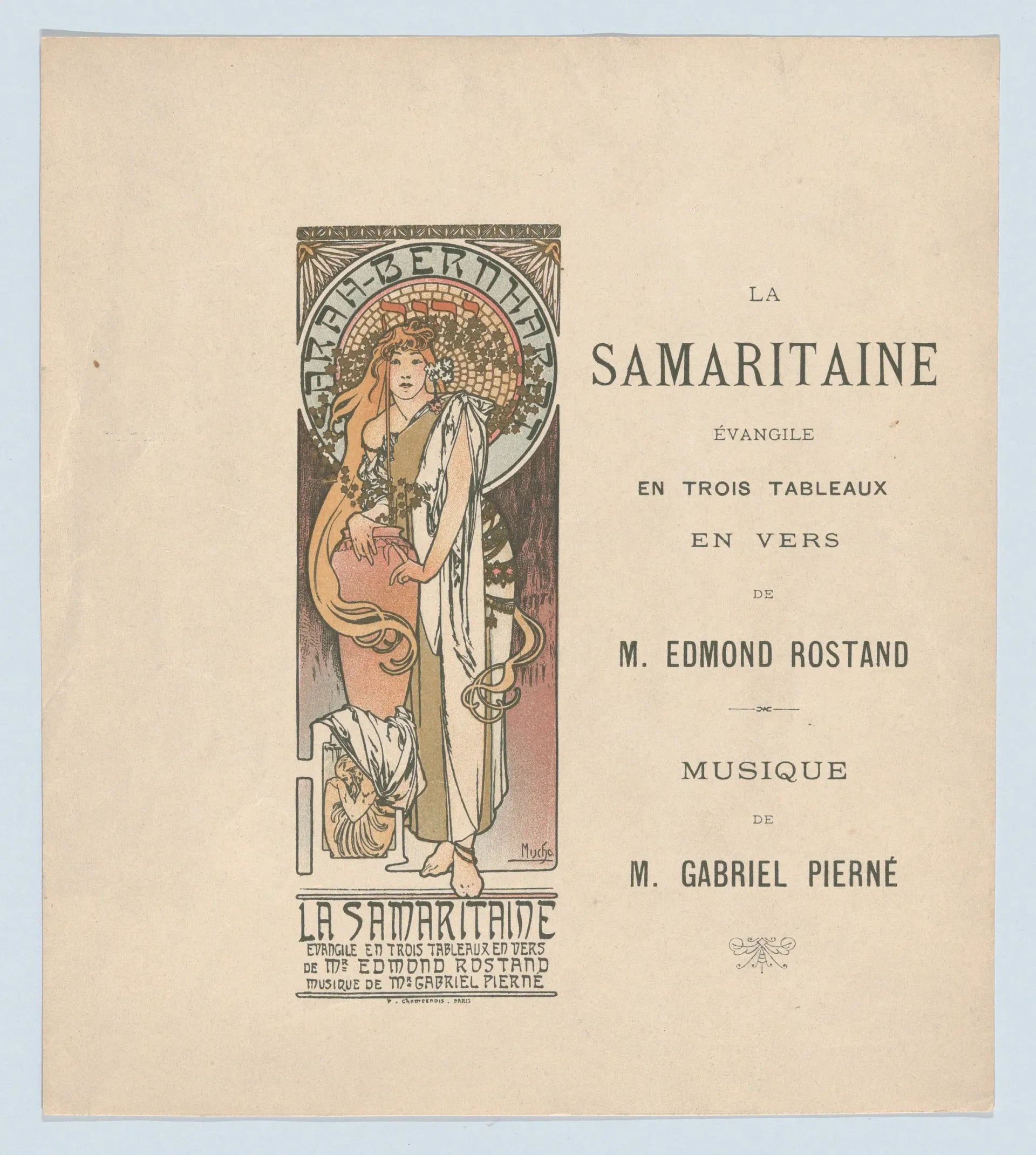
Czech artist Alphonse Mucha became Art Nouveau's most recognizable practitioner through his theatrical and commercial posters. His distinctive style, elongated female figures surrounded by decorative frames of flowers, foliage, and geometric patterns, defined the movement's graphic language. Mucha's women captured an ideal of ethereal beauty, often associated with nature, the seasons, or abstract concepts like Art or Music.
The La Samaritaine poster, created for the Paris department store, typifies Mucha's approach. A graceful female figure dominates the composition, her flowing hair and drapery merging with the ornate frame. Stylized floral motifs and the characteristic "Mucha woman" aesthetic (pale skin, almond eyes, and hair that seems to grow into the decorative elements) create an image that is both advertising and art.
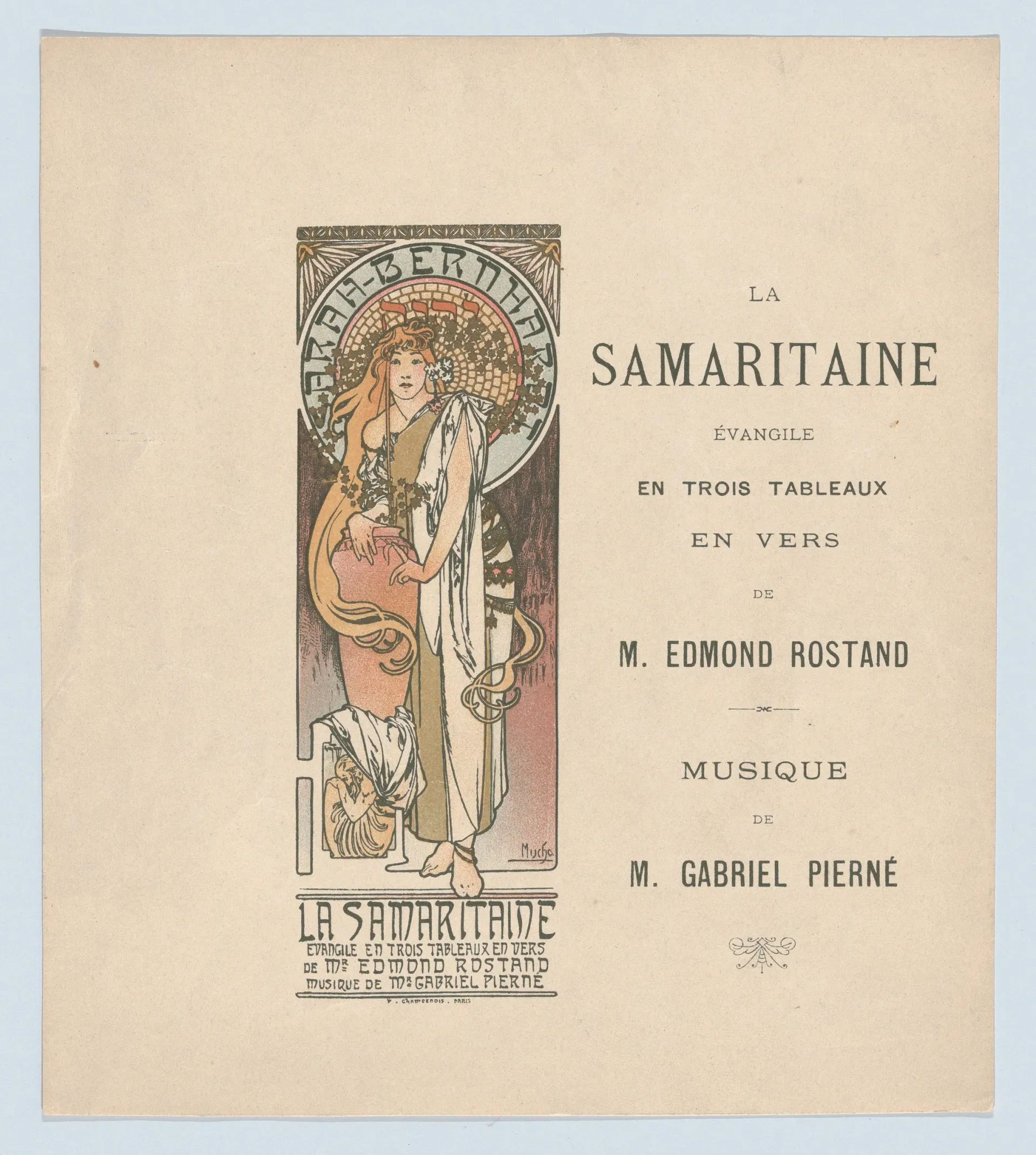
La Samaritaine by Alphonse Mucha (Source)

Mucha's posters for the actress Sarah Bernhardt brought him fame and established the commercial poster as a legitimate art form. He designed costumes and sets for her productions, and their collaboration continued for years. His later work, including The Slav Epic, a cycle of twenty large-scale paintings depicting Slavic history, revealed deeper ambitions. Mucha spent eighteen years on the cycle, which he considered his life's work. He donated it to Prague in 1928. Nevertheless, his poster work remains his most enduring achievement, instantly recognisable even to those who cannot name the artist.
Architecture and the Organic Built Environment
Art Nouveau architecture transformed the urban landscape of Brussels, Paris, Barcelona, and Glasgow. Belgian architect Victor Horta pioneered the style with the Tassel House (1893), using iron and glass to create organic, plant-like structures. His whiplash curves in stair railings, columns, and floor mosaics made the building itself seem to grow from the ground.
In Barcelona, Antoni Gaudí took organic form to extraordinary extremes. The Sagrada Família, though still unfinished, demonstrates his fusion of Gothic structure with natural inspiration, columns branching like trees, surfaces textured like bark or honeycomb. Gaudí's Casa Batlló and Park Güell transformed conventional architecture into fantasy landscapes.
The Paris Métro entrances designed by Hector Guimard, with their wrought-iron stalks and glass canopies resembling orchid blooms, brought Art Nouveau to the street level, making the new aesthetic part of daily urban experience. Some Parisians found them alarming; one critic compared them to insectoid incursions. But they have since become beloved landmarks. Charles Rennie Mackintosh in Glasgow developed a more restrained, geometric variant that anticipated later modernism while retaining Art Nouveau's decorative sensibility. His Glasgow School of Art (1896–1909) and the Willow Tea Rooms showed that organic inspiration could be disciplined into crisp, modern forms.
In Vienna, the Secession movement under Gustav Klimt and Josef Hoffmann took a different path. Their work was more abstract and geometric, with gold leaf and ornamental detail used for psychological and symbolic effect. Klimt's The Kiss (1907–08), though often classified as Art Nouveau, points toward the more decorative and erotic directions the style could take.
Woman with Poppies: Nature and Symbolism
Mucha's 1898 poster for the Salon des Cent exhibition, often called Woman with Poppies, captures the movement's fusion of feminine ideal and botanical motif. The figure wears a crown of poppies, flowers associated with sleep, dreams, and in some traditions, remembrance. Her contemplative expression and the flowing lines of her hair and garment merge with the decorative frame, suggesting the unity of human and natural realms.
Art Nouveau's botanical vocabulary carries meanings that remain accessible today. Ivy represented fidelity, lilies purity, roses love—motifs that appeared throughout the movement's output. The preference for certain plants (irises, poppies, thistles, ginkgo leaves) reflected both European tradition and the influence of Japanese art, which had its own elaborate language of floral symbolism. Those interested in plant symbolism and natural magic will find dense connections in Art Nouveau's repeated use of flora as carriers of meaning.
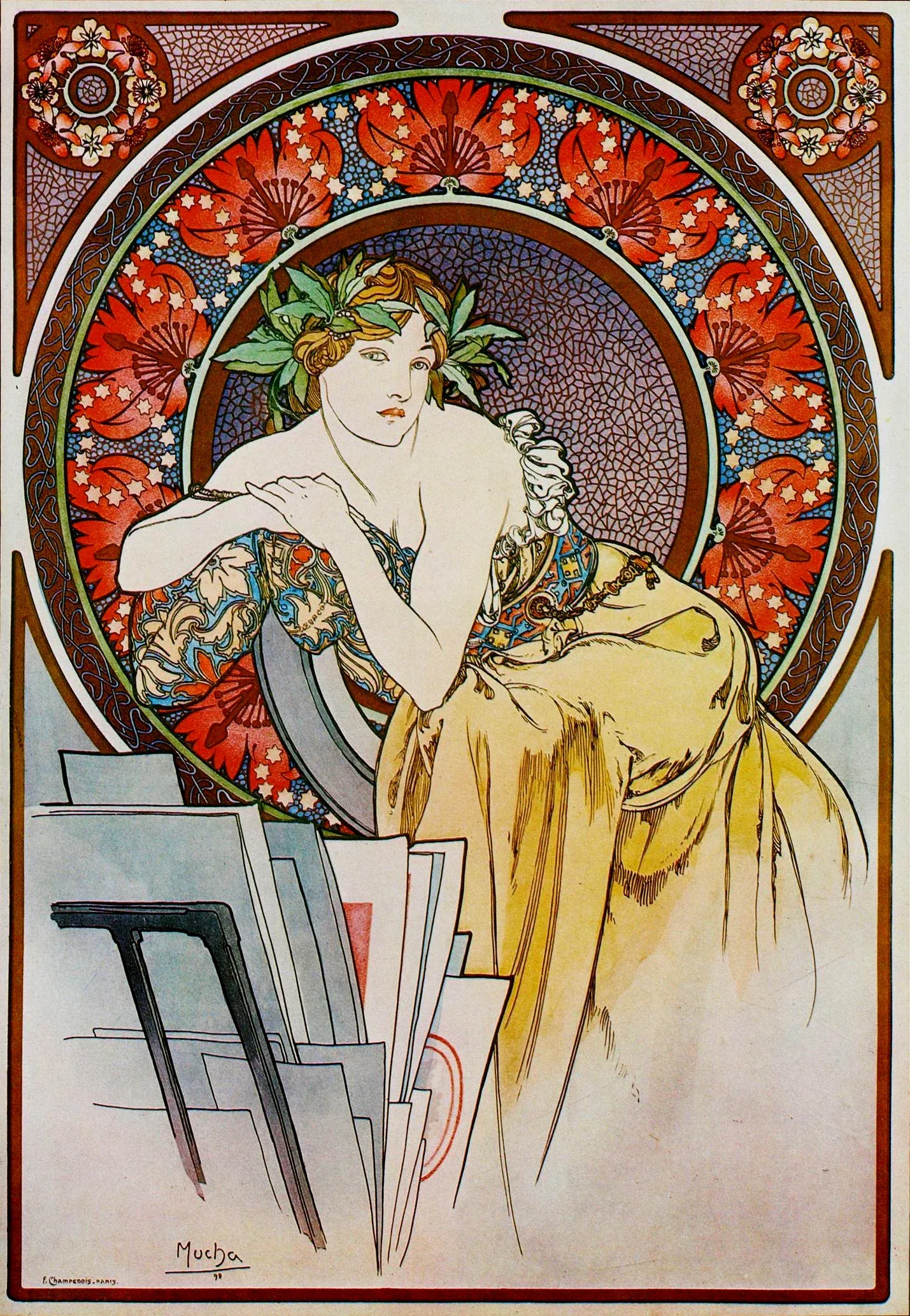
Woman with Poppies by Alphonse Mucha, 1898 (Source)

The Esoteric Connection
Art Nouveau coincided with the late-19th-century occult revival. Theosophy, spiritualism, and ritual magic attracted artists and intellectuals, and the movement's interest in symbolic meaning, organic unity, and transcendent beauty often overlapped with esoteric thought. Some Art Nouveau designers drew on alchemical symbolism; others incorporated motifs from medieval and Renaissance occult traditions.
The movement's emphasis on the feminine (as muse, as nature, as creative force) fits with contemporary goddess spirituality and feminist witchcraft. The flowing, non-hierarchical forms of Art Nouveau can be read as a visual counterpart to alternative spiritualities that sought to recover pre-patriarchal or nature-based ways of understanding the world.
Decline and Legacy
Art Nouveau's dominance was brief. By 1910, criticism had mounted: the style was deemed excessive, feminized, or insufficiently modern. Adolf Loos's essay "Ornament and Crime" (1908) attacked decorative excess in general, and Art Nouveau was an obvious target. World War I accelerated its decline; the geometric rigour of Art Deco succeeded it. Yet Art Nouveau's influence persisted. It established design as a serious discipline, influenced the Bauhaus and mid-century modernism, and continues to inspire tattoo art, fantasy illustration, and contemporary pagan aesthetics.
The Musée Mucha in Prague and the Horta Museum in Brussels preserve major collections for visitors who want to see the originals. The Horta Museum occupies the architect's former home and studio; visitors can walk through the sinuous stairwell and experience the integration of structure and decoration that Horta advocated. In Barcelona, Gaudí's buildings draw millions of visitors annually. Art Nouveau may have lasted only two decades as a dominant style, but its emphasis on the unity of design, its celebration of organic form, and its integration of art into everyday environments have never entirely faded. The movement also left a lasting mark on typography and book design. Mucha's lettering, with its flowing capitals and decorative initials, influenced commercial and artistic printing. Publishers like Siegfried Bing in Paris and Morris's Kelmscott Press in Britain produced books where every element (type, illustration, binding) formed a unified whole. This attention to the book as object would influence the fine press movement and 20th-century graphic design.
Related Resources
- Symbolism – The movement that preceded and influenced Art Nouveau
- Post-Impressionism – Contemporary developments in painting
- Art Deco – The style that succeeded Art Nouveau
- Introduction to Art History
Related in this topic
More from Occult Art History & Symbolism — Start Here.
Symbolism
Discover the meaning of symbolism! Learn its origins, art and famous symbolist painters. Find hidden emotions in art.
Naïve Art
Naïve art: untrained artists created startling originality through simplified forms, vivid colors, and unfiltered imagination.
Art Informel
Art Informel: the European parallel to Abstract Expressionism. Dubuffet, Tàpies, and the art of the unformed and the raw.
Street Art
Street Art: from subway tags to gallery walls. Banksy, Keith Haring, and the art that reclaims public space.
You Might Also Like
Art Informel
Art Informel: the European parallel to Abstract Expressionism. Dubuffet, Tàpies, and the art of the unformed and the raw.
Street Art
Street Art: from subway tags to gallery walls. Banksy, Keith Haring, and the art that reclaims public space.