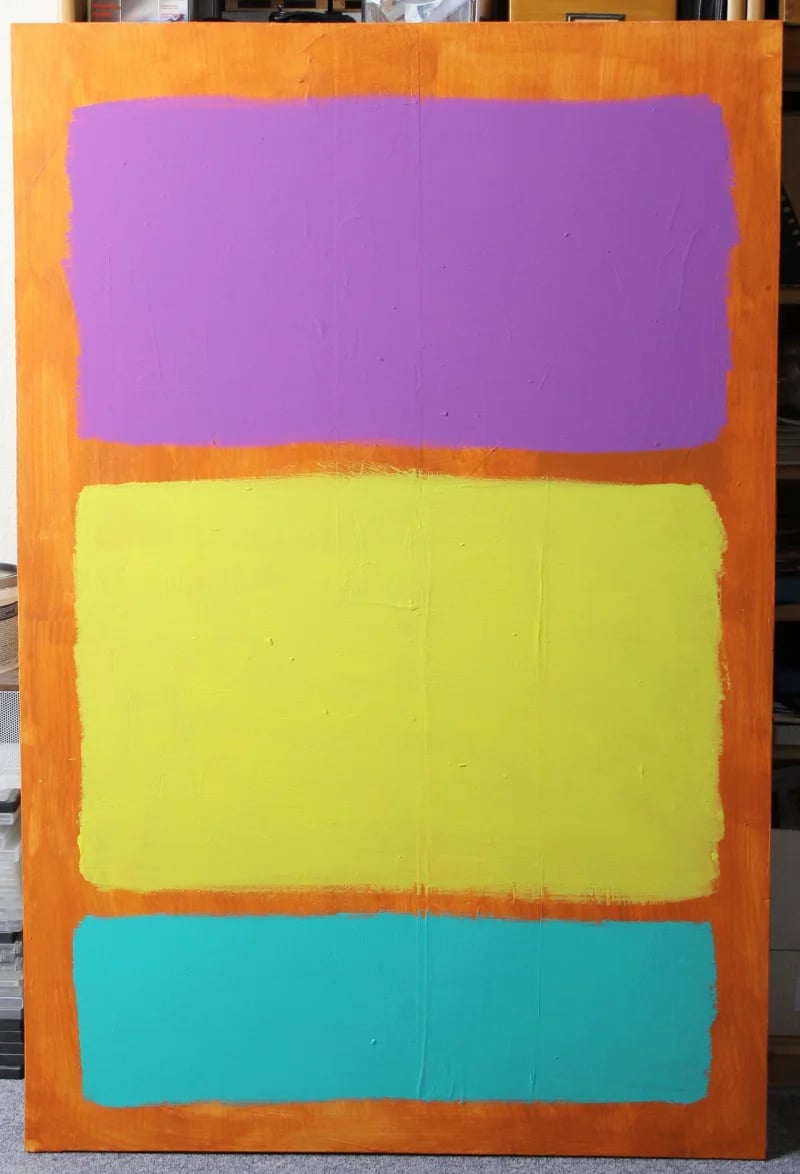
Period: Late 1940s to 1970s
Characteristics: Large areas of flat or stained colour; minimal gesture; emphasis on colour as subject; contemplative, immersive effect
Events: Clement Greenberg's "American-Type Painting" (1955); Post-Painterly Abstraction exhibition (1964)
Colour as Experience
Color Field painting emerged in the United States in the late 1940s as a tendency within Abstract Expressionism. Its practitioners, including Mark Rothko, Barnett Newman, and Clyfford Still, used large areas of colour to create immersive, contemplative experiences. Where the Action Painters (Pollock, de Kooning) emphasised gesture and process, the Color Field painters emphasised colour as a field, a zone of pure sensation. The distinction was not absolute; Rothko and Newman were often grouped with the Abstract Expressionists. But by the 1960s, a second generation (Helen Frankenthaler, Morris Louis, Kenneth Noland) had developed a different approach: they soaked thinned paint into unprimed canvas, creating stains that eliminated brushwork entirely. The critic Clement Greenberg called this "Post-Painterly Abstraction"; it represented, for him, the logical development of modernism's drive toward flatness.
Color Field painting was not a unified movement. Rothko, Newman, and Still had different aims; Frankenthaler, Louis, and Noland were more concerned with process and material. What they shared was a belief that colour could function as the primary subject of painting, and that large-scale colour could produce a direct, almost physical effect on the viewer.
Mark Rothko: The Chapel of Colour
Mark Rothko (1903–1970) is the Color Field painter most associated with contemplative experience. His mature work, from the late 1940s onward, consisted of soft-edged rectangles of colour stacked on large canvases. The paintings seem to hover, shimmer, or breathe; the edges of the forms blur into the ground. Rothko wanted his work to move viewers to tears. He refused to sell paintings to spaces where they would be used as decoration; he wanted them encountered in conditions of quiet attention. The Rothko Chapel in Houston (1971) was designed in collaboration with the artist; it houses fourteen large paintings in a non-denominational space for meditation. Rothko's work has been compared to religious art; the colour fields function, for some viewers, as secular icons.
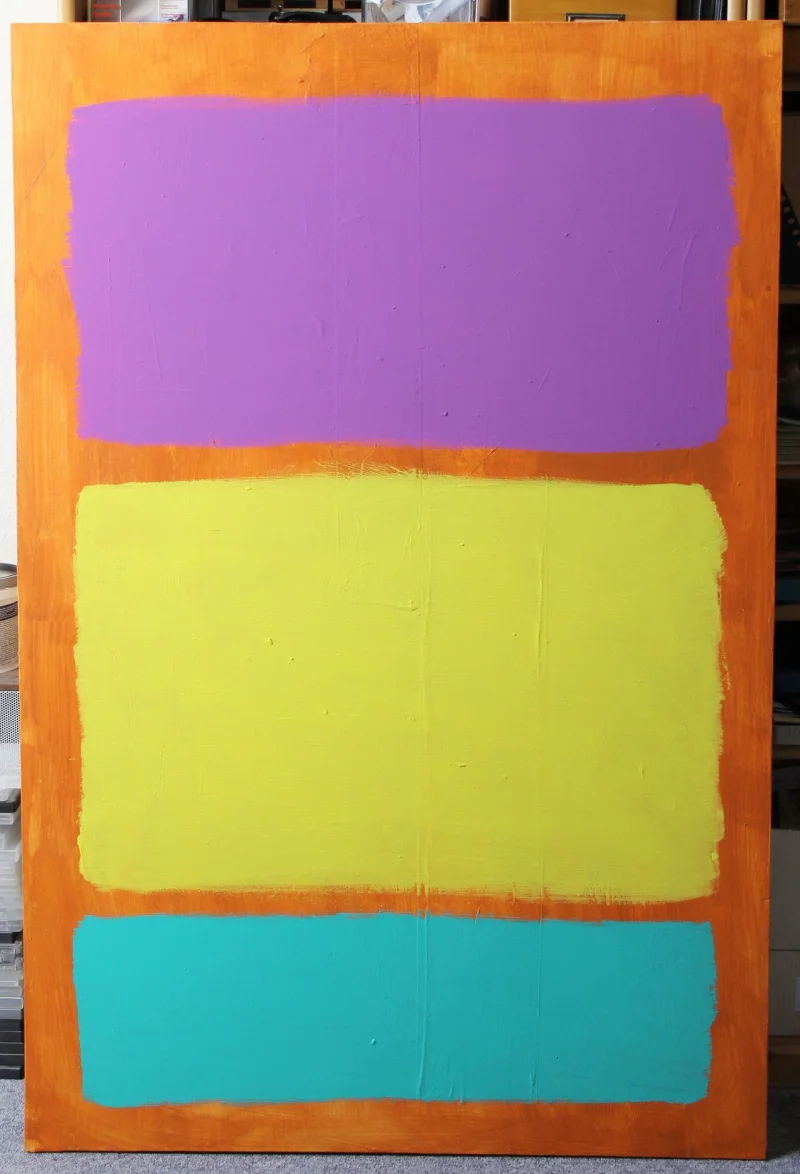
Paintings in the style of Mark Rothko (Source)

Rothko was influenced by Nietzsche, by myth, and by a lifelong interest in the tragic and the sublime. He rejected the term "abstract" for his work, insisting that he painted "the human drama." His suicide in 1970 has coloured interpretation of his work, but the paintings themselves remain open: they invite contemplation without prescribing what the viewer should feel. For practitioners who use colour meditation or who seek art that supports contemplative states, Rothko's work remains a primary reference.
Helen Frankenthaler and the Stain
Helen Frankenthaler (1928–2011) developed the "stain" technique in 1952. She poured thinned paint onto unprimed canvas, allowing the colour to soak into the fabric. The result was a fusion of colour and support; there was no layer of paint on top of the canvas, just colour absorbed into it. Mountains and Sea (1952) was the breakthrough work. Frankenthaler had visited Nova Scotia and been struck by the landscape; back in New York, she made a large painting that suggested coastal forms through poured stains of blue, pink, and green. The work influenced Morris Louis and Kenneth Noland, who visited her studio in 1953. They adopted the technique and pushed it toward purer, more systematic compositions.
Frankenthaler's work retained a quality of accident and flow. Her stains suggest landscape, weather, or inner states without representing them. She continued to paint for five decades, moving through different scales and colour palettes. Her work has received renewed attention in recent years; the stain technique's influence on later abstraction is now widely acknowledged.
Morris Louis and Kenneth Noland: The Washington Color School
Morris Louis (1912–1962) and Kenneth Noland (1924–2010) worked in Washington, D.C., and are often grouped as the "Washington Color School." Louis made "Veil" paintings (1954–59): bands of thinned paint poured down the canvas, overlapping and bleeding into one another. His "Unfurled" series (1960–61) used bands of colour along the edges of the canvas, leaving the centre blank. The paint ran in rivulets; the effect was both controlled and spontaneous. Noland made "Target" paintings (1950s–60s): concentric circles of colour on square canvases. He also made chevron and stripe paintings. His work was more systematic than Louis's; he was interested in the relationship between colour and shape, and in the way the edges of the canvas could structure composition.
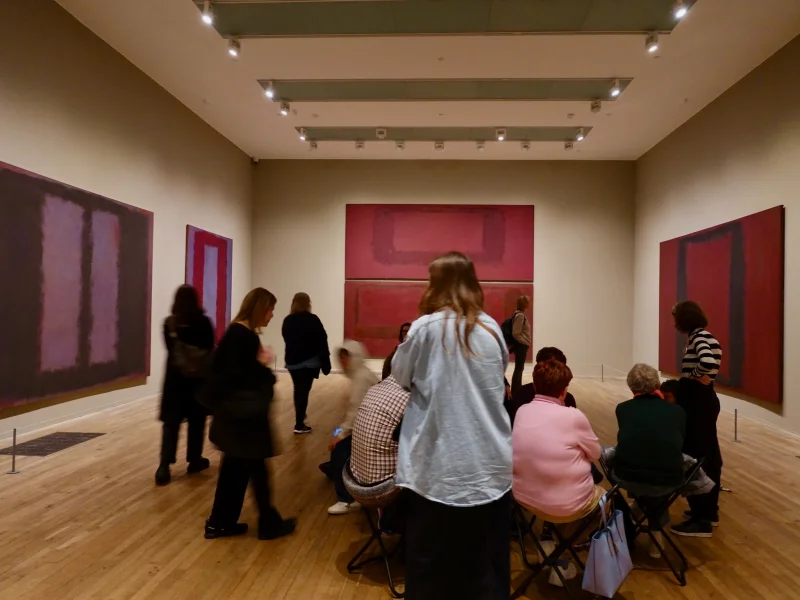
A gallery of paintings by Mark Rothko, Tate Modern (Source)

Barnett Newman and Clyfford Still
Barnett Newman (1905–1970) made paintings of flat colour divided by vertical bands he called "zips." Vir Heroicus Sublimis (1950–51) is a large red field with thin vertical stripes; the effect is both minimal and overwhelming. Newman wrote about the "sublime" and the "metaphysical"; his work sought to create an experience of transcendence through pure colour and form. Clyfford Still (1904–1980) made jagged, vertical compositions in dark colours; his surfaces are thick and torn. He rejected the art world and controlled the exhibition of his work; a museum dedicated to him opened in Denver in 2011. Both Newman and Still resisted the "Color Field" label; they saw their work as continuous with, but distinct from, Abstract Expressionism.
Jules Olitski and the Stain in Three Dimensions
Jules Olitski (1922–2007) applied Color Field principles to sprayed paint. His work of the 1960s used an industrial spray gun to create fields of colour that seemed to hover at the edge of visibility. The spray eliminated the brushmark entirely; the colour appeared to exist in the air. Olitski also made sculpture, painted aluminium forms that extended Color Field ideas into three dimensions. The movement's interest in colour as a phenomenological experience, in the way large fields of colour could produce a physical response, was taken to an extreme in his work. The critic Michael Fried later repudiated his early support for such work; he came to see it as "theatrical" rather than genuinely aesthetic. The debate about what counts as serious art, and whether immersion in a colour field is a legitimate experience, continues.
Legacy
Color Field painting extended Abstract Expressionism's interest in large-scale colour while moving away from gesture and process. Its influence is visible in the work of younger artists who use colour as their primary material, and in the way we think about painting as an immersive experience. The movement's emphasis on contemplation, on the physical presence of the work, and on colour as a carrier of affect: these concerns remain relevant. For practitioners who work with colour in ritual, meditation, or magical practice, Color Field painting offers a twentieth-century precedent. The experience of standing before a large Rothko, or a Frankenthaler stain, is not easily put into words; it is something that must be encountered in person.
Related Resources
- Abstract Expressionism – The movement Color Field emerged from
- Minimalism – Shared reduction and emphasis on presence
- Op Art – Contrasting approach to colour and perception
- Introduction to Art History
Related in this topic
More from Occult Art History & Symbolism — Start Here.
Symbolism
Discover the meaning of symbolism! Learn its origins, art and famous symbolist painters. Find hidden emotions in art.
Naïve Art
Naïve art: untrained artists created startling originality through simplified forms, vivid colors, and unfiltered imagination.
Art Informel
Art Informel: the European parallel to Abstract Expressionism. Dubuffet, Tàpies, and the art of the unformed and the raw.
Street Art
Street Art: from subway tags to gallery walls. Banksy, Keith Haring, and the art that reclaims public space.
You Might Also Like
Art Informel
Art Informel: the European parallel to Abstract Expressionism. Dubuffet, Tàpies, and the art of the unformed and the raw.
Street Art
Street Art: from subway tags to gallery walls. Banksy, Keith Haring, and the art that reclaims public space.