Period: 1940s to 1960s
Characteristics: Rejection of geometric abstraction; emphasis on matter, gesture, and the spontaneous; raw or unworked surfaces; existential themes
Events: Jean Dubuffet coins "Art Brut" (1945); Michel Tapié's "Un Art Autre" (1952); spread across Europe
The Formless and the Raw
Art Informel (or "Informel") was the European counterpart to American Abstract Expressionism. The term was used in Paris in the early 1950s to describe work that rejected the geometric abstraction of the pre-war period in favour of matter, gesture, and the spontaneous. "Informel" suggested the "unformed" or "without form"; it was not a style but an attitude. The critic Michel Tapié used the phrase "Un Art Autre" (An Other Art) to describe work that refused the rational, the composed, and the legible. Art Informel included Tachisme (from "tache," or stain), which emphasised the spontaneous mark; it also included Matter painting (Art Brut in the sense of "raw" or unworked material) and the work of artists who used thick impasto, sand, tar, or other non-traditional materials.
The movement had no single centre. Paris was important; so were cities in Germany, Spain, and Italy. The artists did not form a group; they were linked by a shared rejection of pre-war abstraction (whether geometric or surrealist) and by a turn toward the visceral, the existential, and the raw. Art Informel emerged in the shadow of the Second World War; it reflected a crisis of meaning and a search for new kinds of expression.
Jean Dubuffet: Matter and Art Brut
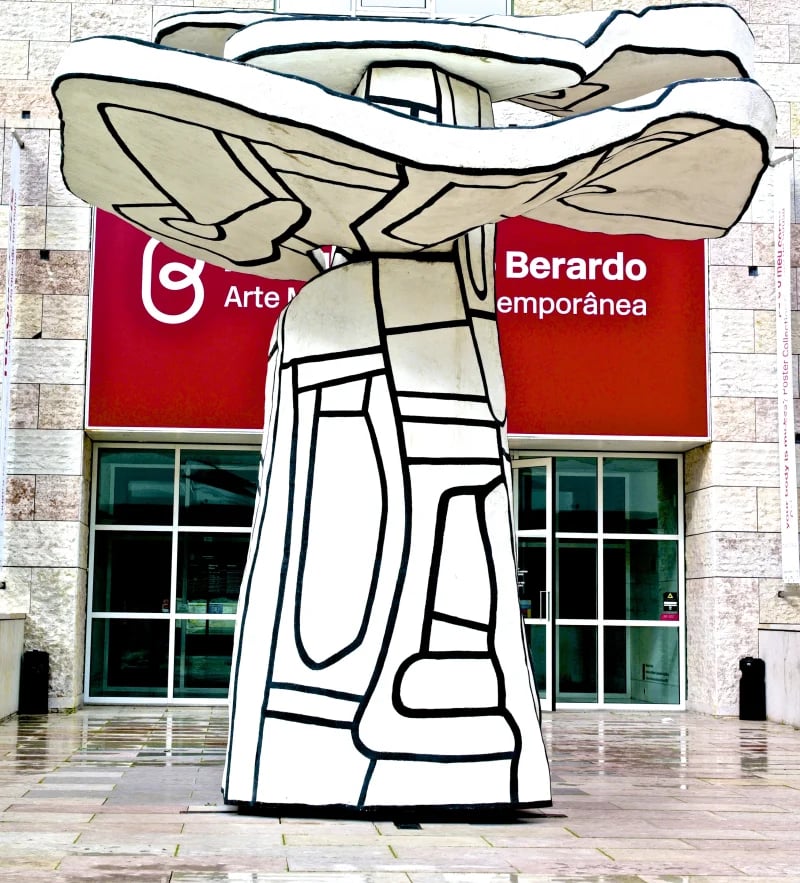
Jean Dubuffet (1901–1985) was Art Informel's most influential figure. He had worked in the wine trade before devoting himself to art in 1942. He was fascinated by the art of children, psychiatric patients, and untrained makers; he coined the term "Art Brut" (raw art) in 1945 to describe such work. His own painting used thick materials: sand, tar, gravel, and glue mixed with pigment. The surfaces were rough, lumpy, almost sculptural. L'Arbre biplan (1968) is characteristic: a tree form built from thick, textured paint in earthy colours. The work suggests something primordial, something that might have been dug from the ground rather than painted.
Dubuffet's interest in the "raw" extended to his rejection of cultural refinement. He argued that Western art had become overcivilised; the art of the mad, the imprisoned, and the isolated offered a more direct vision. His own work oscillated between figuration and abstraction; he made portraits, landscapes, and wholly invented forms. The consistency was in the material: paint as matter, as stuff, as something that could be heaped and scraped. For practitioners interested in the power of raw material, in art that bypasses refinement, or in the overlap between the mad and the visionary, Dubuffet's work remains central.
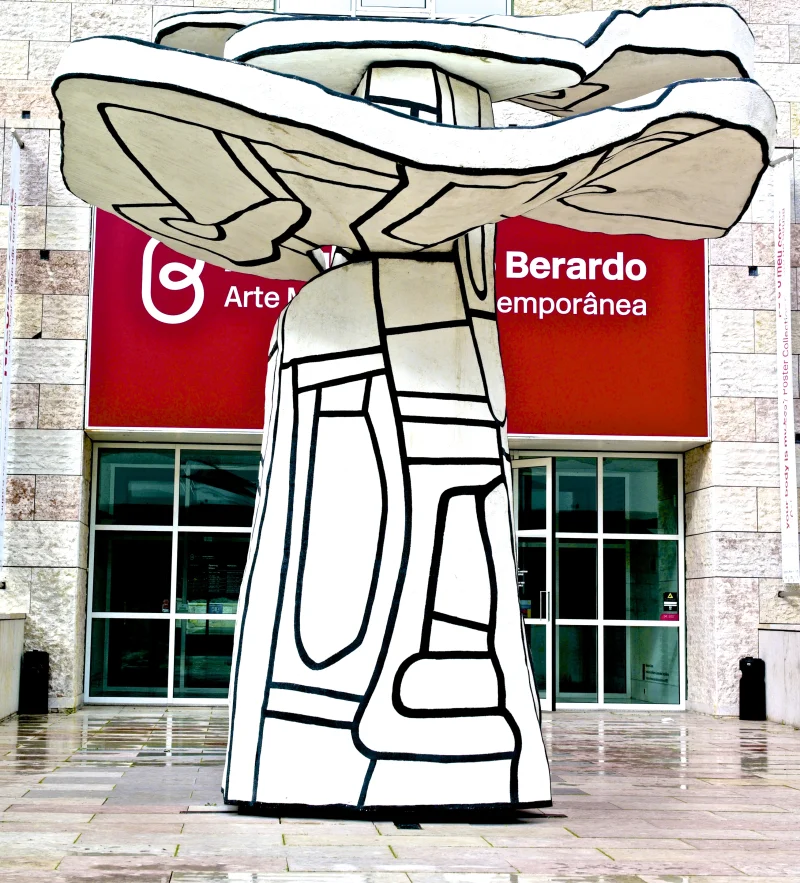
L'Arbre biplan by Jean Dubuffet, 1968 (Source)
_-_Jean_Dubuffet_(1901_-_1985)_(23420452431).jpg)
Antoni Tàpies: Walls and Signs
Antoni Tàpies (1923–2012) was a Catalan artist who developed a distinctive language of matter and symbol. His work often resembled walls: rough surfaces of mixed media, sometimes with scratched marks, footprints, or suggestive shapes. He used marble dust, sand, and everyday materials; the effect was both tactile and symbolic. Núvol i cadira (Cloud and Chair, 1984) combines abstract form with a hint of the everyday. Tàpies was interested in Eastern philosophy, in the body, and in the way matter could carry meaning without representing it. His work has been compared to the art of meditation and to the tradition of the sacred mark.
Tàpies was politically committed; he opposed the Franco regime and supported Catalan identity. His work was often censored in Spain. But his influence extended internationally; he showed in Paris, New York, and beyond. His combination of matter, symbol, and political implication made him a key figure in postwar European art.
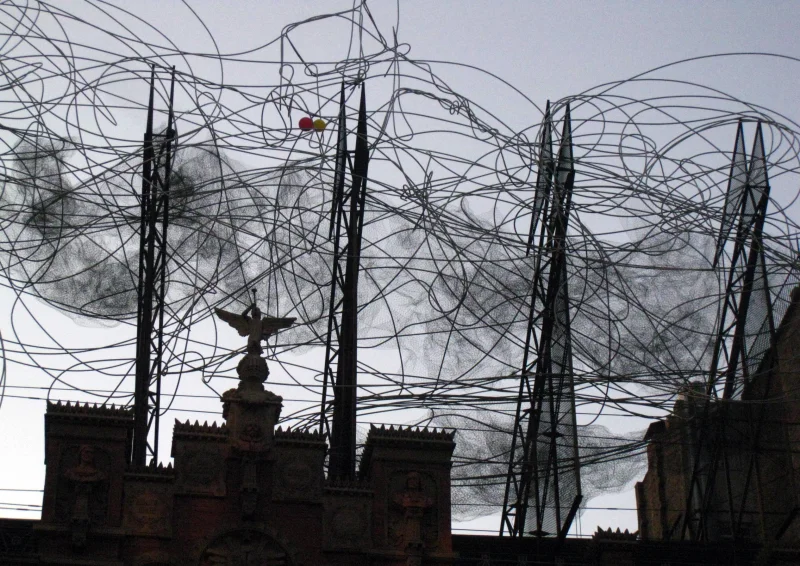
Núvol i cadira by Antoni Tàpies (Source)

Wols, Fautrier, and the Postwar Moment
Wols (1913–1951) was a German artist who worked in Paris. His small, dense paintings use tangled lines and organic shapes; they suggest microorganisms, wounds, or the inside of the body. He was a photographer and a musician as well as a painter; he lived in poverty and died young. His work was championed by Tapié and by the critic Jean Paulhan. Jean Fautrier (1898–1964) made "Hostage" paintings in 1943–45: thick, scarred surfaces that suggested the violence of the Occupation. His work blurred the line between abstraction and figuration; the matter itself seemed to carry the trace of trauma. Pierre Soulages (1919–2022) made black paintings that explored the texture and reflectivity of the surface; his work was often grouped with Art Informel though he resisted the label.
Alberto Burri and the Matter of Italy
Alberto Burri (1915–1995) was an Italian artist who began to make work from burlap sacks, wood, and plastic in the 1950s. His "Sacchi" (sacks) used stitched and patched fabric; his "Combustioni" (combustions) used burned plastic. The work was not traditionally beautiful; it was rough, charred, and suggestive of wound or repair. Burri had been a doctor in the war; he had seen damaged bodies. His art did not represent that experience directly, but the matter carried a weight that went beyond formal experiment. Burri's influence on Arte Povera, the Italian movement of the late 1960s that used "poor" materials, was direct. The belief that matter could speak, that the raw could be more truthful than the refined, linked Art Informel to a longer European tradition of the unworked and the visceral.
Legacy
Art Informel did not last long as a named movement. By the 1960s, its practitioners had moved in different directions. But its influence was lasting. The turn toward matter, gesture, and the unformed shaped Arte Povera in Italy, the Gutai group in Japan, and later tendencies in European art. The belief that paint could be stuff, that the mark could carry existential weight, and that the raw could be more truthful than the refined: these ideas remain in circulation. For practitioners interested in the power of material, in the overlap between art and the unprocessed, or in the way the body can register in matter, Art Informel offers a European precedent. It is the other side of Abstract Expressionism: not the heroic gesture of the New York School, but the wounded, material, postwar sensibility of the Old World.
Related Resources
- Art Brut – Dubuffet and the art of the marginal
- Abstract Expressionism – American parallel
- Surrealism – Earlier interest in the irrational and the raw
- Introduction to Art History
Related in this topic
More from Occult Art History & Symbolism — Start Here.
Symbolism
Discover the meaning of symbolism! Learn its origins, art and famous symbolist painters. Find hidden emotions in art.
Naïve Art
Naïve art: untrained artists created startling originality through simplified forms, vivid colors, and unfiltered imagination.
Street Art
Street Art: from subway tags to gallery walls. Banksy, Keith Haring, and the art that reclaims public space.
You Might Also Like
Street Art
Street Art: from subway tags to gallery walls. Banksy, Keith Haring, and the art that reclaims public space.