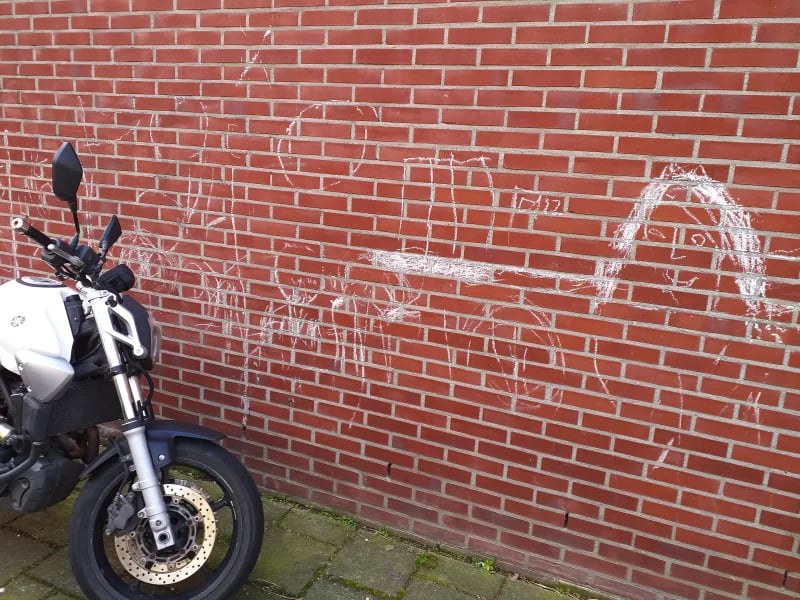
Period: 1960s to present
Characteristics: Work in public space; often unauthorised; diverse techniques (spray, stencil, wheatpaste, sticker); engagement with urban environment
Events: Graffiti explosion in New York (1970s); Keith Haring's subway drawings (1980s); Banksy's rise (2000s)
Art in the Street
Street art is a broad category that includes graffiti, stencil art, murals, wheatpaste posters, and installations in public space. It has no single origin. Graffiti as we know it emerged in Philadelphia and New York in the late 1960s, when young people began to write their names, or "tags," on subway trains and walls. The practice spread; by the 1970s, "writers" were competing for visibility, developing elaborate styles, and turning subway cars into moving canvases. The authorities responded with crackdowns; the "war on graffiti" became part of the politics of urban space. But the practice continued, and it evolved. By the 1980s, artists like Keith Haring and Jean-Michel Basquiat had brought graffiti into galleries. By the 2000s, figures like Banksy had made street art a global phenomenon.
Street art is distinguished from "public art" in that it is often unauthorised. It exists in a legal grey area: some works are commissioned, others are illicit. The tension between institutional acceptance and outsider status has shaped the field. Street artists have been arrested, their work has been removed, and they have been celebrated in museums. The ambiguity is part of the practice.
Keith Haring: Radiant Baby and the Subway
Keith Haring (1958–1990) began drawing in the New York subway in 1980. He used white chalk on the black paper that covered unused advertising spaces. His figures were simple: radiant babies, barking dogs, figures with holes in their bodies. They were immediate, recognisable, and everywhere. Haring was not a traditional graffiti writer; he was an art-school graduate who chose the street as his gallery. He believed that art should be accessible, and he made work for everyone. By the mid-1980s he had been embraced by the art world; he collaborated with Grace Jones, designed Swatch watches, and painted murals around the world. He died of AIDS-related illness in 1990; his work remains a symbol of activism and accessibility.
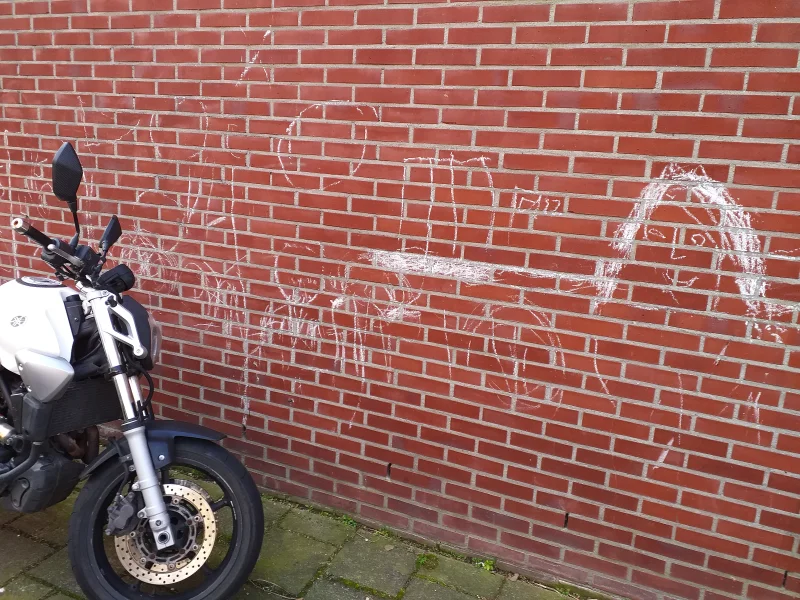
Street art in Amsterdam (Source)

Banksy: Stencil and Satire
Banksy (identity unknown, b. c. 1974) emerged in Bristol in the late 1990s and rose to global fame in the 2000s. He uses stencils to create works quickly, often with satirical or political content. Girl with Balloon (2002), Flower Thrower (2003), and Dismaland (2015), a dystopian theme park, have become iconic. Banksy's work sells for millions at auction; it is also painted over, removed, or stolen from walls. The artist has remained anonymous; the mystery has fuelled his fame. His work raises questions about the relationship between street art and the market: when a mural is cut from a wall and sold, what remains of its meaning? Banksy has addressed this by shredding a painting at auction (2018) and by making works that destroy themselves. The gesture is both critique and publicity.
Stencils, Wheatpaste, and Murals
Street art uses many techniques. Stencil art allows for precise, repeatable images; it has been used by Blek le Rat in Paris (since the 1980s), Banksy, and countless others. Wheatpaste uses a flour-and-water adhesive to attach posters to walls; it has been used for everything from band promotion to political protest. Murals can be commissioned or illicit; they range from small tags to building-sized compositions. The common thread is the use of public space as a support. The street is not neutral; it is contested. Property owners, municipal governments, and residents often view street art as vandalism; artists and advocates argue that it enlivens the city and democratises access to art. The tension is unresolved. Some cities have designated "legal walls" where graffiti is permitted; others have commissioned murals to deter tagging. The commodification of street art has created new problems: works are sometimes removed and sold without the artist's consent. Banksy's Slave Labour (2012) was removed from a wall in London and put up for auction; public outcry forced its withdrawal. The question of who owns art that exists in public space, and who has the right to remove or sell it, remains open. Street art claims space, if only temporarily.
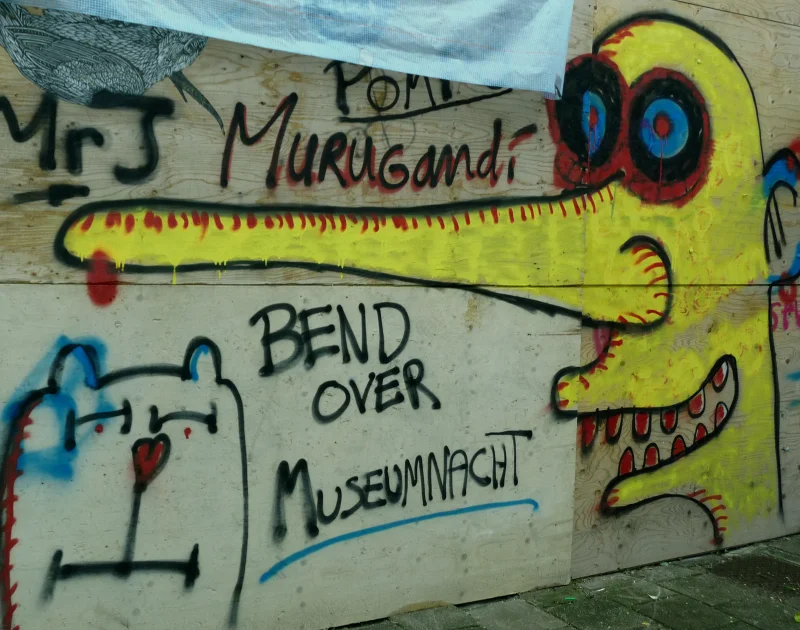
Stencil art on construction wall, Amsterdam (Source)

Shepard Fairey, Invader, and the Global Spread
Shepard Fairey (b. 1970) began with stickers of André the Giant and the slogan "OBEY." His Hope poster for Barack Obama's 2008 campaign became one of the most recognisable political images of the decade. Invader (b. 1969) places tile mosaics based on Space Invaders characters on walls in cities around the world; he has "invaded" over 80 cities. The French artist JR (b. 1983) pastes large-scale black-and-white portraits in public spaces, from the favelas of Rio to the Louvre. Street art has become a global language; the same techniques and concerns appear in cities worldwide. Local contexts shape the work, but the impulse to mark public space is universal.
Legacy and Tension
Street art exists in tension with property, authority, and the art market. It is celebrated when it brings tourism and "character" to a neighbourhood; it is criminalised when it is seen as vandalism. The line between street art and graffiti is porous; some artists reject the distinction. For practitioners interested in the power of public image, in the reclaiming of space, or in the relationship between art and the street, street art offers a living tradition. It is not a style but a practice: the decision to make work in public, to risk removal, to address a passing audience. That practice continues to evolve.
The Graffiti Roots: Tags, Throw-ups, and Pieces
Before street art became a gallery category, there was graffiti. In New York in the 1970s, writers developed a hierarchy of forms: the "tag" (a stylised signature), the "throw-up" (a quick, bubble-letter piece), and the "piece" (a full, elaborate production). Writers risked arrest, injury, and death (some were killed by trains) to paint subway cars that would travel the city, carrying their names to every borough. The culture had its own codes, its own celebrities, and its own aesthetic evolution. Graffiti was not "art" in the institutional sense; it was vandalism, it was territorial, it was identity. But when gallery owners and collectors began to take notice, the lines blurred. Jean-Michel Basquiat (1960–1988) began as a graffiti writer (SAMO) before crossing into the art world. His work retained the energy and illegibility of the street even when it hung in museums. The history of street art cannot be told without graffiti; the two are intertwined, sometimes in tension, sometimes in collaboration.
Related Resources
- Pop Art – Use of popular imagery and mass reproduction
- Conceptual Art – Art beyond the gallery
- Introduction to Art History
Related in this topic
More from Occult Art History & Symbolism — Start Here.
Symbolism
Discover the meaning of symbolism! Learn its origins, art and famous symbolist painters. Find hidden emotions in art.
Naïve Art
Naïve art: untrained artists created startling originality through simplified forms, vivid colors, and unfiltered imagination.
Art Informel
Art Informel: the European parallel to Abstract Expressionism. Dubuffet, Tàpies, and the art of the unformed and the raw.
You Might Also Like
Art Informel
Art Informel: the European parallel to Abstract Expressionism. Dubuffet, Tàpies, and the art of the unformed and the raw.