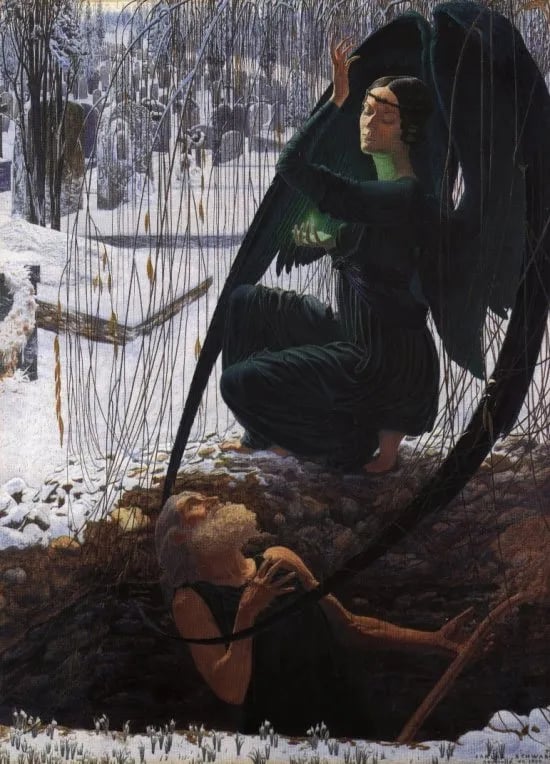
Period: 1848 – c. 1900
Characteristics: Medieval and literary subjects; bright colour; naturalistic detail; rejection of academic "slosh"; moral and spiritual themes
Events: Formation of Pre-Raphaelite Brotherhood (1848), Ruskin's defence (1851), Morris's Arts and Crafts (1860s)
Before Raphael: A Return to Truth
The Pre-Raphaelite Brotherhood formed in London in 1848, the year of revolutions across Europe. Three young painters (Dante Gabriel Rossetti, John Everett Millais, and William Holman Hunt) founded the group in protest against what they saw as the stale conventions of the Royal Academy. They took their name from a belief that art had declined since the Italian Renaissance: Raphael and his followers had introduced idealisation and mannerism at the expense of truth to nature. The Pre-Raphaelites wanted to go "before" that decline and recover the directness, colour, and sincerity they found in early Italian and Flemish painting.
They painted on white grounds (rather than the dark underpainting favoured by the Academy), used bright pigments, and studied nature with botanical precision. Subjects came from the Bible, Shakespeare, Keats, Arthurian legend, and medieval history. The movement had no explicit occult programme, but its fascination with myth, the feminine divine, and a romanticised medieval past would influence later occult and pagan aesthetics. Practitioners drawn to medieval symbolism, plant lore, or the visual language of Victorian spiritualism will find points of connection.
The Brotherhood and Its Circle
The original Brotherhood was small: seven members, including the painter Ford Madox Brown (who never officially joined but shared their aims) and the critic F. G. Stephens. They exhibited under the initials "PRB" and attracted both admiration and scorn. Charles Dickens attacked Millais's Christ in the House of His Parents (1850) as blasphemous and ugly. John Ruskin, by contrast, came to their defence in letters to The Times, arguing that their truth to nature was exactly what British art needed.
The Brotherhood dissolved within a few years, but the movement continued. Rossetti gathered a second wave of disciples, including Edward Burne-Jones and William Morris. The latter would found the Arts and Crafts movement, bringing Pre-Raphaelite principles to design, printing, and the applied arts. Morris's Kelmscott Press, his wallpapers and textiles, and his political writings all owed something to the Pre-Raphaelite vision of art integrated with life.
Dante Gabriel Rossetti: Desire and the Feminine
Dante Gabriel Rossetti (1828–1882) was the Brotherhood's most charismatic figure. Poet and painter, he drew on Dante, medieval legend, and his own tangled love life. His repeated depictions of women, often with the same face (that of his model and later wife Elizabeth Siddal), created a type: the Pre-Raphaelite woman, with flowing hair, pale skin, and an air of melancholy or transcendence. Beata Beatrix (1864–70) shows Siddal as Dante's Beatrice, in a trance-like state between life and death. The painting was completed after Siddal's death from an overdose; it is at once memorial and myth.
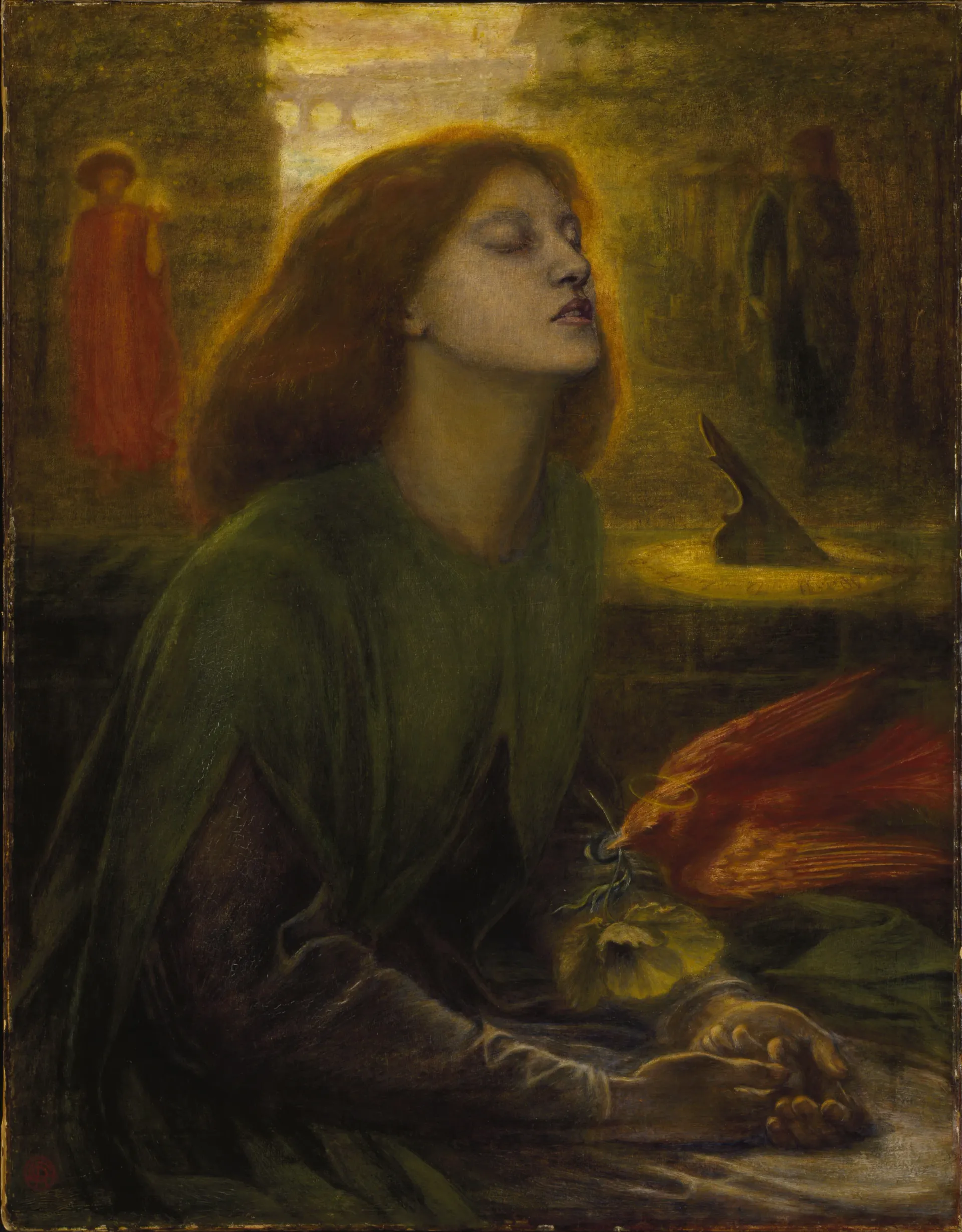
Beata Beatrix by Dante Gabriel Rossetti, 1864-70 (Source)

Rossetti's later work grew more decorative and sensual. His Proserpine (1874), Astarte Syriaca (1877), and other femme fatale images drew on classical and Near Eastern goddesses. He was interested in Ouija boards and séances; his circle included spiritualists and occultists. The convergence of feminine archetypes, myth, and a Victorian interest in the Otherworld makes Rossetti's work a touchstone for those who work with goddess imagery or the intersection of art and spirit.
John Everett Millais: From Brotherhood to Academic
John Everett Millais (1829–1896) was the Brotherhood's most technically gifted painter. Ophelia (1851–52) shows Shakespeare's drowned heroine floating among flowers, each plant rendered with botanical accuracy. Siddal posed in a bath for the figure; she caught a cold from the ordeal. The painting combines literary subject matter with an almost hallucinatory attention to natural detail.
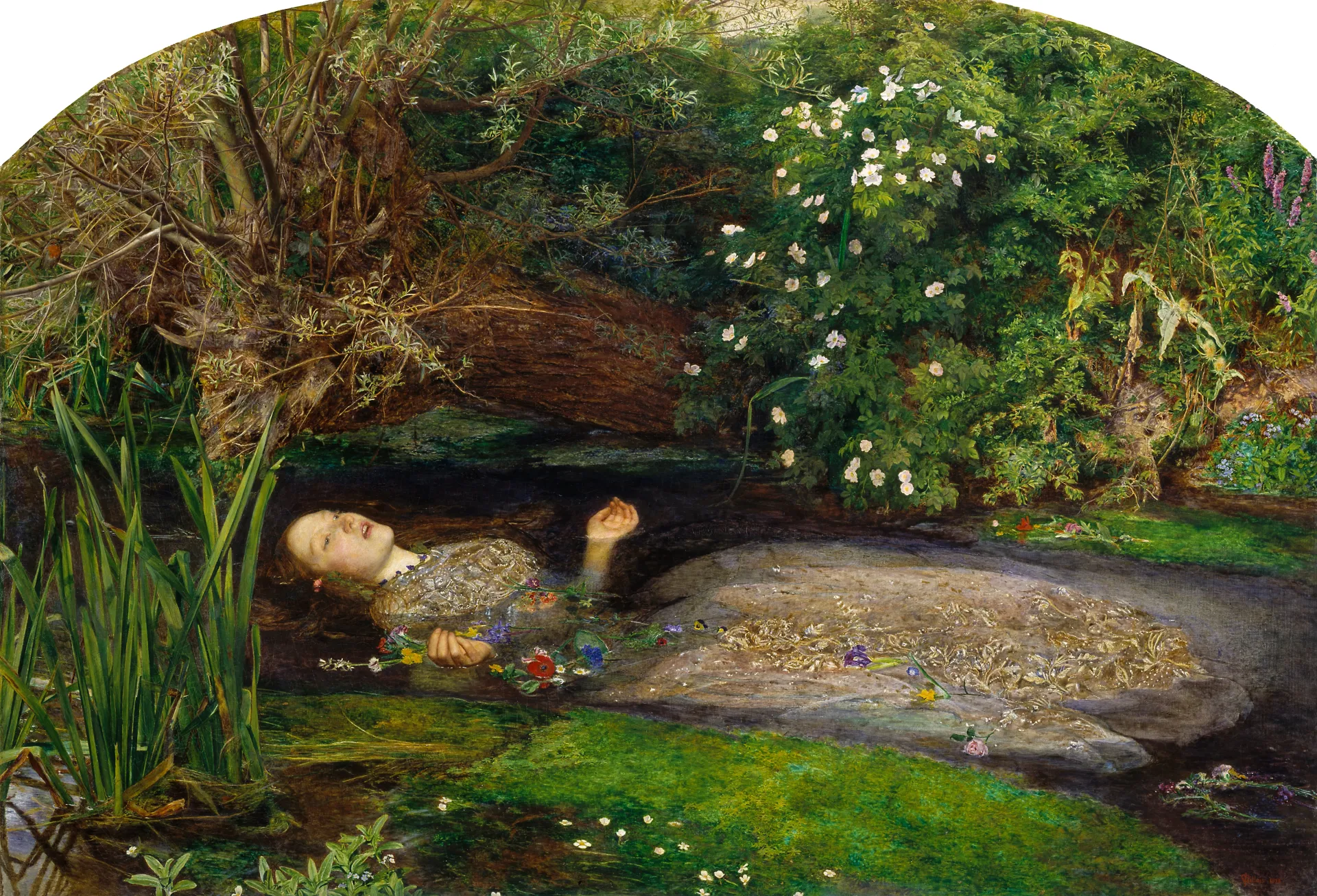
Ophelia by John Everett Millais, 1851-52 (Source)

Millais later moved toward a more conventional style and became President of the Royal Academy. His early Pre-Raphaelite work, however, remains his most distinctive. Mariana (1851), from Tennyson's poem, shows a woman in a blue dress in a claustrophobic interior, her posture expressing longing and confinement. The treatment of light, fabric, and architectural detail was new in British painting.
Edward Burne-Jones and William Morris: Medieval Dreams
Edward Burne-Jones (1833–1898) carried the Pre-Raphaelite vision into the late Victorian period. His work was more stylised and decorative than the early Brotherhood's, influenced by Botticelli and the Italian primitives, but also by the Arts and Crafts aesthetic. He painted cycles based on Arthurian legend (The Beguiling of Merlin, 1872–77), Greek myth (The Pygmalion Series), and biblical narrative. His figures are often elongated, dreamy, and wrapped in flowing drapery.
William Morris (1834–1896) is better known as a designer and socialist than as a painter, but he began as a Pre-Raphaelite. His La Belle Iseult (1858) shows Guinevere in a medieval interior filled with patterned textiles. Morris would devote his life to making such interiors available: his firm produced wallpapers, fabrics, and furnishings that brought medieval and natural motifs into middle-class homes. He was also a practicing magician, associated with the Hermetic Order of the Golden Dawn. His interest in Icelandic sagas, Norse myth, and the recovery of pre-Christian traditions shaped both his design and his politics.
Botanical and Natural Detail
The Pre-Raphaelites studied plants and flowers with a precision that bordered on obsession. Millais's Ophelia includes identifiable species (willow, nettle, daisy, poppy), each chosen for its literary or symbolic associations. The Brotherhood believed that truth to nature was a form of spiritual discipline; careful observation could reveal the divine in the particular. This approach parallels the attention to correspondences in magical practice, the idea that plants, colours, and symbols carry specific meanings that can be learned and used.
Victorian flower language (the "language of flowers") was in vogue; the Pre-Raphaelites used it knowingly. A painting might encode meaning through its botanical choices, readable to viewers who knew the code. Those who work with herbalism, plant spirit medicine, or the symbolic use of flora will find Pre-Raphaelite painting a source of visual vocabulary and conceptual overlap.
Elizabeth Siddal (1829–1862) was the Pre-Raphaelites' most famous model and the only woman to exhibit with the Brotherhood. She was also a painter and poet in her own right. Her watercolours are sparse and delicate, often drawing on ballad and legend. She has sometimes been reduced to a tragic muse, the woman who died young after posing in a cold bath, but her own work deserves attention. Siddal was part of the circle that experimented with spiritualism; her art and her life intersected with the Victorian fascination with the border between life and death.
Critics and Controversy
The Pre-Raphaelites were never universally loved. Ruskin championed them, but others found their work garish, morbid, or absurd. The bright colours and sharp focus offended viewers accustomed to the mellow browns of the Academy. The choice of subjects (fallen women, medieval violence, Tennyson's morbid heroines) disturbed bourgeois sensibilities. The Brotherhood itself splintered: Millais moved toward conventional success, while Rossetti and Morris pursued more arcane paths. The tension between popularity and purity would haunt the movement for decades.
Legacy
The Pre-Raphaelites influenced illustration (Aubrey Beardsley, the golden age of book illustration), the Aesthetic movement, and Art Nouveau. Their medievalism and nature worship found echoes in the early Pagan revival. The Arts and Crafts movement, with its critique of industrial production and its emphasis on handmade beauty, drew directly on Pre-Raphaelite ideals. Tolkien and C.S. Lewis were influenced by the movement's vision of a romanticised medieval past. Contemporary fantasy illustration and pagan altar aesthetics still carry traces of the Pre-Raphaelite woman and the Pre-Raphaelite landscape: luminous, detailed, and charged with latent meaning. The movement's insistence that beauty could be found in the particular (in a flower, a face, a moment of light) fits with practices that attend to correspondences and the symbolic weight of small things. To look at a Pre-Raphaelite painting is to enter a world where everything might mean something more. The movement's afterlife extends into gothic subculture, fantasy role-playing, and pagan aesthetics, anywhere that medievalism, nature reverence, and a certain romantic intensity still flourish. The Pre-Raphaelite Brotherhood lasted only a few years as a formal group, but the sensibility it named has never entirely disappeared. It persists wherever artists and viewers seek beauty that is both exact and mystical, both naturalistic and charged with symbolic potential.
Related Resources
- Romanticism – The movement that preceded and influenced the Pre-Raphaelites
- Art Nouveau – Later developments in organic form and design
- Symbolism – Shared interest in myth and hidden meaning
- Introduction to Art History
Related in this topic
More from Occult Art History & Symbolism — Start Here.
Symbolism
Discover the meaning of symbolism! Learn its origins, art and famous symbolist painters. Find hidden emotions in art.
Naïve Art
Naïve art: untrained artists created startling originality through simplified forms, vivid colors, and unfiltered imagination.
Art Informel
Art Informel: the European parallel to Abstract Expressionism. Dubuffet, Tàpies, and the art of the unformed and the raw.
Street Art
Street Art: from subway tags to gallery walls. Banksy, Keith Haring, and the art that reclaims public space.
You Might Also Like
Art Informel
Art Informel: the European parallel to Abstract Expressionism. Dubuffet, Tàpies, and the art of the unformed and the raw.
Street Art
Street Art: from subway tags to gallery walls. Banksy, Keith Haring, and the art that reclaims public space.