Period: 1945 – present
Characteristics: Work made outside art-world training; marginal or institutional contexts; raw materials; repetitive or obsessive motifs; spiritual or visionary content
Events: Dubuffet coins "Art Brut" (1945), Collection de l'Art Brut founded (1971), "Outsider Art" enters usage (1972)
Beyond the Art World
Art Brut ("raw art") is a term coined by the French artist Jean Dubuffet in 1945 to describe work made by people outside the professional art world. These were individuals who had not trained in academies, who often worked in psychiatric hospitals, prisons, or in isolation, and who created without regard for art-world conventions. Dubuffet was fascinated by the directness, intensity, and strangeness of their output. He began collecting such work, eventually establishing the Collection de l'Art Brut in Lausanne, Switzerland, where it remains one of the world's major holdings of outsider art.
The term "Outsider Art" entered English usage in 1972, when Roger Cardinal published a book of that name. It has come to cover a broader range of self-taught, vernacular, and "visionary" work. The boundaries are disputed: some artists have been "discovered" and shown in galleries, which complicates the idea of true outsider status. But the category persists because it names something real: art that comes from outside institutional culture, often with a rawness and directness that trained artists struggle to achieve. For practitioners interested in spirit-led creation, mediumistic art, or the idea that the best work bypasses conscious intention, Art Brut offers a twentieth-century precedent.
Jean Dubuffet and the Invention of Art Brut
Jean Dubuffet (1901–1985) was already an established painter when he began collecting Art Brut. He had rejected his own academic training and sought a more direct, "uncivilised" approach to making. During trips to Switzerland in the 1940s, he encountered work by psychiatric patients and self-taught artists. He was struck by its freedom from convention, the way it could be obsessive, repetitive, or apparently meaningless without apologising. He saw in it a purity that the art world had lost.
Dubuffet's own painting was influenced by Art Brut: he used rough materials, childlike or "primitive" forms, and a deliberate awkwardness. He argued that cultural conditioning had corrupted taste; the "raw" art of the insane, the imprisoned, and the isolated could restore a more authentic vision. His collection grew to thousands of works. He was not always a reliable ally; he could be paternalistic, and his categories sometimes flattened the complexity of the artists' lives. But his advocacy brought Art Brut to wider attention.
Adolf Wölfli, Aloïse Corbaz, and the Psychiatric Context
Many early Art Brut artists lived in psychiatric institutions. Adolf Wölfli (1864–1930) spent most of his adult life in the Waldau clinic near Bern. He produced an enormous body of work: drawings, texts, musical notation, and an elaborate fantasy autobiography in which he reinvented himself as a hero, saint, and cosmic figure. His drawings are dense with pattern, text, and invented symbols. They suggest a complete private cosmology, a world built from the inside out.
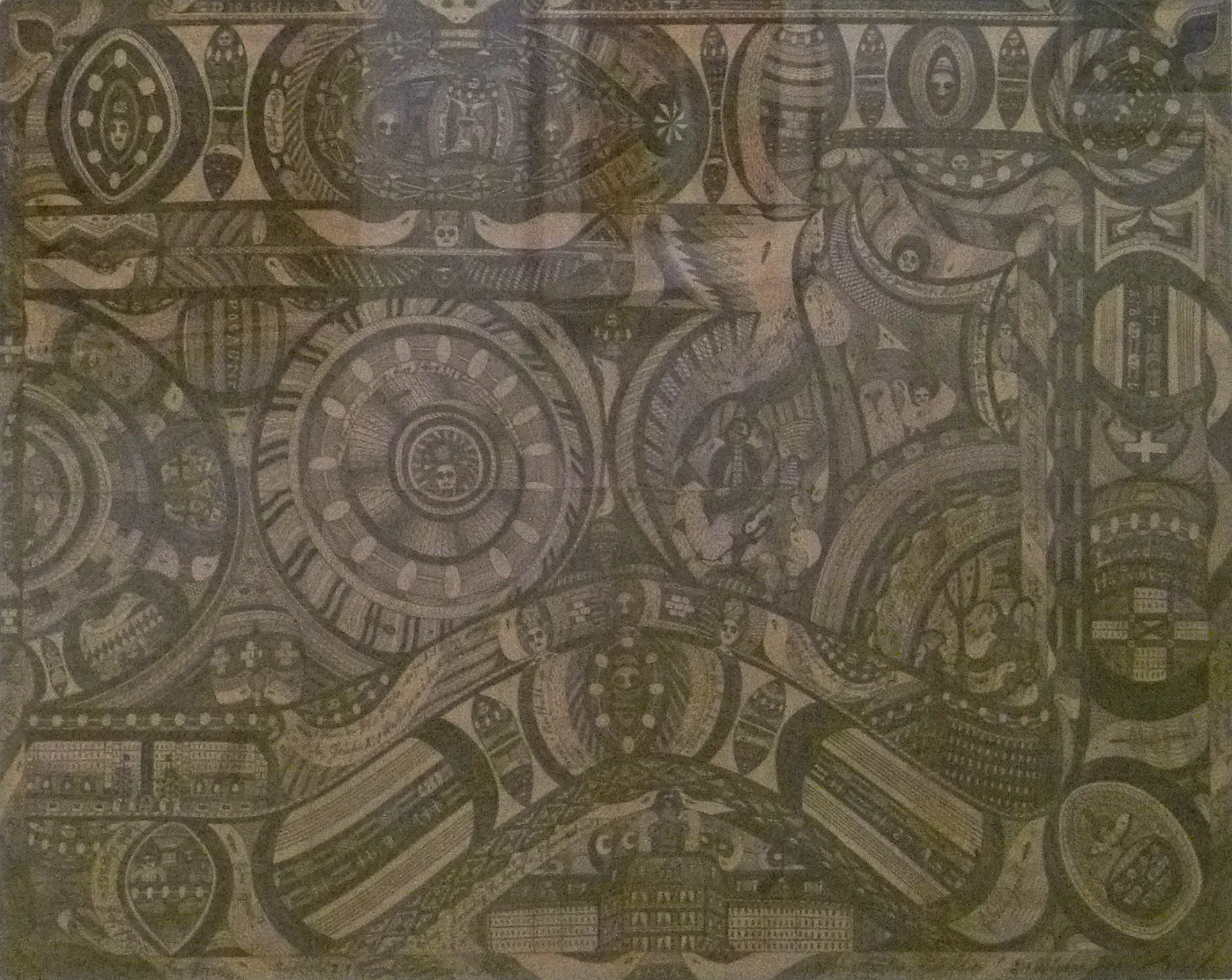
Drawing by Adolf Wölfli (Source)

Aloïse Corbaz (1886–1964) was institutionalised after unrequited love for a German chaplain during the First World War. She drew and wrote on whatever she could find (newspapers, packaging, sheets of paper), creating images of opulent feminine figures, romantic encounters, and elaborate decorative borders. Her work has been compared to manuscript illumination and to the art of schizophrenic visionaries. She had no art training; she made because she had to.
The relationship between psychosis and creativity remains contested. Art Brut does not require a psychiatric diagnosis; many outsider artists have no such history. But the early collection did include work from asylums, and Dubuffet was interested in states of mind that bypassed rational control. Practitioners who work with trance, spirit contact, or automatic creation may find parallels: the idea that compelling imagery can emerge when ordinary consciousness is relaxed or displaced.
Henry Darger, Joseph Yoakum, and American Outsiders
Henry Darger (1892–1973) lived as a recluse in Chicago, working as a hospital janitor. After his death, his landlords discovered a vast body of work: a 15,000-page novel, The Story of the Vivian Girls, and hundreds of drawings and watercolours. The images show young girls in idyllic landscapes, often in peril from grotesque soldiers; Darger had traced figures from colouring books and comics, collaging them into elaborate battle scenes. The work is disturbing, obsessive, and visually striking. Darger had no audience; he made for himself alone.
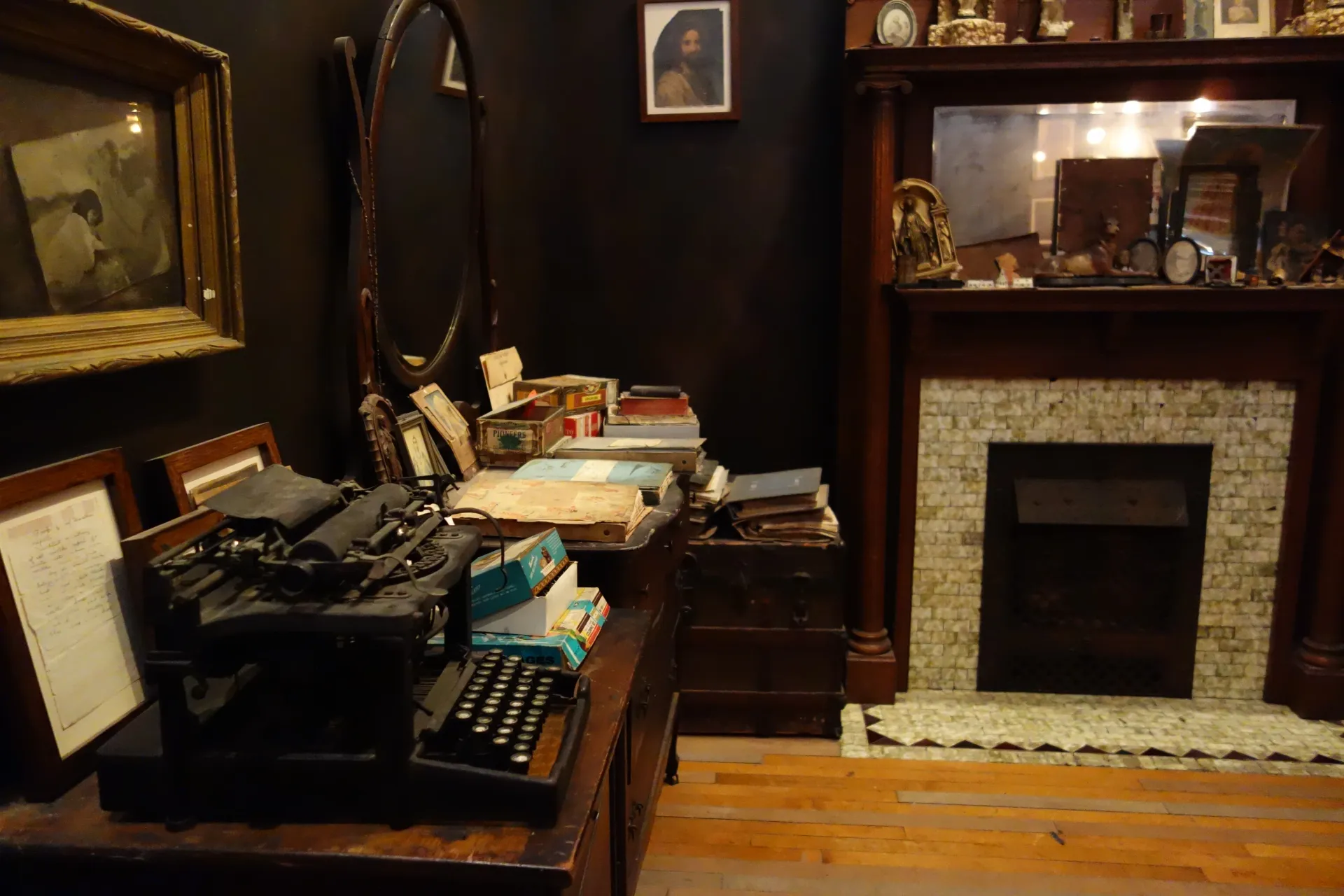
Henry Darger Room at the Intuit Art Museum, Chicago (Source)

Joseph Yoakum (1890–1972) claimed to have travelled the world as a circus worker; he drew "memory" landscapes of places real and imagined. His work was discovered late in his life and shown in Chicago alongside that of the Hairy Who and other Chicago Imagists. Yoakum's swirling, organic forms and invented geography fit the Outsider Art category. He was self-taught, elderly, and outside the art world, but his work also connected to Surrealist landscape and to a longer tradition of visionary geography.
Madge Gill, Augustin Lesage, and Mediumistic Art
Some Art Brut artists understood their work as spirit-led. Madge Gill (1882–1961) was an Englishwoman who began drawing after a series of spiritualist experiences. She claimed to work under the guidance of "Myrninerest," a spirit who directed her hand. Her drawings, dense webs of ink with repeated female faces, were produced in trance-like states, sometimes at night by lamplight. She never sold her work; she gave it away or hid it.
Augustin Lesage (1876–1954) was a French coal miner who began making art after hearing voices that told him he would become a painter. His large, symmetrical canvases are filled with architectural and ornamental motifs, suggesting temples, palaces, or metaphysical diagrams. He saw himself as a medium; the imagery came through him rather than from him. The overlap with Spiritualist and mediumistic traditions is direct: Art Brut and spirit art have often converged.
Scottie Wilson (1888–1972) was a Scottish-Canadian self-taught artist who drew dense, patterned works filled with birds, animals, and faces. He sold his work on the street before being "discovered" by dealers; he resented the art world's categorisation of him as a primitive. His case illustrates the dilemma: recognition brought money and attention, but it also reframed his work in terms he did not choose. The tension between preserving Art Brut's outsider status and giving its makers the recognition they deserve has never been fully resolved.
The Collection de l'Art Brut Today
The Collection de l'Art Brut in Lausanne holds over 70,000 works by more than 1,100 artists. The collection continues to acquire new work; the definition of Art Brut has expanded to include self-taught artists from diverse contexts. The museum's approach has evolved; it now foregrounds the artists' biographies and voices where possible, rather than reducing them to diagnostic categories. Visitors can encounter Wölfli's cosmology, Corbaz's romantic visions, and hundreds of other makers who created outside the art world. The building itself, renovated and expanded, has become a pilgrimage site for anyone interested in raw vision.
The Tension of "Discovery"
When outsider artists are "discovered" (shown in galleries, written about, sold), they cease to be purely outside. The market, the critic, and the curator all reshape the work's meaning. Some artists have welcomed recognition; others have been indifferent or distressed. The category "Outsider Art" can dignify marginalised makers, but it can also exoticise or consume them. The best approach may be to attend to the work itself: its materials, its obsessions, its visual logic. Whether the maker was "inside" or "outside" matters less than what the work does.
For practitioners who create without formal training, or who use art as part of spirit work or magical practice, Art Brut suggests that compelling creation need not pass through the academy. The raw, the obsessive, the apparently naive can carry force. The question is not whether such work is "art"—that gatekeeping has largely collapsed—but what it communicates and how it might inform one's own practice. Art Brut reminds us that compelling vision can emerge from anywhere: a hospital ward, a prison cell, a cramped apartment. The conditions of making matter less than the act of making itself.
Related Resources
- Surrealism – Shared interest in automatism and the irrational
- Naive Art – Another category of self-taught, non-academic work
- Symbolism – Visionary and spiritual themes in art
- Introduction to Art History
Related in this topic
More from Occult Art History & Symbolism — Start Here.
Symbolism
Discover the meaning of symbolism! Learn its origins, art and famous symbolist painters. Find hidden emotions in art.
Naïve Art
Naïve art: untrained artists created startling originality through simplified forms, vivid colors, and unfiltered imagination.
Art Informel
Art Informel: the European parallel to Abstract Expressionism. Dubuffet, Tàpies, and the art of the unformed and the raw.
Street Art
Street Art: from subway tags to gallery walls. Banksy, Keith Haring, and the art that reclaims public space.
You Might Also Like
Art Informel
Art Informel: the European parallel to Abstract Expressionism. Dubuffet, Tàpies, and the art of the unformed and the raw.
Street Art
Street Art: from subway tags to gallery walls. Banksy, Keith Haring, and the art that reclaims public space.