Period: 1907 – 1920s
Characteristics: Multiple viewpoints; fragmentation of form; geometric analysis of space; rejection of single-point perspective
Events: Picasso completes Les Demoiselles d'Avignon (1907), Publication of Du "Cubisme" by Gleizes and Metzinger (1912), Introduction of collage (1912)
A New Vision: Seeing Through Multiple Eyes
Cubism revolutionised Western art by rejecting the Renaissance tradition of depicting space from a single viewpoint. Instead of showing objects as they would appear from one position, Cubist painters represented them from multiple angles simultaneously, as if the viewer could see front, side, and back at once. The result was a radical fracturing of form that challenged centuries of pictorial convention.
The movement was pioneered by Pablo Picasso and Georges Braque, who worked in close dialogue from 1908 until Braque left for war in 1914. Their innovations (analytic Cubism's fragmented, muted forms and synthetic Cubism's introduction of collage and brighter colour) opened new possibilities for how painting could represent reality, or construct new realities altogether.
The poet and critic Guillaume Apollinaire became Cubism's chief advocate, writing essays that helped the public, and the artists themselves, understand what they were doing. His 1913 book Les Peintres cubistes framed the movement as a revolution in vision. Gertrude Stein's experimental prose, with its fractured syntax and repetition, ran parallel to Cubist procedure; she collected Picasso and Braque and wrote about them. Practitioners interested in non-ordinary perception, multiplicity of perspective, or the deconstruction of conventional ways of seeing will find Cubism useful: a visual parallel for alternative modes of consciousness.
From Cézanne to Cubism
Paul Cézanne's late work provided central inspiration. His treatment of landscape and still life as structured by underlying geometric volumes rather than optical appearance, suggested that painting could analyse form rather than merely record it. A 1907 Cézanne retrospective in Paris confirmed this direction for Picasso and Braque. The older artist's practice of building form from discrete planes and his disregard for conventional perspective gave the younger painters permission to break the rules more radically. Cézanne had written that nature could be reduced to the cylinder, the sphere, and the cone; the Cubists took that claim literally and pushed it further than Cézanne had dared.
Picasso's Les Demoiselles d'Avignon (1907) marks the movement's birth. The painting's five female nudes are rendered with fractured, angular forms; two faces on the right draw on African masks, reflecting the period's interest in so-called "primitive" art. Picasso had visited the ethnographic museum at the Trocadéro in Paris, where he encountered African and Oceanic sculpture. The impact was immediate: he reworked the right side of the canvas to incorporate the mask-like faces. The work shocked even Picasso's closest associates. Braque reportedly said that looking at it was like "drinking petrol and spitting fire." But it established a new pictorial language that would dominate avant-garde painting for the next decade.
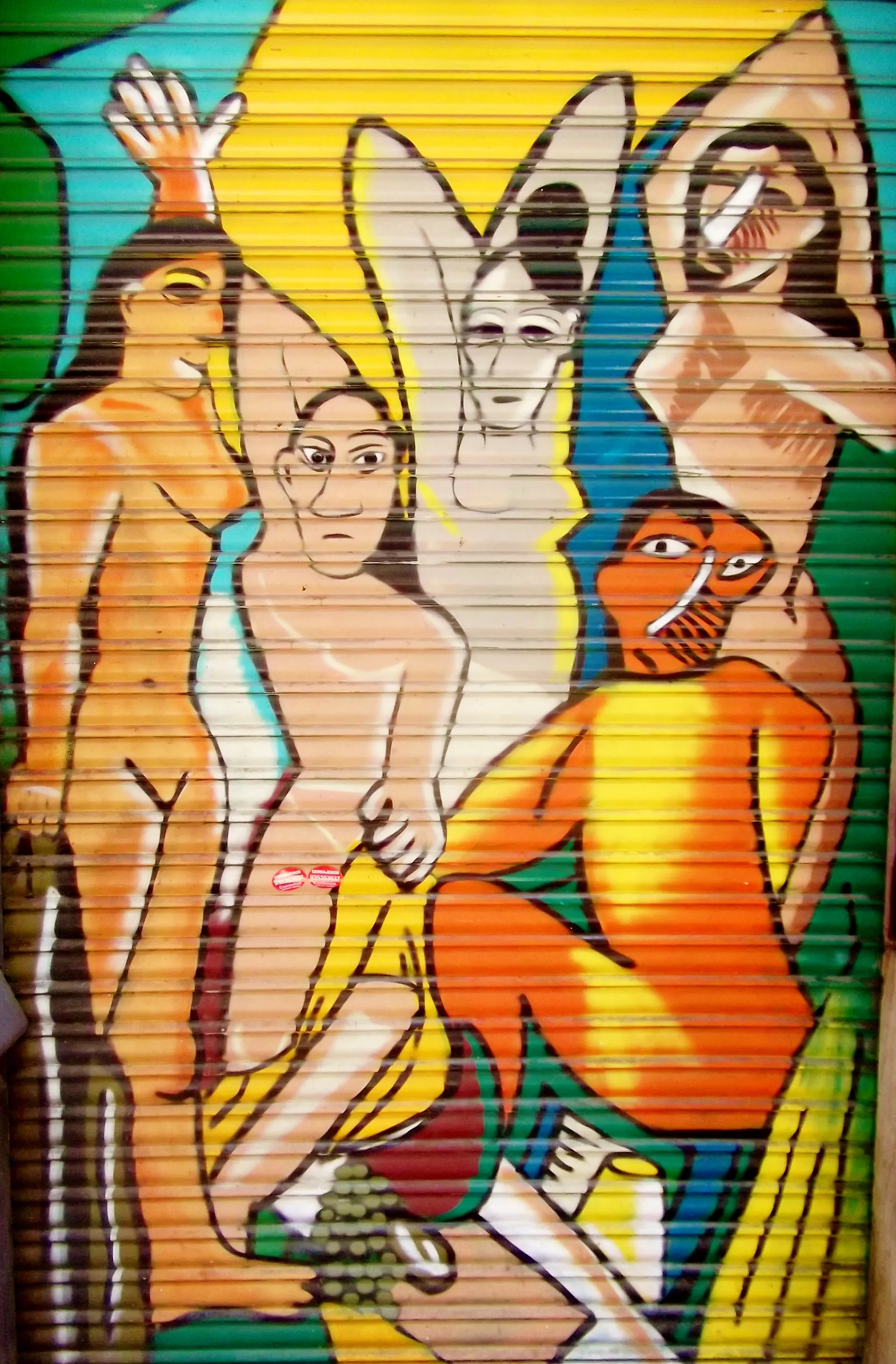
Les Demoiselles d'Avignon by Pablo Picasso, 1907 (Source)
.jpg)
Picasso and Braque: The Partnership
Picasso (1881–1973) and Braque (1882–1963) developed Cubism in near-tandem, sometimes producing works so similar that experts struggle to attribute them. Both had passed through Fauvism; Braque exhibited with the Fauves in 1905. They turned toward structure over colour. Their analytic phase (roughly 1908–1912) reduced subjects to geometric facets in muted browns, greys, and greens. They analysed objects (still lifes, figures, landscapes) into overlapping planes that suggested multiple viewpoints. The canvas became a field of intersecting angles rather than a window onto a coherent space.
Synthetic Cubism (from 1912 onward) introduced collage: newspaper, wallpaper, and other materials were pasted onto the canvas alongside painted areas. The technique blurred the boundary between representation and reality, between art and everyday materials. Braque's papiers collés and Picasso's Still Life with Chair Caning (1912), which used actual oilcloth printed with a cane pattern, defined this phase. The inclusion of found materials challenged the definition of painting itself. A fragment of newspaper could refer to current events (many Cubist collages include headlines from the Balkan Wars) while also functioning as texture and shape. The real world entered the picture not as subject matter but as stuff.
Analytic and Synthetic Phases
Analytic Cubism reduced the palette to near-monochrome so that form, not colour, carried the meaning. Figures and objects dissolved into facets and planes; the picture surface became a dense web of overlapping shapes. Viewers had to work to reconstruct a guitar, a bottle, or a face from the fragments. The effect could be disorienting, but also intellectually stimulating, like a kind of visual puzzle.
Synthetic Cubism reintroduced colour and texture through collage. Cut-out letters, newspaper fragments, and patterned paper brought the real world onto the canvas in literal form. The technique raised questions about authenticity, authorship, and the nature of representation that would preoccupy artists for decades. Picasso and Braque did not invent these questions, but they gave them vivid visual form.
Juan Gris (1887–1927), a Spanish painter who joined the Cubist circle in Paris, developed a more systematic approach to synthetic Cubism. His still lifes often began with newspaper or wallpaper as the base, with painted elements completing the composition. Gris wrote that he preferred to work from the general to the particular ("from a cylinder to the object that is a cylinder"), inverting the traditional method of building a picture from observed details. His work helped codify Cubist procedure even as the movement was already fragmenting.
Fernand Léger developed a variant sometimes called "tubism" for its emphasis on cylindrical and tubular forms. His The City (1919) applied Cubist fragmentation to the urban landscape, creating a kaleidoscopic vision of the modern metropolis. Léger's work was more colourful and more legible than analytic Cubism; it helped spread Cubist ideas to a wider audience and influenced both mural painting and design. His experience in the trenches during the First World War (he was gassed at Verdun) affected his vision of modern life. The machine, the city, and the mechanical rhythms of industrial society became his subjects, rendered in a Cubist idiom that was more celebratory than analytical.
Robert Delaunay and Orphic Cubism
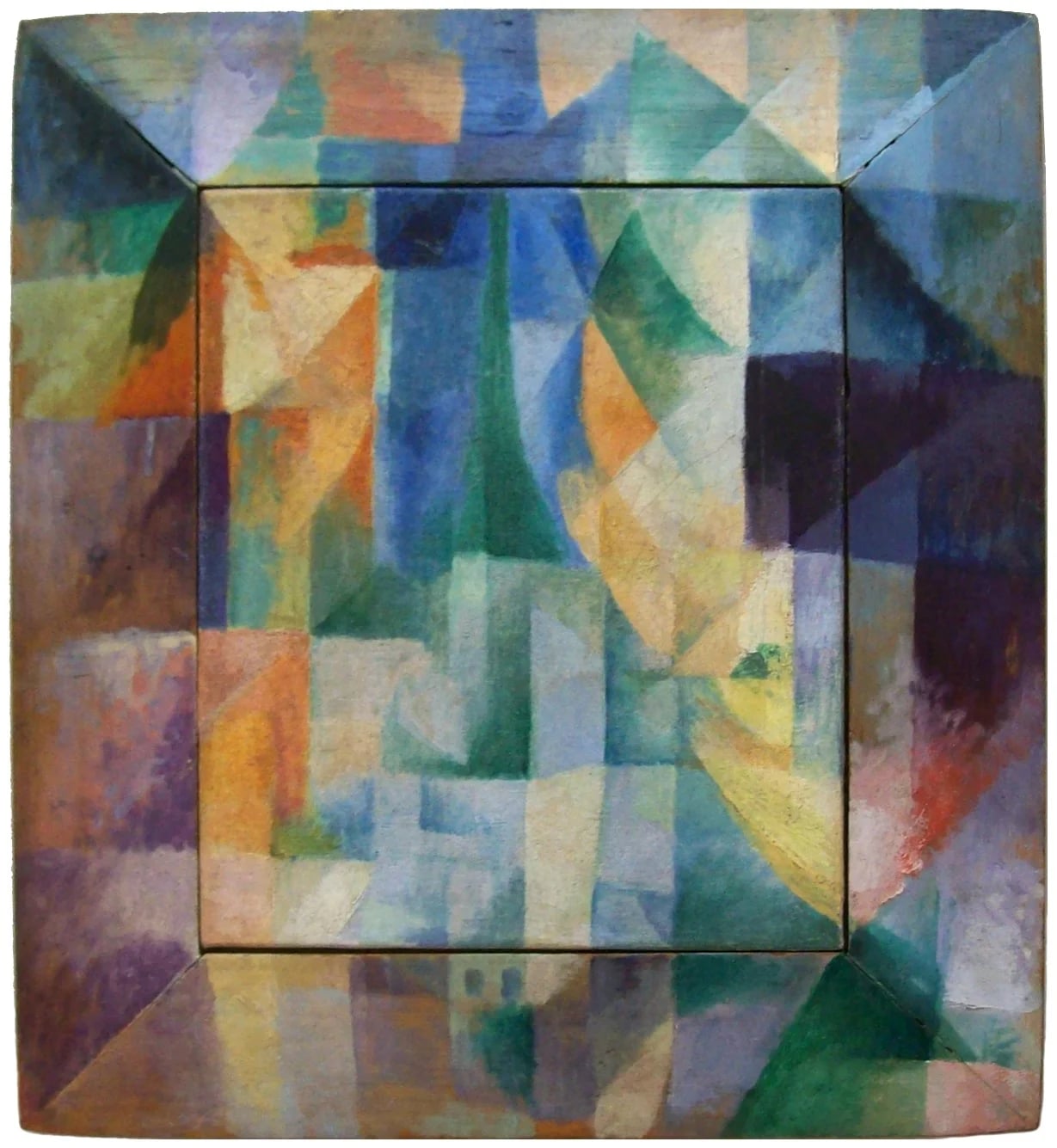
Robert Delaunay (1885–1941) developed a variant often called Orphic Cubism or Orphism, named by poet Guillaume Apollinaire after Orpheus, the mythic musician. Delaunay's work emphasised colour and light over geometric analysis. His Simultaneous Windows series (1912) broke the picture into prismatic fragments of colour, suggesting the experience of looking through a window at a sunlit city, multiple perceptions merged into a single visual field.
Delaunay's interest in the optical and spiritual effects of colour connected Cubism to both scientific colour theory and the era's occult interests. The "simultaneous" in his titles suggested a collapse of sequential perception into a unified, transcendent moment. His wife Sonia Delaunay extended these ideas into fashion and textile design, bringing Cubist geometry to wearable form. She designed fabrics, clothes, and even cars in geometric patterns; her 1925 Citroën B12 "art car" was painted in a bold abstract design. The Delaunays' work showed that Cubist principles could extend far beyond the canvas.
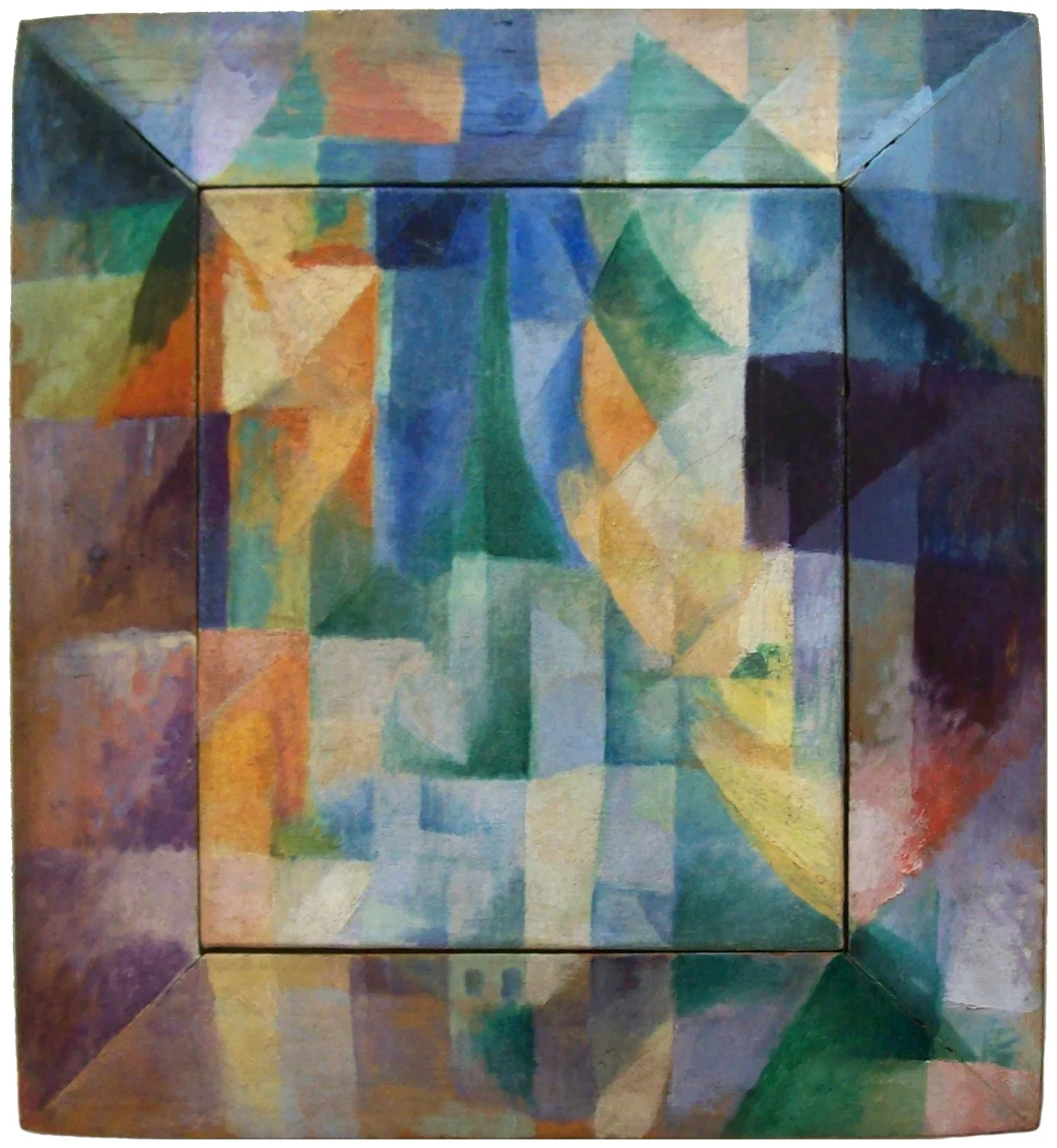
Simultaneous Windows on the City by Robert Delaunay, 1912 (Source)
,_40_x_46_cm,_Kunsthalle_Hamburg.jpg)
Legacy: Fragmentation as Freedom
Cubism's influence extended far beyond painting. It affected sculpture (Picasso, Jacques Lipchitz, Henri Laurens), architecture (Czech Rondocubism), and design. Picasso's constructed sculptures of 1912–14 (guitars and absinthe glasses made from sheet metal, wire, and other materials) extended the collage principle into three dimensions. Lipchitz and Laurens translated Cubist fragmentation into bronze and stone. In Prague, architects adapted Cubist facets to building facades, creating a national variant that lasted into the 1920s. The movement's fragmentation of form prefigured the disjointed experience of modern life and the multiplication of perspectives in a globalised, media-saturated world.
The First World War scattered the Cubist circle. Braque was wounded; others were mobilised. After the war, both Picasso and Braque moved in new directions; the intense partnership was over. Picasso turned toward a more classical, figurative style in the 1920s, though he would return to Cubist devices throughout his career. Braque developed a gentler, more decorative manner. But Cubism had already done its work. It had dismantled the Renaissance picture and reassembled it according to new rules.Every subsequent modernist movement had to reckon with its legacy, from Dada and Surrealism to the geometric abstraction of the post-war period. The critic Clement Greenberg would later argue that Cubism had initiated the modernist drive toward flatness and self-reference; painters as different as Jackson Pollock and Bridget Riley acknowledged the debt.
The movement's assertion that reality could be represented or constructed in ways that exceeded single-point perspective has a visual parallel in the idea that consciousness itself might encompass multiple viewpoints, or that the ordinary world might be one frame among many. For those who work with trance, meditation, or expanded states of awareness, Cubism provides a historical precedent for art that breaks habitual ways of seeing.
Related Resources
- Post-Impressionism – Cézanne and the roots of Cubism
- Fauvism – Braque's earlier Fauve period
- Art Deco – The style that absorbed Cubist geometry
- Introduction to Art History
Related in this topic
More from Occult Art History & Symbolism — Start Here.
Symbolism
Discover the meaning of symbolism! Learn its origins, art and famous symbolist painters. Find hidden emotions in art.
Naïve Art
Naïve art: untrained artists created startling originality through simplified forms, vivid colors, and unfiltered imagination.
Art Informel
Art Informel: the European parallel to Abstract Expressionism. Dubuffet, Tàpies, and the art of the unformed and the raw.
Street Art
Street Art: from subway tags to gallery walls. Banksy, Keith Haring, and the art that reclaims public space.
You Might Also Like
Art Informel
Art Informel: the European parallel to Abstract Expressionism. Dubuffet, Tàpies, and the art of the unformed and the raw.
Street Art
Street Art: from subway tags to gallery walls. Banksy, Keith Haring, and the art that reclaims public space.