Period: 1904 – 1910
Characteristics: Bold, non-naturalistic color; expressive brushwork; simplified form; rejection of Impressionist refinement
Events: Salon d'Automne (1905) where the term "fauves" was coined, Death of Cézanne (1906), Rise of Cubism (1907)
The Wild Beasts: Color Unleashed
Fauvism burst onto the Paris art scene in 1905 with an explosion of color that critics found shocking and incomprehensible. At the Salon d'Automne that year, a room of paintings by Henri Matisse, André Derain, Maurice de Vlaminck, and others so startled viewers that critic Louis Vauxcelles compared the artists to "fauves" (wild beasts). The intended insult became the movement's name.
For barely six years, the Fauves produced some of the most audacious paintings of the early 20th century. Rejecting both the subtle optical effects of Impressionism and the symbolic obscurity of Symbolism, they embraced color as an emotional and expressive force in its own right. The sky could be orange, a face could be green, and a tree could be red: not because the artists lacked skill, but because they deliberately subordinated natural appearance to emotional and aesthetic truth. They painted in the south of France and in London, seeking light that would justify their palettes. The Mediterranean sun at Collioure and the Thames fog gave them different excuses for intensity.
Origins: Beyond Impressionism
Fauvism grew from the innovations of Post-Impressionism. Van Gogh's emotional intensity, Gauguin's flat planes of symbolic color, and Cézanne's structural rigor all informed the Fauve approach. Matisse had studied with Gustave Moreau, whose Symbolist leanings encouraged individuality and expression over academic convention. When Matisse and Derain spent the summer of 1905 in Collioure on the Mediterranean coast, they developed a shared approach: pure color applied with bold, sometimes crude brushwork, capturing the intensity of light and the emotion of the moment.
The Fauves had no manifesto and no formal organization. They were united by a sensibility rather than a program, a willingness to let color carry meaning, to simplify form for expressive effect, and to reject the polished finish expected by the Salon. The Salon d'Automne itself was a relatively new institution, founded in 1903 as an alternative to the conservative spring Salon. It gave younger artists a place to exhibit; the 1905 show where the Fauves earned their name was in Room VII, which critics quickly dubbed the cage aux fauves, the cage of wild beasts. A classical sculpture stood in the centre of the room, which may have sharpened the contrast between academic tradition and the Fauves' assault on convention. The juxtaposition was unintentional but telling.
Matisse's Woman with a Hat: The Scandal of 1905
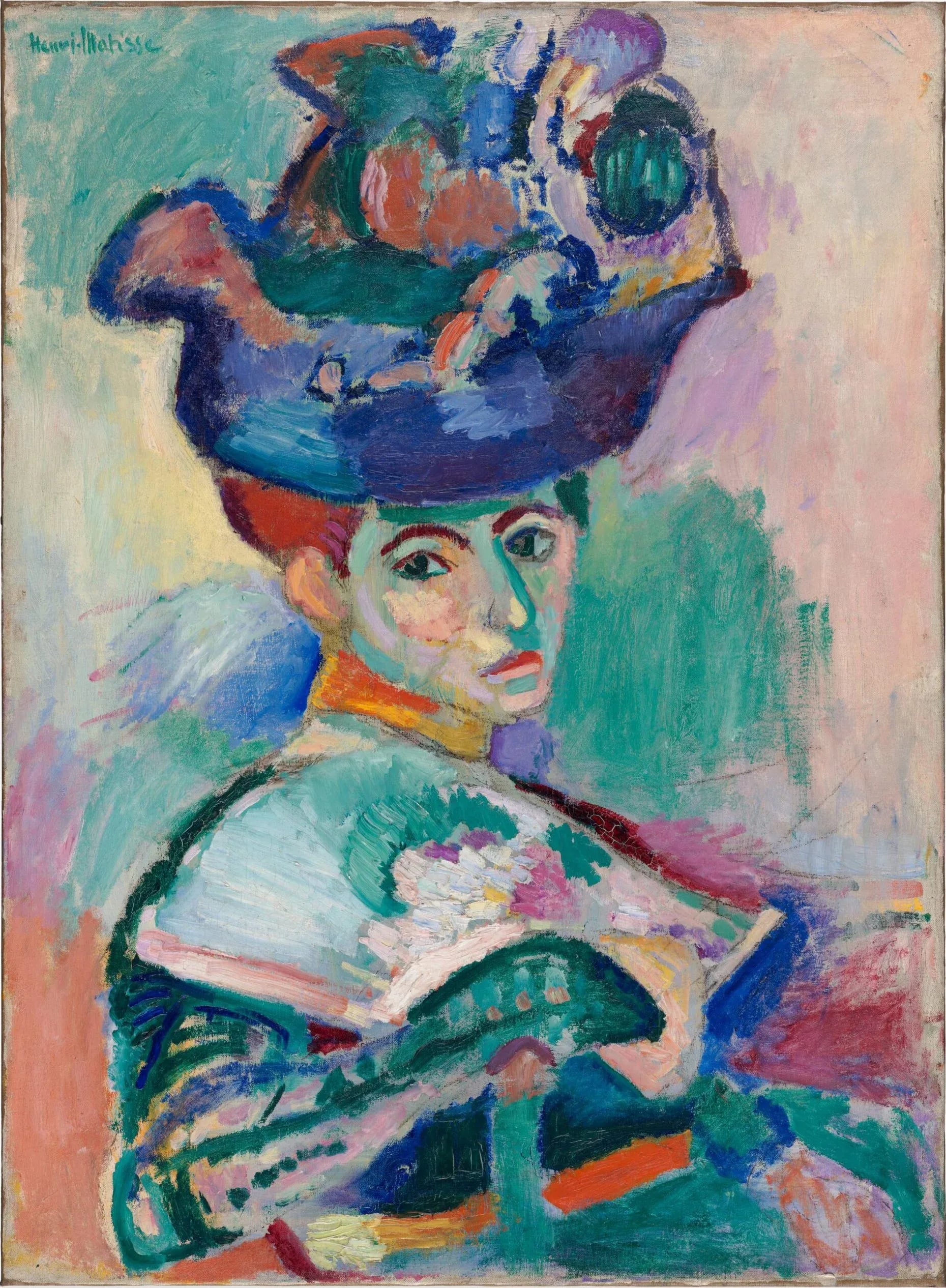
Henri Matisse's Woman with a Hat (1905) became the emblematic Fauve painting. Depicting his wife Amélie in an elaborate hat and dress, the work shocked viewers with its strident, apparently arbitrary color. Greens, blues, purples, and oranges appear where convention demanded naturalistic flesh tones and fabric colors. The brushwork is visible and vigorous, the surface seemingly unfinished.
When Gertrude Stein and her brother Leo purchased the painting (despite widespread derision), they gave Matisse decisive support and established his reputation among avant-garde collectors. The Steins' salon at 27 rue de Fleurus became a meeting place for artists and writers; Picasso, Braque, and others passed through. The Steins' patronage helped sustain Matisse through the movement's brief lifespan and beyond. Leo Stein later wrote that he had hesitated at the price but that the painting "had a quality of life that made it important." The acquisition marked a turning point: modernism had found its first major American collectors.
The painting's power lies in its refusal to subordinate color to description. Matisse reportedly said that when asked what color the dress had been in reality, he replied "Black, of course." The vivid hues were entirely expressive, a declaration that painting could create its own reality rather than merely record the visible world.
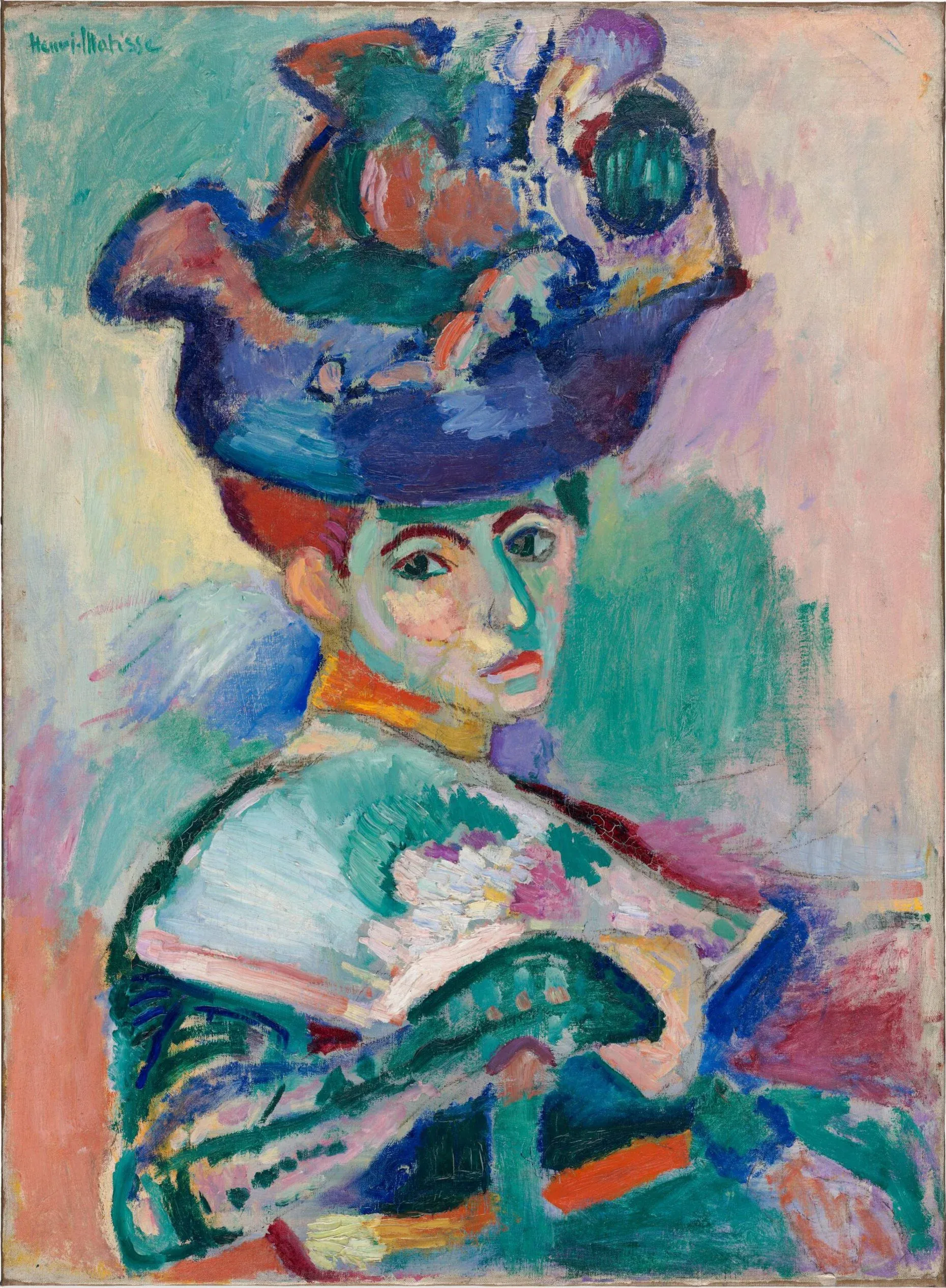
Woman with a Hat by Henri Matisse, 1905 (Source)

Henri Matisse: The Relentless Colorist
Matisse (1869–1954) outlived Fauvism by nearly five decades and never abandoned his commitment to color. After the Fauve period, he moved through phases of increasing simplification. The so-called "wild" Matisse of 1905–1907 gave way to more ordered compositions, but color always remained primary. His odalisques, interiors, and late cut-outs continued to treat color as an independent force, not a servant to description.
The Red Studio (1911) shows how far Matisse had developed: a single room flooded with red, with paintings and furniture indicated by contours alone. The effect is both radical and harmonious.
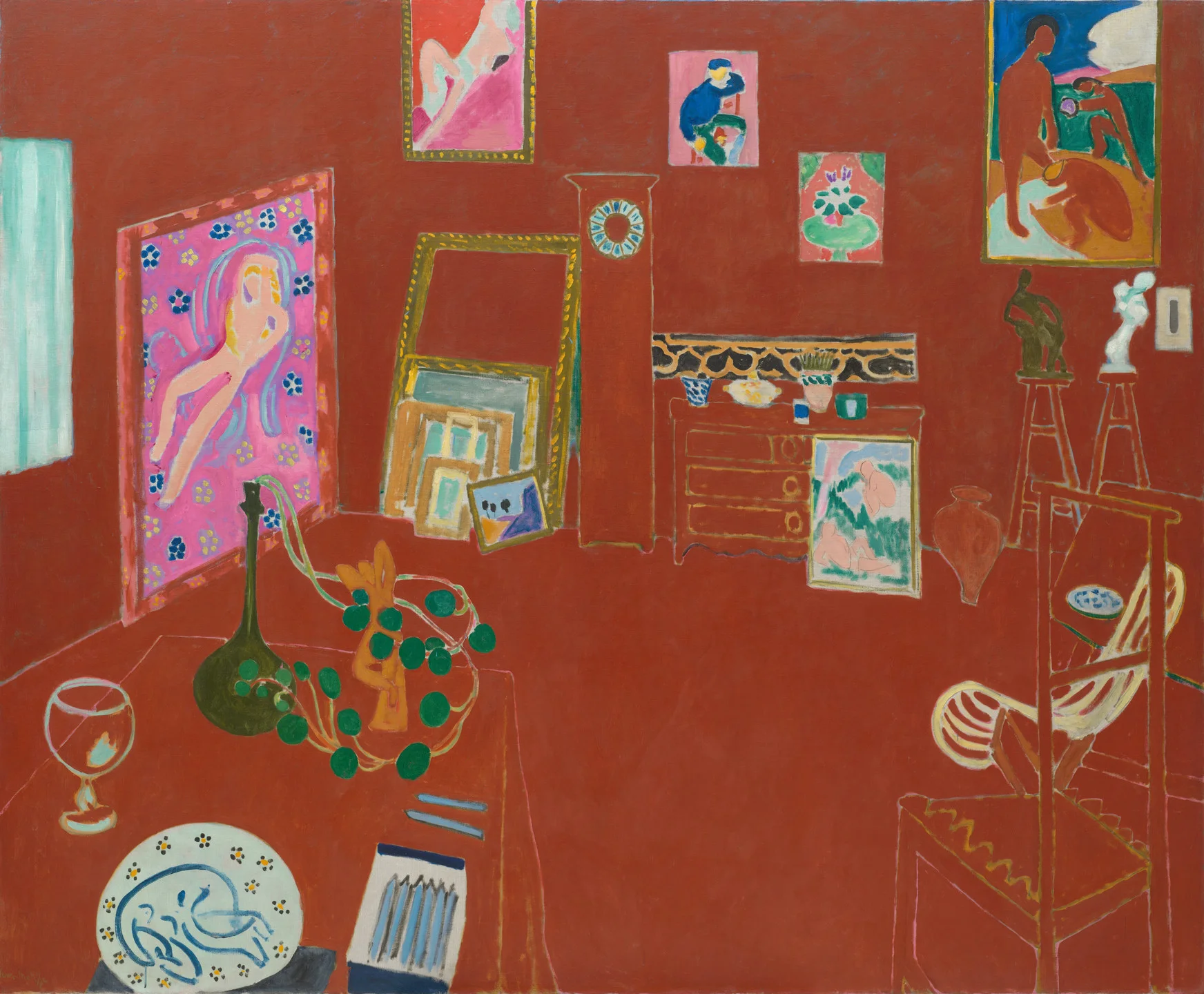
The Red Studio by Henri Matisse, 1911 (Source)

Matisse spent his career arguing that art should be "like a good armchair"—a place of rest and pleasure—but his means were never complacent. He pushed color relationships to the edge of discord and back, creating works that feel inevitable in hindsight but required immense nerve to paint.
In his later years, confined to a wheelchair after surgery, Matisse turned to cut-outs. Using scissors and coloured paper, he created compositions that distilled his lifelong concern with colour and form into their simplest elements. The Jazz series (1943–47) and the designs for the Chapelle du Rosaire in Vence (1948–51) showed that the Fauve spirit could adapt to new media and new constraints. "Only what I created after the illness constitutes my real self," he said.
The Fauve Circle
André Derain (1880–1954) worked alongside Matisse at Collioure and in London, producing landscapes and portraits in similarly intense palettes. His views of the Thames and Westminster Bridge transform the city into blocks of pure color. Derain would later turn toward a more classical, subdued style, a move that some saw as a betrayal of his Fauve daring. Maurice de Vlaminck (1876–1958), more impulsive and less theoretical than Matisse, produced landscapes of raw emotional power. He claimed never to have set foot in the Louvre; he wanted no contamination from the past. Raoul Dufy, Georges Braque (before his Cubist turn), and Kees van Dongen also exhibited with the group.
The Fauves differed in temperament: Matisse sought harmony and decorativeness even within bold color; Vlaminck embraced a more savage, anti-intellectual stance. But they shared a commitment to color as the primary vehicle of expression. Raoul Dufy (1877–1953) brought a lighter touch; his scenes of regattas, racecourses, and the French Riviera used Fauve colour for pleasure rather than provocation. Kees van Dongen (1877–1968) applied the Fauve palette to portraiture and nightlife, often with a satirical or decadent edge. His portraits of Parisian socialites and performers showed that bold colour could serve fashion and society painting as well as landscape.
From Fauvism to Abstraction
Fauvism was short-lived. By 1908, most of its practitioners had moved on. Braque turned toward Cubism after his 1907 encounter with Picasso's Les Demoiselles d'Avignon. Derain adopted a more classical approach that some contemporaries saw as a retreat from his earlier daring. Matisse alone sustained and developed the Fauve sensibility throughout his long career, refining bold color into increasingly sophisticated harmonies that would influence later movements from Abstract Expressionism to Color Field painting.
The critic who coined the term "Fauves" did not mean it as a compliment. But the artists accepted it, and the name stuck. In doing so, they reclaimed an insult, much as the Impressionists had done decades earlier.
Fauvism's impact on colour theory extended beyond painting. Designers and architects took note of the Fauves' willingness to use colour boldly. The Bauhaus, despite its later preference for primary colours and geometric form, inherited something of the Fauve spirit, the idea that colour could be deployed for effect rather than imitation. Interior designers in the 1920s and 30s often cited Fauvism as a precedent for using strong colour in domestic spaces. The movement's legacy is visible wherever colour is used for mood rather than mimesis: in film, fashion, and graphic design as well as in painting. Matisse's The Dance (1909–10), a mural-sized painting of nude figures in a circle against flat bands of blue and green, showed how far Fauve simplification could go. The work was commissioned by Russian collector Sergei Shchukin for his Moscow home. Its radical simplification of the human form and its ecstatic use of colour would influence generations of artists. The Fauve legacy lies in its assertion that color need not describe; it can express, transform, and create meaning. Practitioners of color magic or those who work with correspondences between hues and spiritual states will find Fauvism a historical precedent: painters who treated color as a carrier of emotional and symbolic power, independent of natural appearance.
Related Resources
- Post-Impressionism – The movement that preceded Fauvism
- Expressionism – The German response to emotional intensity in art
- Cubism – The movement that followed, with Braque's participation
- Introduction to Art History
Related in this topic
More from Occult Art History & Symbolism — Start Here.
Symbolism
Discover the meaning of symbolism! Learn its origins, art and famous symbolist painters. Find hidden emotions in art.
Naïve Art
Naïve art: untrained artists created startling originality through simplified forms, vivid colors, and unfiltered imagination.
Art Informel
Art Informel: the European parallel to Abstract Expressionism. Dubuffet, Tàpies, and the art of the unformed and the raw.
Street Art
Street Art: from subway tags to gallery walls. Banksy, Keith Haring, and the art that reclaims public space.
You Might Also Like
Art Informel
Art Informel: the European parallel to Abstract Expressionism. Dubuffet, Tàpies, and the art of the unformed and the raw.
Street Art
Street Art: from subway tags to gallery walls. Banksy, Keith Haring, and the art that reclaims public space.