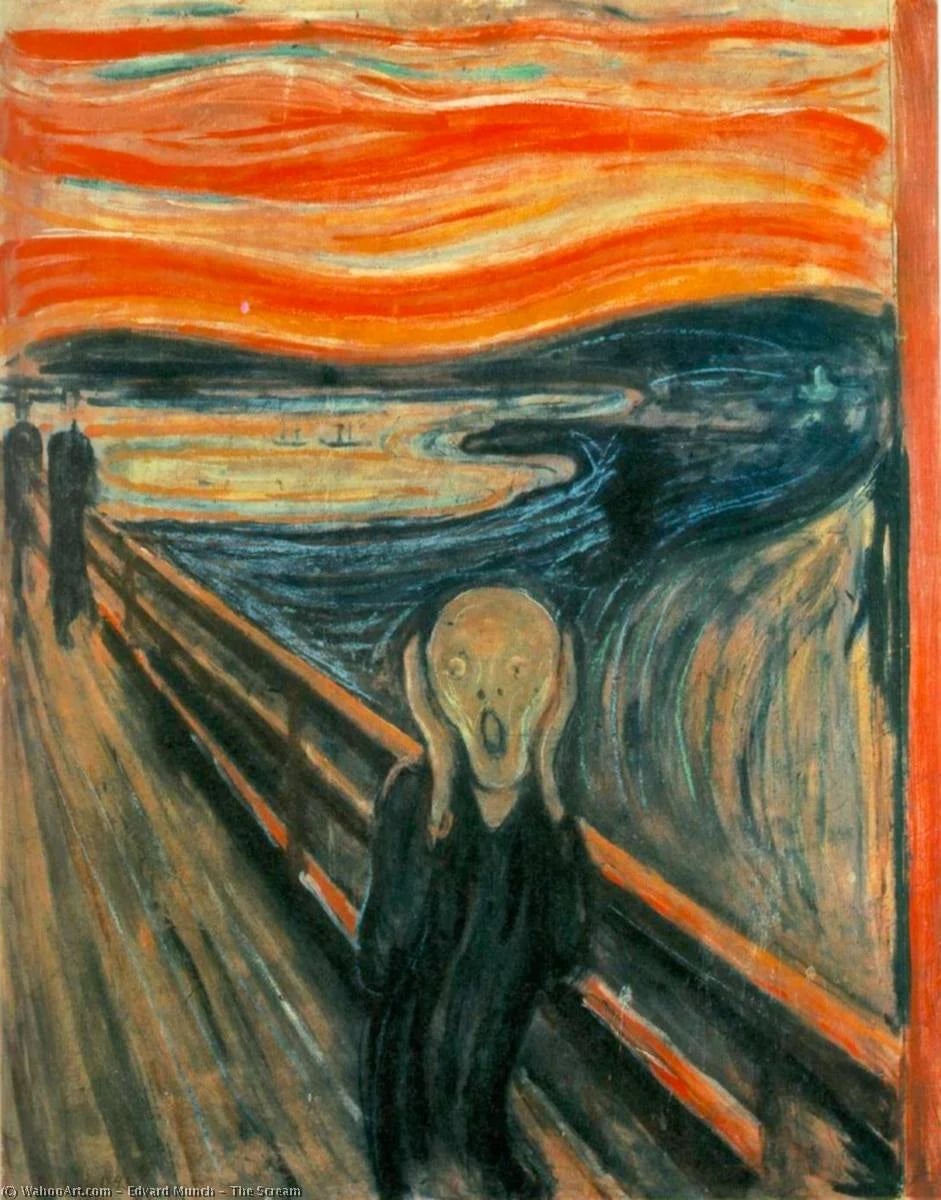
Period: 1905 – 1930s
Characteristics: Distortion of form and color for emotional effect; focus on inner experience; angst, alienation, and psychological depth
Events: Formation of Die Brücke (1905), Edvard Munch's influential exhibitions, Rise of Nazi condemnation of "degenerate art" (1930s)
The Inner Eye: Art as Emotional Truth
Expressionism emerged in early-20th-century Germany and Northern Europe as a rejection of Impressionism's optical objectivity and the decorative elegance of Art Nouveau. Where Impressionists sought to capture the external world as perceived by the eye, Expressionists sought to render the internal world (emotions, anxieties, spiritual states) through distortion, bold color, and raw brushwork.
The movement had no single origin. Edvard Munch in Norway created images of psychological intensity that would strongly influence German Expressionism. The groups Die Brücke (The Bridge) and Der Blaue Reiter (The Blue Rider) in Germany developed distinct but related approaches. What united them was the belief that art should express the artist's subjective experience rather than depict objective reality, and that formal distortion could convey psychological and emotional truth more effectively than naturalistic representation.
Expressionism also had literary and theatrical dimensions. The German playwrights Frank Wedekind and Georg Büchner, and later Bertolt Brecht, shared the movement's interest in raw emotion, social critique, and the breaking of conventional form. August Strindberg's dream plays influenced both theatre and visual art. The term "Expressionism" was first used in relation to painting around 1911, but the sensibility had been building for decades. The Norwegian painter and printmaker Edvard Munch was arguably the first true Expressionist, though he resisted the label and continued to work in his own idiom across half a century. German Expressionism, by contrast, was more clearly organised around groups and publications, with Der Blaue Reiter almanac (1912) as a kind of manifesto.
Practitioners interested in shadow work, the unconscious, or the representation of non-ordinary states of consciousness may find Expressionism useful: a visual language for making the invisible visible.
Edvard Munch and The Scream
Edvard Munch's The Scream (1893) has become one of the most iconic images in art history and one of the most recognisable expressions of existential anxiety. The figure on the bridge, face contorted in a silent cry, stands against a swirling, blood-red sky. The landscape itself seems to vibrate with the figure's anguish, as Munch described: "I felt a scream passing through nature."
Munch (1863–1944) created multiple versions in paint and pastel; at least four versions survive. The work draws on his own experience of anxiety and the broader fin-de-siècle sense of existential dislocation. Its power lies in its ability to externalise internal states, to make visible what cannot be seen, the scream that has no sound. Munch suffered from alcoholism, depression, and hallucinations; his art gave form to experiences that resist easy description.
His influence on Expressionism was decisive. His exploration of death, sexuality, anxiety, and the boundary between self and world provided a model for later Expressionists who would similarly prioritise emotional authenticity over formal beauty. The Frieze of Life cycle, a series of works on love, anxiety, and death that Munch exhibited in Berlin in 1902, caused a scandal and was shut down by the authorities, but it established his reputation among younger German artists who would form Die Brücke three years later.
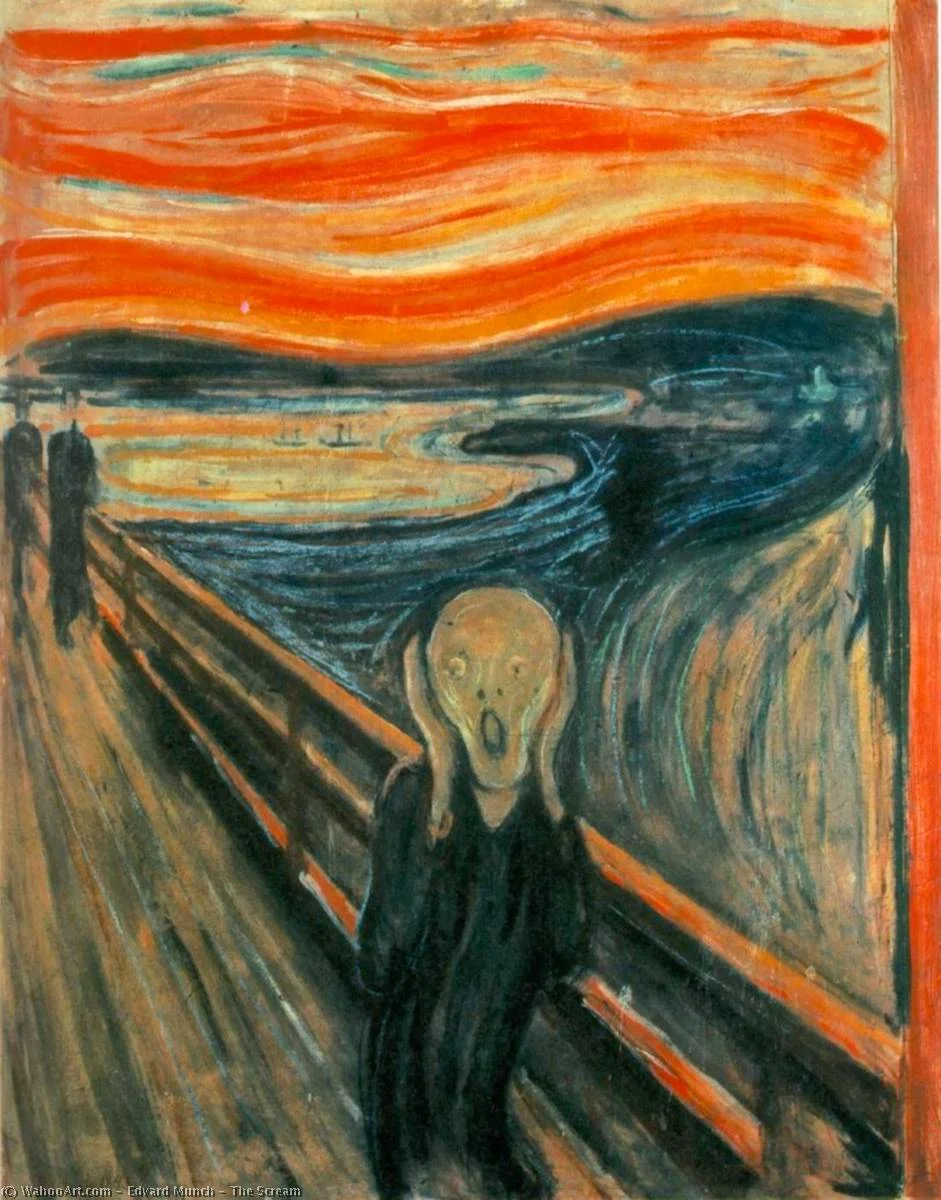
The Scream by Edvard Munch (Source)

Die Brücke: The Bridge to the Future
Founded in Dresden in 1905 by Ernst Ludwig Kirchner, Erich Heckel, Karl Schmidt-Rottluff, and Fritz Bleyl, Die Brücke took its name from the idea of building a bridge between the present and a more authentic, primitive future. The artists sought raw, unfiltered expression, drawing inspiration from African and Oceanic art, medieval woodcuts, and the work of Van Gogh and Munch.
Die Brücke artists favoured woodcut and lithography, media that allowed for bold, simplified forms and stark contrast. Their subject matter often focused on urban life, the nude, and landscapes, all rendered with angular, distorted forms and jarring color. Kirchner's street scenes of Berlin capture the alienation and frenetic energy of modern urban existence. The group published an annual portfolio of prints; members also shared a studio and sometimes models, creating a communal approach to art-making that echoed their utopian ideals.
The group disbanded in 1913, but its members continued to develop their styles; Kirchner's work grew darker and more fractured after his traumatic military service in the First World War. He was discharged after a breakdown and moved to Switzerland, where he produced some of his most powerful Alpine landscapes. Schmidt-Rottluff continued to work in a bold, graphic style; his woodcuts in particular influenced later printmakers.
Der Blaue Reiter: Spirit and Abstraction
The Blue Rider group, formed in Munich in 1911 by Wassily Kandinsky and Franz Marc, took a more spiritual and theoretical approach. The name came from Marc's love of horses and Kandinsky's of riders; blue was the colour of spirituality for both. Kandinsky (1866–1944) had trained as a lawyer before turning to art; his interest in Theosophy and the idea that color and form could convey transcendent meaning led him toward abstraction. His treatise Concerning the Spiritual in Art (1911) argued that art could access spiritual realities beyond material appearance. Kandinsky hoped that his paintings would produce "vibrations" in the viewer's soul, analogous to the effect of music.
Franz Marc (1880–1916) painted animals (blue horses, yellow cows) using color symbolically to represent spiritual qualities. For Marc, animals carried a purity and connection to nature that industrialised humanity had lost.
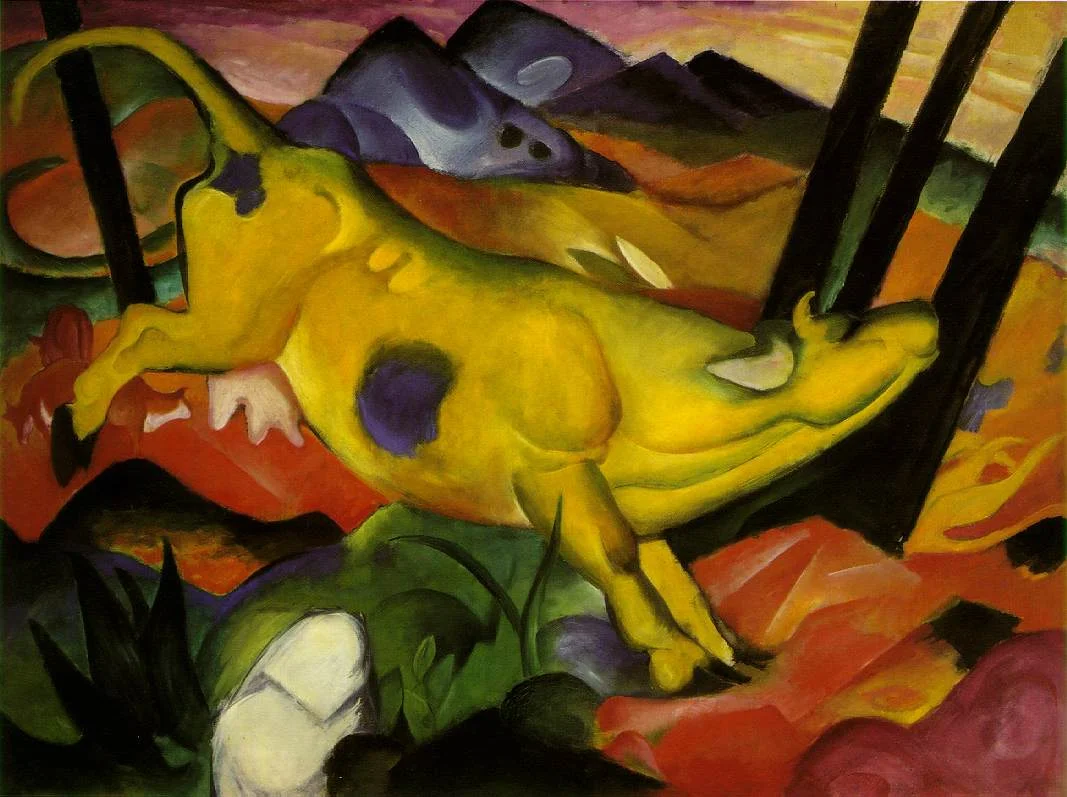
The Yellow Cow by Franz Marc, 1911 (Source)

He was killed at Verdun in 1916; his wife later learned that he had been working on abstract sketches in his pocket notebook when he died.
Egon Schiele: The Body in Crisis
Austrian artist Egon Schiele (1890–1918) developed an Expressionist idiom that focused relentlessly on the human body. His figures are often gaunt, contorted, and sexually explicit, far from classical ideals. Schiele studied briefly with Gustav Klimt but quickly developed a more aggressive, psychologically charged style. His self-portraits show him in anguished or defiant poses; his female nudes refuse the passive, decorative role assigned to the female body in much Western art. Schiele's line is wiry and nervous, tracing contours with an intensity that makes even his landscapes feel fraught.
Schiele's work was repeatedly censored and once led to a brief imprisonment on charges of immorality. He died in the 1918 influenza pandemic, three days after his pregnant wife. He was twenty-eight. His output was small but influential; later figurative expressionists from Francis Bacon to the Neo-Expressionists of the 1980s looked to his work for its unflinching treatment of bodily and psychological extremity. The Portrait of Wally (1912), one of his best-known works, was the subject of a protracted restitution case in the late 20th century, a reminder that Expressionist art often carried difficult histories in its wake.
The Legacy of Expressionism
Expressionism was condemned by the Nazi regime as "degenerate art" and many works were destroyed or sold abroad. The 1937 Entartete Kunst exhibition in Munich juxtaposed Expressionist and other modern works with images of disability and racial caricature, inviting ridicule and disgust. Kirchner committed suicide in 1938, partly in despair at the Nazi seizure of his work. Yet the movement's influence persisted. Its emphasis on subjective experience, its use of distortion for emotional effect, and its engagement with the irrational and the unconscious would carry through Surrealism, Abstract Expressionism, and contemporary art. When the Abstract Expressionists emerged in New York in the 1940s, they looked directly to the Expressionists, and to Kandinsky's abstractions in particular, as forerunners. Many German Expressionist works had been sold abroad or destroyed; some found their way to American museums and collections. The New York School painters inherited the belief that art could express the inner life directly, without the mediation of representational convention. The legacy of Expressionism continues in contemporary art that privileges psychological truth over formal prettiness. Käthe Kollwitz (1867–1945), though often classified separately, created prints and drawings that shared Expressionism's emotional intensity. Her images of war, poverty, and maternal grief used stark black-and-white and distorted form to communicate suffering. Her work was also condemned by the Nazis and removed from German museums. She represents the movement's social conscience, its willingness to engage with the darkest aspects of human experience without softening or aestheticising them.
Those who work with trance, vision, or altered states may find Expressionism a useful precedent: art that gives form to experiences that resist conventional representation. The distorted faces, unnatural color, and raw brushwork are not mistakes; they are the point. Expressionism asked what it would mean to paint not what the eye sees, but what the psyche feels.
Related Resources
- Symbolism – Precursor to Expressionist interest in the unconscious
- Fauvism – Contemporary use of bold, non-naturalistic color
- Witchcraft in Art – Supernatural and occult themes in visual art
- Introduction to Art History
Related in this topic
More from Occult Art History & Symbolism — Start Here.
Symbolism
Discover the meaning of symbolism! Learn its origins, art and famous symbolist painters. Find hidden emotions in art.
Naïve Art
Naïve art: untrained artists created startling originality through simplified forms, vivid colors, and unfiltered imagination.
Art Informel
Art Informel: the European parallel to Abstract Expressionism. Dubuffet, Tàpies, and the art of the unformed and the raw.
Street Art
Street Art: from subway tags to gallery walls. Banksy, Keith Haring, and the art that reclaims public space.
You Might Also Like
Art Informel
Art Informel: the European parallel to Abstract Expressionism. Dubuffet, Tàpies, and the art of the unformed and the raw.
Street Art
Street Art: from subway tags to gallery walls. Banksy, Keith Haring, and the art that reclaims public space.