Period: 1884 to mid-1890s
Characteristics: Divisionism (separate dots or strokes of pure colour); optical mixing; scientific approach to colour; structured composition; interest in modern life
Events: Seurat exhibits A Sunday on La Grande Jatte (1886); Signac's From Delacroix to Neo-Impressionism (1899)
Science and the Dot
Neo-Impressionism emerged in Paris in the mid-1884, when Georges Seurat (1859–1891) began to develop a systematic approach to colour based on contemporary optical theory. The movement's painters applied pigment in small dots or strokes of unmixed colour, relying on the eye to blend them at a distance. This technique, often called Pointillism or Divisionism, was meant to produce greater luminosity and more precise colour relationships than traditional methods. The approach was deliberately scientific: Seurat and his followers read the treatises of Chevreul, Rood, and other colour theorists, and they saw their work as a rational development of Impressionism rather than a rejection of it.
The term "Neo-Impressionism" was coined by the critic Félix Fénéon in 1886. He was a supporter of the movement and helped to define its principles. "Pointillism" came into use to describe the dot technique specifically; "Divisionism" was the preferred term among the artists themselves, as it emphasised the division of colour rather than the shape of the brushmark. The movement was short-lived as a coherent group, but its influence extended to the Fauves, the Italian Divisionists, and later colour theory in art.
Georges Seurat and A Sunday on La Grande Jatte
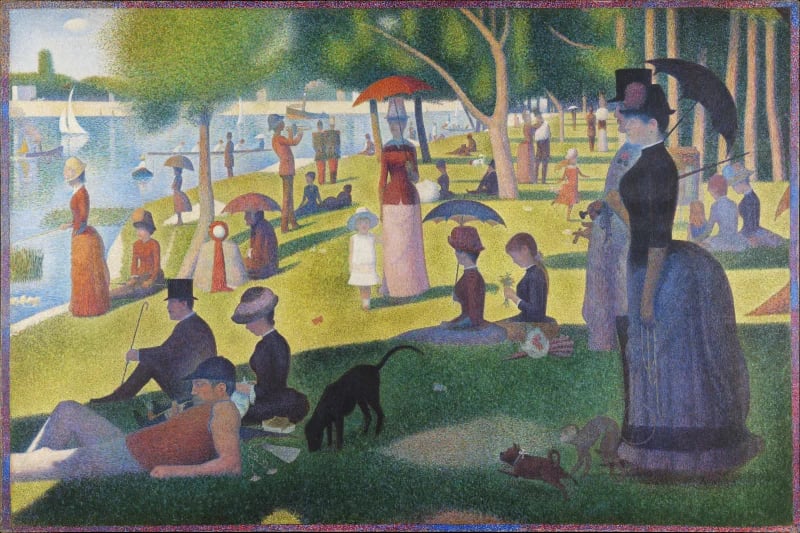
Georges Seurat studied at the École des Beaux-Arts and was influenced by the colour theories of Michel Eugène Chevreul and Ogden Rood. His first major work, Bathing at Asnières (1884), was refused by the Salon and shown at the first Salon des Indépendants. He then began A Sunday on La Grande Jatte (1884–86), a large canvas showing Parisians at leisure on an island in the Seine. The painting was exhibited at the eighth Impressionist exhibition in 1886. It caused a sensation. The figures are stiff, almost monumental; the space is carefully structured. The technique of small dots of colour creates a shimmering, static surface. Seurat had transformed the spontaneous Impressionist moment into something more like a frieze or a ritual.
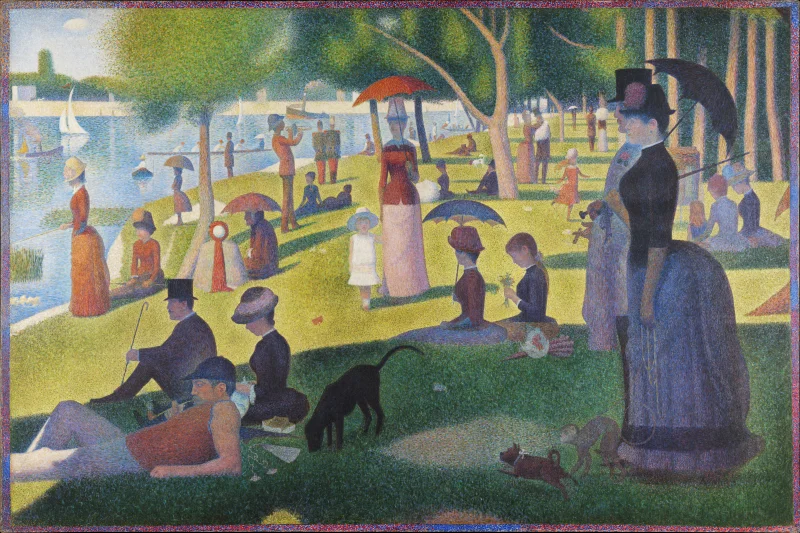
A Sunday on La Grande Jatte by Georges Seurat, 1884-86 (Source)

Seurat continued to refine his method until his early death in 1891. His later works, such as The Circus (1890–91), applied Divisionism to more dynamic subjects. He was secretive about his technique; he did not want others to copy it. His death at thirty-one cut short a career that might have developed in unexpected directions. The legacy of La Grande Jatte alone would have secured his place; the painting has been endlessly reproduced, analysed, and parodied. It appears in films, in advertising, and in popular culture as a shorthand for "Sunday afternoon" or "Parisian leisure." The stillness of the figures, the geometric structure of the space, and the shimmer of the dot technique have made it one of the most recognisable works of the nineteenth century. He also made drawings in Conté crayon that explore tone without colour. His influence was immediate: Pissarro experimented with the technique for a few years, and a younger generation of painters, including Paul Signac, Henri-Edmond Cross, and Maximilien Luce, took up the cause.
Paul Signac: Theorist and Practitioner
Paul Signac (1863–1935) met Seurat in 1884 and became the movement's most vocal advocate. His Portrait of Félix Fénéon (1890) shows the critic against a swirling, abstract background of Divisionist dots; it is one of the movement's most striking works. Signac also painted harbour scenes, coastal views, and river landscapes, applying the technique to a wide range of subjects. In 1899 he published From Eugène Delacroix to Neo-Impressionism, a treatise that explained the movement's principles and traced its lineage from Delacroix's colour experiments through Impressionism to the present.
Signac outlived Seurat by more than forty years. His later work became freer; the dots grew larger, and the colour became more arbitrary. He influenced Matisse during the summer they spent together in Saint-Tropez in 1904; Fauvism owes something to Neo-Impressionist colour, though the Fauves rejected the dot technique. Signac remained committed to the idea that art could be both scientifically grounded and emotionally resonant.
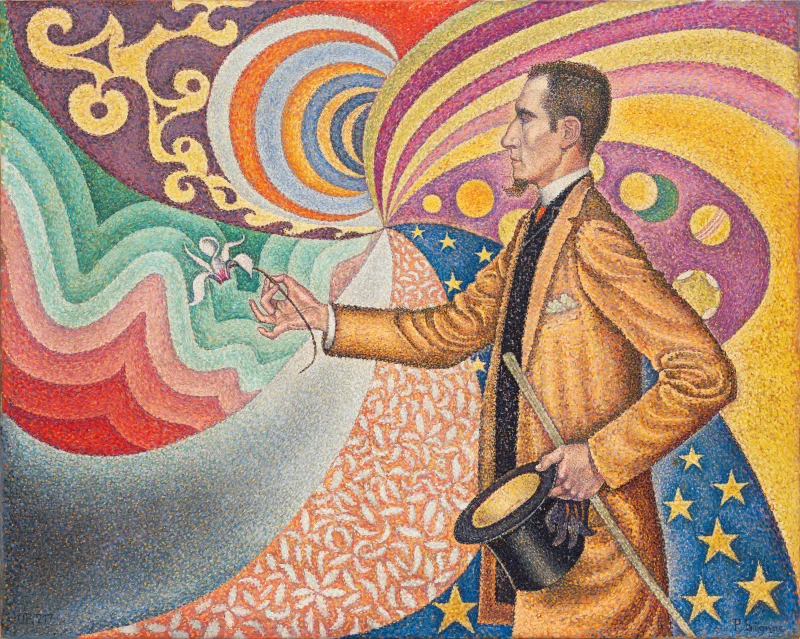
Portrait of Félix Fénéon by Paul Signac, 1890 (Source)

Divisionism in Italy
Italian painters took up Divisionism in the 1890s. Giovanni Segantini, Giuseppe Pellizza da Volpedo, and Gaetano Previati applied the technique to Symbolist subjects: rural life, labour, and spiritual themes. Pellizza's The Fourth Estate (1898–1901) shows workers advancing toward the viewer; the Divisionist technique gives the scene a luminous, almost visionary quality. The Italian Divisionists were less concerned with optical theory than with the expressive possibilities of broken colour. Their work bridged Neo-Impressionism and the emerging modernist movements of the early twentieth century.
The Legacy of Neo-Impressionism
Neo-Impressionism did not last long as a unified movement. By the mid-1890s, many of its practitioners had moved on. But its impact was lasting. The idea that colour could be analysed and applied systematically, that the viewer's eye completed the work of the painter, and that modern science could inform artistic practice: these ideas shaped twentieth-century art. The dot and the stroke became tools for later painters; the interest in optical effects anticipated Op Art. For practitioners interested in the relationship between perception and representation, or in the way systematic method can produce unexpected beauty, Neo-Impressionism offers a historical example.
Henri-Edmond Cross and Maximilien Luce
Henri-Edmond Cross (1856–1910) and Maximilien Luce (1858–1941) were fellow travellers. Cross's later work used larger, more loosely applied strokes; his Golden Isles (1891–92) suggests a bridge between Neo-Impressionism and Fauvism. Luce was also an anarchist; his Port of London (1892) and other urban scenes applied Divisionism to industrial subjects. Both artists outlived Seurat by decades; their work shows how the technique could be adapted and softened. The Belgian painter Théo van Rysselberghe (1862–1926) was another early adherent; his portrait of Octave Maus (1890) applies the dot technique to the depiction of the founder of Les XX. The movement was never large, but it was international: Neo-Impressionist ideas spread to Italy, Belgium, and beyond. The scientific pretensions of the movement have been questioned; later research has shown that optical mixing does not always work as the theorists claimed. But the desire to ground art in something beyond intuition, to make painting a rational practice, has had lasting influence.
Related Resources
- Impressionism – The movement Neo-Impressionism developed from
- Post-Impressionism – Contemporary developments
- Fauvism – Later use of pure colour
- Introduction to Art History
Related in this topic
More from Occult Art History & Symbolism — Start Here.
Symbolism
Discover the meaning of symbolism! Learn its origins, art and famous symbolist painters. Find hidden emotions in art.
Naïve Art
Naïve art: untrained artists created startling originality through simplified forms, vivid colors, and unfiltered imagination.
Art Informel
Art Informel: the European parallel to Abstract Expressionism. Dubuffet, Tàpies, and the art of the unformed and the raw.
Street Art
Street Art: from subway tags to gallery walls. Banksy, Keith Haring, and the art that reclaims public space.
You Might Also Like
Art Informel
Art Informel: the European parallel to Abstract Expressionism. Dubuffet, Tàpies, and the art of the unformed and the raw.
Street Art
Street Art: from subway tags to gallery walls. Banksy, Keith Haring, and the art that reclaims public space.