Period: Mid-1950s to late 1960s
Characteristics: Mass media imagery; commercial aesthetics; irony and detachment; flat colour; repetition; blurring of high and low culture
Events: Independent Group, London (1952); first Pop exhibitions in New York (1962); Warhol's Factory (1963)
From Advertising to the Gallery Wall
Pop Art emerged in Britain and the United States during the 1950s, at a time when postwar prosperity had filled homes and streets with mass-produced goods, billboards, and comic books. Artists began to take these commercial images seriously: not as debased kitsch, but as the real visual language of modern life. The movement took its name from "popular culture"; its practitioners lifted imagery from advertisements, product packaging, newspapers, and comic strips and placed it in the gallery, often with ironic distance but also with genuine fascination. By 1964, Pop had become one of the most visible movements in contemporary art, and its influence would extend into design, fashion, and the broader culture.
The British artist Richard Hamilton gave an early definition in 1957: Pop Art should be "popular, transient, expendable, low-cost, mass-produced, young, witty, sexy, gimmicky, glamorous, and Big Business." Hamilton's collage Just what is it that makes today's homes so different, so appealing? (1956) assembled images from American magazines into a satirical vision of domestic consumer paradise. The Independent Group, which met at the Institute of Contemporary Arts in London from 1952, had already been discussing mass culture and its relationship to fine art. Eduardo Paolozzi showed his "Bunk" collages of American advertising and machinery as early as 1952. By the time Pop exploded in New York in the early 1960s, the ground had been prepared.
Andy Warhol: Repetition and the Celebrity Image
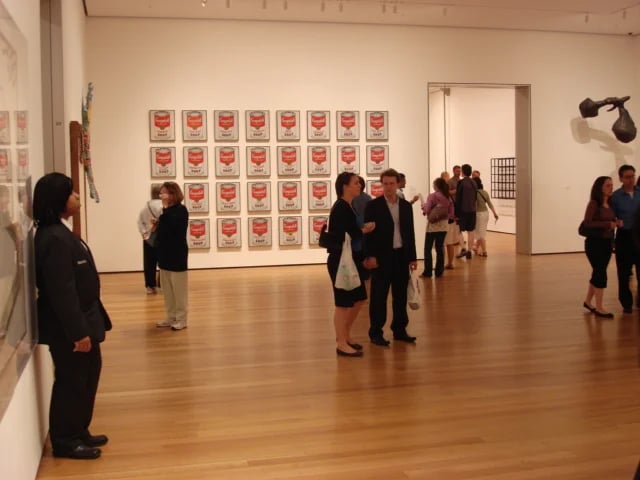
Andy Warhol (1928–1987) was a commercial illustrator in New York before he turned to fine art. In 1960 he began to make paintings based on newspaper advertisements and comic strips. His breakthrough came in 1962 with the Campbell's Soup Cans: thirty-two canvases, each showing a different variety of soup, arranged in a grid. Warhol had eaten Campbell's soup for lunch for years; the images were familiar to millions. By painting them (and later screenprinting them), he raised the question of what counted as art. Was a tin of tomato soup worthy of the museum? Warhol's answer was to repeat the image until the question dissolved in the repetition itself.

Campbell's Soup Cans by Andy Warhol, 1962 (Source)
.jpg)
Warhol opened his studio, the Factory, in 1963. He surrounded himself with assistants, celebrities, and hangers-on; the line between life and art blurred. He made series of Marilyn Monroe (after her death in 1962), Elizabeth Taylor, Elvis Presley, and Mao Zedong. He used silkscreen printing so that each image could be repeated with slight variations: colour shifts, misregistrations, smudges. The celebrity portrait became a commodity, like the soup can. Warhol said he wanted to be a machine; his work suggested that in a mass-media age, everyone was already part of the machine. His films from the mid-1960s, such as Empire (1964), an eight-hour shot of the Empire State Building, extended this logic: endless repetition, minimal content, maximum exposure.
Roy Lichtenstein: Comics and the Benday Dot
Roy Lichtenstein (1923–1997) began to paint comic-strip images in 1961. He enlarged panels from romance and war comics, reproducing the bold outlines, flat colours, and Ben-Day dots that printers used to create tone. The effect was at once recognisable and strange: the melodrama of the original (a weeping woman, an exploding fighter plane) became formalised, distant. Whaam! (1963) shows a jet firing a missile; the caption "Whaam!" fills the picture. Drowning Girl (1963) shows a woman in water, thinking "I don't care! I'd rather sink than call Brad for help!" The drama is absurd, but the composition is precise.
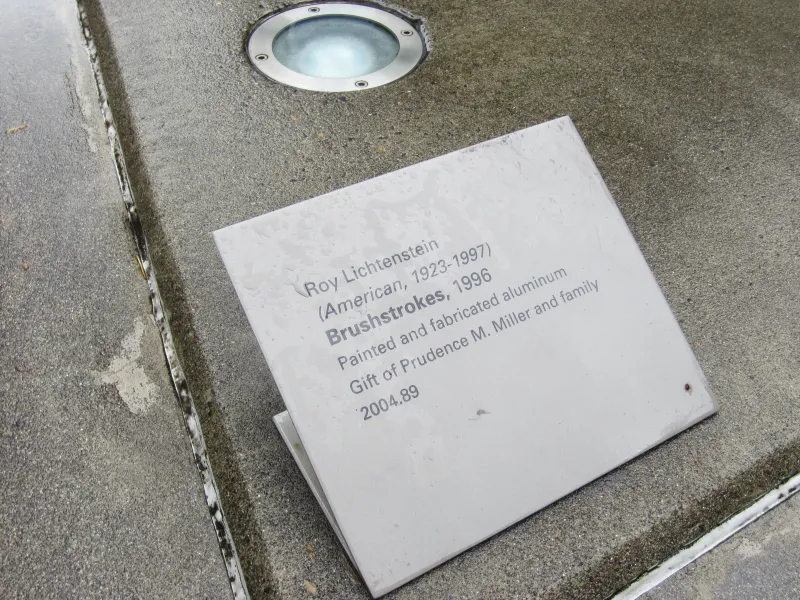
Brushstrokes by Roy Lichtenstein (Source)
.JPG)
Lichtenstein was accused of mere copying; he argued that he was transforming the source material through scale, colour, and formal decisions. His later work included paintings that mimicked the gestural brushstroke of Abstract Expressionism, but in his signature comic style: the heroic mark of the artist became another form of mass reproduction. By the late 1960s he had extended his approach to mirrors, interiors, and landscape. The Pop aesthetic, for Lichtenstein, was a way to question both high-art seriousness and the supposed transparency of commercial imagery.
British Pop: Blake, Hockney, and Jones
In Britain, Pop developed alongside the American version but with distinct concerns. Peter Blake (b. 1932) made collages and assemblages that referenced pop music, wrestling, and pin-ups; his design for the Beatles' Sgt. Pepper's Lonely Hearts Club Band album cover (1967) became one of the most famous images of the decade. David Hockney (b. 1937) moved to Los Angeles in 1964 and painted swimming pools, suburban lawns, and domestic interiors in flat, sunny colours. His A Bigger Splash (1967) captures a moment of impact in a pool; the stillness is almost surreal. Allen Jones (b. 1937) created figures of women as furniture, which were controversial from the start and remain so. British Pop often had a more literary or narrative quality than the American variant; it drew on music-hall, advertising, and a specifically British sense of class and nostalgia.
Jasper Johns and Robert Rauschenberg: Precursors
Before Warhol and Lichtenstein, Jasper Johns (b. 1930) and Robert Rauschenberg (1925–2008) had already brought everyday objects and images into painting. Johns's Flag (1954–55) and Target (1955) presented familiar symbols as painted objects; the question was not what they meant but what they became when treated as art. Rauschenberg's "combines" of the 1950s mixed painting with newspaper clippings, photographs, and found objects. His Bed (1955) was literally a quilt and pillow, splattered with paint. These works anticipated Pop's interest in the blurring of art and life, though Johns and Rauschenberg are often grouped with Neo-Dada or as bridges between Abstract Expressionism and Pop.
Claes Oldenburg and Tom Wesselmann: Objects and the Body
Pop Art was not limited to painting. Claes Oldenburg (b. 1929) made soft sculptures of everyday objects: giant hamburgers, typewriters, and lipstick tubes that drooped and sagged. His Store (1961) in New York sold plaster replicas of consumer goods. Later he proposed monumental public sculptures: a giant clothes peg for Philadelphia, a spoon with a cherry for Minneapolis. Tom Wesselmann (1931–2004) made the Great American Nude series, combining the female form with advertising imagery and household objects in collaged interiors. His work was often sexually explicit, drawing on the same commercial sources as Warhol but with a cooler, more voyeuristic tone. Both artists extended Pop's interest in the body as another kind of mass-produced image. Oldenburg's soft sculptures deflated the heroic scale of public monuments; Wesselmann's nudes placed the body in the same frame as toothpaste and televisions. The domestic and the commercial became the new territory of art.
Pop and the Occult
Pop Art had no explicit occult dimension, but its interest in repetition, the mass image, and the blurring of high and low has resonances for magical practice. Warhol's serial images (the repeated Marilyn, the grid of soup cans) recall the use of repetition in mantra and sigil work: the same form, repeated until it acquires a different quality. Lichtenstein's comic-strip melodrama, frozen and formalised, suggests the way symbols can be lifted from one context and recharged in another. For practitioners who work with mass-cultural imagery, advertising aesthetics, or the idea that the everyday can be ritually charged, Pop Art offers a twentieth-century precedent. The movement did not spiritualise consumer culture; it held it up for inspection. But in doing so, it acknowledged the power of images that circulate at scale, and the possibility that their repetition could produce something more than mere recognition.
The Legacy of Pop
Pop Art did not last long as a coherent movement; by the early 1970s its main figures had moved on. But its influence has been lasting. The idea that mass culture could be a legitimate subject for art, that repetition and seriality could replace unique gesture, and that the artist could adopt the strategies of advertising without simply endorsing them: all of this entered the mainstream. Later movements such as Appropriation Art and the Young British Artists of the 1990s built directly on Pop's logic. Warhol's prediction that "everyone will be famous for fifteen minutes" has come true in the age of social media. For practitioners interested in the power of images, symbols, and repetition in magical or ritual contexts, Pop Art offers a twentieth-century precedent: the elevation of the everyday into something charged, repeated, and transformative.
Related Resources
- Abstract Expressionism – The movement Pop reacted against
- Surrealism – Another engagement with popular imagery and the unconscious
- Art Deco – Earlier commercial and decorative modernism
- Introduction to Art History
Related in this topic
More from Occult Art History & Symbolism — Start Here.
Symbolism
Discover the meaning of symbolism! Learn its origins, art and famous symbolist painters. Find hidden emotions in art.
Naïve Art
Naïve art: untrained artists created startling originality through simplified forms, vivid colors, and unfiltered imagination.
Art Informel
Art Informel: the European parallel to Abstract Expressionism. Dubuffet, Tàpies, and the art of the unformed and the raw.
Street Art
Street Art: from subway tags to gallery walls. Banksy, Keith Haring, and the art that reclaims public space.
You Might Also Like
Art Informel
Art Informel: the European parallel to Abstract Expressionism. Dubuffet, Tàpies, and the art of the unformed and the raw.
Street Art
Street Art: from subway tags to gallery walls. Banksy, Keith Haring, and the art that reclaims public space.