Period: Mid-1960s to mid-1970s
Characteristics: Idea over object; language as medium; dematerialisation; critique of the art market; emphasis on the artist's instruction or proposition
Events: Sol LeWitt's "Paragraphs on Conceptual Art" (1967); "Software" exhibition (1970); Documenta 5 (1972)
Art as Idea
Conceptual Art emerged in the mid-1960s when a group of artists began to argue that the idea behind a work could be more important than the object itself. If a work of art could be a photograph of a photograph, a dictionary definition, or a set of instructions, then what counted as "the work"? Conceptual artists tested these boundaries. They made art from words, from documents, from performances that left no permanent trace. They questioned the commodity status of the art object and the role of the gallery and the museum. The movement had no single style, but it shared a commitment to the primacy of the concept.
The term "Conceptual Art" was used by the artist Henry Flynt in 1961 and popularised by Sol LeWitt in 1967. LeWitt wrote that "in conceptual art the idea or concept is the most important aspect of the work." The execution could be perfunctory; the idea was what mattered. This did not mean that Conceptual Art was anti-visual. Many works were highly visual; but the visual was in the service of the idea. The movement drew on Duchamp's readymades, on Minimalism's emphasis on the viewer's experience, and on the analytical philosophy that was then current in universities.
Joseph Kosuth: Art as Definition
Joseph Kosuth (b. 1945) made work that turned art back on itself. His One and Three Chairs (1965) presented a real chair, a photograph of the same chair, and a dictionary definition of "chair" mounted on the wall. The work asked: which of these is the "chair"? What is the relationship between the object, its image, and its definition? Kosuth's Art as Idea as Idea series (1966–68) used photostats of dictionary definitions of words like "meaning," "truth," and "water." The work was the definition; there was nothing to look at in the traditional sense.
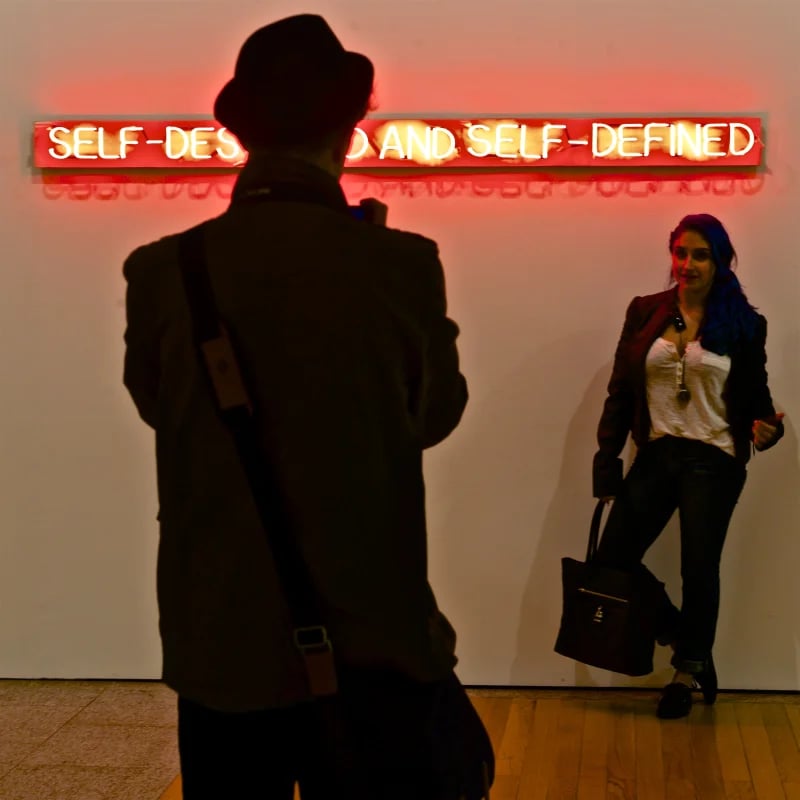
Self-Described and Self-Defined (1965) extended this logic. Kosuth was interested in the way language structures thought, and in the possibility that art could operate at the level of the concept rather than the percept. His work was influential but also controversial; some saw it as a dead end, others as a necessary critique of art's institutionalisation. For practitioners interested in the relationship between language and reality, or in the idea that the most radical art might be the least visible, Kosuth's work remains a reference.
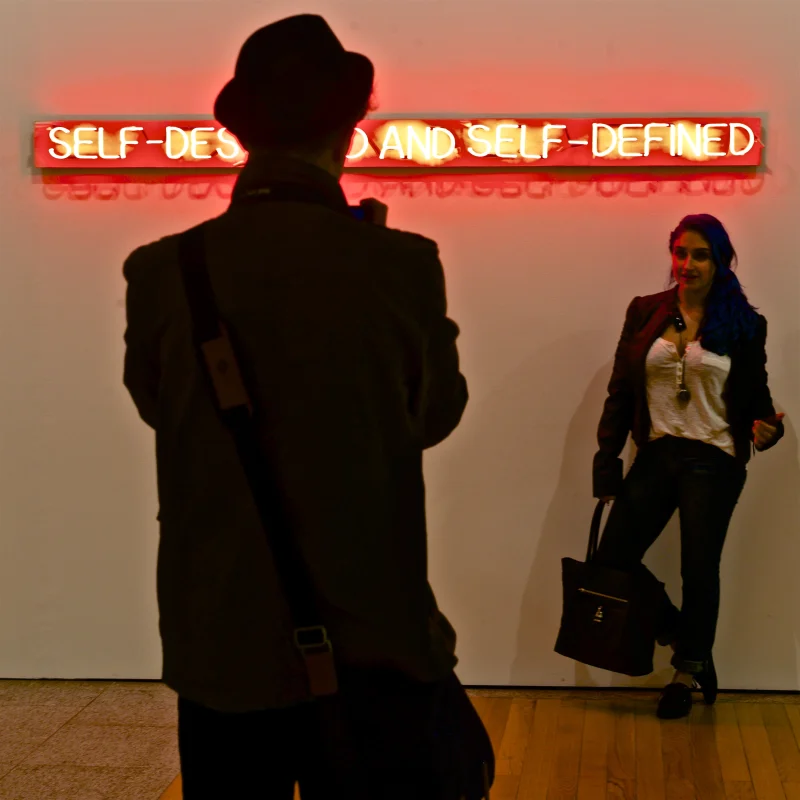
Self-Described and Self-Defined by Joseph Kosuth, 1965 (Source)
_-_Joseph_Kosuth_(1948)_(24010621475).jpg)
Sol LeWitt: Instructions and Wall Drawings
Sol LeWitt (1928–2007) began as a Minimalist sculptor before turning to Conceptual Art. His wall drawings were not drawn by him; they were executed by others following his instructions. A typical instruction might read: "On a wall, all combinations of two lines crossing, placed at random, using arcs from corners and sides, straight, not-straight, and broken lines." The work existed as a certificate and a set of instructions; the actual drawing could be made and remade anywhere, by anyone. LeWitt's Wall Drawing 831 (1997) at the Guggenheim Bilbao uses geometric forms in a systematic arrangement. The result is visually striking, but the "work" is the concept, not the particular execution.
LeWitt wrote that "the idea becomes a machine that makes the art." He was interested in systems, in the way a simple rule could generate complex results. His work connected Conceptual Art to Minimalism (he had worked with Judd and others) and to the emerging field of algorithmic art. For practitioners interested in the relationship between instruction and execution, or in the idea that the artist need not touch the work, LeWitt's wall drawings offer a clear model.
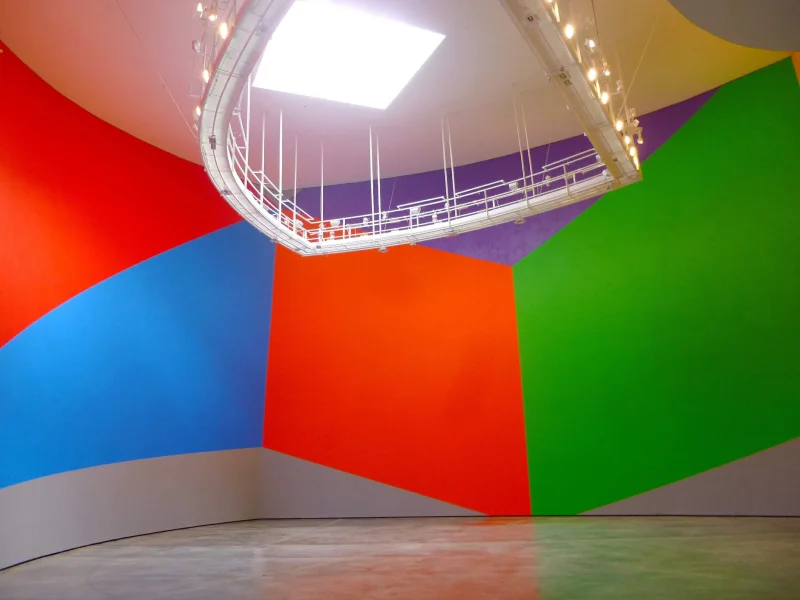
Wall Drawing 831 (Geometric Forms) by Sol LeWitt, Guggenheim Bilbao (Source)
,_de_Sol_LeWitt_6.JPG)
Lawrence Weiner, Douglas Huebler, and the Dematerialised Object
Lawrence Weiner (1942–2021) made work that often existed only as language. His "Statements" (1968–70) were propositions that could be realised or not: "A 36" x 36" removal of lathing or support wall." The work was the statement; the physical realisation was optional. Douglas Huebler (1924–1997) made "duration pieces" that documented arbitrary events: photographing everyone he met, or declaring that he would make a work each day. Both artists extended the logic of Conceptual Art to a point where the object almost disappeared.
The critic Lucy Lippard described this tendency as "the dematerialisation of the art object." She curated the exhibition "557,087" in Seattle (1969) and "955,000" in Vancouver (1970), which showed work that was often ephemeral, documentary, or linguistic. The hope was that art could escape the market, that it could resist commodification. The reality was more complex: Conceptual Art was soon collected, exhibited, and sold. The certificate, the photograph, and the instruction became collectible objects in turn.
Marcel Duchamp and the Readymade
Conceptual Art's deepest roots lie in Marcel Duchamp's readymades. In 1917, Duchamp submitted a porcelain urinal signed "R. Mutt" to an exhibition in New York; it was rejected, but the gesture had been made. The readymade asked: what makes something art? Is it the object, the intention, or the context? Duchamp later said that the choice of the object was the artistic act; the object itself was indifferent. This logic, extended and formalised, became Conceptual Art. The idea that art could be a proposition, an instruction, or a document rather than a unique object: all of this was implicit in the readymade. Duchamp did not identify as a Conceptual artist; he was too elusive for that. But his shadow falls over every work that asks what counts as art.
Legacy
Conceptual Art changed the definition of art. It made room for work that had no traditional object, for art that could be a performance, a photograph, a text, or an instruction. The movement's influence is visible in installation art, in relational aesthetics, and in the way contemporary artists use documentation and archival strategies. The question it posed, "What counts as art?" has never been fully resolved. For practitioners interested in the power of the idea, in the relationship between concept and execution, or in the possibility that the most radical work might be the least visible, Conceptual Art offers a historical anchor and an ongoing challenge.
Related Resources
- Dada – Earlier use of the readymade and the absurd
- Minimalism – Emphasis on the object and the viewer
- Land Art – Art beyond the gallery
- Introduction to Art History
Related in this topic
More from Occult Art History & Symbolism — Start Here.
Symbolism
Discover the meaning of symbolism! Learn its origins, art and famous symbolist painters. Find hidden emotions in art.
Naïve Art
Naïve art: untrained artists created startling originality through simplified forms, vivid colors, and unfiltered imagination.
Art Informel
Art Informel: the European parallel to Abstract Expressionism. Dubuffet, Tàpies, and the art of the unformed and the raw.
Street Art
Street Art: from subway tags to gallery walls. Banksy, Keith Haring, and the art that reclaims public space.
You Might Also Like
Art Informel
Art Informel: the European parallel to Abstract Expressionism. Dubuffet, Tàpies, and the art of the unformed and the raw.
Street Art
Street Art: from subway tags to gallery walls. Banksy, Keith Haring, and the art that reclaims public space.