Period: 1960s to 1970s
Characteristics: Works in and with landscape; earth, rock, and natural materials; site-specificity; often remote or inaccessible; scale beyond the gallery
Events: Spiral Jetty (1970); "Earthworks" exhibition (1968); Wrapped Coast (1969)
Art Beyond the Gallery
Land Art (also called Earth Art or Earthworks) emerged in the late 1960s when a group of American artists began to make work in and with the landscape. They used earth, rock, water, and vegetation as materials; they built in deserts, on coasts, and in remote locations. The work could not be collected in the traditional sense; it existed in place, subject to weather, erosion, and time. Land Art was a reaction against the commodification of art and the constraints of the gallery. It was also a response to the ecological consciousness of the period: the first Earth Day was in 1970, the same year as Robert Smithson's Spiral Jetty.
The movement had no single manifesto. Its practitioners included Robert Smithson, Michael Heizer, Walter De Maria, Nancy Holt, and the couple Christo and Jeanne-Claude. Some worked with massive scale and industrial equipment; others used subtle interventions that were barely visible. What they shared was a belief that art could engage directly with the land, and that the gallery was not the only, or even the best, context for artistic experience.
Robert Smithson and Spiral Jetty
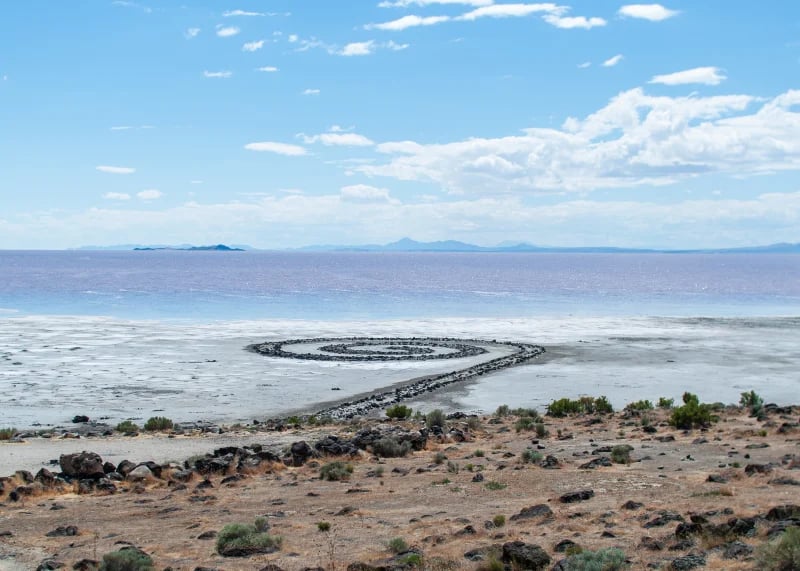
Robert Smithson (1938–1973) was Land Art's most influential figure. In 1970 he built Spiral Jetty in the Great Salt Lake, Utah. The work is a spiral of black basalt rock and earth, 1,500 feet long, projecting into the lake. It was built with a bulldozer and truck; it took about a week. The spiral form evokes a galaxy, a whirlpool, or the primordial; Smithson was interested in entropy, geology, and the scale of deep time. The jetty is now partly submerged or exposed depending on the lake's level; it has been encrusted with salt crystals, turning it white. It was acquired by the Dia Art Foundation in 1999 and is now a pilgrimage site for those interested in Land Art.
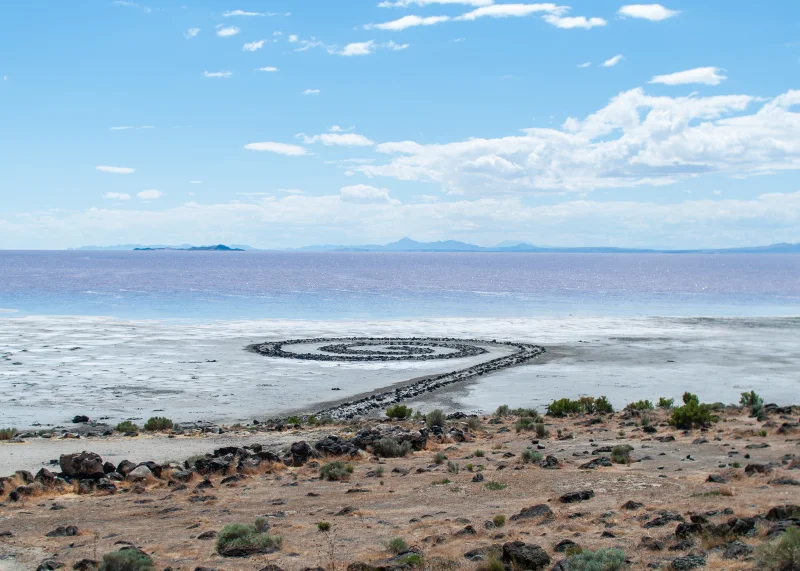
Viewing Robert Smithson's Spiral Jetty (Source)

Smithson also made "non-sites": containers of earth or rock from a specific location, displayed in the gallery with maps and photographs. These works brought the land into the gallery while pointing to a place outside it. He wrote extensively about his practice; his essays on entropy, mirrors, and the dialectics of site and non-site are key texts for understanding Land Art. He died in a plane crash in 1973 while surveying a work in Texas.
Michael Heizer and the Scale of the Desert
Michael Heizer (b. 1944) began to make work in the Nevada desert in 1967. Double Negative (1969–70) consists of two trenches cut into the Mormon Mesa, each 30 feet wide, 50 feet deep, and 1,500 feet long. The work is a negative volume: earth removed rather than added. Heizer used dynamite and bulldozers; the scale is vast. City (1972–present) is an even larger project: a complex of mounds, berms, and depressions spread across a valley in Nevada. It has been under construction for decades; access is limited. Heizer's work emphasises the raw power of industrial construction and the insignificance of the human body against the scale of the land.
Christo and Jeanne-Claude: Wrapping and Revelation
Christo (1935–2020) and Jeanne-Claude (1935–2009) wrapped buildings, bridges, and coastlines in fabric. Wrapped Coast (1969) in Australia covered a mile of coastline in fabric and rope. Valley Curtain (1970–72) stretched an orange curtain between two Colorado mountains. The Gates (2005) placed 7,503 saffron-coloured gates along the paths of Central Park. The couple financed their projects through the sale of preparatory drawings and earlier work; they accepted no sponsorship. The works were temporary; they existed for weeks and then were removed. The wrapping revealed form by obscuring it; the fabric made the familiar strange.
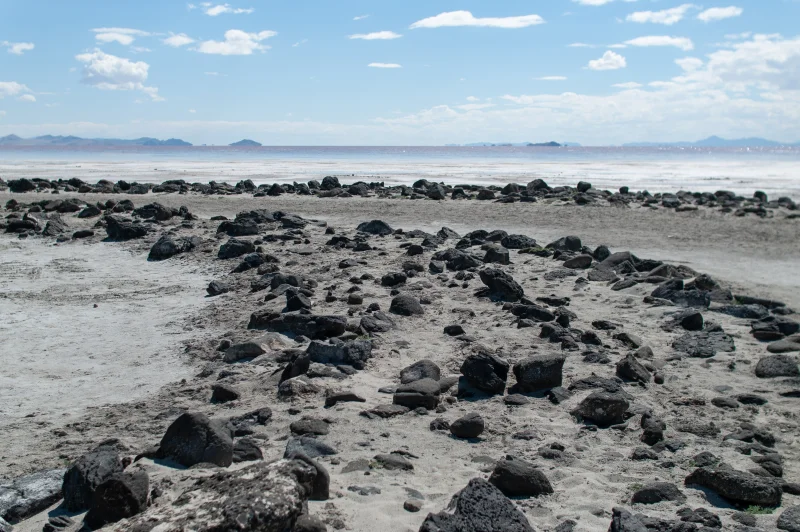
Walking on Robert Smithson's Spiral Jetty (Source)

Nancy Holt, Walter De Maria, and the Lightning Field
Nancy Holt (1938–2014) made work that often involved perception and light. Sun Tunnels (1973–76) in Utah consists of four concrete pipes aligned with the sun at the solstices; the viewer looks through them at the horizon. Dark Star Park (1979) in Arlington, Virginia, uses concrete spheres and shadow patterns to mark the position of the sun on a specific date. Walter De Maria (1935–2013) made The Lightning Field (1977) in New Mexico: 400 stainless steel poles arranged in a grid over an area of one mile by one kilometer. The poles attract lightning during storms; the work is best experienced over 24 hours, including sunrise and sunset. Access is by appointment only; visitors stay overnight in a cabin. The work demands time and commitment; it cannot be consumed quickly.
James Turrell and the Perception of Light
James Turrell (b. 1943) has worked for decades on the Roden Crater in Arizona, transforming a volcanic cinder cone into an observatory for the naked eye. Viewers enter chambers that frame the sky; the experience is one of pure light and perception. Turrell's work is often grouped with Land Art, though it is also a form of installation and a kind of perceptual experiment. The Roden Crater is not yet fully open to the public; it represents a lifetime commitment to a single site. The scale of Land Art projects, from Smithson's week-long construction of Spiral Jetty to Turrell's decades at Roden Crater, suggests that the relationship between artist and land can be intimate and prolonged. The land is not a backdrop; it is a partner.
Legacy
Land Art extended the idea of sculpture to include the land itself. It asked what it meant to make art that could not be bought, that existed in a specific place, and that was subject to natural forces. The movement's interest in site, scale, and duration has influenced later environmental art, public art, and the way we think about the relationship between art and place. For practitioners interested in the land as sacred, in ritual space, or in the idea that the most powerful work might exist outside the gallery, Land Art offers a twentieth-century precedent. The earth is the oldest medium; Land Art reminded us that it could still be used.
Related Resources
- Conceptual Art – Idea over object, art beyond the commodity
- Minimalism – Scale, materials, and the viewer's bodily experience
- Art Brut – Work made outside institutional contexts
- Introduction to Art History
Related in this topic
More from Occult Art History & Symbolism — Start Here.
Symbolism
Discover the meaning of symbolism! Learn its origins, art and famous symbolist painters. Find hidden emotions in art.
Naïve Art
Naïve art: untrained artists created startling originality through simplified forms, vivid colors, and unfiltered imagination.
Art Informel
Art Informel: the European parallel to Abstract Expressionism. Dubuffet, Tàpies, and the art of the unformed and the raw.
Street Art
Street Art: from subway tags to gallery walls. Banksy, Keith Haring, and the art that reclaims public space.
You Might Also Like
Art Informel
Art Informel: the European parallel to Abstract Expressionism. Dubuffet, Tàpies, and the art of the unformed and the raw.
Street Art
Street Art: from subway tags to gallery walls. Banksy, Keith Haring, and the art that reclaims public space.