
Period: 1943 – c. 1960
Characteristics: Large-scale abstraction; emphasis on process and gesture; interest in the unconscious; rejection of European tradition; spiritual and existential themes
Events: Peggy Guggenheim's "Art of This Century" gallery (1942), First generation exhibitions (late 1940s), Pollock's drip paintings (1947–50)
The New York School
Abstract Expressionism emerged in New York in the 1940s, when a group of American painters began to produce large-scale, abstract work that emphasised gesture, process, and the artist's direct encounter with the canvas. The movement had no unified style. It included Jackson Pollock's poured and dripped paint, Mark Rothko's luminous colour fields, Willem de Kooning's aggressive brushwork, and Barnett Newman's vertical "zips." But the artists shared a belief that painting could reach beyond representation toward something existential or transcendent.
The war had brought European Surrealists to New York; many Abstract Expressionists had contact with their work and ideas. Automatic drawing, the emphasis on the unconscious, and the notion of art as a form of revelation influenced the Americans. But they also rejected Surrealist figuration and literary content. They wanted a purer abstraction, one that could speak directly to the viewer without the mediation of symbol or story. For practitioners who use art in meditation, pathworking, or ritual, Abstract Expressionism provides a twentieth-century precedent for art that can hold or support transcendent experience.
Jackson Pollock: Action and Accident
Jackson Pollock (1912–1956) developed his "drip" or "pour" technique around 1947. He would place unstretched canvas on the floor and apply paint by pouring, dripping, and flinging. The resulting webs of line and colour recorded the movement of his body; the canvas became a field of action rather than a window onto a scene. Pollock spoke of being "in" the painting, of a loss of self during the process. Critics dubbed the approach "action painting."
Pollock had studied with Thomas Hart Benton and had worked through Surrealist and Jungian influences. His early work included mythological and figurative elements; the drip paintings distilled that energy into pure gesture. He was interested in Native American sand painting and in the idea of the artist as shaman. His alcoholism and early death in a car crash have sometimes overshadowed the work itself, but the paintings remain powerful: vast, rhythmical, and demanding a physical as well as visual response from the viewer.
Mark Rothko: Colour and the Sublime
Mark Rothko (1903–1970) took a different path. His mature work, from the late 1940s onward, consisted of soft-edged rectangles of colour stacked on large canvases. The paintings seem to hover, shimmer, or breathe; the edges of the forms blur into the ground, creating an effect of transcendent spaciousness. Rothko wanted his work to move viewers to tears. He spoke of creating a place of contemplation, a " temple" for secular spirituality. He refused to sell paintings to spaces where they would be used as decoration; he wanted them encountered in conditions of quiet attention.
Rothko was influenced by Nietzsche, by myth, and by a lifelong interest in the tragic and the sublime. His work has been compared to religious art—the colour-field paintings function, for some viewers, as secular icons. He rejected the term "abstract" for his work, insisting that he painted "the human drama." Rothko's suicide in 1970 has coloured interpretation of his work, but the paintings themselves remain open: they invite contemplation without prescribing what the viewer should feel. Practitioners who use colour meditation or who seek art that supports contemplative states may find Rothko's work useful.
Willem de Kooning, Franz Kline, and the Gesturalists
Willem de Kooning (1904–1997) maintained a tension between abstraction and figuration. His Woman series (1950–53) featured aggressive, distorted female figures that scandalised some viewers and fascinated others. The brushwork was raw and physical; the paint itself seemed to embody conflict. De Kooning had worked as a commercial artist and brought a craftsman's control to apparently spontaneous gesture.
Franz Kline (1910–1962) painted huge black shapes on white grounds, bold calligraphic marks that suggested bridges, architectures, or pure abstraction. His work shared Pollock's scale and immediacy but used a more restricted palette and a clearer sense of structure. The "black and white" Kline of the 1950s gave way to colour in his last years.
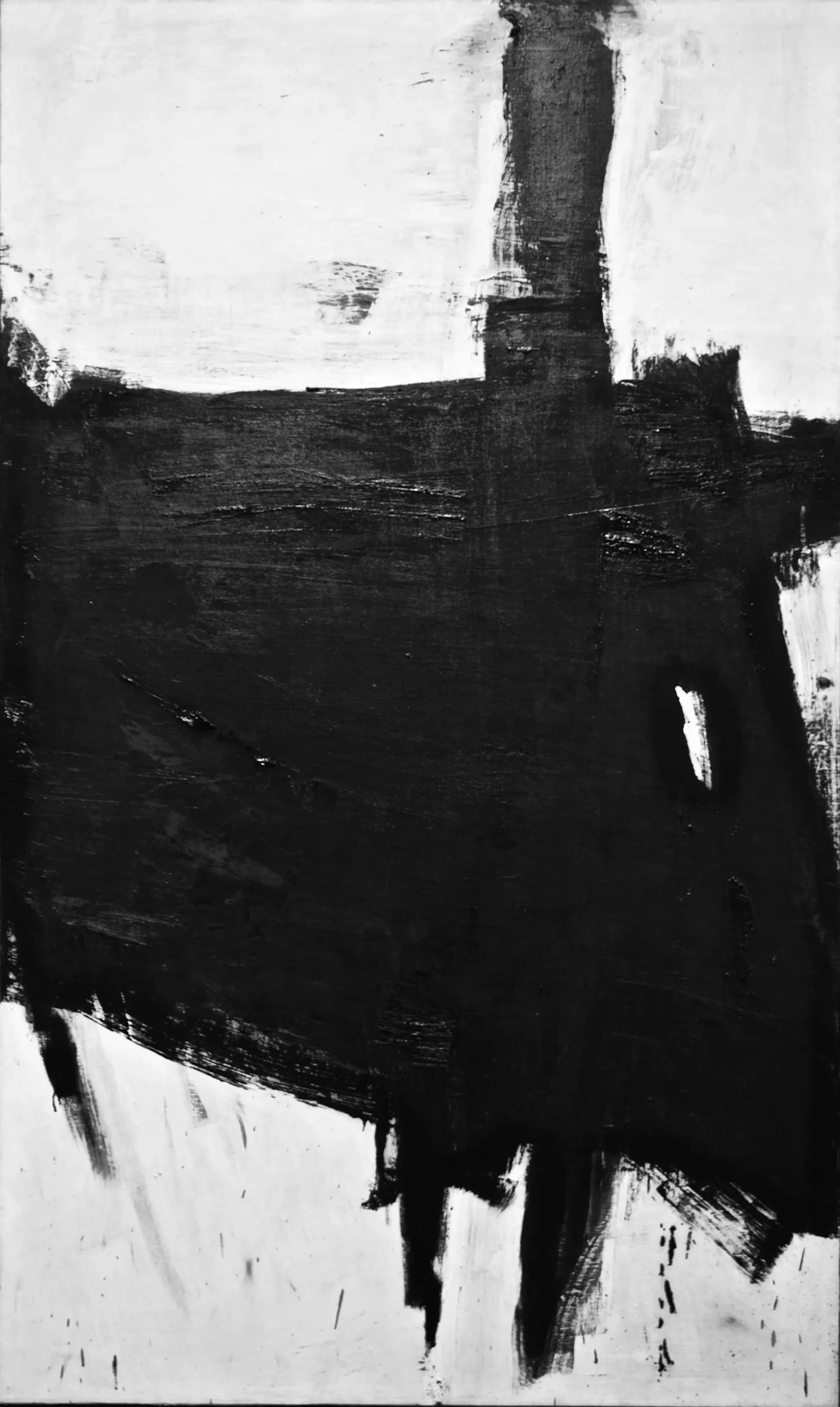
Sabra by Franz Kline (Source)
_-_Franz_Kline_(1910-1962)_(31087622617).jpg)
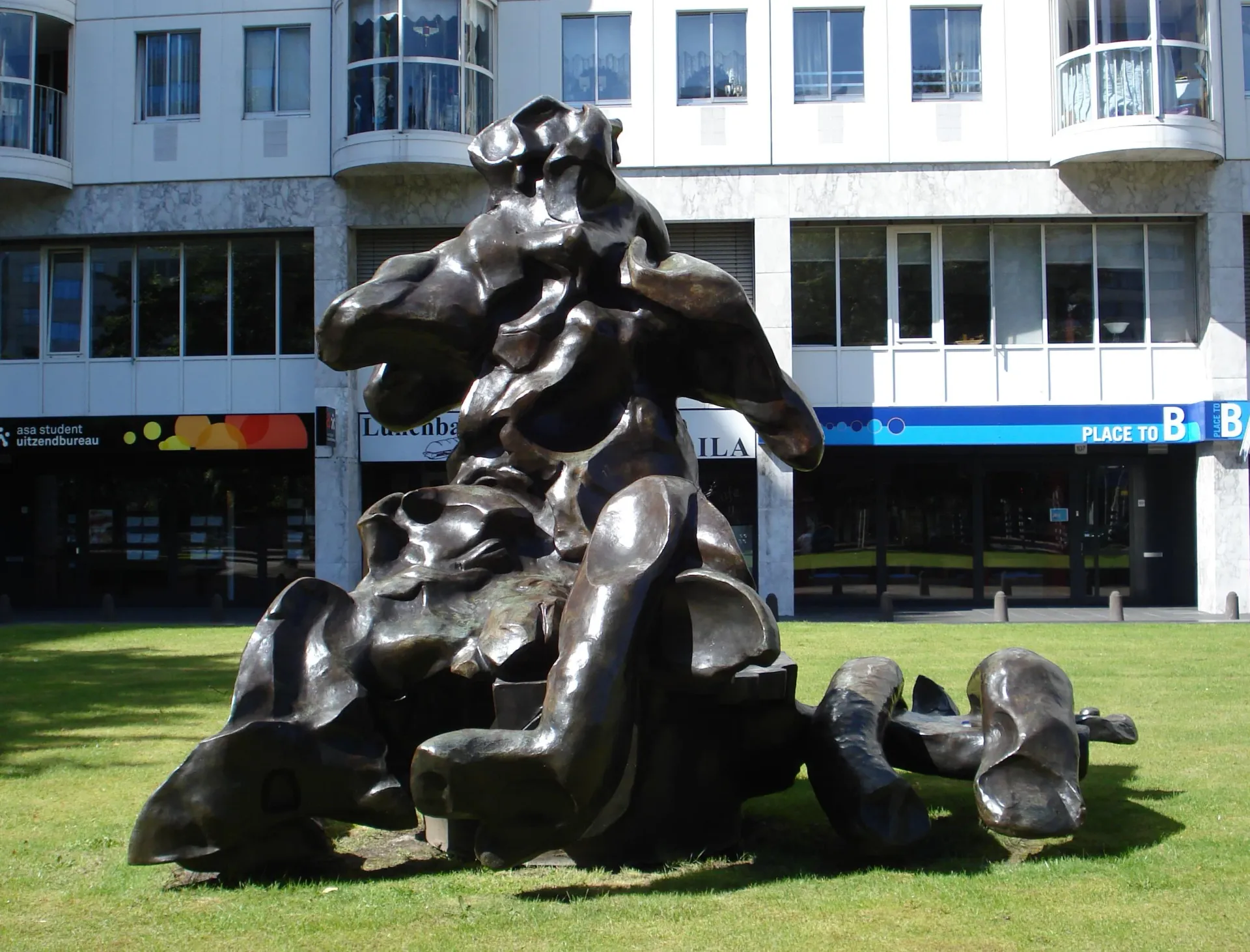
Seated Woman by Willem de Kooning, Rotterdam (Source)

The critic Clement Greenberg championed Abstract Expressionism, arguing that it represented the logical culmination of modernism's drive toward flatness and self-reference. His narrative, that painting had progressively shed illusion and decoration to arrive at pure abstraction, shaped the movement's reception. Not everyone agreed. The painter Fairfield Porter criticised the cult of the new and the dismissal of representational art. But for a decade or more, Abstract Expressionism dominated American art discourse. The Museum of Modern Art and major galleries promoted it; the CIA allegedly used it as cultural propaganda during the Cold War, presenting American freedom against Soviet conformity.
Barnett Newman (1905–1970) and Clyfford Still (1904–1980) represented a more austere tendency. Newman's "zips"—vertical bands that divide the canvas—create a sense of presence and threshold. Vir Heroicus Sublimis (1950–51) is a vast red field with subtle vertical striations; the viewer is meant to stand before it and experience scale, colour, and the act of looking itself. Still's jagged, vertical forms and brooding palette suggest something geological or primordial. Both artists rejected decorative or compositional concerns in favour of a direct encounter with the painted surface.
Spiritual and Occult Dimensions
Several Abstract Expressionists had explicit spiritual or mystical interests. Pollock underwent Jungian analysis and used archetypal imagery in his early work. Rothko read widely in philosophy and myth. Newman wrote about the sublime and the metaphysical. The critic Harold Rosenberg described the canvas as "an arena in which to act"; the language of ritual and performance was never far away.
Theosophy and related doctrines had influenced Kandinsky and the earlier European avant-garde; those ideas circulated in New York through exhibitions, émigré artists, and publications. The Abstract Expressionists did not form a mystery school, but they shared a belief that art could access something beyond the everyday. For practitioners who use visualisation, meditation on colour or form, or art as a support for ritual, the Abstract Expressionists offer a secular-but-spiritual precedent: painters who treated the canvas as a place of transformation.
Women of the New York School
The Abstract Expressionist narrative has often focused on the male "heroes"—Pollock, Rothko, de Kooning—but women were present from the start. Lee Krasner (1908–1984), Pollock's wife, was an established painter before they met; her work evolved in dialogue with his but retained its own logic. She destroyed and reworked canvases obsessively; her "Little Image" paintings of the 1940s are dense, hieroglyphic fields. After Pollock's death, she produced large-scale, confident work that has received overdue attention.
Joan Mitchell (1925–1992) and Helen Frankenthaler (1928–2011) extended Abstract Expressionist concerns into the 1960s and beyond. Mitchell's brushwork was fierce and lyrical; she often worked on diptychs or multi-panel works. Frankenthaler developed the "stain" technique—pouring thinned paint onto unprimed canvas—which influenced Morris Louis and Kenneth Noland and helped spawn the Colour Field tendency. The history of Abstract Expressionism is richer when these artists are included.
Legacy
Abstract Expressionism established New York as the centre of the art world, a position it would hold for decades. The movement's influence spread through colour-field painting, minimalism, and performance art. The idea of the artist as heroic individual, locked in struggle with the canvas, became a cliché, and a target for later artists who rejected such myths. But the work itself remains: Pollock's rhythmic webs, Rothko's luminous rectangles, the physical immediacy of paint applied at scale. These paintings continue to affect viewers who encounter them in person. Reproduction flattens them; they need to be seen at full size, in conditions that allow sustained attention. The Rothko Chapel in Houston, the Pollock-Krasner House on Long Island, and the rooms of the Museum of Modern Art in New York still offer the chance to stand before these works and experience what they demand: time, physical presence, and a willingness to let the painting work on you.
Related Resources
- Surrealism – Influence on Abstract Expressionist automatism
- Expressionism – Earlier emphasis on inner experience
- Cubism – Structural lessons absorbed and transcended
- Introduction to Art History
Related in this topic
More from Occult Art History & Symbolism — Start Here.
Symbolism
Discover the meaning of symbolism! Learn its origins, art and famous symbolist painters. Find hidden emotions in art.
Naïve Art
Naïve art: untrained artists created startling originality through simplified forms, vivid colors, and unfiltered imagination.
Art Informel
Art Informel: the European parallel to Abstract Expressionism. Dubuffet, Tàpies, and the art of the unformed and the raw.
Street Art
Street Art: from subway tags to gallery walls. Banksy, Keith Haring, and the art that reclaims public space.
You Might Also Like
Art Informel
Art Informel: the European parallel to Abstract Expressionism. Dubuffet, Tàpies, and the art of the unformed and the raw.
Street Art
Street Art: from subway tags to gallery walls. Banksy, Keith Haring, and the art that reclaims public space.