
Period: 1919 to 1933
Characteristics: Unity of art and craft; integration with industry; geometric form; functional design; workshop-based teaching
Events: Foundation in Weimar (1919); move to Dessau (1925); closure under Nazis (1933); diaspora to US and elsewhere
A School for a New World
The Bauhaus was a German design school founded in Weimar in 1919 by the architect Walter Gropius. Its name combined "Bau" (building) and "Haus" (house); the aim was to reunite the fine arts with the crafts and to train a new generation of designers who could shape the built environment. The school's motto, "Art and technology, a new unity," reflected a belief that the industrial age demanded a new aesthetic: one that was functional, rational, and accessible. The Bauhaus lasted only fourteen years before the Nazis forced it to close in 1933, but its influence on architecture, furniture, typography, and graphic design has been immense. Many of its teachers and students emigrated to the United States, where they helped to establish modern design education and practice.
Gropius had been influenced by the Deutscher Werkbund, the arts-and-crafts reform movement, and by the idea that design could serve society. He recruited a faculty that included painters, sculptors, and craftspeople: Johannes Itten, who taught the preliminary course; Lyonel Feininger, Georg Muche, and Oskar Schlemmer; and later Wassily Kandinsky and Paul Klee. The curriculum began with a six-month foundation course that introduced students to materials, colour, and form. After that, students chose a workshop: carpentry, metalwork, weaving, pottery, typography, or stage design. The goal was to produce objects and buildings that were both beautiful and useful, and that could be mass-produced.
Weimar, Dessau, Berlin
The Bauhaus moved from Weimar to Dessau in 1925, after the Thuringian government cut its funding. Gropius designed a new building for the school: a complex of interconnected blocks with a glass curtain wall, flat roofs, and an asymmetrical plan. The Dessau building, completed in 1926, became an icon of modernist architecture. It housed workshops, studios, a theatre, and residential accommodation. The design emphasised transparency, efficiency, and the rejection of ornament. Gropius resigned in 1928 and was succeeded by the architect Hannes Meyer, who pushed the school further toward social and political engagement. Meyer was dismissed in 1930 and replaced by Ludwig Mies van der Rohe. Under pressure from the rising Nazi party, the school moved to Berlin in 1932 and was closed the following year.
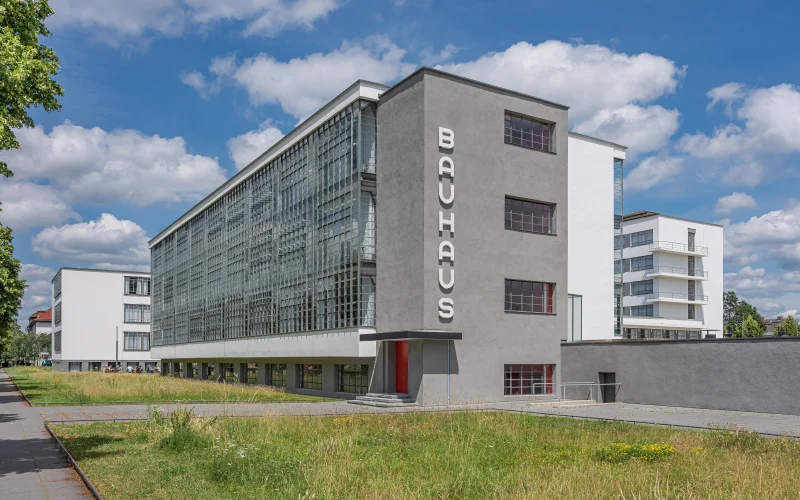
Bauhaus building in Dessau, 1925-26 (Source)

Marcel Breuer and the Wassily Chair
Marcel Breuer (1902–1981) studied at the Bauhaus and later headed the carpentry workshop. In 1925 he designed a chair using bent tubular steel, a material borrowed from the bicycle industry. The chair was originally known as the B3; it was later named the Wassily Chair after Kandinsky, who admired it. The design was radical: the frame was a single continuous loop of steel, and the seat and back were made of canvas or leather straps. No wood, no ornament, no compromise. The chair could be mass-produced, was light and stackable, and became one of the most copied designs of the twentieth century. Breuer's later work included the Cesca chair (1928), with a cantilevered frame, and his influential housing and furniture designs in the United States after 1937.
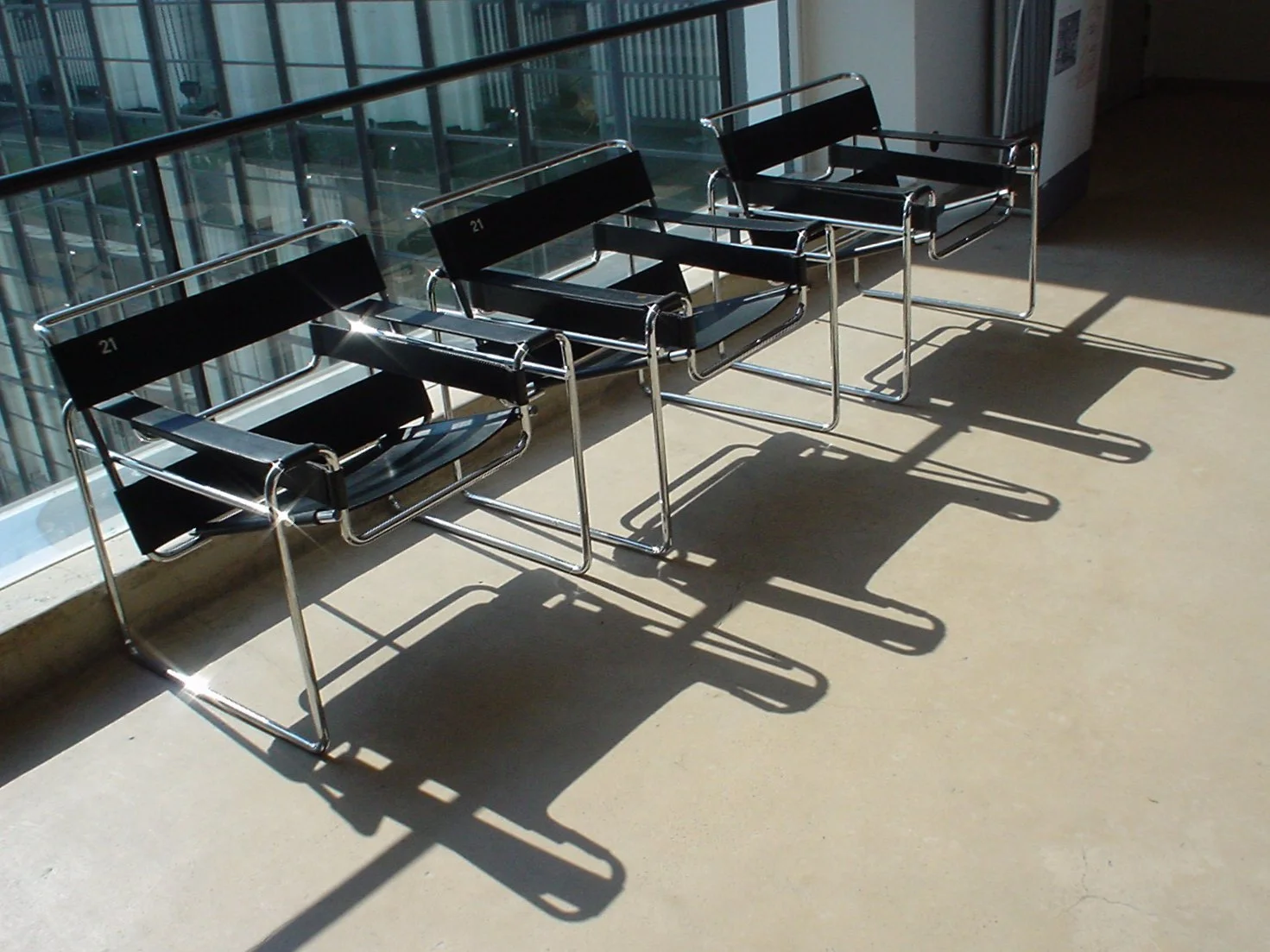
Wassily Chair by Marcel Breuer, 1925-26 (Source)

Klee, Kandinsky, and the Preliminary Course
Paul Klee (1879–1940) and Wassily Kandinsky (1866–1944) were among the most famous artists to teach at the Bauhaus. Klee joined in 1921 and taught in the weaving, glass-painting, and bookbinding workshops. His classes on form and colour were legendary; he encouraged students to think of line, tone, and shape as elements that could be combined like music. His own work ranged from geometric abstraction to whimsical figuration. Kandinsky arrived in 1922 and taught the mural workshop and the preliminary course. He had already developed his theory of abstraction in Concerning the Spiritual in Art (1911); at the Bauhaus he formalised his ideas about the relationships between form and colour. Both Klee and Kandinsky published influential books during their Bauhaus years: Klee's Pedagogical Sketchbook (1925) and Kandinsky's Point and Line to Plane (1926) became standard texts for design education.
László Moholy-Nagy and the New Vision
László Moholy-Nagy (1895–1946) replaced Itten as head of the preliminary course in 1923. He emphasised the use of new technologies: photography, film, and photomontage. He made "photograms" by placing objects on light-sensitive paper; the results were abstract compositions of light and shadow. He believed that the camera offered a new way of seeing, distinct from human vision. His typography and poster design used bold sans-serif type, asymmetrical layouts, and geometric form. After leaving the Bauhaus in 1928, he worked in Berlin and Amsterdam before emigrating to Chicago, where he founded the New Bauhaus (later the Institute of Design) in 1937. The school continued the Bauhaus philosophy of integrating art, craft, and technology.
Marianne Brandt and the Metal Workshop
The Bauhaus workshops were not limited to men. Marianne Brandt (1893–1983) studied in the metal workshop and became one of its leading designers. Her tea infuser (1924) and Kandem lamp (1928) are now considered design classics. The tea infuser combined a hemispherical body with a cylindrical lid and a wooden handle; the form was pure geometry. Brandt also made photomontages that combined fragments of industrial imagery with more abstract elements. Her work exemplifies the Bauhaus ideal of uniting craft skill with industrial production. After the school closed, she worked as a designer in East Germany.
Oskar Schlemmer and the Stage Workshop
Oskar Schlemmer (1888–1943) directed the Bauhaus stage workshop from 1923 to 1929. He made costumes and performances that treated the human body as a geometric form: the Triadic Ballet (1922) used padded costumes that transformed dancers into abstract shapes. Schlemmer was interested in the relationship between body, space, and costume; his work anticipated later experiments in performance art and contemporary dance. He left the Bauhaus in 1929 and taught elsewhere until the Nazis dismissed him in 1933. His Bauhaus Stairs (1932), a painting of figures ascending a staircase in the Dessau building, has become an iconic image of the school. The geometric treatment of the figures and the clean architecture capture the Bauhaus aesthetic in paint.
The Bauhaus Legacy
The Bauhaus diaspora spread its ideas across the world. Gropius and Breuer went to Harvard; Mies van der Rohe to the Illinois Institute of Technology; Moholy-Nagy to Chicago. The aesthetic of the Bauhaus, stripped of ornament, functional, and geometric, became the default for much of twentieth-century design. Office buildings, furniture, typography, and household objects all bore its imprint. The school has been criticised for a certain coldness, for prioritising form over comfort, and for its sometimes utopian faith in design's ability to improve life. The Bauhaus chair, for all its elegance, is not always the most comfortable seat. The glass curtain wall, for all its transparency, can create buildings that are expensive to heat and cool. But the school's emphasis on clarity, on the integration of art and craft, and on the idea that design is a social practice rather than a luxury, has shaped the way we think about the built environment. The Bauhaus legacy is visible in every modern office block, in every piece of tubular steel furniture, in every sans-serif font. It is part of the visual grammar of the twentieth century. But its insistence that design matters, that the objects we live with shape our experience, remains relevant. For practitioners interested in the relationship between form and function, or in the idea that visual order can support clarity of thought, the Bauhaus offers a historical model and a continuing influence.
Women at the Bauhaus
The Bauhaus admitted women from the start, though Gropius initially tried to direct them toward the weaving workshop rather than architecture or painting. Many women made significant contributions. Gunta Stölzl (1897–1983) revitalised the weaving workshop and developed new dyeing and construction techniques. Anni Albers (1899–1994) studied weaving and married Josef Albers; she later became a leading textile designer and writer. Marianne Brandt, as noted, led in the metal workshop. Margarete Heymann-Loebenstein established a ceramics workshop in the pottery town of Marwitz. The weaving workshop became one of the school's most commercially successful departments; its textiles were produced for industry and are still reproduced today. The history of women at the Bauhaus has received more attention in recent decades, correcting an earlier narrative that focused largely on the male masters.
Related Resources
- Constructivism – Parallel Russian avant-garde and design
- Art Deco – Contemporary decorative modernism
- Minimalism – Later reduction and geometric form
- Introduction to Art History
Related in this topic
More from Occult Art History & Symbolism — Start Here.
Symbolism
Discover the meaning of symbolism! Learn its origins, art and famous symbolist painters. Find hidden emotions in art.
Naïve Art
Naïve art: untrained artists created startling originality through simplified forms, vivid colors, and unfiltered imagination.
Art Informel
Art Informel: the European parallel to Abstract Expressionism. Dubuffet, Tàpies, and the art of the unformed and the raw.
Street Art
Street Art: from subway tags to gallery walls. Banksy, Keith Haring, and the art that reclaims public space.
You Might Also Like
Art Informel
Art Informel: the European parallel to Abstract Expressionism. Dubuffet, Tàpies, and the art of the unformed and the raw.
Street Art
Street Art: from subway tags to gallery walls. Banksy, Keith Haring, and the art that reclaims public space.