Period: 1960s to early 1970s
Characteristics: Geometric forms; industrial materials; serial repetition; no illusion or representation; emphasis on the physical object in space
Events: Primary Structures exhibition, New York (1966); Judd's first "specific objects" (1963); Andre's floor pieces (mid-1960s)
Against Expression
Minimalism emerged in New York in the early 1960s as a reaction against Abstract Expressionism. Where the Expressionists had valued gesture, emotion, and the artist's hand, the Minimalists wanted to remove the artist from the work. They made objects: boxes, cubes, grids, and simple geometric forms, often from industrial materials such as plywood, steel, aluminium, and fluorescent tubes. The critic Barbara Rose coined the term "ABC Art" in 1965; "Minimalism" came into use around the same time. The movement had no formal manifesto, but its practitioners shared a commitment to reduction, clarity, and the viewer's bodily experience of the work in real space.
The philosopher and art critic Donald Judd, who would become one of the movement's leading artists, wrote in 1965 that the new work was "neither painting nor sculpture" but "specific objects." It did not represent anything; it simply was. The work's meaning lay in its physical presence, its scale, its arrangement in the gallery. The viewer was meant to encounter it as a thing in the world, not as a window onto another world.
Donald Judd: Boxes and Stacks
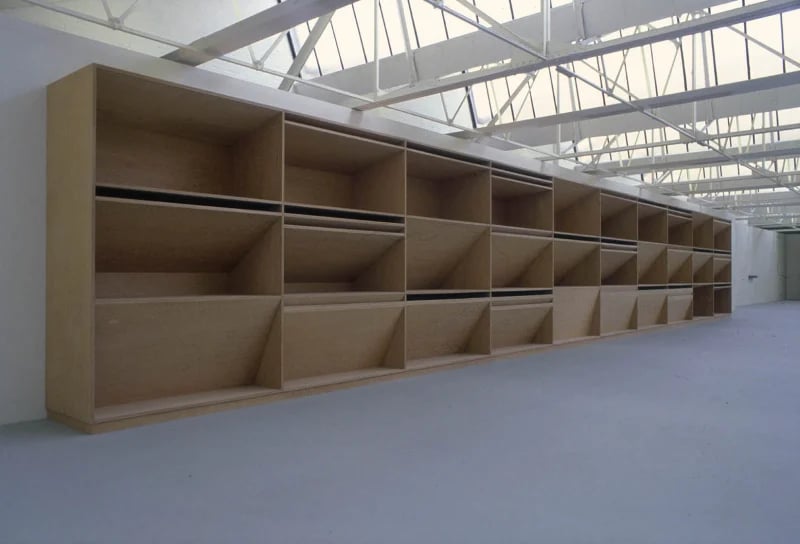
Donald Judd (1928–1994) began as a painter before turning to three-dimensional work in 1962. By 1963 he had made his first "specific objects": box-like forms, often open or with internal divisions, made from wood, metal, or plexiglass. He had them fabricated by industrial workshops rather than making them himself; the hand of the artist was absent. His stacks of identical units, spaced at regular intervals along a wall, became one of Minimalism's most recognisable images. Untitled (1965), a stack of ten galvanised iron boxes, each 9 by 40 by 31 inches, creates a vertical rhythm that the viewer reads both as a single work and as a series.
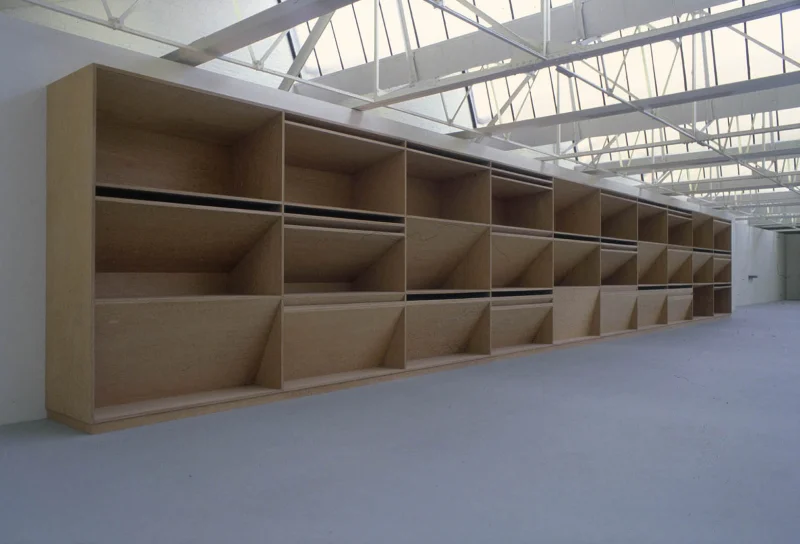
Donald Judd installation at Saatchi Gallery (Source)

Judd later worked in Marfa, Texas, where he established the Chinati Foundation in 1986. The foundation houses large-scale installations in converted military buildings; the work is meant to be experienced in relation to the desert light and the vast space. Judd was interested in colour, too; his anodised aluminium pieces from the 1980s use red, blue, and green that shift with the changing light. He rejected the term "Minimalism," preferring to describe his work as "the simple expression of complex thought." But his insistence on the object, on fabrication rather than craft, and on the primacy of the viewer's perception placed him at the centre of the movement.
Carl Andre: Floor Pieces and Materials
Carl Andre (b. 1935) began as a sculptor in the late 1950s, working with wood. By the mid-1960s he had turned to floor pieces: arrangements of identical units (bricks, metal plates, timber blocks) laid directly on the floor. Equivalent VIII (1966), better known as "the bricks," consisted of 120 firebricks arranged in a rectangle. When the Tate Gallery acquired it in 1972, the press accused the institution of wasting public money. Andre's point was that the arrangement of ordinary materials could create a new kind of sculpture: one you could walk on, one that defined space without occupying it vertically. His metal plate pieces, such as 37th Piece of Work (1969), allowed the viewer to move across the work; the sculpture became a kind of platform or field.
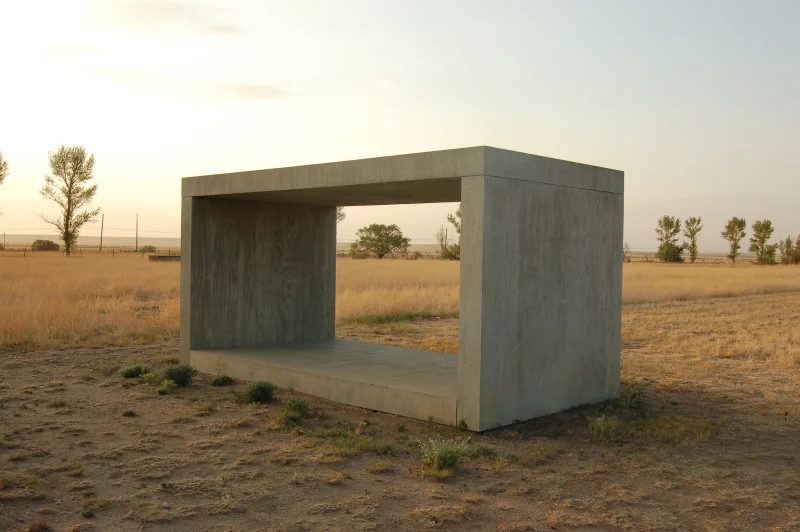
Donald Judd concrete blocks (Source)

Andre emphasised the physical nature of his materials: the weight of metal, the texture of brick, the way light fell on a surface. He rejected metaphor; the work was what it was. His Lever (1966) was a line of 137 firebricks extending across the gallery floor. The title suggested a simple mechanical principle; the work itself was nothing more than bricks in a row. For practitioners interested in the power of arrangement, repetition, and the presence of simple forms in space, Andre's work offers a secular analogue: meaning through placement rather than symbol.
Dan Flavin: Fluorescent Light
Dan Flavin (1933–1996) began to use fluorescent tubes as his primary medium in 1963. His work was Minimalism in the sense that it reduced form to the most basic unit: a standard industrial light fixture. But light also transformed the space around it; the walls, the floor, and the air took on the colour of the tubes. Monument for V. Tatlin (1964) was a series of seven vertical white fluorescents, arranged in a progression; it referred to the Russian Constructivist Vladimir Tatlin but was made from nothing but shop-bought hardware. Untitled (to you, Heiner, with admiration and affection) (1973) used green and pink tubes to create a corner piece that flooded the space with coloured light.
Flavin's work raised questions about where the art ended and the environment began. The tubes were mass-produced; anyone could buy them. The "art" lay in the selection, arrangement, and the way the light modified the room. His work has influenced countless installations since; the use of fluorescent or LED light as a sculptural medium is now commonplace. For those interested in the relationship between physical form and immaterial effect (light, atmosphere, presence), Flavin's work remains a key reference.
Robert Morris, Anne Truitt, and Frank Stella
Robert Morris (1931–2018) made grey fibreglass pieces in the mid-1960s that seemed to change as the viewer moved; their shape was indeterminate from any single viewpoint. He also wrote influential essays on Minimalism, arguing that the work's meaning derived from the viewer's experience of scale, duration, and bodily relation to the object. Anne Truitt (1921–2004) made painted wooden columns that stood on the floor; her work was often grouped with Minimalism, though she resisted the label and emphasised the personal and emotional content of her colour choices. Frank Stella (1936–2024) had already made his Black Paintings (1958–60), which reduced painting to repeating bands; his shaped canvases of the 1960s extended the logic of the object into painting itself.
The Critique of Minimalism
Minimalism was attacked from several directions. Some saw it as empty, corporate, or nihilistic. The art historian Michael Fried, in his essay "Art and Objecthood" (1967), argued that Minimalist work depended on the viewer's presence in a way that undermined the autonomy of the art object; it became "theatrical" rather than genuinely artistic. The Minimalists themselves were often unconcerned with such distinctions. They wanted to make work that was present, that demanded a bodily response, and that refused to signify anything beyond itself. The debate shaped the reception of the movement and continues to inform discussions of installation and participatory art.
Agnes Martin and the Pencil Line
Agnes Martin (1912–2004) was often grouped with the Minimalists, though she rejected the label. She made paintings of subtle grids and bands, drawn in pencil on gessoed canvas, with pale colours that seemed to hover between presence and absence. Her work shared Minimalism's reduction and seriality, but it had a meditative, almost spiritual quality that set it apart. Martin wrote about beauty, inspiration, and the need to empty the mind. Her influence extended beyond painting to later generations interested in quiet, repetitive mark-making. For practitioners who value simplicity as a path to attention, Martin's work offers a bridge between Minimalism's objecthood and a more contemplative tradition.
Legacy
By the early 1970s, many Minimalist artists had moved in new directions. Judd continued to refine his language of boxes and stacks; Andre and Flavin pursued their chosen materials. The movement had established that reduction could create intensity: a single fluorescent tube, a row of bricks, a stack of boxes could demand attention in a way that busier work might not. The body's relation to the object, the way scale and spacing affected perception, the refusal of metaphor: these became part of the vocabulary of late twentieth-century art. Minimalism also influenced design, architecture, and music. The clean lines of modernist furniture, the austerity of certain public buildings, and the repetitive structures of minimalist composition (Steve Reich's Music for 18 Musicians, from 1976, is a key example) all share something with the visual movement. The movement's influence spread to architecture, design, and music (the term "minimalist" is now applied to composers such as Steve Reich and Philip Glass). For practitioners interested in ritual space, altar arrangement, or the power of simple geometric forms, Minimalism offers a twentieth-century precedent: the idea that reduction can intensify presence, and that the body's relation to the object matters as much as the object itself.
Related Resources
- Abstract Expressionism – The movement Minimalism reacted against
- Constructivism – Earlier use of industrial materials and geometric form
- Bauhaus – Modernist design and reduction
- Introduction to Art History
Related in this topic
More from Occult Art History & Symbolism — Start Here.
Symbolism
Discover the meaning of symbolism! Learn its origins, art and famous symbolist painters. Find hidden emotions in art.
Naïve Art
Naïve art: untrained artists created startling originality through simplified forms, vivid colors, and unfiltered imagination.
Art Informel
Art Informel: the European parallel to Abstract Expressionism. Dubuffet, Tàpies, and the art of the unformed and the raw.
Street Art
Street Art: from subway tags to gallery walls. Banksy, Keith Haring, and the art that reclaims public space.
You Might Also Like
Art Informel
Art Informel: the European parallel to Abstract Expressionism. Dubuffet, Tàpies, and the art of the unformed and the raw.
Street Art
Street Art: from subway tags to gallery walls. Banksy, Keith Haring, and the art that reclaims public space.