Period: 1913 to early 1930s
Characteristics: Geometric abstraction; industrial materials; art as construction; integration with architecture and design; commitment to social revolution
Events: Tatlin's counter-reliefs (1914–15); October Revolution (1917); Monument to the Third International (1919–20); Productivist turn (1921)
Art and Revolution
Constructivism emerged in Russia in the years before and after the October Revolution of 1917. Its practitioners sought to break with the old art of illusion and representation and to build a new art suited to a new society. They used industrial materials (metal, wood, glass, sometimes found objects) and emphasised construction over composition. The term "Constructivism" came into use around 1920; it distinguished this work from the more intuitive approaches of earlier Russian avant-garde movements such as Suprematism. The Constructivists believed that art could serve the revolution by producing useful objects: posters, clothing, furniture, architecture. By the late 1920s, the Soviet state had turned against the avant-garde, and many Constructivists were marginalised or forced to adapt. But the movement's impact on design, typography, and the idea of art's social role has lasted.
The sculptor Vladimir Tatlin (1885–1953) is often credited with founding Constructivism. He had visited Paris in 1913 and seen Picasso's cubist constructions; back in Moscow he began to make three-dimensional works from wood, metal, and other materials. These "counter-reliefs" or " Corner Counter-Reliefs" (1914–15) hung in corners or projected from walls; they rejected the picture plane in favour of real space and real materials. Tatlin insisted that the work was built, not composed; the artist was a constructor, not a composer.
Tatlin's Tower
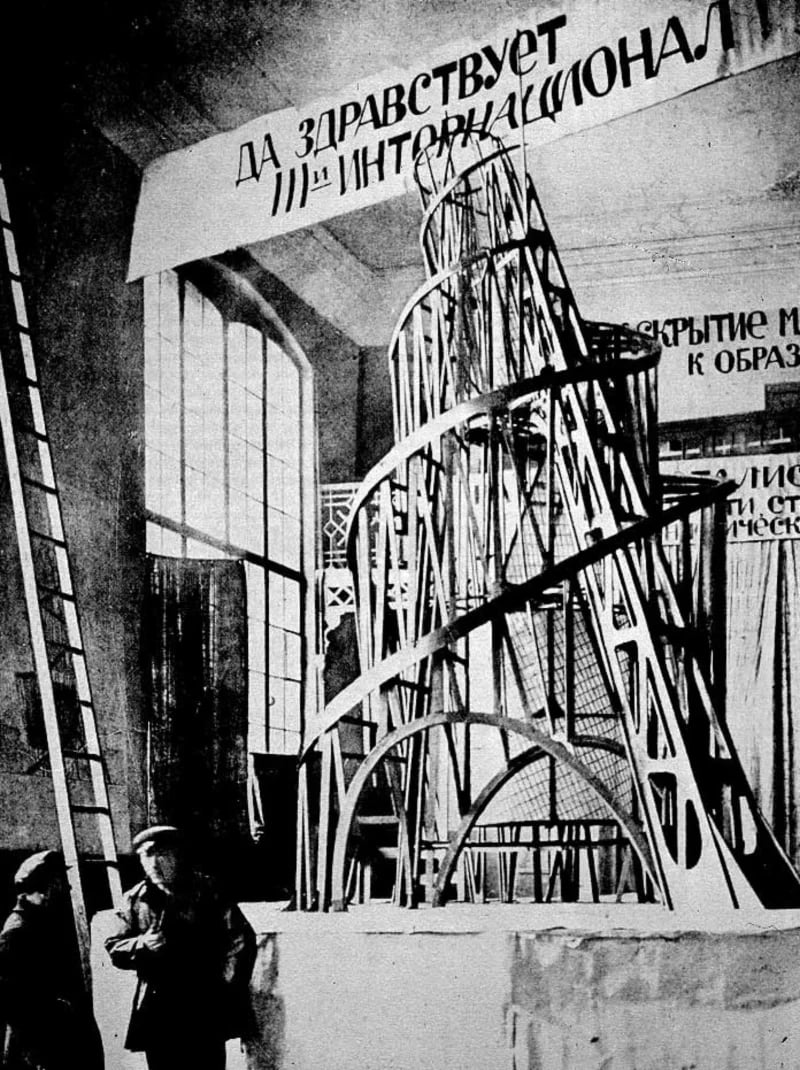
In 1919 Tatlin was commissioned to design a monument to the Third International, the Communist organisation founded in that year. The resulting project, usually called Tatlin's Tower, was never built; only models exist. The design was a spiralling iron framework, over 400 metres tall, that would have contained three rotating glass volumes: a cube (for legislative assemblies), a pyramid (for executive bodies), and a cylinder (for information and propaganda). Each volume would rotate at a different speed: the cube once a year, the pyramid once a month, the cylinder once a day. The tower was meant to be both a symbol of the new world order and a functioning building. It combined the dynamism of modern machinery with utopian politics.

Model of Tatlin's Monument to the Third International, 1919 (Source)

The tower was technically unfeasible and politically controversial. Some saw it as the apex of revolutionary aesthetics; others as wasteful fantasy. Tatlin continued to work on models and variants until the mid-1920s. The project has haunted architecture and design ever since; countless exhibitions have reconstructed the model, and its spiral form has been cited as an influence on later tower designs. For practitioners interested in the relationship between visionary form and political aspiration, Tatlin's Tower remains a landmark.
The Productivist Turn
In 1921 a group of Constructivists, including Aleksandr Rodchenko and Varvara Stepanova, declared that they would abandon "art for art's sake" and become "Productivists." They would work in factories, design useful objects, and serve the new Soviet state directly. Rodchenko (1891–1956) had begun as a painter, making non-objective compositions with geometric shapes. By 1921 he had renounced painting and turned to photography, typography, and design. His poster for Dziga Vertov's film Kino-Glaz (1924) used bold diagonal composition and stark contrast; his magazine layouts for LEF and Novyi LEF became models for modernist graphic design. He also designed workers' clubs, textiles, and furniture. His folding chair of 1925 was meant for mass production; the aesthetic was reduced to function and structure.
Liubov Popova (1889–1924) moved from Cubo-Futurist painting to pure geometric abstraction and then to textile and costume design. Her Painterly Architectonics series (1916–18) used overlapping planes of colour in dynamic equilibrium. Later she designed patterns for the First State Textile Printing Factory in Moscow. She died of scarlet fever in 1924, at the height of her Productivist phase. Her work exemplifies the Constructivist belief that the same formal principles could apply to painting, fabric, and stage design.
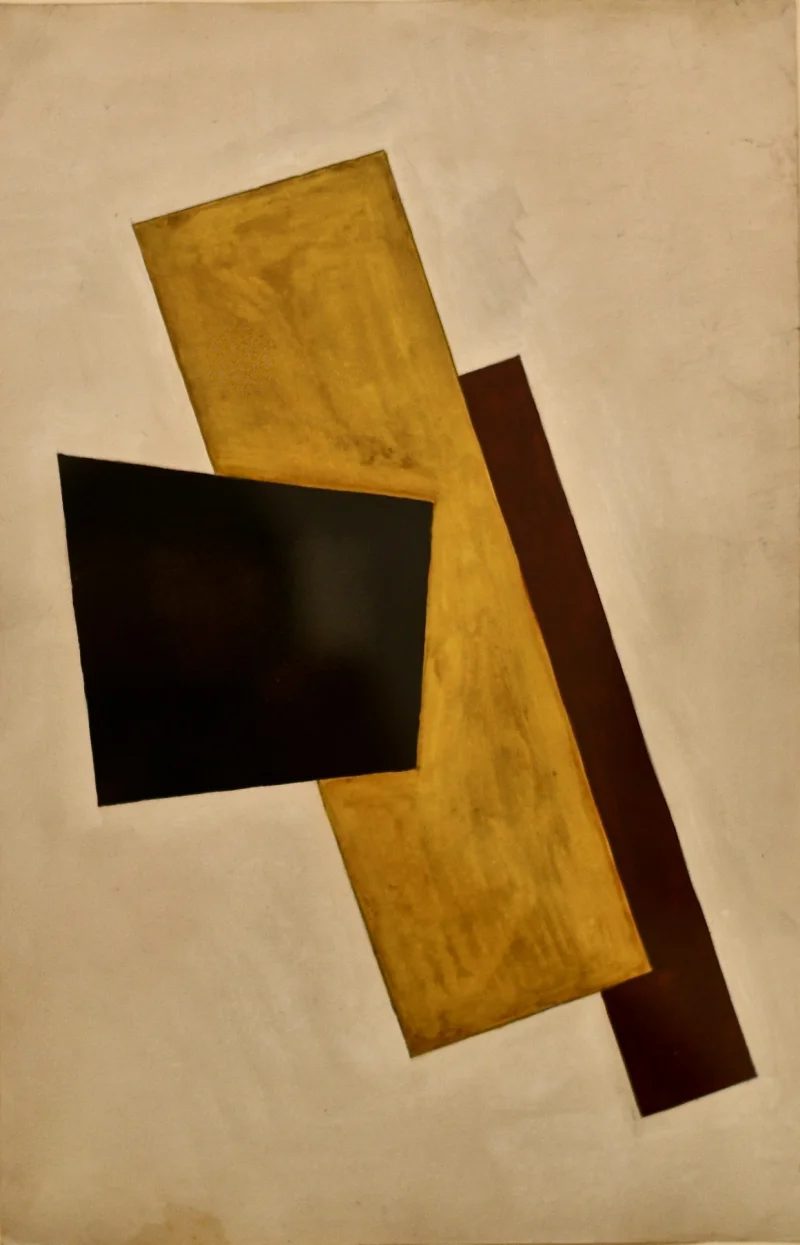
Composition by Liubov Popova, 1917 (Source)
_-_Liubova_Popova_(1889-1924)_(45056449312).jpg)
Rodchenko, El Lissitzky, and Propaganda
Aleksandr Rodchenko's photography from the late 1920s used extreme angles, close-ups, and diagonal compositions to create a new visual language for the Soviet subject. His portrait of his mother (1924) and his images of workers and factories were meant to show the new Soviet citizen. El Lissitzky (1890–1941) had trained as an architect; his "Prouns" (Projects for the Affirmation of the New) were geometric compositions that hovered between painting and spatial design. He worked in Germany and Switzerland in the 1920s, spreading Constructivist ideas to the West. His book Of Two Squares (1922) was a Suprematist story for children; his exhibition designs used dynamic spatial arrangements that influenced later display design. Gustav Klutsis (1898–1938) made photomontage posters for the Soviet state; his dynamic compositions combined photography with bold typography. He was executed in 1938 during the Great Purge.
Stepanova, Klutsis, and the Graphic Legacy
Varvara Stepanova (1894–1958) worked closely with Rodchenko and designed textiles, costumes, and typography. Her "process clothing" of 1923 proposed garments suited to specific work tasks; the aesthetic was functional and geometric. She also made photomontages and contributed to the design of the Soviet pavilion at the Paris Expo of 1925. Gustav Klutsis, who had trained as a painter, turned to photomontage in the 1920s. His posters combined photographs of workers, machinery, and leaders with bold typography and geometric shapes. The images were meant to inspire and instruct; they were propaganda in the strict sense of the word (things to be propagated). Klutsis was arrested in 1938 and executed; his work was largely forgotten until the late Soviet period. The graphic style he helped to create, however, influenced poster design throughout the twentieth century.
The End of Constructivism
By the early 1930s, Soviet cultural policy had turned toward Socialist Realism. The avant-garde was denounced as bourgeois formalism; abstract art was suppressed. Many Constructivists adapted or fell silent. Rodchenko continued to work in design and photography but under increasing constraint. Tatlin turned to theatre design and later to glider design; he spent his last years in obscurity. The movement's legacy was carried abroad by emigrés and by exhibitions such as the 1922 Erste Russische Kunstausstellung in Berlin. The Bauhaus, De Stijl, and later modernist movements all absorbed Constructivist ideas. The belief that design could reshape society, that geometry and industry could serve a collective project: these ideas outlived the movement itself. The Constructivists had asked whether art could be useful, whether the artist could be a worker, and whether form could serve revolution. The answers they gave were partial and often tragic; the revolution did not deliver what they hoped. But the questions remain. Every time a designer considers the social impact of their work, every time an artist asks how form might serve a community, the Constructivist legacy is present. The movement also left a rich visual archive: Rodchenko's posters, Tatlin's tower models, Popova's textiles. These works continue to inspire designers, architects, and artists who seek a union of rigor and utopian vision.
For practitioners interested in the power of geometric form, the fusion of art and utility, or the relationship between vision and political change, Constructivism offers a historical example. The movement asked what art might become when it ceased to represent and began to construct. The answers were various, and often tragic; but the question remains relevant wherever form and function meet.
Suprematism and Constructivism: A Brief Distinction
Constructivism is sometimes confused with Suprematism, the movement founded by Kazimir Malevich in 1915. Suprematism used simple geometric forms (squares, circles, lines) against white or coloured backgrounds; it was purely abstract and had no immediate utilitarian aim. Malevich's Black Square (1915) is the movement's emblem. Constructivism, by contrast, emphasised materials, construction, and use. Tatlin and Malevich were rivals; their 1915 exchange at the "0,10" exhibition in Petrograd marked a split in the Russian avant-garde. Constructivists saw Suprematism as too idealistic; Suprematists saw Constructivism as too material. The distinction mattered for the artists involved, and it helps to clarify what made Constructivism unique: not abstract form for its own sake, but form in service of a new society.
Related Resources
- Bauhaus – German design school influenced by Constructivism
- Minimalism – Later use of geometric form and industrial materials
- Abstract Expressionism – Postwar reaction and contrast
- Introduction to Art History
Related in this topic
More from Occult Art History & Symbolism — Start Here.
Symbolism
Discover the meaning of symbolism! Learn its origins, art and famous symbolist painters. Find hidden emotions in art.
Naïve Art
Naïve art: untrained artists created startling originality through simplified forms, vivid colors, and unfiltered imagination.
Art Informel
Art Informel: the European parallel to Abstract Expressionism. Dubuffet, Tàpies, and the art of the unformed and the raw.
Street Art
Street Art: from subway tags to gallery walls. Banksy, Keith Haring, and the art that reclaims public space.
You Might Also Like
Art Informel
Art Informel: the European parallel to Abstract Expressionism. Dubuffet, Tàpies, and the art of the unformed and the raw.
Street Art
Street Art: from subway tags to gallery walls. Banksy, Keith Haring, and the art that reclaims public space.