Period: 1960s
Characteristics: Geometric patterns; optical illusion and afterimage; black and white or limited colour; systematic composition; viewer's perception as subject
Events: "The Responsive Eye" exhibition, MoMA (1965); Bridget Riley wins Venice Biennale prize (1968)
Art That Watches Back
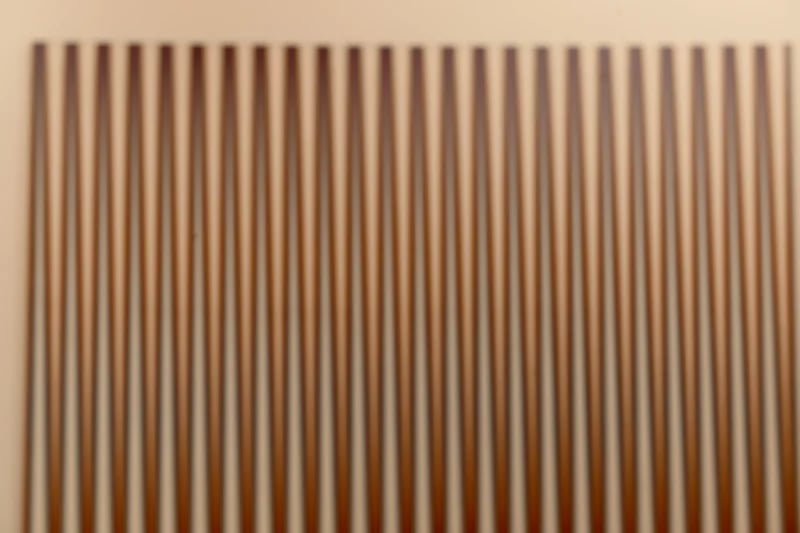
Op Art (short for "optical art") emerged in the 1960s as a movement concerned with visual perception. Its practitioners made works that seemed to move, vibrate, or flicker when viewed; they used geometric patterns, often in black and white, to create effects of afterimage, moiré, and apparent motion. The viewer's eye became the subject of the work: the art did not represent something so much as it triggered a response in the retina and the brain. Op Art was popular, controversial, and short-lived; by the end of the decade it had been absorbed into design, fashion, and advertising. But its best examples remain powerful: they make perception itself visible.
The term "Op Art" was popularised by the exhibition "The Responsive Eye" at the Museum of Modern Art in New York in 1965. The show included work by Bridget Riley, Victor Vasarely, Richard Anuszkiewicz, and Jesús Rafael Soto. It drew huge crowds and was widely criticised as gimmicky. Op Art patterns soon appeared on dresses, album covers, and posters; the movement's aesthetic became synonymous with "the sixties." The artists themselves were often ambivalent about this success; they saw their work as serious experiments in perception, not as decorative fashion.
Bridget Riley: The Master of Vibration
Bridget Riley (b. 1931) is the artist most closely associated with Op Art. She began to make black and white works in the early 1960s, using lines, curves, and geometric shapes to create effects of movement and instability. Movement in Squares (1961) uses a sequence of squares that appear to contract and expand. Fall (1963) uses undulating parallel lines to suggest a cascading motion. Cataract 3 (1967) creates a shimmering, almost nauseating effect through repeated curves. Riley's work can cause dizziness or visual discomfort; she has acknowledged that some viewers find it difficult to look at.
Riley introduced colour in the late 1960s. Orient IV (1970) uses bands of colour that seem to shift and overlap. Her later work has continued to explore perception, though with a softer, more lyrical palette. Riley has resisted the "Op Art" label; she prefers to describe her work as concerned with "the nature of looking." She has cited Seurat and the Pointillists as influences, and she has written about the relationship between making and seeing. For practitioners interested in the power of pattern, repetition, and the way form can affect the body, Riley's work offers a direct experience: stand in front of one of her paintings and feel your eyes respond.
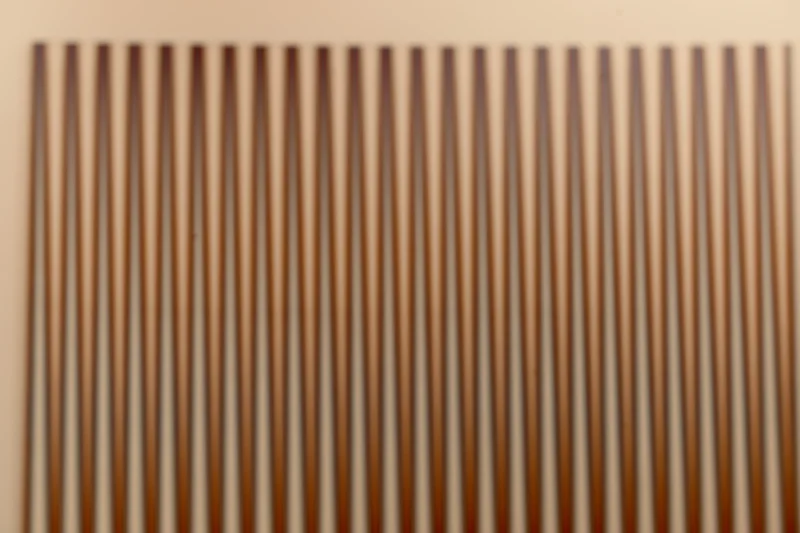
Orient IV by Bridget Riley (Source)
_-_Bridget_Riley_(1931)_(44210674930).jpg)
Victor Vasarely: The Father of Op Art
Victor Vasarely (1906–1997) was a Hungarian-born artist who worked in France. He had trained in graphic design and began to make optical works in the 1950s. His Zebras (1938) used black and white stripes to create a moiré effect; it is often cited as an early Op Art work. By the 1960s he had developed a vocabulary of geometric forms: circles, squares, and rhomboids arranged in grids that seemed to bulge or recede. His Vega series used distorted grids to create the illusion of three-dimensional space on a flat surface.
Vasarely believed that art should be democratic and reproducible. He created multiples and prints so that his work could reach a wide audience. He also designed architecture and envisioned a "plastic alphabet" that could be used across media. His work was more decorative than Riley's; it has been criticised for prioritizing effect over substance. But his influence on graphic design and popular culture was vast. Op Art patterns in fashion, advertising, and album covers often trace back to Vasarely.
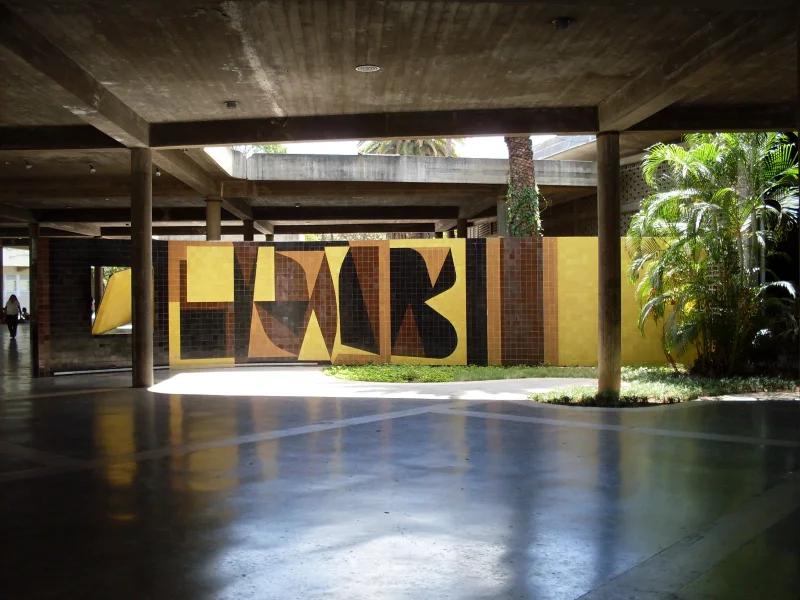
Mural by Victor Vasarely (Source)

Richard Anuszkiewicz, Jesús Rafael Soto, and Others
Richard Anuszkiewicz (1930–2020) was an American painter who studied with Josef Albers. His work used concentric squares and colour relationships to create optical effects. All Things Do Live in the Three (1964) uses nested squares in red and green to create an intense afterimage. Jesús Rafael Soto (1923–2005) made three-dimensional works that used hanging threads or rods to create moiré effects as the viewer moved. His "Penetrables" invited viewers to walk through installations of hanging strings. Both artists extended Op Art beyond the flat canvas.
The movement also included Yaacov Agam, who made lenticular works that changed with the viewer's position, and Julian Stanczak, whose precise geometric compositions explored colour interaction. Op Art's emphasis on perception and systematic method connected it to Minimalism and to the emerging field of perceptual psychology. The movement asked: what happens when we look? The answer was that looking is not passive; it is an activity that the work can shape and disturb.
The Responsive Eye and the Backlash
"The Responsive Eye" (1965) at MoMA drew record crowds but also sharp criticism. Art critics dismissed Op Art as gimmicky, as addressing only the retina and not the mind. The movement was accused of being decorative, commercial, and empty. Riley, in particular, was frustrated by the way her work was reproduced and commodified; she had no control over the dresses and posters that used her patterns. The relationship between Op Art and design was double-edged: the style reached a mass audience, but it also lost some of its critical edge. By the end of the 1960s, Op Art had been absorbed into the mainstream. Its best works, however, retain their power to destabilise perception. Standing before a Riley or a Vasarely, the viewer cannot simply "take it in"; the work insists on its own activity, on the way it acts on the body. That insistence is what makes Op Art more than decoration.
Legacy
Op Art's popularity in the 1960s was both a triumph and a problem. The works were reproduced everywhere; they became clichés. The movement was dismissed as gimmicky, as "retinal" art that addressed only the eye and not the mind. But the best Op Art retains its power. Riley's paintings, in particular, continue to challenge viewers; they cannot be fully captured in reproduction. The movement's interest in perception, in the body's response to visual stimulus, and in the way pattern can produce affect: these concerns have returned in contemporary art and design. For practitioners interested in the relationship between form and perception, or in the idea that art can act directly on the nervous system, Op Art offers a clear precedent.
Related Resources
- Minimalism – Shared interest in geometric form and viewer response
- Neo-Impressionism – Earlier exploration of optical effects
- De Stijl – Geometric abstraction and systematic composition
- Introduction to Art History
Related in this topic
More from Occult Art History & Symbolism — Start Here.
Symbolism
Discover the meaning of symbolism! Learn its origins, art and famous symbolist painters. Find hidden emotions in art.
Naïve Art
Naïve art: untrained artists created startling originality through simplified forms, vivid colors, and unfiltered imagination.
Art Informel
Art Informel: the European parallel to Abstract Expressionism. Dubuffet, Tàpies, and the art of the unformed and the raw.
Street Art
Street Art: from subway tags to gallery walls. Banksy, Keith Haring, and the art that reclaims public space.
You Might Also Like
Art Informel
Art Informel: the European parallel to Abstract Expressionism. Dubuffet, Tàpies, and the art of the unformed and the raw.
Street Art
Street Art: from subway tags to gallery walls. Banksy, Keith Haring, and the art that reclaims public space.