
Period: 1916 – c. 1924
Characteristics: Anti-art stance; use of chance and accident; collage and assemblage; mockery of bourgeois values; rejection of logic and reason
Events: Cabaret Voltaire opens (Zurich, 1916), Duchamp's "Fountain" rejected (1917), Berlin Dada (1918–20), Paris Dada (1920–24)
The Birth of Anti-Art
Dada emerged in Zurich in 1916, in the midst of the First World War. A group of émigrés and exiles (among them Hugo Ball, Emmy Hennings, Tristan Tzara, Marcel Janco, and Richard Huelsenbeck) gathered at the Cabaret Voltaire to perform, exhibit, and provoke. The name "Dada" was supposedly chosen at random from a dictionary; it means "hobby horse" in French and "yes yes" in Romanian, but its meaning was deliberately absurd. The movement declared war on reason, on the art that had failed to prevent the war, and on the bourgeois culture that had produced the slaughter.
Dada had no unified style. It included performance (sound poetry, simultaneous readings, chaos), visual art (collage, photomontage, readymades), and manifestos that mocked the very idea of the manifesto. The only constant was negation: Dada was against. Against the academy, against logic, against good taste, against the idea that art could redeem or explain anything. For practitioners interested in the use of chance in magic, in the breaking of convention as ritual act, or in the power of the absurd to disrupt habitual thinking, Dada offers a historical precedent. Sometimes the most effective challenge to a stuck situation is to refuse to play by its rules.
Zurich: Cabaret Voltaire and Sound Poetry
Hugo Ball (1886–1927) founded the Cabaret Voltaire in February 1916. The space hosted performances that combined nonsense verse, noise, and provocation. Ball developed "sound poetry," poems that abandoned semantic meaning for pure phonetic effect. Dressed in a cardboard costume that made him look like an obelisk, he recited the "Karawane" and other pieces. The audience was baffled or delighted. The war was raging; in neutral Switzerland, a handful of artists were dismantling language itself.
Tristan Tzara (1896–1963) became Dada's chief publicist. He wrote manifestos that contradicted themselves, organised chaotic soirées, and promoted the use of chance in composition. His instruction for making a Dada poem (cut words from a newspaper, draw them from a bag at random, arrange in order) became legendary. The method paralleled divinatory techniques: randomness as a way to bypass the rational mind. Tzara would later join the Surrealists before breaking with Breton.
Marcel Duchamp and the Readymade
Marcel Duchamp (1887–1968) was the most influential Dada-associated artist, though he kept his distance from groups and labels. In 1917, he submitted a porcelain urinal, signed "R. Mutt," to the Society of Independent Artists in New York. Titled Fountain, it was rejected by the hanging committee despite the exhibition's policy of accepting all submissions. The gesture asked: what makes something art? Is it the object, the context, or the act of designation? Duchamp had already made other "readymades," manufactured objects selected and presented as art, including a bottle rack and a snow shovel. Fountain became the most famous.
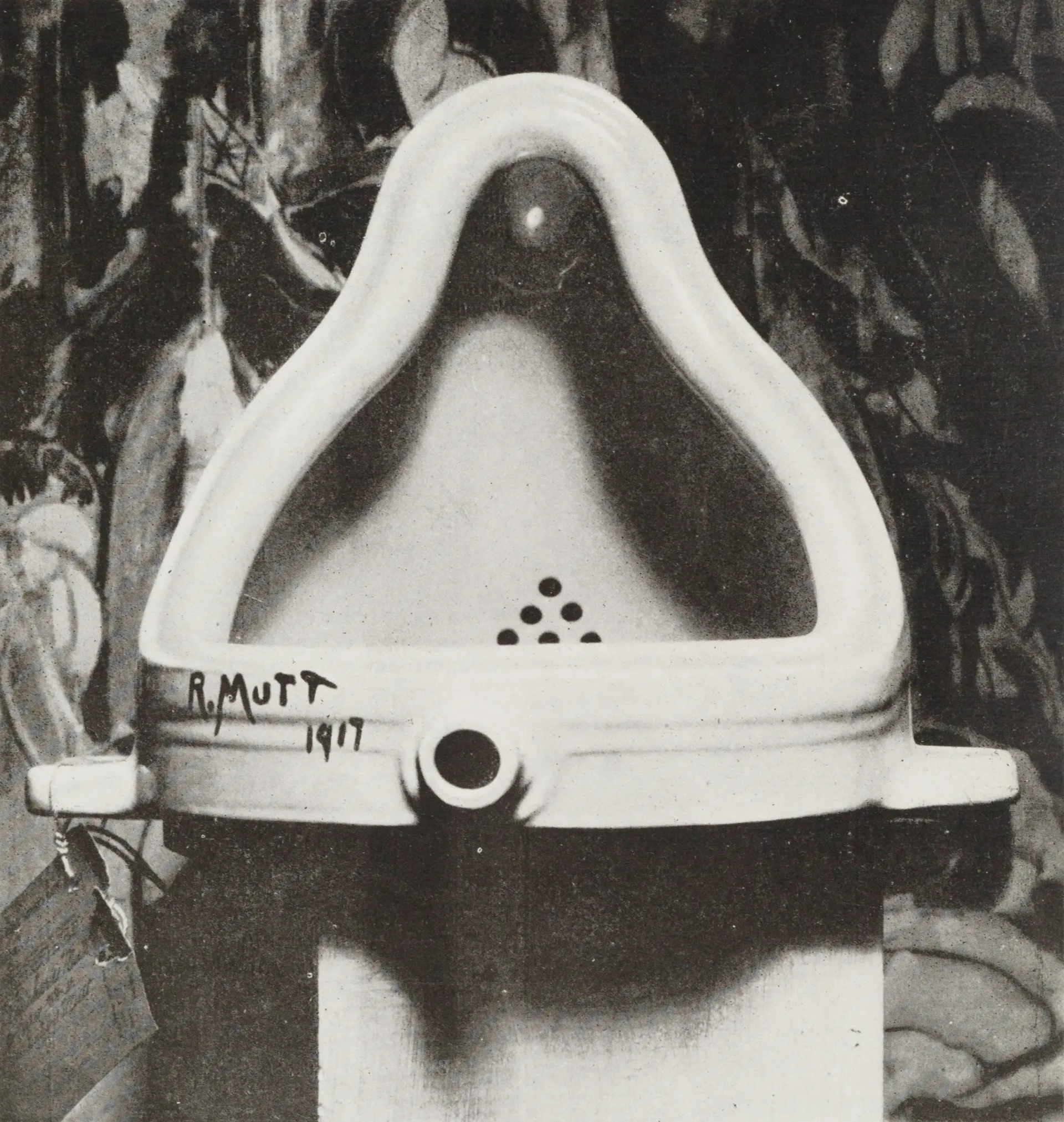
Fountain by Marcel Duchamp, 1917 (Source)

Duchamp's readymades challenged the idea that art required skill, beauty, or originality. The artist's role was reduced to choosing and naming. The implications would ripple through the rest of the century: Pop Art, Conceptual Art, and appropriation all owed something to Duchamp. For practitioners who work with ordinary objects in ritual, who consecrate the commonplace or find the sacred in the mundane, the readymade has a parallel. Anything can carry meaning if we assign it.
Berlin Dada: Politics and Photomontage
In Berlin, Dada took a more overtly political turn. George Grosz, John Heartfield, and Raoul Hausmann used photomontage (cutting and pasting photographs from newspapers and magazines) to create savage critiques of the Weimar Republic, the military, and capitalism. Heartfield's work was explicitly communist; his images appeared on magazine covers and in anti-fascist campaigns. The Berlin Dadaists saw art as a weapon. Their mockery was not aimless; it had targets.
Hannah Höch (1889–1978) was the only woman in the Berlin group, and she had to fight for inclusion. Her photomontages critiqued gender roles, the "New Woman" of the 1920s, and the hypocrisy of bourgeois marriage. Cut with the Kitchen Knife (1919) is a sprawling composition that mixes political figures, machinery, and female dancers. Höch's work has been reassessed in recent decades as a major contribution to both Dada and feminist art history.
New York and Paris
Dada also flourished in New York, where Duchamp, Francis Picabia, and Man Ray produced work that mixed mechanical imagery, chance, and provocation. Picabia's "machine" drawings parodied the worship of technology. Man Ray developed the rayograph, photographs made without a camera by placing objects on light-sensitive paper. The result was ethereal, quasi-abstract imagery that influenced later Surrealist photography.
In Paris, Dada merged with Surrealism. Breton, who had been involved in Paris Dada, gradually turned toward a more positive programme. The famous "Dada funeral" of 1921, a mock trial of Maurice Barrès and a symbolic burial of Dada, marked the transition. By 1924, Breton had published the first Surrealist Manifesto; Dada was over, but its methods lived on.
Francis Picabia and Machine Art
Francis Picabia (1879–1953) moved between Dada, Surrealism, and abstraction. His "mechanomorphic" drawings of the 1910s and 20s used mechanical forms (gears, pistons, diagrams) to represent human relationships. A portrait might be a collection of cogs and springs; the effect was satirical and unsettling.
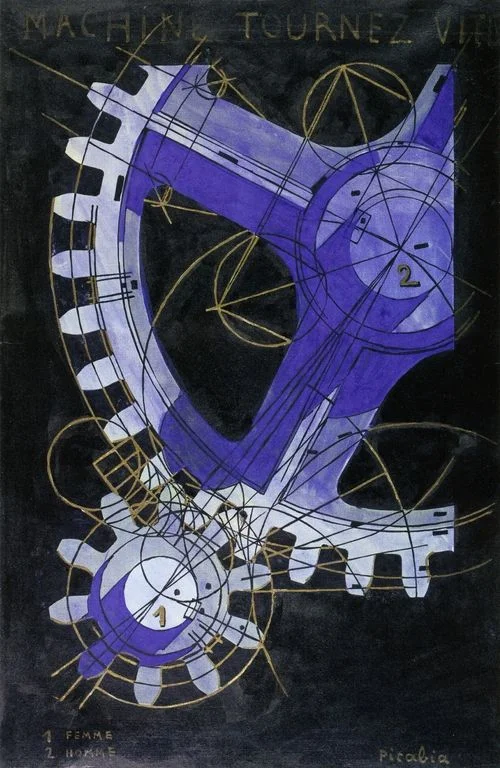
Machine tournez vite by Francis Picabia, 1917 (Source)

Picabia mocked the worship of the machine while also finding a strange beauty in it. His work influenced both Dada's anti-art stance and later Pop Art's fascination with mechanical reproduction. He was a provocateur to the end: in his final years he produced kitsch paintings of nude women that deliberately offended the avant-garde that had once admired him.
Chance, Divination, and the Irrational
Dada's use of chance had multiple sources. Tzara's cut-up poems drew on a tradition of poetic experimentation. Duchamp used chance in works like Three Standard Stoppages (1913–14), where he dropped metre-long threads and used their random curves to create new units of measurement. Hans Arp arranged torn papers by chance and pasted them where they fell. The Surrealists would develop these methods further (the exquisite corpse, automatic writing), but Dada got there first.
The parallel with divination is suggestive. Tarot, I Ching, and other systems use randomness to access the non-rational. The Dadaists did not frame their work in spiritual terms; they were more likely to invoke nonsense or anti-sense. But the structural similarity remains: when reason and habit fail, introducing chance can open new possibilities. Dada asked what would happen if we stopped making sense. Sometimes the answer is: something unexpected.
Sophie Taeuber-Arp and the Neglected Dadaists
Sophie Taeuber-Arp (1889–1943) was a central figure in Zurich Dada but has often been overshadowed by her husband Jean Arp. She made geometric compositions, textiles, puppets for the Cabaret Voltaire, and Dada heads, abstract sculptures that could be worn. Her work bridged fine art and design; she taught at the applied arts school in Zurich. She was killed by a stray carbon monoxide leak in 1943. Her geometric abstraction and her integration of art with everyday objects make her a precursor to the Bauhaus and to later minimalist tendencies. The recent reassessment of women in Dada has restored her to visibility.
Legacy
Dada lasted barely a decade, but its influence has been enormous. It legitimised anti-art, the readymade, performance, and the use of chance. It showed that art could be a form of critique rather than celebration. Its descendants include Fluxus, Situationism, punk, and much of contemporary conceptual and participatory art. The Dada spirit (sceptical, irreverent, willing to break things) continues to surface whenever artists refuse to accept the given.
For practitioners who value the irrational, who use chance in ritual, or who seek to disrupt stuck patterns through provocation or play, Dada is a twentieth-century touchstone. It did not offer a spirituality, but it offered a method: sometimes the way through is the way of refusal. Dada's heirs are those who still ask: what if we stopped taking this seriously? What if we introduced chaos where order was expected? The questions are as useful in ritual as in art. When a practice has grown stale, a dose of absurdity can sometimes restore its power.
Related Resources
- Surrealism – The movement that absorbed and transcended Dada
- Cubism – Structural innovations that Dada rejected and reused
- Art Brut – Another tradition of work outside institutional norms
- Introduction to Art History
Related in this topic
More from Occult Art History & Symbolism — Start Here.
Symbolism
Discover the meaning of symbolism! Learn its origins, art and famous symbolist painters. Find hidden emotions in art.
Naïve Art
Naïve art: untrained artists created startling originality through simplified forms, vivid colors, and unfiltered imagination.
Art Informel
Art Informel: the European parallel to Abstract Expressionism. Dubuffet, Tàpies, and the art of the unformed and the raw.
Street Art
Street Art: from subway tags to gallery walls. Banksy, Keith Haring, and the art that reclaims public space.
You Might Also Like
Art Informel
Art Informel: the European parallel to Abstract Expressionism. Dubuffet, Tàpies, and the art of the unformed and the raw.
Street Art
Street Art: from subway tags to gallery walls. Banksy, Keith Haring, and the art that reclaims public space.