Period: 1917 to 1931
Characteristics: Primary colours (red, yellow, blue) plus black, white, and grey; rectilinear form; horizontal and vertical lines only; asymmetry within balance
Events: De Stijl journal founded (1917); Mondrian's mature style (1920s); Van Doesburg introduces diagonal (1924); movement dissolves (1931)
Art as Universal Language
De Stijl ("The Style") was a Dutch artistic movement founded in 1917. Its leading figures were the painter Piet Mondrian and the artist and theorist Theo van Doesburg. They sought to create a visual language that could express universal harmony, free from the accidents of individual taste or national tradition. The movement's aesthetic was rigorous: primary colours only (red, yellow, blue), plus black, white, and grey; straight lines only (horizontal and vertical); rectangular forms; no curves, no diagonals (at least in Mondrian's version). The result was an art of radical simplification, meant to reflect the underlying structure of reality.
The name "Neoplasticism" (Nieuwe Beelding) was also used; it suggested a "new plastic" or formative principle in art. The movement had connections to Theosophy: Mondrian had been a Theosophist since 1909, and he believed that abstract art could reveal the spiritual structure of the universe. De Stijl was not merely decorative; it was, for its adherents, a form of truth.
Piet Mondrian: From Nature to Rhythm
Piet Mondrian (1872–1944) had painted landscapes and flowers before turning to abstraction. His transition was gradual. By 1914 he was reducing trees and facades to networks of lines. By 1917 he had arrived at the grid: black lines dividing the canvas into rectangles of white or primary colour. His mature style, developed in the 1920s in Paris, used an asymmetrical arrangement of rectangles to create balance through imbalance. No two works are alike; the proportions and placement were arrived at through intuition and revision.
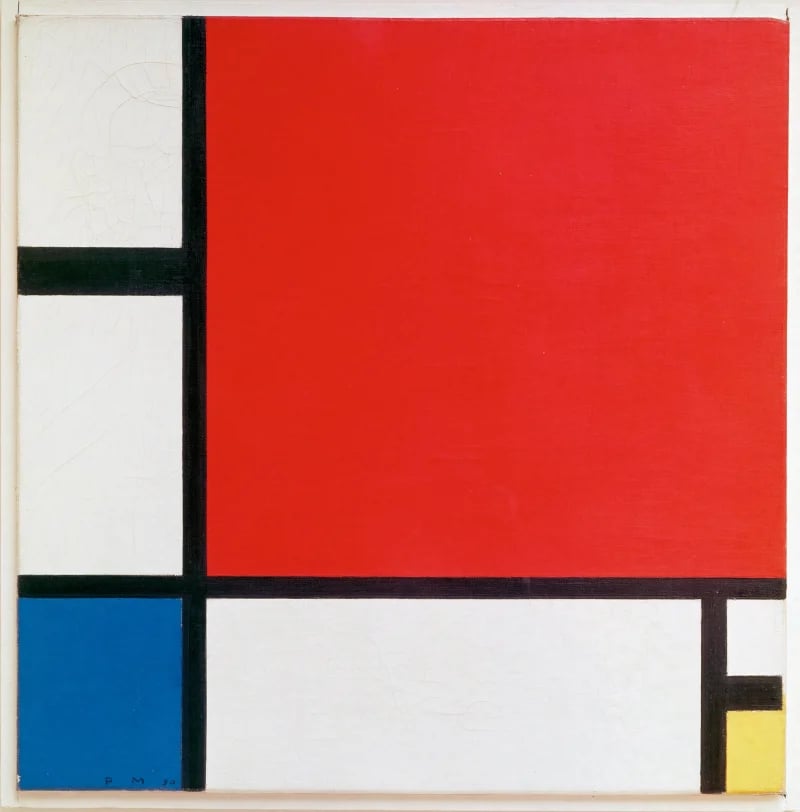
Composition II in Red, Blue, and Yellow (1930) is a classic example. A grid of black lines structures the canvas; most of the space is white, with a large red rectangle, a smaller blue one, and a yellow rectangle. The composition feels balanced but not static; the placement creates a kind of rhythm. Mondrian wrote that he sought to express "dynamic equilibrium," the tension between opposing forces held in harmony. He was a careful, even obsessive worker; he would revise a painting many times before considering it complete. His studio in Paris was a white box with coloured rectangles pinned to the walls; he lived in his art. He fled to London in 1938 and to New York in 1940, escaping the Nazis. In New York he discovered jazz and the Broadway grid; his last works pulse with a new energy. Victory Boogie Woogie (1942–44) was left unfinished at his death; it uses tiny rectangles of colour in a syncopated rhythm. The work suggests that even the most rigorous system could absorb the chaos of the modern city. His later work in New York (1940–44) introduced coloured lines and a more buoyant rhythm; the Broadway Boogie Woogie (1942–43) reflects the grid of Manhattan and the syncopation of jazz.
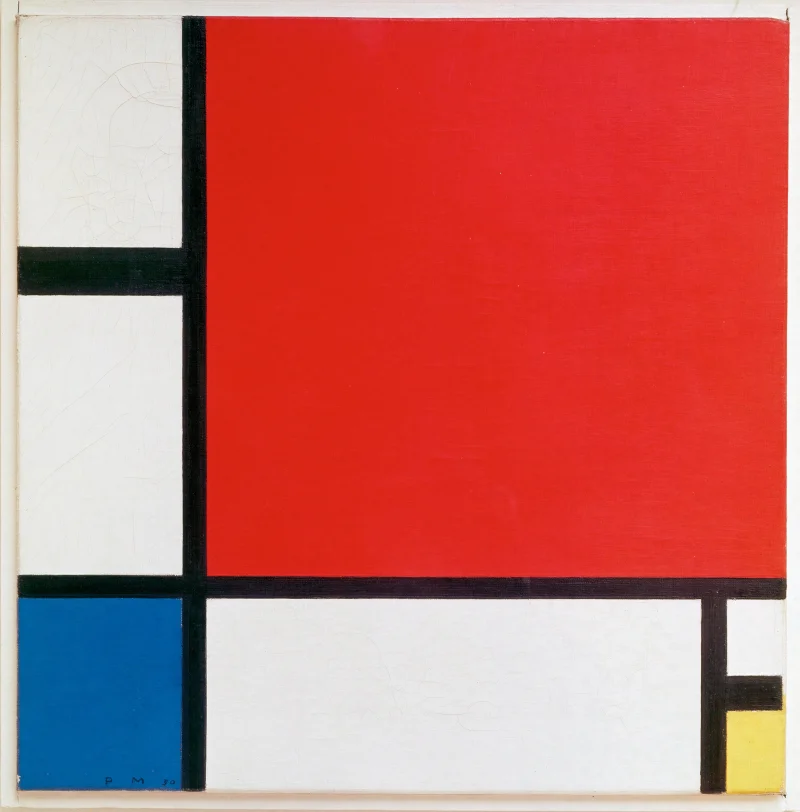
Composition II in Red, Blue, and Yellow by Mondrian, 1930 (Source)

Theo van Doesburg: Architect, Painter, Theorist
Theo van Doesburg (1883–1931) was the movement's organiser and propagandist. He founded the journal De Stijl in 1917 and recruited Mondrian, the architect J. J. P. Oud, and the designer Gerrit Rietveld. Van Doesburg painted, designed, and wrote; his influence extended to architecture and typography. In 1924 he introduced the diagonal into his work, calling it "Elementarism." Mondrian saw this as a betrayal of De Stijl's principles and left the movement. The diagonal, for Mondrian, introduced the arbitrary; for Van Doesburg, it added dynamism.
Van Doesburg's Leaded Glass Composition V (1918) applies De Stijl principles to stained glass: rectangular panes of primary colours and black, arranged in an asymmetrical grid. The work shows how the movement's aesthetic could extend beyond painting into architecture and design. Van Doesburg designed the interior of the Café Aubette in Strasbourg (1926–28) with Sophie Taeuber-Arp and Jean Arp; the result was one of the most complete applications of De Stijl to an architectural space.
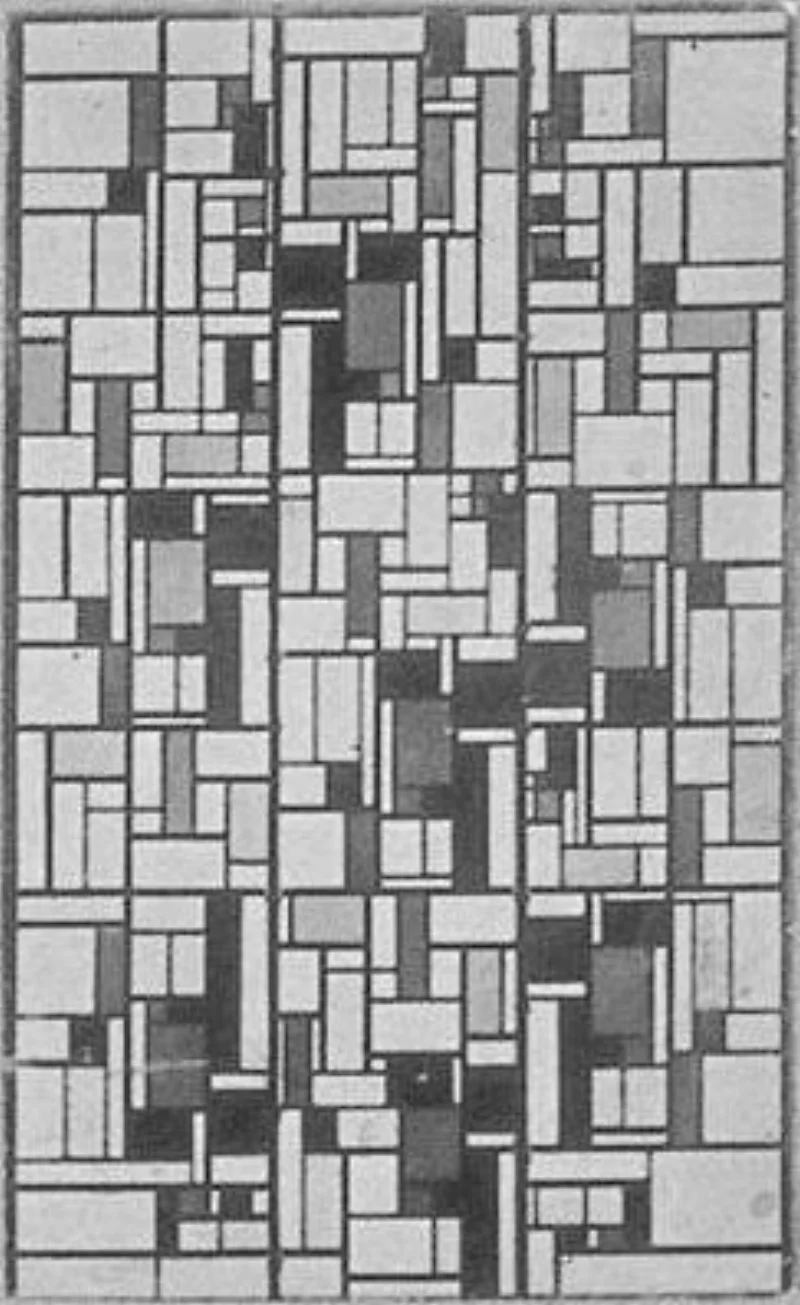
Leaded Glass Composition V by Theo van Doesburg, 1918 (Source)

Gerrit Rietveld and the Red and Blue Chair
Gerrit Rietveld (1888–1964) was a furniture maker who joined De Stijl in 1919. His Red and Blue Chair (1917–18, revised 1923) applies the movement's colour and form to furniture: black arms and legs, blue seat and back, red elements, and yellow end pieces. The chair is not meant to be comfortable in a conventional sense; it is a spatial composition, a manifesto in wood. Rietveld's Schröder House in Utrecht (1924), designed with Truus Schröder-Schräder, is the only building that fully embodies De Stijl principles: primary colours, rectilinear form, open plan, and a radical rethinking of domestic space.
The Legacy of De Stijl
De Stijl dissolved after Van Doesburg's death in 1931. But its influence was vast. The movement's aesthetic shaped the Bauhaus, international Modernism, and generations of graphic design. The grid, the primary colours, the belief that reduction could lead to universality: these became part of the visual vocabulary of the twentieth century. Mondrian's work, in particular, has been endlessly reproduced and parodied; the pattern of coloured rectangles has become a shorthand for "modern art" in popular culture.
For practitioners interested in the power of geometric form, in the idea that simplification can reveal underlying structure, or in the relationship between abstract art and spiritual or philosophical systems, De Stijl offers a clear example. The movement asked whether visual harmony could be reduced to a set of rules, and whether those rules could express something universal. The answers it gave remain compelling, and troubling, today.
Bart van der Leck and the Origins of the Style
Bart van der Leck (1876–1958) was a founding member of De Stijl who had already developed a flat, geometric style before meeting Mondrian. His Composition 1917 used primary colours and rectangular form; it influenced Mondrian's turn toward neoplasticism. Van der Leck later left the movement when it became too dogmatic; he preferred to retain some figurative reference. The tension between strict abstraction and the possibility of representation was present from the start. Vilmos Huszár (1884–1960) designed the cover of the first issue of De Stijl; he also made stained glass and furniture. The movement was always more than painting; it was a total design philosophy that sought to reshape the environment. The belief that a reduced visual language could produce a better world may seem naive today, but it was sincerely held. De Stijl's legacy in graphic design, architecture, and product design is everywhere: the grid, the primary colours, the right angle.
Related Resources
- Bauhaus – Shared emphasis on design and reduction
- Constructivism – Russian geometric avant-garde
- Suprematism – Malevich and pure geometric form
- Introduction to Art History
Related in this topic
More from Occult Art History & Symbolism — Start Here.
Symbolism
Discover the meaning of symbolism! Learn its origins, art and famous symbolist painters. Find hidden emotions in art.
Naïve Art
Naïve art: untrained artists created startling originality through simplified forms, vivid colors, and unfiltered imagination.
Art Informel
Art Informel: the European parallel to Abstract Expressionism. Dubuffet, Tàpies, and the art of the unformed and the raw.
Street Art
Street Art: from subway tags to gallery walls. Banksy, Keith Haring, and the art that reclaims public space.
You Might Also Like
Art Informel
Art Informel: the European parallel to Abstract Expressionism. Dubuffet, Tàpies, and the art of the unformed and the raw.
Street Art
Street Art: from subway tags to gallery walls. Banksy, Keith Haring, and the art that reclaims public space.