Period: 1915 to c. 1930
Characteristics: Pure geometric form; rejection of representation; black square as icon; emphasis on the "zero" of painting; spiritual dimension
Events: "0,10" exhibition, Petrograd (1915); Malevich's Black Square (1915); Suprematist Manifesto (1916)
Beyond Representation
Suprematism was founded by the Russian artist Kazimir Malevich in 1915. The name came from Malevich's belief that the "supremacy of pure feeling" in art had been achieved through the reduction of painting to its most basic elements: the square, the circle, the cross, the line. There was nothing to represent; painting had reached its "zero point," from which a new art could begin. Malevich displayed his Black Square at the "0,10" exhibition in Petrograd in December 1915. It was hung in the corner of the room, the place where Russian Orthodox icons were traditionally placed. The painting was both an endpoint and a beginning: the end of illusionistic art, the start of a new kind of vision.
Malevich had passed through Impressionism, Symbolism, and Cubo-Futurism before arriving at Suprematism. His Black Square was not the first non-representational work in Western art (Kandinsky and others had already made abstract paintings), but it was the most radical in its reduction. A black square on a white ground: no subject, no narrative, no reference to the visible world. Malevich saw it as an icon for a new age.
Malevich and the Suprematist System
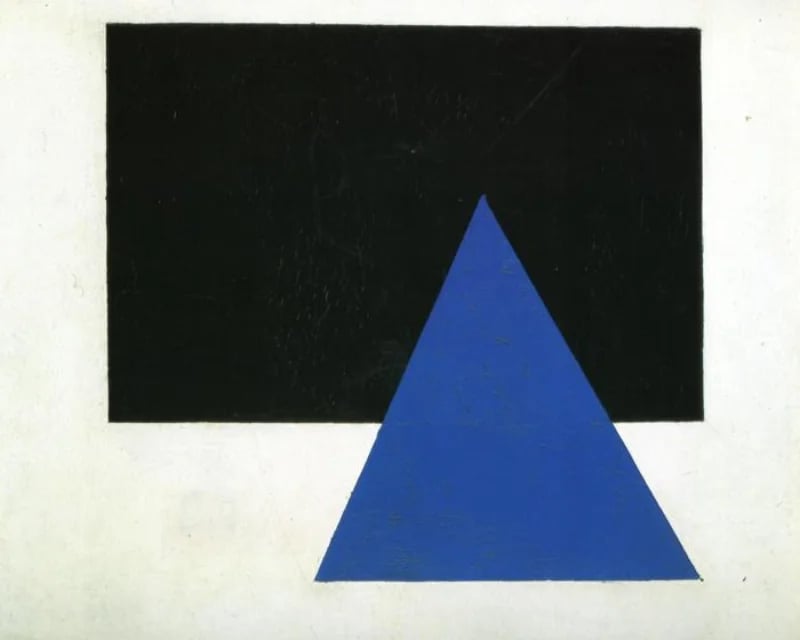
Malevich (1879–1935) developed Suprematism through a series of works that progressively simplified form. Black Square (1915) was followed by Black Circle and Black Cross (both 1915). He then introduced colour: red, blue, green, and yellow rectangles arranged in dynamic compositions. Suprematism with Blue Triangle and Black Square (1915) shows geometric forms floating against a white background; the arrangement suggests an infinite, weightless space. Suprematist Composition: White on White (1918) pushed further: a white square tilted on a white ground, almost dissolving into the canvas. The reduction could go no further.
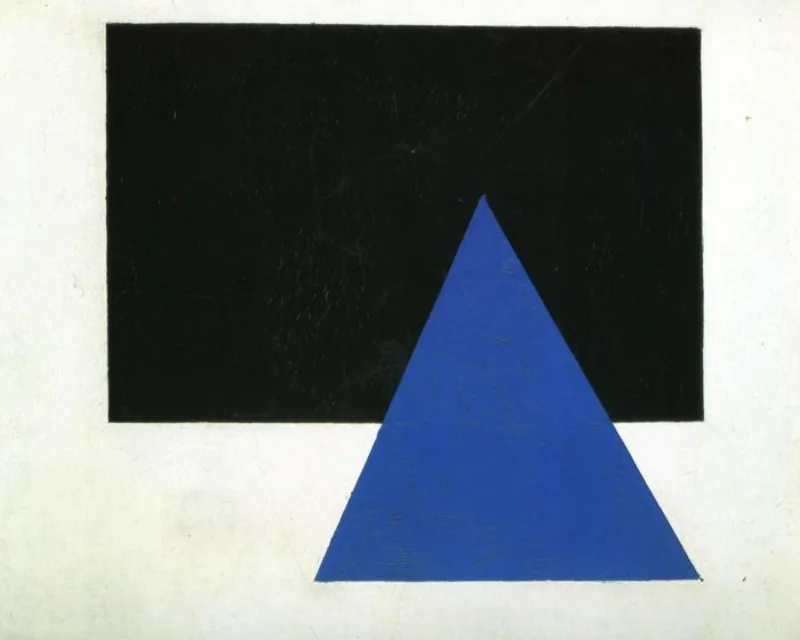
Suprematism with Blue Triangle and Black Square by Malevich, 1915 (Source)

Malevich wrote several texts explaining Suprematism. In From Cubism and Futurism to Suprematism (1915), he argued that representational art had exhausted itself; the new art would be "non-objective," concerned only with the relationships between form and colour. He saw Suprematism as having a spiritual dimension: the square was a doorway to a higher consciousness, a "feeling" that transcended the material world. This spiritual reading connected to Theosophy and to Russian mystical thought; Malevich was not alone among the Russian avant-garde in seeking transcendence through abstraction.
The "0,10" Exhibition and the Black Square
The "0,10" exhibition (also known as "The Last Futurist Exhibition of Paintings") opened in Petrograd on 19 December 1915. It included work by Malevich, Vladimir Tatlin, and others. Malevich hung Black Square in the corner, the "red corner" where Russian homes traditionally placed icons. The gesture was deliberate: the painting was to be a new kind of sacred image, one that pointed beyond the material world. Tatlin showed his corner reliefs; the two artists had a public disagreement. Tatlin favoured material construction; Malevich favoured pure form. The split between Suprematism and Constructivism would define the Russian avant-garde for the next decade.
Black Square has been interpreted in many ways: as an icon, as a void, as a rejection of Western pictorial tradition, as a political symbol. Malevich painted several versions; the original from 1915 has cracked and yellowed with age. The painting has become one of the most famous works of twentieth-century art, a touchstone for anyone interested in the limits of representation and the possibility of art that refers to nothing but itself.
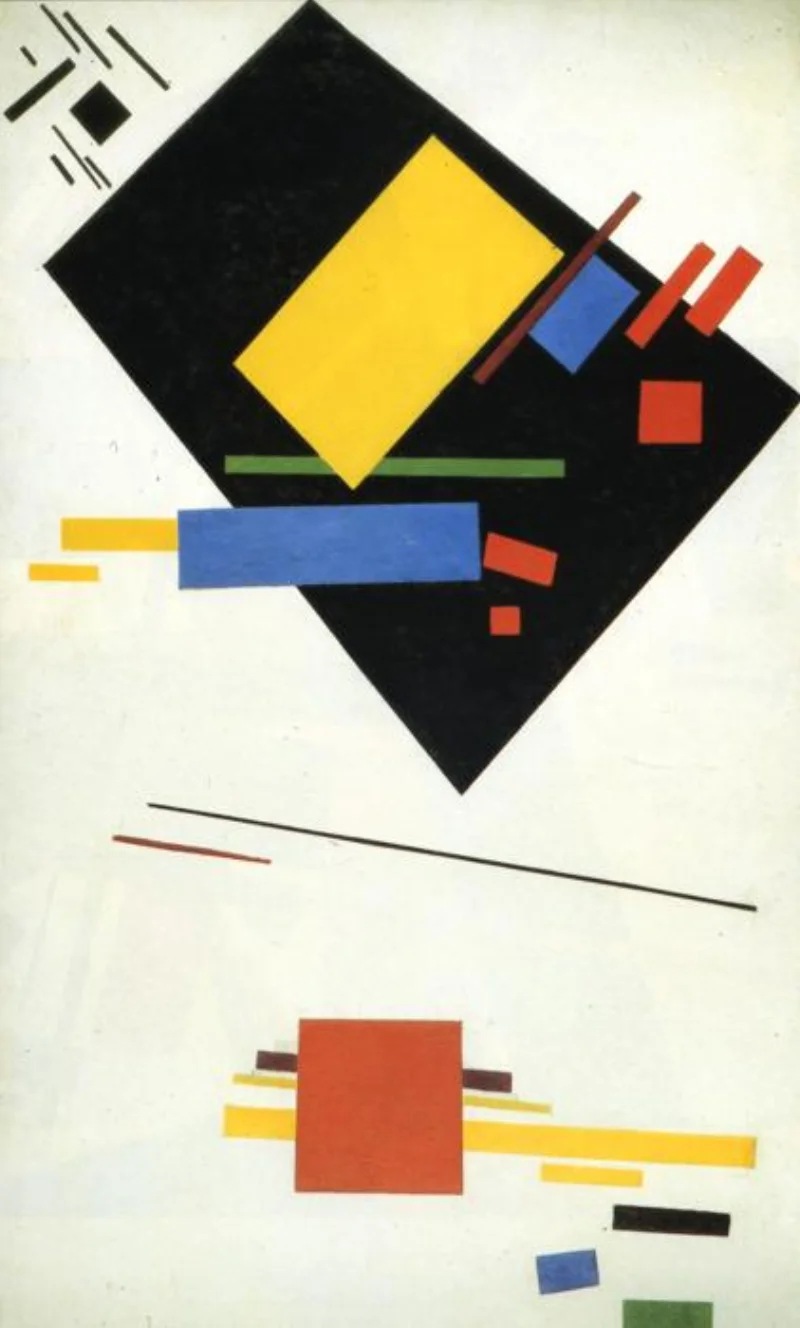
Suprematist Painting (with Black Trapezium and Red Square) by Malevich (Source)

El Lissitzky and the Spread of Suprematism
El Lissitzky (1890–1941) studied with Malevich in Vitebsk in 1919. He developed the "Proun" (Project for the Affirmation of the New), works that took Suprematist geometry into three dimensions. His Prouns were floating architectural compositions, somewhere between painting and design. They influenced the Bauhaus and De Stijl; Lissitzky travelled to Germany and Switzerland in the 1920s, spreading Suprematist ideas. His book Of Two Squares (1922) was a Suprematist story for children; his exhibition designs used dynamic spatial arrangements. Lissitzky bridged Suprematism and Constructivism; he saw geometric form as a tool for social transformation.
The End of Suprematism
By the late 1920s, Soviet cultural policy was turning against the avant-garde. Malevich was criticised; his work was removed from display. He returned to figuration in his last years, though his late portraits and landscapes retain something of the Suprematist sensibility. He died in 1935; his funeral in Leningrad included Black Square on his coffin. Suprematism had lasted only about fifteen years as a coherent movement, but its influence was lasting. The belief that painting could be reduced to pure form, that geometry could carry spiritual or utopian meaning, and that the "zero point" could be a new beginning: these ideas shaped Minimalism, conceptual art, and much of postwar abstraction.
For practitioners interested in the power of simple form, in the relationship between abstraction and the transcendent, or in the idea that the most reduced image can carry the most weight, Suprematism offers a historical model. Malevich's Black Square remains a challenge: what can a black square mean? The answer is still being made.
Olga Rozanova and the Broader Circle
Malevich was not alone. Olga Rozanova (1886–1918) made Suprematist works that combined geometric form with a more organic sensibility. Ivan Kliun (1878–1943) was a close associate of Malevich and produced paintings that explored the relationship between colour and form. The movement had a pedagogical dimension: Malevich taught at the Vitebsk art school from 1919 to 1922, where he influenced El Lissitzky and others. The school became a laboratory for Suprematist ideas, with students producing works that extended the system into design, architecture, and even ceramics. The utopian dimension of Suprematism, the belief that a new art could herald a new world, was tested by the realities of revolution and civil war. By the time Malevich was rehabilitated in the late 1980s, Suprematism had long been part of art history.
Related Resources
- Constructivism – Russian avant-garde emphasis on materials and utility
- De Stijl – Dutch geometric abstraction
- Minimalism – Later reduction and geometric form
- Introduction to Art History
Related in this topic
More from Occult Art History & Symbolism — Start Here.
Symbolism
Discover the meaning of symbolism! Learn its origins, art and famous symbolist painters. Find hidden emotions in art.
Naïve Art
Naïve art: untrained artists created startling originality through simplified forms, vivid colors, and unfiltered imagination.
Art Informel
Art Informel: the European parallel to Abstract Expressionism. Dubuffet, Tàpies, and the art of the unformed and the raw.
Street Art
Street Art: from subway tags to gallery walls. Banksy, Keith Haring, and the art that reclaims public space.
You Might Also Like
Art Informel
Art Informel: the European parallel to Abstract Expressionism. Dubuffet, Tàpies, and the art of the unformed and the raw.
Street Art
Street Art: from subway tags to gallery walls. Banksy, Keith Haring, and the art that reclaims public space.