Period: 1909 to c. 1916
Characteristics: Dynamic motion; industrial and urban subjects; rejection of the past; cult of speed and machinery; aggressive rhetoric
Events: Marinetti publishes the Futurist Manifesto (1909); Technical Manifesto of Futurist Painting (1910); first Futurist exhibition, Paris (1912)
The Cult of the New
Futurism was an Italian avant-garde movement launched on 20 February 1909, when the poet Filippo Tommaso Marinetti published his "Founding and Manifesto of Futurism" on the front page of Le Figaro in Paris. The manifesto declared war on the past: museums, libraries, and academies were cemeteries. The movement exalted speed, youth, violence, and the machine. "A racing car whose hood is adorned with great pipes, like serpents of explosive breath, a roaring car that seems to ride on grapeshot, is more beautiful than the Victory of Samothrace." Marinetti's rhetoric was deliberately provocative; it attracted painters, sculptors, architects, and musicians who wanted to break with tradition and celebrate the modern world.
The painters Umberto Boccioni, Carlo Carrà, Luigi Russolo, Giacomo Balla, and Gino Severini joined the movement in 1910. They published the "Technical Manifesto of Futurist Painting" that year, rejecting Impressionism and Divisionism in favour of a new aesthetic of dynamism. The aim was to represent movement itself: not a frozen moment, but the continuity of motion through time and space. Their work drew on Cubism's fractured planes but pushed toward a more agitated, machine-age sensibility.
Umberto Boccioni: Dynamism in Paint and Sculpture
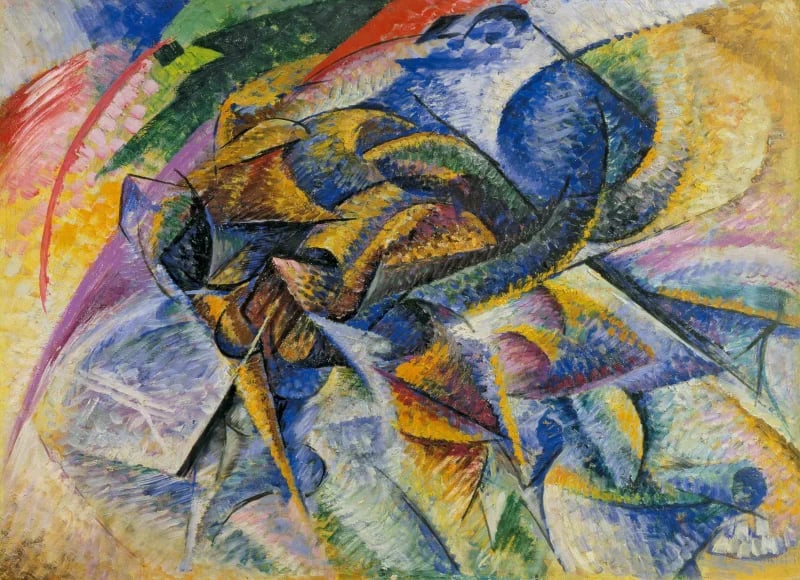
Umberto Boccioni (1882–1916) was the movement's most gifted artist. His painting Dynamism of a Cyclist (1913) fragments the figure of a rider and his bicycle into overlapping planes that suggest speed and forward motion. The cyclist becomes one with the machine; the background streaks past. Boccioni applied the same logic to sculpture. His Unique Forms of Continuity in Space (1913) shows a striding figure whose body seems to stretch and deform as it moves through space. The work became one of Futurism's most recognisable images; it appears on the Italian twenty-cent euro coin.
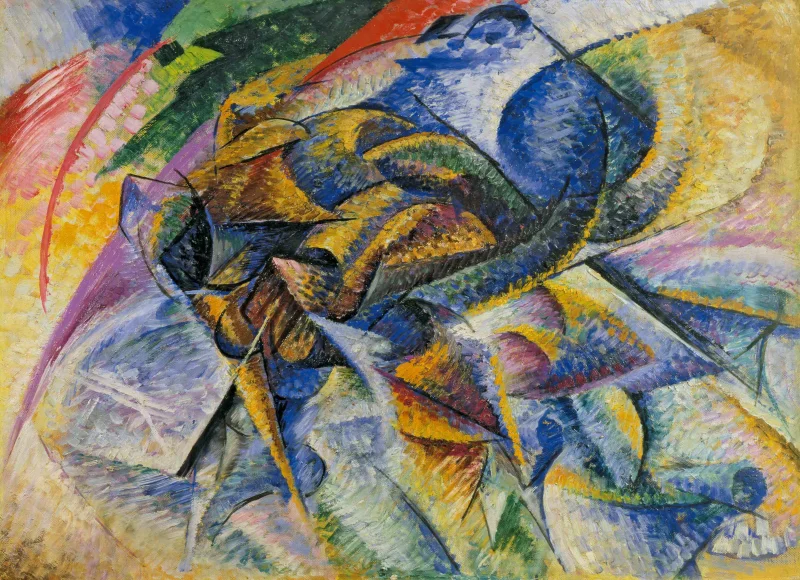
Dynamism of a Cyclist by Umberto Boccioni, 1913 (Source)
,_oil_on_canvas,_70_x_95_cm,_Gianni_Mattioli_Collection,_on_long-term_loan_to_the_Peggy_Guggenheim_Collection,_Venice.jpg)
Boccioni was killed in 1916 when he fell from a horse during cavalry training. His death marked the effective end of the first phase of Futurism. His writings, including the "Technical Manifesto of Futurist Sculpture" (1912), argued that sculpture should open itself to space, using new materials and embracing the environment. The idea that art could extend into the world, rather than sitting on a pedestal, influenced later movements including Constructivism and Dada.
Giacomo Balla and the Representation of Motion
Giacomo Balla (1871–1958) had trained as a painter in Turin before moving to Rome in 1895. He was older than the other Futurists and initially more cautious. His Street Light (1909) shows an electric lamp with rays of light spreading outward; it predates his full commitment to Futurism. By 1912 he had adopted the movement's vocabulary. Dynamism of a Dog on a Leash (1912) shows a woman walking her dog; the dog's legs and tail, and the woman's feet and skirt, are multiplied into overlapping bands that suggest rapid movement. The effect is both comic and precise: Balla had studied chronophotography, the technique of capturing motion in a sequence of still images.
Balla later designed Futurist clothing and furniture. His Abstract Speed and Sound (1913–14) reduced the car to a blur of diagonal lines. He remained in Italy when other Futurists went to Paris; his work became more decorative and less political. But his early paintings remain key examples of Futurist dynamism.
The Futurists in Paris
In February 1912 the Futurists exhibited at the Galerie Bernheim-Jeune in Paris. The show included Boccioni, Carrà, Russolo, Balla, and Severini. The French avant-garde was sceptical; Cubists saw Futurist work as derivative and theatrical. But the exhibition brought the movement to international attention. Severini, who lived in Paris, had the strongest links to Cubism; his Dynamic Hieroglyphic of the Bal Tabarin (1912) combined Futurist motion with Cubist fragmentation. Carrà's Funeral of the Anarchist Galli (1910–11) used diagonal lines and crowded figures to convey political chaos. Russolo later turned to music, building noise-generating instruments and composing Futurist sound works.
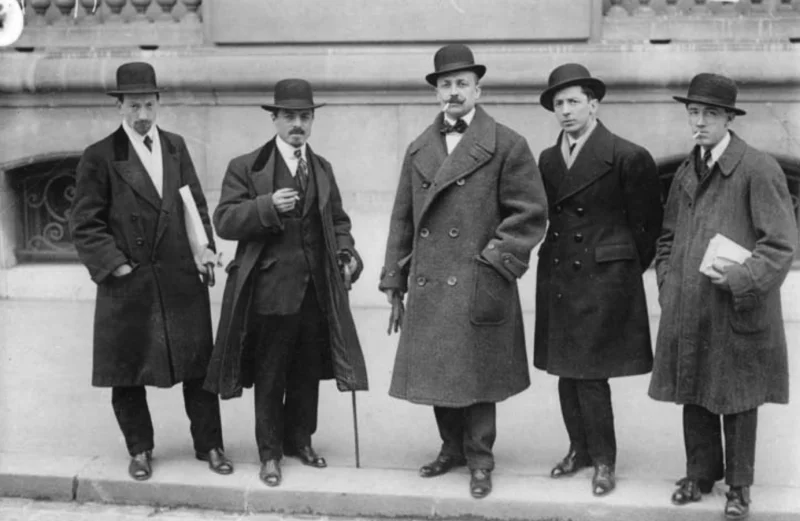
The Futurists in Paris, February 1912 (Source)

Marinetti, Politics, and the Legacy of Futurism
Marinetti was a provocateur. He advocated the destruction of museums and libraries, praised war as "the world's only hygiene," and later aligned Futurism with Italian Fascism. His 1909 manifesto declared that "we will glorify war, the world's only hygiene, militarism, patriotism, the destructive gesture of freedom-bringers, beautiful ideas worth dying for, and scorn for women." The misogyny and violence of the rhetoric have rightly been condemned. Many Futurist artists, including Balla and Severini, did not share Marinetti's politics. Boccioni volunteered for the war and died in a training accident; his relationship to Marinetti's enthusiasm for combat was complex. The movement's legacy is therefore split: formal innovation on one side, toxic politics on the other. Art historians continue to argue about how to teach Futurism without endorsing its worst aspects. Many Futurist artists did not follow him into politics; Balla, for example, kept his distance. But the movement's rhetoric of violence and its glorification of the machine age have been criticised ever since. Futurism's enthusiasm for war and its celebration of masculine aggression have cast a shadow over its aesthetic achievements.
Yet the movement's formal innovations mattered. The idea that painting could represent dynamic forces rather than static objects, that sculpture could open into space, and that art should engage with modernity rather than retreat from it: these ideas influenced Dada, Constructivism, and later twentieth-century art. The Futurists were the first to make a cult of the machine and of urban speed; their legacy is visible in advertising, film, and design as well as in fine art. For practitioners interested in the relationship between art and the modern world, or in the power of formal innovation to convey new experiences, Futurism remains a contradictory but important reference.
Severini, Carrà, and the Paris Connection
Gino Severini (1883–1966) lived in Paris and had direct contact with the Cubists. His Dynamic Hieroglyphic of the Bal Tabarin (1912) combined Futurist motion with Cubist fragmentation in a dance-hall scene. Carlo Carrà (1881–1966) painted The Funeral of the Anarchist Galli (1910–11) before moving toward a more metaphysical, de Chirico-influenced style. Luigi Russolo (1885–1947) built "intonarumori," noise-making machines, and wrote The Art of Noises (1913), a manifesto for Futurist music. The movement was never limited to visual art; it encompassed theatre, music, literature, and politics. Marinetti's performative readings, Balla's stage designs, and the group's collective exhibitions created a total environment of Futurist provocation. The energy was unsustainable; by 1916, with Boccioni dead and Europe at war, the first phase had ended. A second Futurism emerged in the 1920s, more closely aligned with Fascism and less aesthetically innovative.
Related Resources
- Cubism – Shared interest in fractured form and multiple viewpoints
- Constructivism – Russian avant-garde and the machine aesthetic
- Dada – Later avant-garde reaction and provocation
- Introduction to Art History
Related in this topic
More from Occult Art History & Symbolism — Start Here.
Symbolism
Discover the meaning of symbolism! Learn its origins, art and famous symbolist painters. Find hidden emotions in art.
Naïve Art
Naïve art: untrained artists created startling originality through simplified forms, vivid colors, and unfiltered imagination.
Art Informel
Art Informel: the European parallel to Abstract Expressionism. Dubuffet, Tàpies, and the art of the unformed and the raw.
Street Art
Street Art: from subway tags to gallery walls. Banksy, Keith Haring, and the art that reclaims public space.
You Might Also Like
Art Informel
Art Informel: the European parallel to Abstract Expressionism. Dubuffet, Tàpies, and the art of the unformed and the raw.
Street Art
Street Art: from subway tags to gallery walls. Banksy, Keith Haring, and the art that reclaims public space.