

You may be here out of long curiosity, a quiet pull you cannot name yet, or the wish for a spiritual craft that fits ordinary life. You are allowed to begin without already knowing which kind of witch you will become.
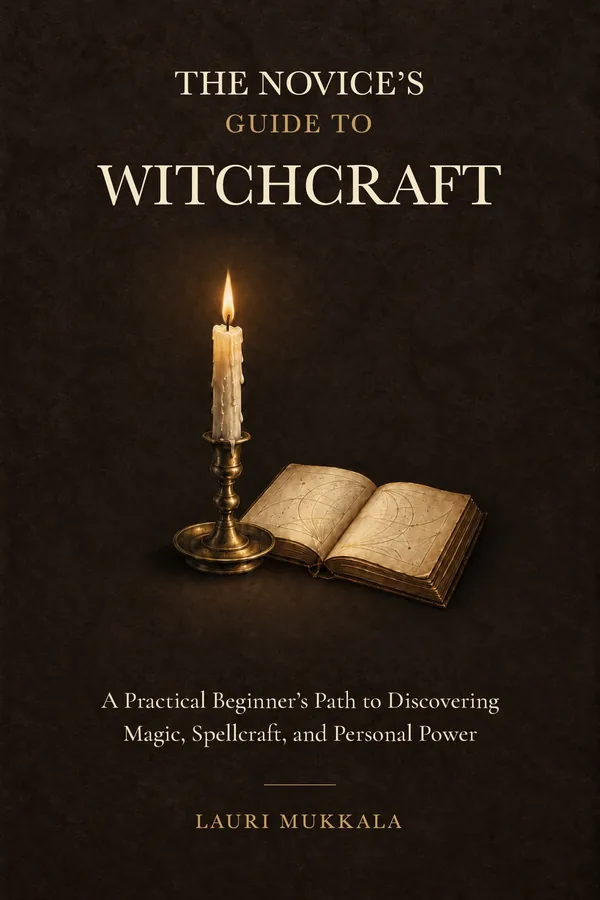
The Novice’s Guide to Witchcraft is a practical, honest introduction for adults who are beginning or restarting a personal practice. It pairs clear history and ethics with techniques you can try this week, and it treats safety as part of the craft rather than an afterthought.
What witchcraft means in this book
Witchcraft here means working with attention, symbol, habit, material and the living world around you. It can include herbs, moon phases, candle work, prayer and craft. It is not movie supernaturalism, and it is not one unbroken prehistoric religion that every modern witch inherits unchanged. Wicca is one modern religion within witchcraft. Many witches are not Wiccan, and many practice without any religion at all.
What is inside
- An honest history of witchcraft, from ancient magic and the witch trials to Gerald Gardner, Doreen Valiente and the modern revival, with popular myths checked against the evidence.
- Intentions you can test, plus grounding and centering with eyes-open and no-imagery options.
- A simple altar on any budget, including shared homes, dorms and travel, and the four elements met through ordinary materials.
- Herbs and plant magic with clear safety rules, a list of poisonous plants the book does not use and ethical sourcing.
- Moon magic grounded in real astronomy, with a safety-first approach to moon water.
- Spellcrafting step by step: candles, charm sachets, jars, written petitions, cleanup and honest review.
- Divination basics, including a one-card check-in, the pendulum and bibliomancy, with limits stated up front.
- Protection that starts with locks, detectors and common sense, then adds symbol and habit.
- The Wheel of the Year as a modern framework, kitchen witchcraft with food safety first, and intuition without psychic pressure.
- Finding community safely, red flags in groups and teachers, and how to judge a source.
- A chapter on ethics, consent and repair, plus four-week practice paths.
- Appendices: a glossary, common herbs, crystals and stones, magical tools and correspondences.
A taste of the approach
One early exercise asks you to finish two sentences in your journal: “I am drawn to witchcraft because…” and “Through practice, I hope to…” Another shows how to turn a wish into an intention you can actually test. “I want to be lucky with money” becomes “I will track my spending for four weeks and notice one pattern.” That is the spirit of the whole book: modest, observable practice that you can review honestly.
How to use it
You are holding a guide, not a rulebook. Take what resonates and leave the rest. Read the history chapter first for myth-checking, then move toward whatever you need most: an altar, the elements, herbs, the moon or spellcraft. You do not have to wait until the ethics chapter to practice consent and proportion. A simple journal for dates, questions and what you actually did will teach you faster than rereading theory alone.
If you would like more structure, the introduction offers an optional four-week start. In the first week you read the introduction and the first two chapters and note one misconception you are ready to drop. In the second you keep one small daily practice and write a single line about it. In the third you try one practice from a chapter on tools or the elements. In the fourth you review your journal, keep what helped and drop what became noise. That is enough. Depth comes from repetition, not from finishing the book in a weekend.
Honest practice, safety first
Results are not guaranteed, and other people’s choices stay theirs. No practice in this book targets another person’s will, and it does not teach hexes, curses or love spells aimed at a named person. Flame, smoke, essential oils, pets and food all come with plain safety rules. Herbs are not prescribed as medicine, crystals are not treated as cures, and closed or initiatory traditions are not taught. The book is not medical, legal or financial advice, and it works alongside the care and support you already use.
Who it is for
Adults who are new to witchcraft or returning to it, whether Wiccan, eclectic, unlabeled or simply curious. Every practice can be adapted to your beliefs, housing and budget, and tools are always optional. Readers under 18 are asked to practice with the knowledge of a safe adult.
If you want elaborate ceremony, guaranteed results or ways to work on someone else’s will without consent, this is not the book for you. If you want a grounded, safe and honest place to begin, start here.
Start free on this site
The witchcraft hub collects my free articles on history, practice and safety. If you are not sure where to begin, Start here helps you choose a first step, and the free Mini-Grimoire gives you printable pages for your own book of practice.
Formats
The book is available as a Kindle ebook, a paperback and a hardcover. The buttons on this page lead to each format on Amazon.
Part of a series
The Novice’s Guide to Witchcraft is part of my Esoteric Witch series. If tarot calls to you as well, The Novice’s Guide to Tarot is its companion. For short, everyday practice there is The 5-Minute Witch, for a private practice The Closet Witch, and for families The Magical Child.
Get the free Mini-Grimoire
A short printable starter guide to tarot and everyday witchcraft, plus my newsletter. Unsubscribe any time.
Opens Substack in a new tab to confirm. More about the newsletter · Privacy