

About Art History
Tarot cards are small paintings. Grimoires are illustrated books. The witch on her broom, the alchemist at his furnace, the sorceress drawing her circle: they all reached us through artists. That is why art history has its own section on this site. You do not need any training to begin. You need your eyes, a notebook and the willingness to look a little longer than usual.
Look at a painting in five steps
Researchers at the Metropolitan Museum of Art timed visitors in front of famous paintings in a study published in 2001. The average was about 27 seconds per work, and the median only 17. Half a minute is enough to recognize an image. It is not enough to see it.
Here is a five-step method you can use with any artwork, in a museum or on a screen. It combines slow looking with the four stages of the art educator Edmund Burke Feldman. Give it ten minutes.
- Look without reading. Do not read the label yet. Let your eyes wander over the whole work. Where does your eye go first? Where does it go next?
- Describe. List what is there, without judging: objects, figures, colors, light, the edges of the picture. “Her mouth is closed and her eyes look down” is description. “She looks sad” is already interpretation.
- Analyze. How are the parts arranged? Look for lines that lead your eye, the brightest area, repeated shapes, what is large and what is small, near and far.
- Interpret. What might the work mean or express? Support every idea with something you described. A good interpretation shows its reasoning, so someone else could test it.
- Read, then judge. Now read the label or the museum’s online record. Which of your questions does it answer? Then decide what you think, and name your standard: beauty, feeling, skill, story or purpose.
The full method, with examples, is in how to look at art.
Try it: The Magic Circle
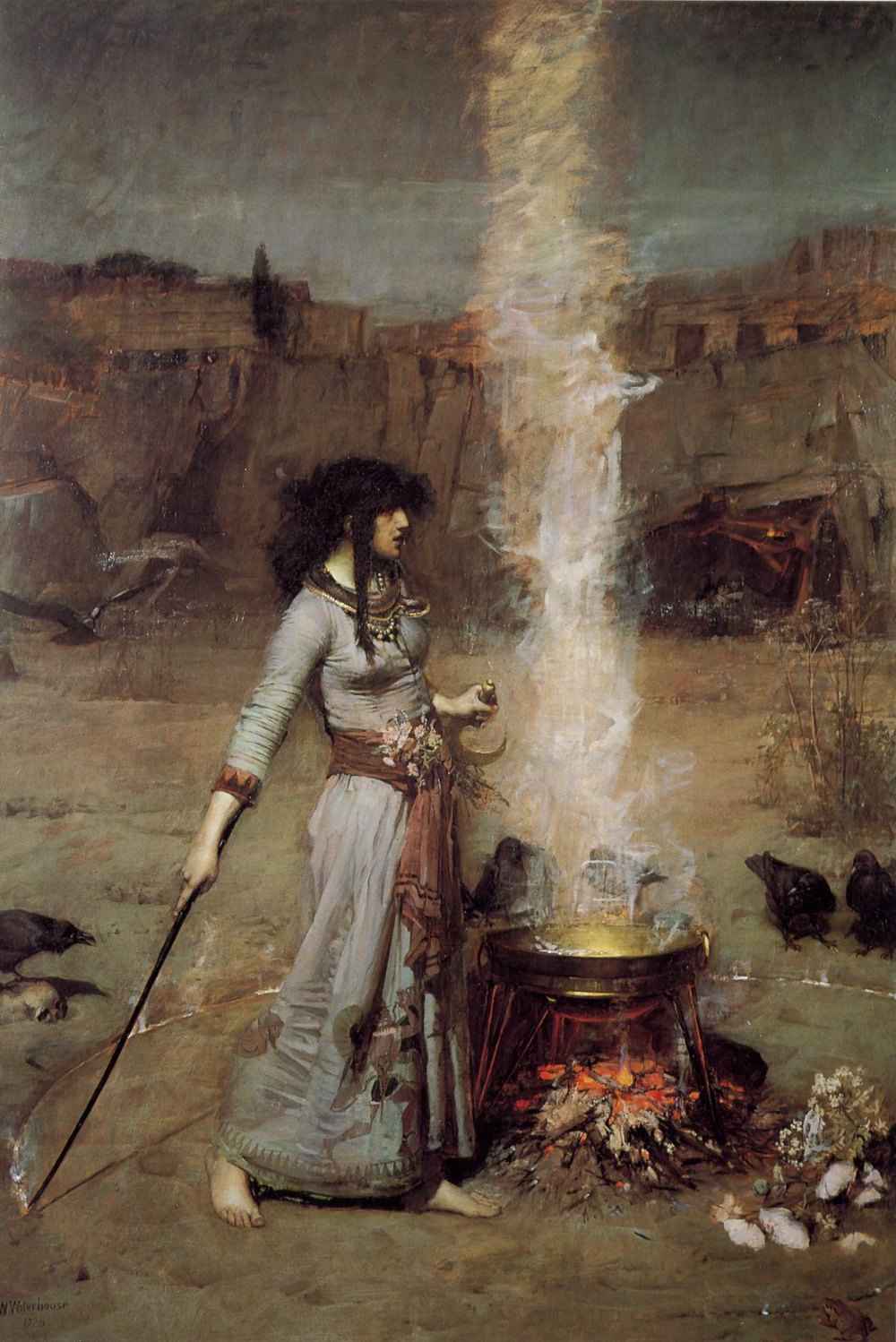
The painting at the top of this page is The Magic Circle by John William Waterhouse, from 1886, now in Tate Britain. Before reading on, give it two minutes.
Here is what I see. A woman in a long patterned robe stands in a bare landscape. With a wand in her right hand she draws a circle on the ground, and the line she draws is smoking or burning. In her left hand is a curved sickle. A small fire burns in front of her, beneath a pot. Outside the circle are ravens and a toad. Inside it are flowers. The sky is heavy, and far behind her are ruins.
The composition is simple: one tall figure, a circle around her, everything wild kept outside. The circle is the subject. It is a boundary between her ordered space and the world beyond it. That idea, the magic circle as protection, appears in real grimoires from the Middle Ages to the Ars Goetia.
What Waterhouse painted, though, is not a record of any real practice. It is a Victorian artist’s dream of a sorceress, drawing on literature, legend and the taste of his time. That difference, between what an artwork shows and what people actually did, is one of the most useful things art history teaches.
A few words to look with
You do not need a big vocabulary, but a handful of words makes looking easier. These are the ones I use most.
- Composition: how the parts of a picture are arranged.
- Focal point: where your eye is pulled first, often the brightest or sharpest area.
- Value: how light or dark a color is. Strong contrasts of value create drama.
- Iconography: the meaning of the objects and figures, such as a skull for death, a lily for purity or a key for St Peter.
- Attribute: an object that identifies a figure. Hekate’s torches and keys are attributes.
- Medium: what the work is made of: oil on canvas, tempera on panel, an engraving, a woodcut.
Every art movement page adds a few words of its own.
The esoteric in art
Magic, astrology, alchemy and the occult run through the history of art, often openly. This site labels three layers here as everywhere:
- Historical: works made to show esoteric ideas, and understood that way at the time. The astrological frescoes of the Palazzo Schifanoia in Ferrara, painted around 1469 to 1470, are one example. The alchemical paintings of the Splendor Solis, made in Germany around 1532 to 1535, are another.
- Later tradition: what scholars, occultists and popular writers later read into works. Some readings are strong, like the link between Albrecht Dürer’s engraving Melencolia I (1514) and Renaissance ideas about melancholy and genius, set out by Klibansky, Panofsky and Saxl. Others, such as claims that Gothic cathedrals encode alchemical secrets, tell us about the 20th century, not the Middle Ages.
- Modern: how people today use art in their own spiritual lives, from altar images to tarot meditation.
A few threads to follow:
- Witches in art. German prints from around 1500, by Albrecht Dürer and Hans Baldung Grien, made the witch a popular subject. Francisco Goya painted and etched witches three centuries later. These images show what their makers and buyers believed or feared. They are not records of what any real practitioners did. See witches in art.
- Alchemy. Emblem books like Michael Maier’s Atalanta Fugiens (1617) combine engravings, poems and music into an alchemical language of kings and queens, lions, pelicans and serpents. The guide to the esoteric in art follows this thread further.
- Diagrams of the cosmos. Engravers of the 17th century, such as Robert Fludd and Athanasius Kircher, drew the Kabbalistic Tree of Life and the harmony of the universe as elaborate diagrams. Kircher’s Tree of Life, from his Oedipus Aegyptiacus, appears on my how I make content page.
- Spiritual abstraction. Hilma af Klint, a Swedish painter involved in Spiritualism and Theosophy, began her Paintings for the Temple in 1906. Wassily Kandinsky cited Madame Blavatsky and Theosophy in Concerning the Spiritual in Art (1911). Occult ideas were one of the roots of abstract painting.
- Surrealist magic. Leonora Carrington and Remedios Varo, friends in Mexico City from the 1940s, filled their paintings with alchemists, ritual feasts and powerful women. Carrington even designed her own tarot trumps.
Read more in the esoteric in art.
Who made it, and for whom?
Every artwork was made by someone, for someone, for a reason. Asking those three questions turns a pretty picture into a piece of history.
Take the Visconti-Sforza tarot cards. Who made them? A painter’s workshop in 15th century Milan. For whom? A ruling family who wanted luxury objects for play and display, with their own emblems painted in. Why? For a fashionable card game, and to show wealth and taste. None of those answers is mystical. All of them help you see the cards more clearly: the gold leaf, the courtly clothes, the family badges, the figures borrowed from processions and pageants.
Now take a modern tarot deck you own. Who made it, for whom and why? The answers will be different, and they tell you just as much.
The same three questions work for witch prints, alchemical emblems and Victorian paintings. Who bought Hans Baldung Grien’s witches around 1510? Mostly educated men, who enjoyed a mix of horror, humour and eroticism. That tells you more about them than about witches.
Looking at sacred art with respect
Much of the world’s art was made for worship: icons, altarpieces, temple sculptures, masks, ancestor figures. In a museum they sit behind glass with a label, but for many people they are still holy.
A few habits help. Learn what an object was for before you decide what it means to you. Use the names its makers used. Be careful with images and objects from living traditions, especially Indigenous ones, which may have rules about who can see or use them. Some museums now ask visitors not to photograph certain objects, or have returned them to their communities. Looking well includes knowing when to look with care.
Tarot as art: from Visconti-Sforza to Pamela Colman Smith
Historical Tarot cards are a real chapter of art history. Playing cards reached Europe from the Islamic world in the late 14th century. In northern Italy, in the first half of the 15th century, a new kind of deck appeared with an extra series of picture cards, the trionfi, used to play a trick-taking game.
The most famous early cards were painted by hand, with gold and silver leaf, for the ruling families of Milan. The best known set, usually dated around 1450 to 1480, is traditionally attributed to Bonifacio Bembo. Its surviving cards are divided between the Morgan Library and Museum in New York, the Accademia Carrara in Bergamo and a private collection. An earlier set, the Cary-Yale Visconti deck, is at Yale’s Beinecke Library. Look at one of these cards slowly and you will see a courtly world: rich fabrics, gilded backgrounds, figures from allegory and pageant. You can see the Popess from this deck on my tarot page.
Later tradition From 1781 on, French writers claimed that the trumps preserved Egyptian wisdom, and the Golden Dawn later wove them into a system of correspondences.
Historical In 1909, in London, the artist Pamela Colman Smith (1878 to 1951) drew all 78 cards of a new deck designed by A. E. Waite. Her crucial idea was to give the numbered Minor Arcana full scenes instead of repeated suit symbols, so every card tells a story. That is why so many beginners learn on her deck, and why it is now often called the Rider-Waite-Smith or Smith-Waite deck, to give her credit. She was an illustrator, a stage designer and a storyteller, and her own story deserves to be better known. See tarot art history and Pamela Colman Smith.
Free public-domain galleries
One of the joys of art history today is that thousands of great works are free to see in high resolution. Museums such as the Metropolitan Museum of Art, the Art Institute of Chicago, the National Gallery of Art in Washington, the Rijksmuseum and the Smithsonian have released large parts of their collections as open access, often under CC0, which means anyone may use the images. Wikimedia Commons gathers many more public-domain works.
On this site I am building small themed galleries of public-domain art: witches, alchemy, the moon, tarot, cards and games. Every image is credited and checked, and I do not show nudity. The one exception is the original 1909 tarot deck, which I show complete, as Pamela Colman Smith drew it. See open-access museums to explore on your own.
Eras at a glance
Art history is a long story. Here is a very short map, to help you place what you see. Each era links to its own movement pages.
- Prehistoric (from at least 40,000 years ago): cave paintings, carved figures and rock art on every inhabited continent. See prehistoric art.
- Ancient (from about 3000 BCE): the Ancient Near East, Egypt, Greece and Rome, alongside the great early arts of South and East Asia, Africa and the Americas.
- Medieval (about 500 to 1400 CE): Byzantine icons, illuminated manuscripts, Romanesque churches and Gothic cathedrals, alongside Islamic geometry and calligraphy.
- Renaissance (about 1400 to 1600): the Early Renaissance, the High Renaissance, the Northern Renaissance and Mannerism: perspective, oil painting, the first printed images, the first tarot cards.
- 1600s and 1700s: Baroque drama, the Dutch Golden Age, Rococo and Neoclassicism.
- The 1800s: Romanticism, the Pre-Raphaelites, Realism, Impressionism, Post-Impressionism, Symbolism, Art Nouveau and Arts and Crafts.
- Modern (from about 1900): Fauvism, Expressionism, Cubism, Futurism, early abstraction, Dada, Surrealism, Abstract Expressionism and Pop Art.
Every art movement
Every movement on this site has its own page, the same way every tarot card does, with dates, key artists, works to look at, the esoteric angle and a small exercise. See them all in order on the art movements timeline.
- Ancient worlds: Prehistoric art, Ancient Near Eastern art, Ancient Egyptian art, Ancient Greek art, Ancient Roman art.
- The Middle Ages: Byzantine art, Early medieval art, Romanesque, Gothic.
- Renaissance: Early Renaissance, High Renaissance, Northern Renaissance, Mannerism.
- 1600s and 1700s: Baroque, Dutch Golden Age, Rococo, Neoclassicism.
- The 1800s: Romanticism, Pre-Raphaelites, Realism, Impressionism, Post-Impressionism, Symbolism, Art Nouveau, Arts and Crafts.
- Modern art, 1900 to 1945: Fauvism, Expressionism, Cubism, Futurism, Early abstraction, Dada, Surrealism.
- After 1945: Abstract Expressionism, Pop Art.
Art you do not like
Here is a small exercise I love. Next time you are in a museum or browsing a collection, stop in front of a work you would normally walk past. Give it the five steps anyway. You do not have to end up liking it. But you will almost always find something: a color, a hand, a strange detail in a corner. Looking at art you dislike is one of the fastest ways to learn what you value, and why. Write down one thing the work does well, even if it is not to your taste. Then write one question you would ask the artist if you could.
Keep learning
The free Art History for Beginners course in the School follows the five steps on this page and then walks through the eras in seven lessons. Tarot is one of the best ways to practice looking, so the free Tarot for Beginners course is a good companion.
If you prefer to read essays, my Substack has longer pieces, such as how to read a painting and witchcraft in art: a short history.
Sources
- Edmund Burke Feldman, Art as Image and Idea (Englewood Cliffs: Prentice-Hall, 1967).
- Jeffrey K. Smith and Lisa F. Smith, “Spending Time on Art”, Empirical Studies of the Arts 19 (2001).
- Raymond Klibansky, Erwin Panofsky and Fritz Saxl, Saturn and Melancholy (London: Nelson, 1964).
- Wassily Kandinsky, Concerning the Spiritual in Art (1911), translated by Michael T. H. Sadler (1914).
- Tate, catalog entry for John William Waterhouse, The Magic Circle (1886).