

About Tarot
This page is a map of tarot for beginners. It explains what tarot is, where it really comes from, how the deck is built and how to start reading tonight. Every section ends with a link to a deeper guide, so you can go as far as you like.
What tarot is (and is not)
Tarot is a deck of 78 cards. Twenty-two of them are picture cards called the Major Arcana, or trumps. The other fifty-six are the Minor Arcana, four suits that look a lot like ordinary playing cards with an extra court card in each suit.
People use tarot for many things: as a journaling prompt, as a way to talk through a decision, as a creative tool for writers, and as a form of divination. You do not need to believe in a fixed future to use it well. You need attention, a clear question and enough honesty to notice what the picture stirs in you.
Tarot is not a verdict. It does not decide what happens to you, and it does not replace a doctor, a lawyer or a hard conversation. I think of a reading as a mirror held at an interesting angle. It shows you something you may have missed. What you do next is yours.
The three layers
Most confusion about tarot comes from mixing three different things. On this site I label them:
- Historical: what the surviving cards and documents show. Tarot was a card game in 15th century Italy.
- Later tradition: what occult writers added from the late 18th century on, such as links to Egypt, Hebrew letters and astrology.
- Modern: how readers use the cards today, from one card a day to the Fool’s Journey as a teaching story.
All three are part of tarot’s life. Knowing which is which makes the cards more interesting, not less.
A short history of tarot
Historical The oldest surviving tarot cards were painted in northern Italy in the middle of the 15th century. They were called carte da trionfi, triumph cards, and they were used to play a trick-taking game. The famous Visconti-Sforza cards, made for the ruling families of Milan, are hand-painted and covered in gold leaf. They were luxury objects, made for play and for display. The Popess at the top of this page comes from one of those decks.
Historical Over the next centuries the game spread to France and Switzerland, and printers cut woodblocks so decks could be made more cheaply. The family of designs we now call the Tarot de Marseille took shape in France across the 17th and 18th centuries. A deck printed by Nicolas Conver in Marseille in 1760 became one of the best known.
Later tradition In 1781 the French writer Antoine Court de Gébelin claimed, in his book Le Monde primitif, that the trumps preserved the wisdom of ancient Egypt. There is no evidence for this, but the idea was attractive and it stuck. Soon after, the Paris card reader Etteilla designed one of the first decks made specifically for fortune telling. In the 19th century Éliphas Lévi linked the 22 trumps to the 22 letters of the Hebrew alphabet, and the Hermetic Order of the Golden Dawn, founded in London in 1888, built tarot into a large system of astrology, Kabbalah and ritual.
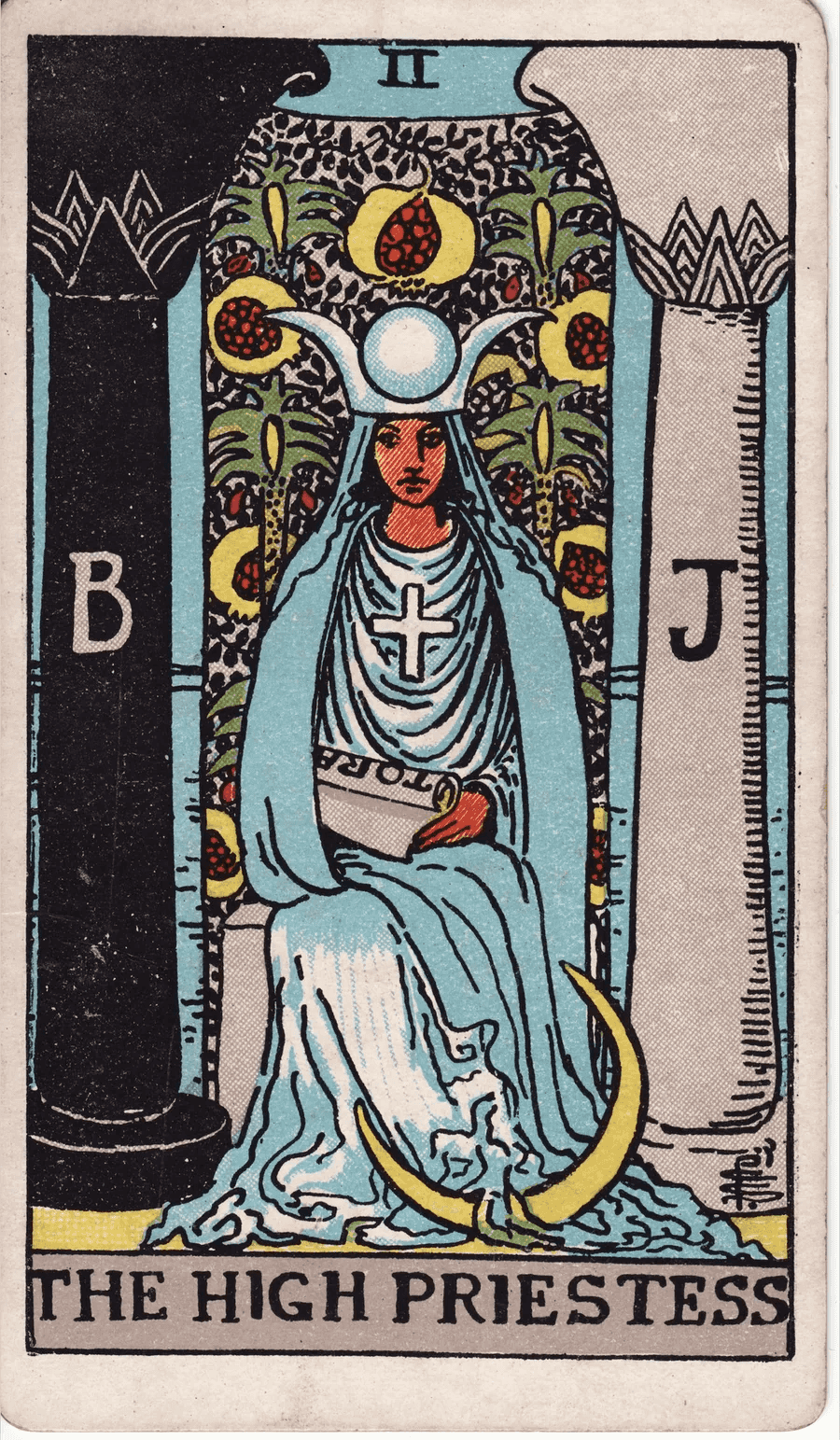
Historical In 1909 the London publisher Rider issued a new deck designed by A. E. Waite, a Golden Dawn member, and painted by the artist Pamela Colman Smith. For the first time, all 56 Minor Arcana cards had full scenes instead of simple arrangements of cups or swords. That one decision made the deck easy to learn, and the Rider-Waite-Smith deck is still the base of most beginner books, including mine. Waite explained it in The Pictorial Key to the Tarot, published in 1910.
Modern In the 20th century, guidebooks in English made tarot a popular practice. Eden Gray’s books in the 1960s and 1970s helped spread the idea of the “Fool’s Journey”, a story that walks the Fool through the trumps. Today there are thousands of decks, and tarot is a living craft with its own debates about ethics and inclusion.
The honest timeline is simple: game first, esoteric reading later. You can love the symbols without needing them to be older than the paper they were printed on. Read more in the history of tarot.
How a deck is built
The Major Arcana
Twenty-two cards numbered 0 to 21, from the Fool to the World. They show big themes: beginnings, choices, crisis, hope, completion. When a Major turns up in a reading, it often names the chapter you are in.
In the Rider-Waite-Smith deck Strength is number VIII and Justice is XI. Older decks, such as the Tarot de Marseille, have them the other way round. Waite swapped them to fit the Golden Dawn’s astrology. If your deck differs, read by the card’s name. See the Major Arcana.
The Minor Arcana and the four suits
Fifty-six cards in four suits of fourteen. They describe the texture of ordinary life: moods, conversations, work and money.
- Cups are feeling, relationships and imagination (element of water).
- Swords are thought, conflict and truth telling (air).
- Pentacles are the body, work, money and practical care (earth).
- Wands are drive, creativity and courage (fire).
Numbers and courts
Each suit runs from Ace to Ten. The numbers add a pattern you can reuse across suits: aces open, twos balance or choose, fives disrupt, tens complete a cycle. Then come four court cards: Page, Knight, Queen and King. Courts can show a person, a part of you or an approach to a situation, whatever the gender of the figure. See court cards and numerology and elements.
How to start reading: five steps
Here is the simple method I teach in the first lessons of the free course.
- Find a spot that is quiet enough. You do not need a perfect altar. You need enough calm to notice the cards.
- Ask a real, open question. “What helps me with…?” works better than a yes or no question. See how to ask better questions.
- Shuffle in any way that feels natural. There is no single correct shuffle.
- Draw one card and read in layers. First what you see, then the keywords, then how the card sits with your question.
- Write one sentence. Name one small thing you will do or watch for. Then put the deck away.
One honest card beats ten rushed ones. If you do this once a day for a week and reread your notes on day seven, you will already know more than you think. The full method is in how to read tarot.
A first reading, step by step
Here is what a real one-card reading can look like, so you can see the steps in action.
Say your question is “What helps me with this busy week?” You shuffle, cut the deck and turn over the Eight of Pentacles. Before you open any book, you look. A young man sits at a bench, carving a pentacle into a disc of wood or metal. Six finished discs hang beside him. One lies at his feet, waiting. A town sits far off in the background. He is not looking at it.
Now the keywords: craft, practice, steady work. Then the question. What helps with a busy week? Perhaps it is doing one task at a time, with care, instead of trying to carry the whole town in your head. Your sentence for the notebook might be: “One thing at a time, done properly.” That is a reading. It took five minutes, and it gave you something to do.
Later in the week, look back. Did the card fit? Was there a moment where it helped? That small habit of checking is how you learn your deck.
Reversed cards
A reversed card is one that lands upside down. Some readers use reversals to show a blocked or inward version of the card, some read them as advice to slow down, and many do not use them at all. All of these are fine. Reversals are a modern reading habit, not a rule.
If you are new, I suggest you start without reversals. Turn every card the right way up and learn the 78 upright meanings first. When you feel ready, decide before you shuffle how you will read a reversed card, and stay with that choice for the whole reading. Clarity beats superstition. See reversed cards.
Common misconceptions
You will hear a lot of rules about tarot. Most of them are modern superstitions, and you can let them go.
- “Tarot comes from ancient Egypt.” It does not. The idea comes from a book of 1781. The cards themselves come from 15th century Italy.
- “Some cards are good and some are bad.” Every card has a light and a shadow side. The Death card is about endings and change, almost never about death.
- “Tarot predicts the future with certainty.” A reading shows a direction and some things to notice. Your choices still matter.
- “No one else should touch your cards.” Some readers like to keep their deck to themselves, others hand it round. Both are personal choices.
- “You must cleanse your deck with sage, moonlight or crystals.” You can, if it helps you feel ready, but it is not required. A deck works fine straight out of the box.
More in tarot misconceptions.
All 78 cards
The cards below link to a full page for each card: what Pamela Colman Smith drew, the upright and reversed meanings, examples for love, work and spirituality, and a small spread. The 22 Major Arcana are listed first, then the four suits. Every card is shown as the original 1909 scan of Pamela Colman Smith’s artwork, never cropped. These cards are in the public domain. A few of them, such as the Lovers and the Star, show nude figures, as Smith drew them. Apart from these historical cards, I keep the site free of nudity.
Browse all of them in tarot card meanings.
Spreads for beginners
A spread is a pattern of positions that gives each card a job. Start small. These six are the ones I use most:
- One card: a daily check-in.
- Three cards: past, present and the direction you are traveling.
- Challenge and advice: two cards for a stuck moment.
- Four-card problem solving: the issue, its roots, what helps and a next step.
- Five-card cross: a fuller picture without the size of the Celtic Cross.
- Celtic Cross: the classic ten-card layout, for when you are ready.
All of them are in tarot spreads.
Ethics: reading for yourself and others
Tarot is a reflective practice, and when you read for someone else you are holding their worries in your hands. A few rules keep that kind:
- Ask for consent. Read for people who asked, and do not read about someone who is not there and has not agreed, such as an ex or a colleague.
- Speak calmly about hard cards. Death, the Tower and the Ten of Swords are not curses. Say what the card shows, then what the person can do.
- Know what tarot should not answer. Health, pregnancy, legal cases and money decisions belong with professionals. You can always say “tarot is not the right tool for this”.
- No fear, no pressure. Never tell anyone that a reading proves something terrible, or that they must pay to fix it.
Read the full guide in tarot ethics.
Choosing your first deck
Choose a deck whose pictures you like looking at. For a first deck I suggest a Rider-Waite-Smith style deck, because almost every beginner book, including mine and this site, follows its pictures. You can buy your own deck: the idea that a first deck must be a gift is a modern superstition. And you do not have to cleanse it with sage or moonlight before you use it, although a small ritual can be a nice way to begin.
See how to choose your first deck and the Rider-Waite-Smith deck.
Keep a tarot journal
The fastest teacher is your own notebook. After each reading, write four things: the date, your question, the card or cards, and one sentence about what you took from it. A week later, add one more line: what actually happened, and whether the card made sense in hindsight.
After a month you will start to see patterns. Maybe the Knight of Wands turns up every time you are about to rush into something. Maybe the Four of Cups appears when you are tired rather than bored. These personal patterns are worth more than any keyword list, because they are about your life and your deck. The journal is also a gentle check on fear: when you reread it, you can see that hard cards were usually about ordinary difficulties, handled one day at a time.
How long does it take to learn?
There is no exam and no finish line. Most beginners feel at home with the 22 Major Arcana within a few weeks of daily one-card draws. The Minor Arcana take longer, because there are more of them and their differences are subtle. My free course is planned for about six weeks at fifteen minutes a day, but you can go faster or slower. You are allowed to be a novice for a long time.
Free course: Tarot for Beginners
If you would like a path instead of a map, my free course takes you through the whole deck in 30 short lessons. It is free, there is no account, your progress stays in your browser and you get a certificate at the end. Start lesson one.
When you want the full book, The Novice’s Guide to Tarot has every card with keywords, affirmations and examples. If you would like a reading from me, I offer a Past, Present, Future reading on Etsy, and my 45-page printable Tarot Workbook works as a cheat sheet for all 78 cards.
Frequently asked questions
Do I need to be psychic to read tarot?
No. Reading tarot is a skill built from looking at pictures, knowing the structure of the deck and practicing. Intuition grows with use, the way it does in any craft.
Can I buy my own deck?
Yes. The idea that a first deck must be a gift is a modern superstition. Most readers buy their own deck, and choosing one you love is part of the fun.
Is tarot evil or dangerous?
No. Tarot began as a card game in 15th century Italy. A deck is printed paper. What matters is how you use it: honestly, kindly and without letting it replace real advice.
Sources
- A. E. Waite, The Pictorial Key to the Tarot (London: Rider, 1910).
- Michael Dummett, The Game of Tarot: From Ferrara to Salt Lake City (London: Duckworth, 1980).
- Robert M. Place, The Tarot: History, Symbolism and Divination (New York: Tarcher/Penguin, 2005).
- Stuart R. Kaplan, The Encyclopedia of Tarot, Volume I (New York: U.S. Games Systems, 1978).
- Lauri Mukkala, The Novice’s Guide to Tarot, “The History of Tarot”.