

About Deities
Many readers come to this site because one of three figures has caught their attention: Hekate, Lilith or Lucifer. They are very different, with very different histories, and each is surrounded by a cloud of confident claims online. These guides take one figure at a time, slowly, history first.
Three figures, three honest paths
Hekate
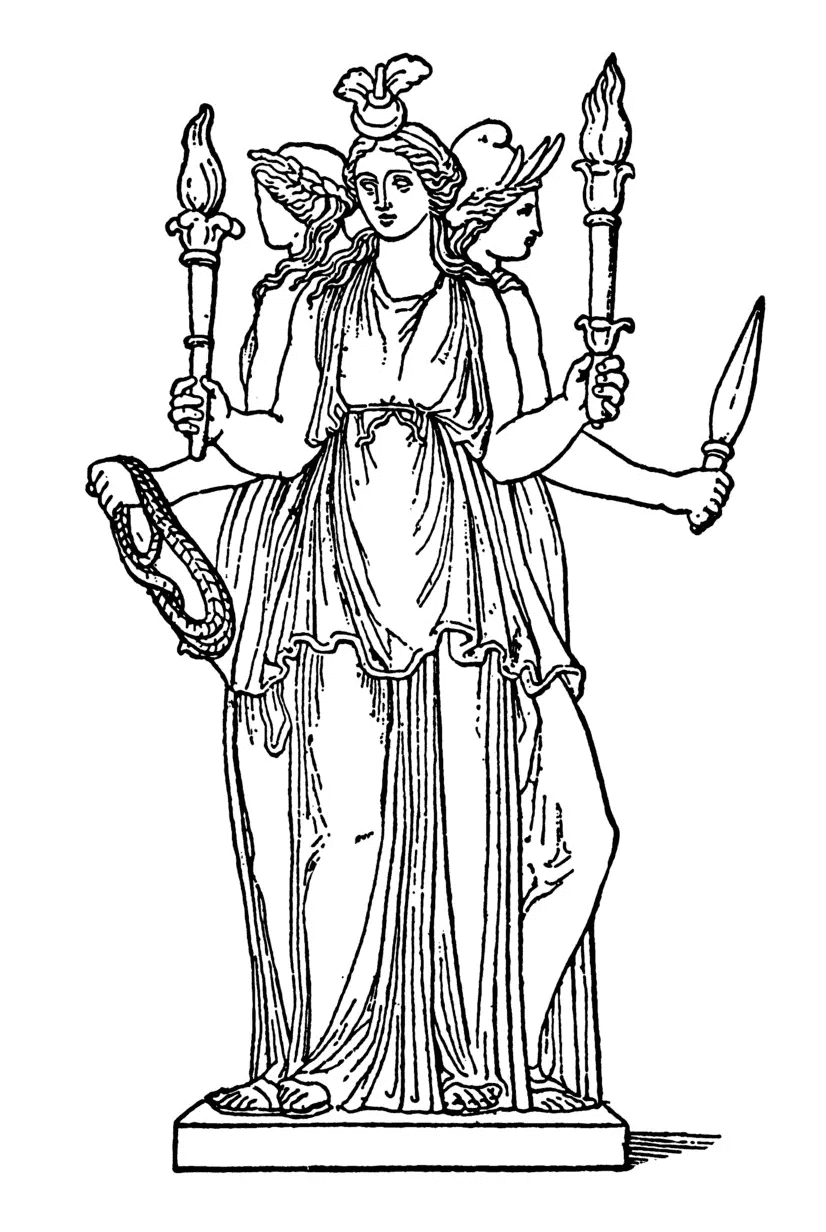
Historical Hekate was a Greek goddess, first named in Hesiod’s Theogony around 700 BCE, where Zeus honors her above all others. Over the centuries she became the goddess of crossroads, thresholds, torches, keys and the night, and later of magic and ghosts. Statues from the Hellenistic and Roman periods often show her in triple form, three figures back to back facing three roads, like the one at the top of this page. Modern Today she is one of the most popular deities in witchcraft and paganism. My guide covers her ancient sources, her symbols and gentle ways to begin. Read the Hekate guide.
Lilith
Historical Lilith’s story is long and tangled. Female night demons with names like lilītu appear in Mesopotamian incantations. A lilit appears once in the Hebrew Bible, in Isaiah 34:14. The famous tale of Lilith as Adam’s first wife, who refused to be ruled and left Eden, comes from a medieval Jewish text, the Alphabet of Ben Sira. Modern Since the 1970s, many feminists and witches have reclaimed her as a figure of independence. My guide follows each layer in turn. Read the Lilith guide.
Lucifer
Historical Lucifer is Latin for “light-bearer”, the morning star, the planet Venus at dawn. In Isaiah 14:12 a fallen king of Babylon is mocked as the “day star”, and Latin translators rendered the phrase as lucifer. Christian writers later read the verse as the fall of Satan. Later tradition Poets like John Milton gave Lucifer a voice, and Romantic writers saw him as a rebel. Modern Today some people honor Lucifer as a bringer of light and knowledge, quite apart from Satanism. Read the Lucifer guide.
How I write about deities
I write about all three in the same way.
- History first. I start with the oldest sources and say exactly where each idea comes from. A figure’s modern meaning is real, but it is not the same as her ancient one.
- Respect. For many people these are living deities, or figures in a living faith. I write about them with care, whatever I or you believe.
- No pressure. You do not need to “be chosen” or “be called” to study a deity. And if you feel drawn, you do not need to rush.
- No promises. I do not tell you that a deity will appear, answer or change your life.
Ethics and discernment
Working with a deity is a relationship, not a transaction. A few questions help you keep your feet on the ground:
- Am I drawn to this figure because of who she is in her sources, or because of a story I read online?
- Does my practice make my life calmer, kinder and more honest, or more anxious and isolated?
- Am I respecting the people for whom this figure is part of a living religion?
- Would I be comfortable telling a trusted friend what I am doing?
If any practice leaves you frightened, sleepless or convinced of things that worry the people who love you, stop and talk to someone. The Goetia safety page covers religious fear and intrusive thoughts carefully, and it applies here too. Read the full guide in working with deities: ethics and discernment.
Keep learning
Each of the three has a free seven-lesson course in the School: Hekate, Lilith and Lucifer.
If you are new to practice, my Novice’s Guide to Witchcraft covers grounding, altars and ethics, the base for any work with a deity. When you sign up for my newsletter, I send you the free Mini-Grimoire.