

About Goetia
The Ars Goetia is a short, strange, fascinating book: a list of 72 spirits, each with a rank, an appearance, a set of powers and a seal, followed by instructions for a long ritual. It has been feared, mocked, sold, filmed and studied for centuries. This page is a calm introduction to what it really is, where it comes from and how people approach it today.
Before anything else: reading a name does not call a spirit. You can study every word on this page and every spirit in the directory safely. If the subject frightens you, or if you grew up being taught that demons are close and dangerous, please read Goetia safety, ethics and mental health first. It is written for exactly that.
What the Goetia is: the Lemegeton and its five books
The Goetia is the first part of a larger collection usually called the Lemegeton, or the Lesser Key of Solomon. The name “Lesser Key” sets it beside an older and better known grimoire, the Key of Solomon. The word Lemegeton appears in some manuscripts, and no one has explained its meaning convincingly.
In the order most editions follow, the Lemegeton has five books:
- Ars Goetia: the 72 spirits, their seals, and the circle, triangle and conjurations. This is what nearly everyone means by “the Goetia”.
- Ars Theurgia-Goetia: spirits of the points of the compass, said to be partly good and partly evil, drawn largely from the Steganographia of the abbot Johannes Trithemius (written around 1500).
- Ars Paulina: angels of the hours of the day and night and of the degrees of the zodiac.
- Ars Almadel: making a wax tablet, the almadel, to call angels of four “altitudes”.
- Ars Notoria: a much older text of prayers and figures for memory and learning, known in Latin from the 13th century.
The important point is that the Lemegeton is a compilation, gathered by English copyists from different sources. It is better described as a 17th century magical anthology than as one ancient book.
The word goetia
Historical Goetia is a Greek word. A goēs was a kind of sorcerer in ancient Greece, and the word is related to goos, the wailing lament sung over the dead. By the time of Plato, goēs had become an insult: a cheat, a quack. Later Platonist philosophers set goetia, low sorcery, against theurgia, sacred “god-work”. Renaissance scholars inherited that pair, and the title Ars Goetia, “the goetic art”, uses the word in exactly that later sense.
Where it comes from
The Goetia names King Solomon as its source, and online you will read that it is three thousand years old. It is not. Its roots are long, but its present form is early modern and English.
Solomon and his ring
Historical In the Bible, Solomon is a king famous for wisdom. Later Jewish, Christian and Islamic legends gave him power over spirits. The Testament of Solomon, a Greek text usually dated somewhere between the 1st and 5th centuries CE, tells how Solomon used a ring given by an angel to bind demons and make them build the Temple. The idea of Solomon as master of demons is ancient. The Goetia borrows his name and his authority.
Medieval necromancy
Historical In the late Middle Ages, a number of clerics and educated men practiced what they called necromancy: ritual magic that commanded demons by the names of God. Richard Kieckhefer’s study of a 15th century manuscript in Munich, Forbidden Rites (1997), shows what this “clerical underworld” looked like: circles, conjurations, and lists of spirits with their powers. The Goetia grows out of this world.
Weyer, 1577
Historical The Dutch physician Johann Weyer argued against the witch trials in his book De praestigiis daemonum (1563). To its 1577 edition he added a short catalog of 69 demons, the Pseudomonarchia daemonum, “the false monarchy of demons”. He printed it partly to show how absurd such books were. Most of the Goetia’s spirits, and their order, come from this list.
Scot, 1584
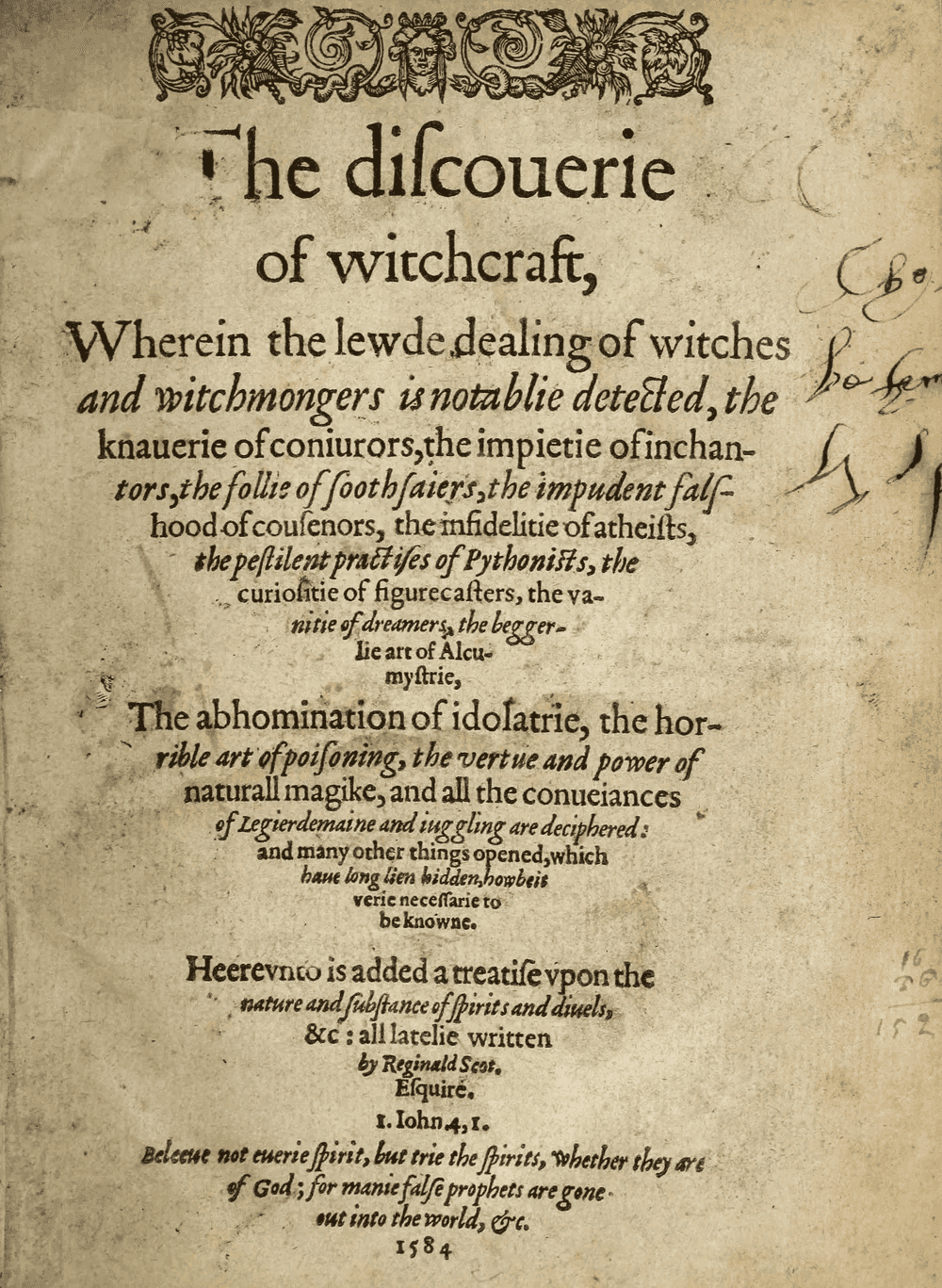
Historical The English writer Reginald Scot translated Weyer’s catalog into English in Book 15 of The Discoverie of Witchcraft (1584), another book written against the witch trials. It is one of history’s ironies that two skeptics preserved the catalog that magicians later copied.
Why would skeptics print a list of demons at all? Weyer and Scot both wanted to show that the people accused of witchcraft were innocent, and that the real fraud lay with learned magicians and their books. Printing the catalog let readers see its claims for themselves: kings with three heads, legions numbered in the thousands, spirits who teach geometry. Scot even ends his version by inviting the reader to multiply the legions. The irony is that the books written to expose the catalog became the main channel through which it survived.
The Sloane and Harley manuscripts
Historical The Goetia as a complete text survives in English manuscripts of the 17th century, now in the British Library. The Sloane manuscripts 3825 and 2731 are the main witnesses (Sloane 2731 is dated 1687), Sloane 3648 is related, and Sloane 3824 contains an earlier form of related material. Harley 6483, associated with a “Dr Rudd”, dates from the early 18th century and pairs each spirit with one of 72 angels. The manuscripts do not agree on every name, number or seal.
Mathers and Crowley, 1904
Later tradition In the 1890s S. L. MacGregor Mathers, a leader of the Hermetic Order of the Golden Dawn, prepared an English text from the Sloane manuscripts. Aleister Crowley, who had fallen out with him, published it in 1904 as The Book of the Goetia of Solomon the King, “translated into the English tongue by a dead hand”. The dead hand was a joke at Mathers, who was very much alive. Crowley added an introduction, notes and a “Preliminary Invocation” taken from a Greek magical papyrus that has nothing to do with the Sloane manuscripts. This 1904 edition is the one most people have read, and it is in the public domain. A 1916 reprint by L. W. de Laurence circulated widely but silently changed some numbers, such as Belial’s legions.
Reading the Goetia in its own time
Historical It helps to picture the England in which the Goetia was copied. The 17th century brought a civil war, the execution of a king and a restoration. It also brought the last major witch hunts in English history, including the trials driven by Matthew Hopkins in the 1640s, and the slow rise of experimental science, with the Royal Society founded in 1660. Belief in spirits was common among educated people. So was suspicion of anyone who tried to command them.
The men who copied the Lemegeton could read Latin and English, draw seals and follow complex instructions. Their reasons are mostly unknown. Some may have practiced, some collected, some sold copies. The concerns in the text, such as treasure, favor, lost goods, love and learning, are the concerns of their world. So are its fears: deception, the spirits’ foul breath, the loss of one’s soul. Reading the Goetia with that world in mind makes it less frightening and much more interesting.
Demons, spirits, daimones
Historical The Goetia calls its 72 spirits evil and treats them as fallen angels. Several entries even say which order of angels a spirit belonged to before the fall. That is a Christian theology. The Greek word daimōn is older and was neutral: it could mean a god, a lesser divine power or a person’s guardian spirit. Socrates spoke of a daimonion, an inner voice that warned him. Only in Christian writing did the word settle on evil spirits.
Modern Today people use the vocabulary in several ways. Some keep the Christian frame. Some reject the word evil and see the spirits as powerful but not wicked. Some see them as parts of the mind. On this site I use “spirit” as the everyday word, because it is neutral, and “demon” when I describe what the sources say.
Read more in the history of the Goetia, the Lemegeton, Weyer and Scot and Mathers and Crowley, 1904.
Where to read the texts
You do not need to buy anything to read the primary sources. The 1904 Mathers and Crowley edition is in the public domain, and Reginald Scot’s Discoverie of Witchcraft is freely available in old printed editions and modern transcriptions. Joseph H. Peterson’s Esoteric Archives offers careful transcriptions of many public-domain grimoires. For close study, his printed edition of the Lemegeton (2001) gives the manuscript variants side by side. Modern editions under copyright should be bought or borrowed, not copied.
When you read online that a seal is “from the original Hebrew Goetia”, or that a ritual was “used by Solomon himself”, you can now check: which manuscript, which edition, which year? That one habit protects you from most of the myths and many of the scams.
How a spirit entry works
Each of the 72 entries follows the same pattern. Knowing it helps you read any entry critically.
- Number and name. The order follows Weyer’s list with additions. Names vary between sources: Bael is also Baal or Baell.
- Rank. Every spirit has a title from a European court: king, prince, duke, marquis, earl, president or knight. Some hold two ranks. The ranks say that hell, like the world, is ordered, and that the magician stands above that order.
- Appearance. Often strange or composite: Bael with three heads, Paimon riding a dromedary, Stolas as a raven.
- Offices. What the spirit can do or teach. Many teach the liberal arts and sciences, the virtues of herbs and stones, or tell things past, present and to come. Some find treasure or give favor. Some cause love, storms or harm. The old text does not sort spirits into good and bad.
- Legions. How many spirits each one commands, from 3 to 200. The numbers express rank, not data, and differ between sources.
- Seal. A drawn sign, which the text says should be made in a metal matching the rank.
Later tradition If you read online that a spirit loves cinnamon, belongs to a tarot card or prefers Thursdays, that comes from the Golden Dawn, from Crowley’s tables in 777 (1909) or from modern practitioners. It is not in the Goetia. On this site every spirit page separates the two. See ranks and offices and seals, circle and triangle.
Why these twelve
The directory has a page for every spirit. If you are new, these twelve are a good place to start, because their offices are mostly about learning, languages, animals and the stars. Each page gives what the 1904 text says, how Weyer and Scot differ and what later writers added, each with its label.
- Bael (1), a king who “speaketh hoarsely” and appears with three heads.
- Agares (2), a duke riding a crocodile, who teaches languages.
- Vassago (3), a prince said to find things lost and hidden.
- Marbas (5), a president who teaches mechanical arts.
- Barbatos (8), a duke who gives understanding of the voices of animals.
- Paimon (9), a king who teaches all arts and sciences, famous today from film.
- Buer (10), a president who teaches philosophy and the virtues of herbs.
- Stolas (36), a prince who teaches astronomy and the virtues of herbs and stones.
- Phenex (37), a marquis who speaks of sciences and is “a good Poet”.
- Orobas (55), a prince who gives true answers and is faithful to the magician.
- Seere (70), a prince who goes and comes swiftly.
- Dantalion (71), a duke who knows the thoughts of others.
See all 72 spirits.
Modern approaches
Modern People who work with the Goetia today do it in very different ways, and they often disagree.
Traditional Solomonic
Some practitioners follow the old ritual closely: the circle, the triangle, the names of God and the conjurations, treating the spirits as dangerous beings to be commanded. This is the historical frame of the text. It is not a beginner’s method, and I do not teach the full conjurations, which include threats and curses.
Psychological
In his 1904 introduction, Crowley argued that the spirits are “portions of the human brain”, and the ritual a way of stimulating them. Many modern readers follow some version of this: the spirits as symbols of forces in the mind, worked with through study, meditation and journaling.
Demonolatry and devotional approaches
Demonolatry, developed in its modern form from the late 20th century and popularised by writers such as S. Connolly, treats the spirits as beings to honor and build a respectful relationship with, rather than command. It is a modern religious path, not a survival of an ancient one.
Chaos magic
Chaos magicians, from the 1970s on, treat belief itself as a tool. Some work with Goetic spirits as one symbol system among many. See the chaos magic safety page.
You do not need to decide what the spirits are in order to study them. Read more in modern approaches.
Safety in brief
If you are struggling right now, call your local emergency number (112 in Europe, 911 in the US and Canada) or see Getting help.
Myths about the Goetia
- “King Solomon wrote it.” The attribution is a literary tradition. The text took shape in 17th century England.
- “It was translated from Hebrew.” The Goetia’s own preface says so, “as it is said”. No Hebrew, Aramaic or Greek original is known. The oldest versions are English.
- “The 72 are ancient gods in disguise.” A few names echo older deities, such as Bael (Baal) and Astaroth (Astarte). The catalog as a whole is a late medieval and early modern Christian creation.
- “The planets and zodiac signs are part of the original.” Most of those links come from the Golden Dawn and Crowley’s 777.
- “You need to make a pact.” There is no pact in the Goetia. Pacts come from other grimoires and from witch-trial fantasy.
- “If you read a demon’s name, it will come for you.” Nothing in four centuries of scholarship supports this.
More in Goetia myths.
Seals, circle and triangle
Historical The second half of the Ars Goetia is a ritual. The magician stands inside a protective circle drawn with divine names, and the spirit is asked to appear in a triangle outside it. The magician wears a hexagram and a pentagram, holds a ring and uses a brass vessel said to be like the one Solomon used to imprison spirits. The conjurations are long and repetitive, and they escalate to threats and a curse if the spirit refuses.
I explain all of this as a text, because it tells you how its writers saw the world: as a place of real spiritual danger, where safety came from God’s names and careful boundaries. I do not teach it as a method. If you are curious about the seals as art, look at them in more than one edition. The 1904 seals are one set of drawings, not the only possible form.
How to study the Goetia
If you would like to go further, here is the order I suggest.
- Read the safety page. Then read it again a week later if you felt anxious the first time.
- Read the history. Start with Weyer and Scot, then the 1904 edition. Scot’s English is easy to find in public-domain editions.
- Choose one spirit and study it slowly. Compare its entry in Scot and in the 1904 text. Note what differs. Look up the names it echoes.
- Keep a study journal. Write what you read, what you noticed and how you felt. That journal is worth more than any ritual.
- Use a scholarly edition. For close reading, Joseph H. Peterson’s edition of the Lemegeton (2001) is the standard.
See beginner criteria.
Keep learning
The free course Demons for Beginners walks through this history in seven study-only lessons, from the Greek daimon to the 1904 Goetia. Like every course here it is free, with no account.
When you sign up for my newsletter, I send you the free Mini-Grimoire, a gentle beginner’s guide to tarot and first rituals.
Frequently asked questions
Is it dangerous to read the names?
No. Reading a name does not call a spirit. The names have been printed, copied and studied for more than four centuries by scholars, editors and librarians.
Is the Goetia Satanism?
No. The Ars Goetia is a 17th century Christian magical text: its magician commands spirits by the names of God. Modern Satanism is a separate, 20th century movement, and most Satanists do not practice Goetia at all.
Which spirit is good for beginners?
For a beginner, the best spirit is none at all for a while. Start with the history and the safety page. When you are curious about a particular entry, choose one whose offices are about learning, such as Buer or Stolas, and simply study it.
Sources
- S. L. MacGregor Mathers and Aleister Crowley, The Book of the Goetia of Solomon the King (Boleskine, 1904).
- Johann Weyer, Pseudomonarchia daemonum, appendix to De praestigiis daemonum (Basel, 1577).
- Reginald Scot, The Discoverie of Witchcraft (London, 1584), Book 15.
- Joseph H. Peterson (ed.), The Lesser Key of Solomon (York Beach: Weiser, 2001).
- J. Collin de Plancy, Dictionnaire infernal, 6th edition with engravings by Louis Le Breton (Paris, 1863).
- Aleister Crowley, 777 (London, 1909).
- S. Connolly, The Complete Book of Demonolatry (DB Publishing, 2006).
- Owen Davies, Grimoires: A History of Magic Books (Oxford University Press, 2009).
- Richard Kieckhefer, Forbidden Rites: A Necromancer’s Manual of the Fifteenth Century (Stroud: Sutton, 1997).