

About Runes
The real history of the runes is so much better than the myths. Before they were ever used for reading or magic, runes were an alphabet: a way of writing names, owner’s marks and memorials on wood, metal and stone. This page starts there, with the oldest inscriptions, and then walks through the 24 runes of the Elder Futhark, the rune poems, modern reading and how to avoid the ugly ways runes have been misused.
A writing system first
Historical The runic alphabet is called the futhark, after its first six letters: f, u, th, a, r, k. Like the word “alphabet” (alpha, beta), the name simply lists the beginning. Each rune stood for a sound, and each also had a name, a real word that began with that sound. Fehu, the first rune, meant “cattle” or “wealth” and stood for f.
Scholars agree that the runes were adapted from a Mediterranean alphabet, most likely Latin or one of the North Italic alphabets used in the Alps. Exactly which one, and who made the adaptation, is still debated. What we can say is that the runes were made for carving: they are built from straight lines, with no horizontal strokes that would get lost in the grain of wood.
Most surviving inscriptions are practical. They name the owner or maker of an object, remember a dead person, or mark a gift. Some are short formulas that may have had a protective or ritual meaning. Very few look like what modern readers would call magic. Keeping that in mind is the first step to reading runes honestly.
The oldest inscriptions
Historical A few finds anchor the early history of the runes:
- The Vimose comb (Denmark), dated to around 160 CE, carries the word harja, which may be a name or may mean “comb”. It is often called the oldest securely dated runic inscription.
- The Øvre Stabu spearhead (Norway), from the late 2nd or early 3rd century, carries raunijaz, usually read as “tester”, a fitting name for a spear.
- The Svingerud stone (Norway), excavated between 2021 and 2023 from a cemetery in Ringerike. Radiocarbon dates from the graves place it between about 50 BCE and 275 CE, which makes it the oldest datable runestone known. It carries the first three runes, ᚠᚢᚦ, in order, and what may be a woman’s name.
- The Kylver stone (Gotland, Sweden), from around 400 CE, has the first complete row of all 24 runes, carved on a slab that covered a grave. It is now in the Swedish History Museum in Stockholm.
A brooch from Meldorf in Germany, from the first half of the 1st century CE, carries four signs that may be very early runes or may be Latin letters. Scholars still argue about it.
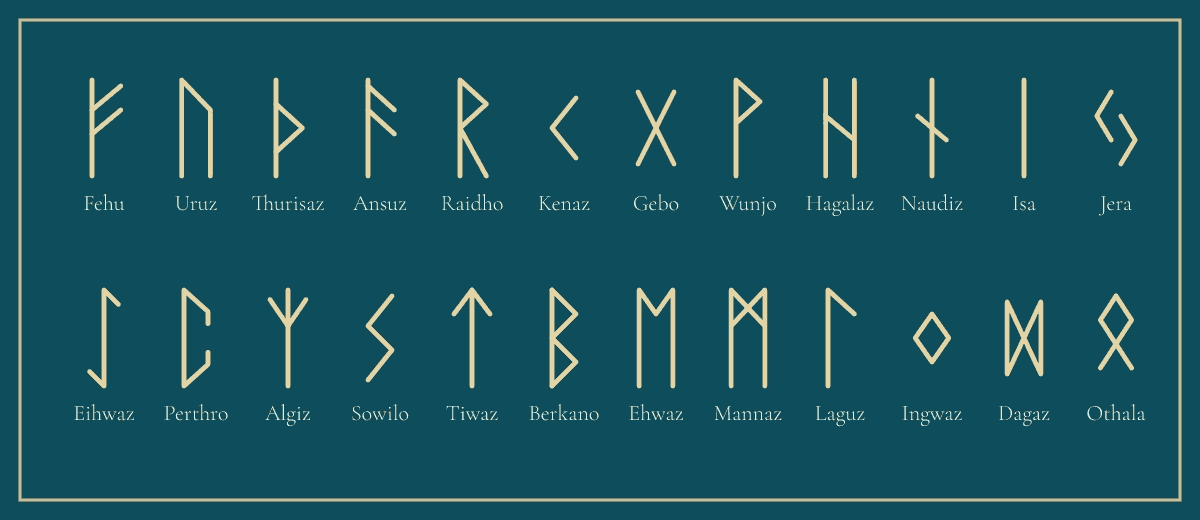
The 24 runes in three aettir
Historical The Elder Futhark has 24 runes. Gold bracteates (thin stamped pendants) from Vadstena and Mariedamm in Sweden, from around 500 CE, divide them into three groups of eight with dots. Later Icelandic tradition calls these groups ættir, “families”, and names them after Freyr, Hagal and Tyr. Those names are late.
The table gives each rune’s shape, its reconstructed name, its sound and what the name meant. “Secure” means scholars are confident; “probable” and “uncertain” mean they are less sure. The last column gives the keywords modern readers use, which are Modern. They grew from the names and the rune poems, and they are not ancient meanings. Click a rune for its full page.
If you are new, I suggest you learn the runes in their three groups of eight, one group a week. Draw one rune each morning, say its name, sound and the meaning of its name, and write one line about where you noticed it during the day. After three weeks you will have met all 24.
The first aett
| Rune | Name | Sound | What the name meant | Modern keywords |
|---|---|---|---|---|
| ᚠ | Fehu | f | ‘cattle, livestock, wealth’ (secure) | wealth, resources, earnings |
| ᚢ | Uruz | u | ‘aurochs’ (probable) | strength, vitality, endurance |
| ᚦ | Thurisaz | th | ‘giant’ (probable); Old English ‘thorn’ | defense, boundaries, conflict |
| ᚨ | Ansuz | a | ‘god’, one of the Æsir (secure) | communication, words, wisdom |
| ᚱ | Raidho | r | ‘ride, journey’ (secure) | journey, travel, movement |
| ᚲ | Kenaz | k | uncertain: ‘sore’ or ‘torch’ (debated) | light, knowledge, insight |
| ᚷ | Gebo | g | ‘gift’ (secure) | gift, generosity, exchange |
| ᚹ | Wunjo | w | ‘joy, delight’ (secure) | joy, contentment, harmony |
The second aett
| Rune | Name | Sound | What the name meant | Modern keywords |
|---|---|---|---|---|
| ᚺ | Hagalaz | h | ‘hail’ (secure) | disruption, sudden change |
| ᚾ | Naudiz | n | ‘need, distress’ (secure) | need, constraint, hardship |
| ᛁ | Isa | i | ‘ice’ (secure) | stillness, pause, standstill |
| ᛃ | Jera | j | ‘year, harvest’ (secure) | harvest, reward, cycles |
| ᛇ | Eihwaz | ï / æ | ‘yew’ (probable) | endurance, resilience |
| ᛈ | Perthro | p | unknown (uncertain) | mystery, the unknown, chance |
| ᛉ | Algiz | z | unknown, perhaps ‘elk’ (uncertain) | protection, guardianship |
| ᛊ | Sowilo | s | ‘sun’ (secure) | sun, success, vitality |
The third aett
| Rune | Name | Sound | What the name meant | Modern keywords |
|---|---|---|---|---|
| ᛏ | Tiwaz | t | the god Tiwaz / Týr (secure) | justice, honor, courage |
| ᛒ | Berkano | b | ‘birch’ (secure) | growth, new beginnings |
| ᛖ | Ehwaz | e | ‘horse’ (secure) | partnership, trust |
| ᛗ | Mannaz | m | ‘human being’ (secure) | humanity, self, community |
| ᛚ | Laguz | l | ‘water, lake’ (probable) | water, flow, emotion |
| ᛜ | Ingwaz | ng | the god Ing (probable) | fertility, potential |
| ᛞ | Dagaz | d | ‘day’ (secure) | daybreak, awakening |
| ᛟ | Othala | o | ‘inherited land’ (secure) | home, inheritance, heritage |
Two orders of the last two runes are historical. The Kylver stone ends with Dagaz and then Othala; the Vadstena bracteate ends with Othala and then Dagaz. This site follows Kylver.
The rune poems
Historical Much of what we know about the runes’ names comes from three medieval poems: the Old English, the Old Norwegian and the Old Icelandic rune poems. Each gives a short verse for each rune, beginning with its name. They are late, from roughly the 9th to the 15th centuries, and they describe different alphabets, so they do not always agree. Fehu in the Old English poem is “a comfort to all men”; in the Norwegian poem, wealth “is a source of discord among kinsmen”. Bruce Dickins translated all three in 1915, and his translations are in the public domain.
The poems are not instructions for divination. They are teaching verses and riddles, a way of remembering the letters. But they are the closest thing we have to the runes’ own voice, and many modern meanings come from them.
Three runes in the poems
Here is how the poems handle three runes, in Dickins’s translations. Notice how different they can be.
- Hagalaz (ᚺ), hail. The Old English poem calls hail “the whitest of grain”; the Norwegian poem calls it “the coldest of grain”. Hail is destructive, but it melts into water. Modern readers often take the rune as sudden disruption that passes.
- Isa (ᛁ), ice. In the Old English poem, ice “is very cold”; in the Norwegian, “ice we call the broad bridge”. A bridge you can walk across, and a stillness that holds you in place. The modern keyword “pause” comes from exactly this.
- Kenaz (ᚲ). In the Old English poem it is a torch, “known to every living man”. In the Norwegian poem it is an ulcer, “fatal to children”. The modern meanings of light and knowledge come from the English poem only. That is a good reminder that one modern keyword can hide a lot of history.
The Younger Futhark and the Anglo-Saxon futhorc
Historical Around the 8th century, in Scandinavia, the Elder Futhark was simplified to just 16 runes: the Younger Futhark. This is the alphabet of the Viking Age and of most of the famous runestones of Sweden, Denmark and Norway, such as the great Jelling stone raised by King Harald Bluetooth in Denmark in the 10th century. With fewer letters, one rune had to stand for several sounds.
In England and Frisia the opposite happened. The Anglo-Saxon futhorc grew to 28 runes and more, to fit the sounds of Old English. It was used on objects like the Franks Casket and the Ruthwell Cross, and it is the alphabet behind the Old English rune poem.
So when someone calls the Elder Futhark “Viking runes”, they are a few centuries out. The Vikings wrote with the Younger Futhark.
Bindrunes
Historical A bindrune joins two or more runes into one sign by sharing a stroke. In inscriptions, bindrunes usually saved space or joined letters within a word, the way we might write “æ”. The Kylver stone ends with a tree-like sign that may be several Tiwaz runes stacked into one.
Modern Today many people design bindrunes as personal symbols, joining runes whose meanings fit an intention, much as witches design sigils. If you make one, check that the finished shape does not accidentally match a hate symbol, and keep it personal. See bindrunes.
Making your first rune set
You can make a perfectly good set in an afternoon. Collect 24 smooth pebbles of similar size, or cut discs from a fallen branch (not yew), and draw one rune on each with a paint pen or a fine marker. Keep the strokes straight and simple, the way the carvers did. Make a small cloth bag, or use any pouch you like. As you draw each rune, say its name and its sound out loud. By the time the set is finished, you will know the shapes better than any chart could teach you.
Runes and magic in the sources
This is where I need to be most careful, because so much online writing is confident and wrong.
Historical The Roman historian Tacitus, writing in 98 CE, describes Germanic peoples casting lots: twigs cut from a fruit tree, marked with “certain signs”, scattered on a white cloth and read. He does not call the signs runes, and he wrote decades before the oldest securely dated runic object. It is a tempting connection, but it is not proof.
Historical Some early inscriptions use words like alu and laþu, which seem to be formulas with a protective or ritual meaning. In the Old Norse poem Sigrdrífumál, a valkyrie teaches the hero runes for victory, ale, birth and healing, and in the poem Hávamál the god Odin wins the runes by hanging on a tree for nine nights. These are poems, written down in Iceland in the 13th century. They show that runes had a mythic and magical reputation, but Norse literature nowhere gives instructions for rune divination.
Later tradition The idea of runes as an esoteric system grew from the 17th century on. In the early 20th century the Austrian occultist Guido von List invented his own “Armanen” runes, mixing them with nationalist mysticism.
Modern Rune reading as most people know it today was popularised by Ralph Blum’s The Book of Runes in 1982, and developed by writers such as Edred Thorsson, Freya Aswynn and Diana Paxson. Modern rune reading is a real and thoughtful practice. It is just modern.
Ethics and misuse
Some runes were taken up by the Nazis and are still used by white supremacist groups. You need to know this, both to avoid giving the wrong impression and to recognize hate symbols when you see them.
- Othala (ᛟ), especially in a form with “wings” or feet, was used as an insignia by two Waffen SS divisions and is used by hate groups today.
- Sowilo (ᛊ), doubled, became the SS “sig” runes.
- Algiz (ᛉ) was used by the Nazis as a “life rune”, and appears in neo-Nazi imagery.
- Tiwaz (ᛏ) and Hagalaz (ᚺ) appear in far-right imagery too, and the shape of Eihwaz (ᛇ) resembles part of the Wolfsangel symbol.
None of this makes the runes themselves evil. They are an alphabet more than a thousand years older than these movements. But context matters. A single Othala on a wooden disc in your rune set is one thing; a tattoo, a flag or a logo can send a message you never meant. The Anti-Defamation League’s hate symbols database is a good place to check a design. In Germany, displaying symbols of banned Nazi organizations is a crime, and that includes the SS runes (this is not legal advice).
I do not use these symbols in the ways hate groups use them, and I will not publish anything that does.
How to cast runes: a short summary
Modern Here is a gentle method for your first reading. The full guide is in how to cast runes.
- Make or get a set. Twenty-four pieces of wood, stone or clay with one rune each. Drawing them yourself is a good way to learn.
- Ask an open question. “What should I notice about this week?” works better than “Will I get the job?”
- Draw one rune from a bag without looking, or scatter all of them on a cloth and read the ones that land face up nearest the center.
- Read in layers. First the shape and name, then what the name meant, then the modern keywords, then how it sits with your question.
- Write it down. Date, question, rune, one sentence. Reread it a week later.
Many readers use a three-rune spread for past, present and the direction you are traveling. Whether to read runes “reversed” is a modern choice; several runes look the same either way up.
Three example readings
To show how a reading feels in practice, here are three single-rune draws from a reading journal.
Question: “What should I notice about this week?” Rune: Jera (ᛃ). Jera’s name meant “year” or “good harvest”. The modern keywords are harvest, reward and cycles. Read against the question, it suggests noticing what is slowly ripening: a project that needs another month, not a push today. A sentence for the notebook: “Let the slow thing be slow.”
Question: “How can I handle a difficult conversation?” Rune: Ansuz (ᚨ). The name meant “god”, one of the Æsir, and the Old English poem calls it “the source of all language”. Modern readers link it to words and wisdom. The suggestion: prepare your words, and say less but say it clearly.
Question: “What helps me rest?” Rune: Isa (ᛁ). Ice, stillness, a pause. Sometimes a reading is not subtle. The advice is to stop, and to stop on purpose.
None of these readings predicts anything. Each turns a rune into a question you can take into your day. That is the most honest and the most useful way I know to read runes.
Common myths about runes
- “Runes are a secret magical code.” They were an everyday alphabet, used for names, owner’s marks and memorials.
- “The Vikings read runes to tell the future.” There is no source describing rune divination in the Viking Age. Tacitus described marked lots centuries earlier, without calling them runes.
- “There is a blank rune.” The blank “Odin’s rune” was introduced by Ralph Blum in 1982. It has no historical basis, although some modern readers like it.
- “Algiz means protection.” We do not know the rune’s original name. “Algiz” and “elk” are scholarly guesses, and “protection” is a modern meaning.
- “Runes are a Nazi symbol.” Runes are far older than Nazism, which stole a few of them. Knowing the difference, and the context, is part of using them well.
Keep learning
The free Tarot for Beginners course teaches the same habits of careful reading that runes need, and when you sign up for my newsletter I send you the free Mini-Grimoire. If you prefer essays, my Substack has the Elder Futhark: what we actually know and how to read runes.
Frequently asked questions
Are runes Viking?
Partly. The Elder Futhark is older than the Viking Age: it was used from around the 2nd century CE. The Vikings wrote with the shorter Younger Futhark, which grew out of it around the 8th century.
Is using runes cultural appropriation?
Runes were an alphabet used across a wide area of northern Europe, and today they belong to many people, from scholars to heathens to artists. Use them respectfully, learn their real history and keep well away from their misuse by hate groups.
Can I make my own rune set?
Yes. Most readers make or buy a set of 24 pieces of wood, stone or clay. Making your own, by drawing the runes on smooth stones or wooden discs, is a good way to learn their shapes.
Sources
- R. I. Page, Runes (London: British Museum Press, 1987).
- Tineke Looijenga, Texts and Contexts of the Oldest Runic Inscriptions (Leiden: Brill, 2003).
- Terje Spurkland, Norwegian Runes and Runic Inscriptions (Woodbridge: Boydell, 2005).
- Michael P. Barnes, Runes: A Handbook (Woodbridge: Boydell, 2012).
- Martin Findell, Runes (London: British Museum Press, 2014).
- Bruce Dickins, Runic and Heroic Poems of the Old Teutonic Peoples (Cambridge University Press, 1915).
- Tacitus, Germania, chapter 10, translated by A. J. Church and W. J. Brodribb (1876).