


How to read the labels Historical what the old sources say. Later tradition what later writers added. Modern modern practice and my own notes.
| Number | 53 of 72 |
|---|---|
| Rank | President |
| Legions | 30 |
| Office (1904) | Is "a Good Disputer." |
| Other spellings | Caim (1904, Weyer, Scot), Caym |
Spirit 53 of the Ars Goetia is Camio. The 1904 edition by S. L. MacGregor Mathers and Aleister Crowley calls him a president ruling 30 legions, and the first office it gives him is this: Camio is “a Good Disputer.”
He answers out of burning ashes and gives the understanding of birds, cattle, dogs and running water. Each part below carries a label for its layer, explained in how to read a spirit page.
At a glance
| Fact | In the entry |
|---|---|
| Number | 53 of 72, in the 1904 order. |
| Name and spellings | Camio in 1904; other spellings: Caim (1904, Weyer, Scot), Caym. |
| Rank and legions | President, 30 legions. |
| Metal of his rank (Observations) | Mercury. |
| Hours for presidents (Observations) | “At any time, excepting Twilight, at Night, unless the King whom they are under be Invocated.” |
| In Weyer’s catalog (1577) | Yes, as the source comparison below shows. |
The 1904 entry
Historical The full entry from the 1904 edition, with footnote numbers and the dash after the heading left out and the heading set in ordinary type:
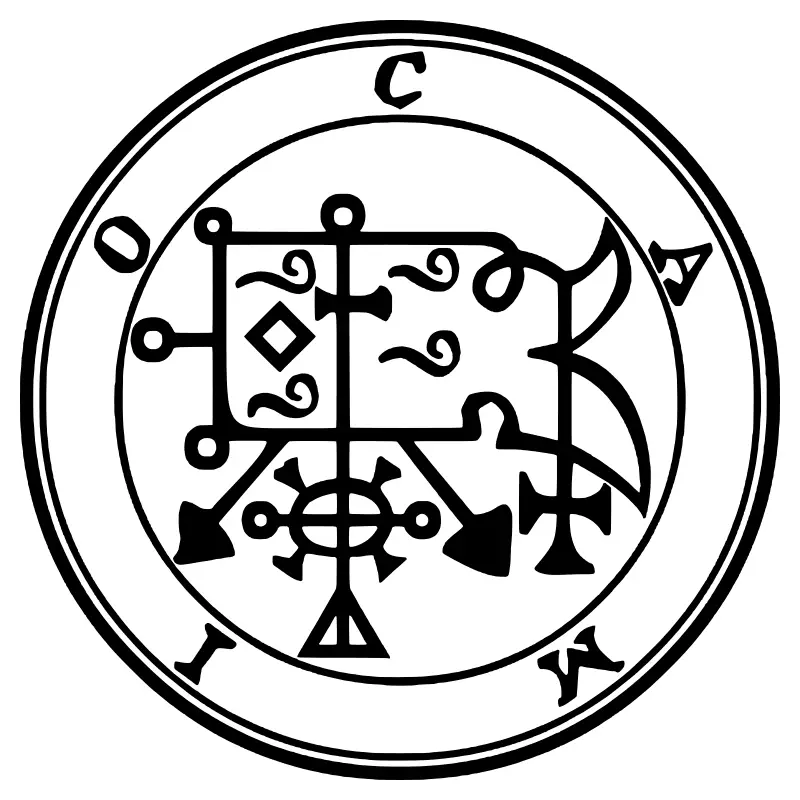
Camio or Caim. The Fifty-third Spirit is Camio, or Caim. He is a Great President, and appeareth in the Form of the Bird called a Thrush at first, but afterwards he putteth on the Shape of a Man carrying in his Hand a Sharp Sword. He seemeth to answer in Burning Ashes, or in Coals of Fire. He is a Good Disputer. His Office is to give unto Men the Understanding of all Birds, Lowing of Bullocks, Barking of Dogs, and other Creatures; and also of the Voice of the Waters. He giveth True Answers of Things to Come. He was of the Order of Angels, but now ruleth over 30 Legions of Spirits Infernal. His Seal is this, which wear thou, etc.
Camio appears first as “the Bird called a Thrush” and then as a man “carrying in his Hand a Sharp Sword”. “He seemeth to answer in Burning Ashes, or in Coals of Fire.” He is “a Good Disputer”, and his office is “to give unto Men the Understanding of all Birds, Lowing of Bullocks, Barking of Dogs, and other Creatures; and also of the Voice of the Waters”. He “was of the Order of Angels”, the lowest of the nine choirs.
Appearance
Historical Camio appears “in the Form of the Bird called a Thrush at first,” then in the shape of a man “carrying in his Hand a Sharp Sword. He seemeth to answer in Burning Ashes, or in Coals of Fire.”
Offices in the Ars Goetia
Historical The offices of Camio, in the order the 1904 text gives them:
- Is “a Good Disputer.”
- Gives understanding of all birds, the lowing of bullocks, the barking of dogs, other creatures, and the voice of the waters.
- Gives true answers of things to come.
He “was of the Order of Angels, but now ruleth over 30 Legions of Spirits Infernal.”
Source comparison: Weyer and Scot
Historical Weyer, in Scot’s English, gives “Caim” as “a great president, taking the forme of a thrush,” who in man’s shape “answereth in burning ashes,” carries a sharp sword, “maketh the best disputers,” and gives understanding of birds, bullocks, dogs, and waters.
The Goetia’s main heading uses the form Camio, but its rank list has Caim. Both give 30 legions.
Historical Weyer’s bird is “merulæ”, a blackbird, which Scot renders as “thrush”. In Weyer he answers “in favilla ardente”, in glowing ash. The disputing is an office for others: “Præ cæteris sapienter argumentari facit”, above all he makes people argue wisely. The Goetia turns this into a trait of the spirit himself, “He is a Good Disputer”. The voices are “volatilium” (all flying creatures), “mugitus boum”, “latratus canum” and “sonitus aquarum”. (About Weyer and Scot.)
Name and etymology
Historical Weyer writes Caym, Scot Caim, and the 1904 text Camio or Caim. No meaning is known.
Seal and images
Historical The seal above is Camio’s as printed in 1904, and by the rules of the Observations it would be made in mercury, the metal of his rank. Mercury is toxic, so a modern copy belongs on paper. Why seals were worn, why editions draw them differently and how to study one are explained in seals, circle and triangle.
Later tradition Le Breton’s 1863 page for Caym has two plates: a blackbird wearing a sword belt, close to Weyer’s “merula”, and a long-beaked bird-man with a crest of feathers.
Later tradition and modern practice
Modern Modern writers often approach Camio for debate skills and for understanding animals.
Lore about Camio’s personality, likes or chosen people is modern, not grimoire material; modern approaches explains where such claims come from.
Beginner’s quick reference
| Item | What the sources say |
|---|---|
| Rank metal and hours (Goetia) | President: mercury (toxic; never handle it); any time except twilight or night, unless his king is invoked (the wording is unclear). |
| Planet (later tradition: Golden Dawn and Crowley’s 777) | Mercury. |
| Decan and day or night spirit (later tradition: 777) | Virgo, second decan (10 to 20 degrees); night spirit. 777 decan incense: “Srorus” (unidentified). Tarot card of the decan: Nine of Pentacles. |
| Commonly reported color, incense, and plant (modern UPG; sources copy each other) | Color orange; incense storax; plant centaurea. |
| Associated symbols | Goetia image: a thrush; later a man with a sharp sword, who seems to answer in burning ashes or coals. 777 Magical Image: the same image. Le Breton engraving (1863): a thrush or blackbird wearing a sash and a saber. Modern Demonolatry/UPG: the seal, used as an altar image. |
| Associated offerings | Modern practice, not in the Goetia manuscripts: most often listed, storax and centaurea (cornflower). |
Before you burn or handle anything listed for Camio, read incense, plants and offerings.
Practical notes
Camio is a president whose offices are debate and understanding animal voices. He fits the beginner criteria. A question about how to argue a position more clearly, or how to observe birds, would suit a first contact. His “answers in burning ashes” are a reason to keep any flame in practice small and supervised.
In the directory, Camio is one of the 30 spirits that fit the beginner criteria.
Try this: one question to study
Weyer has Caym make others argue wisely; the 1904 text makes Camio himself a good disputer. Find another entry where an office for the magician became a trait of the spirit.
What next
To compare Camio with other spirits of his rank, read Ose and Haagenti.
Later tradition In the Golden Dawn scheme of the decans, Camio is the night spirit of the second decan of Virgo, which belongs to the Nine of Pentacles; the day spirit of the same decan is Botis (spirit 17).
Common questions
Is Camio a good spirit for beginners?
He is counted among the 30 of the 72 that fit the three beginner criteria I use: not a king, at least one teaching office, and no central harm, deception or compulsion. Even so, read his whole entry first, because nearly every entry is mixed.
What does Camio do in the Ars Goetia?
The 1904 text calls him a president ruling 30 legions. Its first office for him is this: Camio is "a Good Disputer." The entry lists 3 offices in all.
Does looking at Camio's seal call him?
No. Reading a name or looking at a seal does not call a spirit. The seal is a drawing from a 1904 book, and even the grimoire itself required long rituals for its own purposes.
Get the free Mini-Grimoire
A short printable starter guide to tarot and everyday witchcraft, plus my newsletter. Unsubscribe any time.
Opens Substack in a new tab to confirm. More about the newsletter · Privacy