


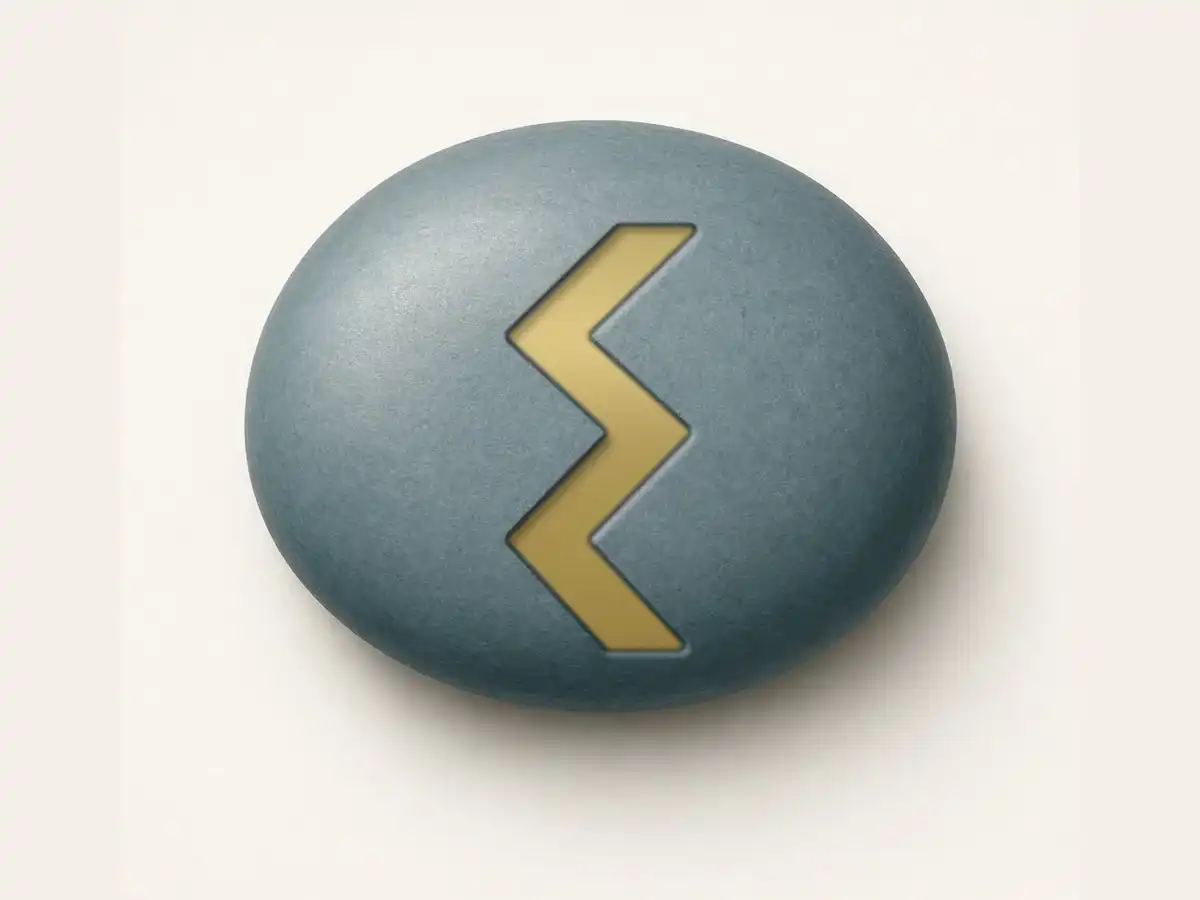
How to read the labels Historical what the old sources say. Later tradition what later writers added. Modern modern practice and my own notes.
| Name | Sowilo |
|---|---|
| Sound | s |
| Meaning of the name | "sun" (secure) |
| Keywords | sun, success, vitality |
Sowilo is rune 16 of the 24 runes of the Elder Futhark, and the eighth rune of the second aett. It stands for the sound s, and its reconstructed name means “sun”.
Modern readers link it with sun, success and vitality. On this page I start with what the evidence says, then the three medieval rune poems, and only then the modern meanings, so you can always see which layer you are reading.
At a glance
| Feature | Sowilo |
|---|---|
| Shape | A zigzag of three strokes, like a lightning flash or an angular S standing upright |
| Sound | s |
| Reconstructed name | *sōwilō, “sun” (secure) |
| Later names | Old English sigel; Old Norwegian and Old Icelandic sól |
| Position | Second aett, rune 16 |
Reconstructed names carry an asterisk because no early source writes them out in full. Scholars work them out from the later Old English and Old Norse names and from related words in other Germanic languages. Where the reconstruction is uncertain, I say so below.
The shape
Sowilo is a zigzag of three strokes standing upright, like an angular S. Early forms vary a lot, and some have more angles. Draw it the full height of the line with plain, even strokes, not sharpened into a bolt.
Use the single historical form, and see the note on misuse below: a doubled version of this shape was the emblem of the SS.
A good way to learn Sowilo is to draw it ten times in a row on scrap paper, saying its sound aloud each time. Then draw it once more beside its neighbors in the futhark, so your hand learns the differences as well as the shape.
In the record
Historical The name *sōwilō, “sun,” is secure, related to Latin sol and English “sun.” The rune represented s in all the runic rows. Its shape varied considerably: in early inscriptions it can have three, four, or more strokes, standing upright or lying on its side.
On the Gallehus horn it has a three-stroke form. In the Younger Futhark it was simplified, sometimes to a short vertical stroke with a twig.
In Old English, the rune’s name was sigel, a word for the sun found mostly in poetry. One of the riddles of the Exeter Book begins and ends with this rune, pointing to the answer, “the sun”.
The rune poems
Historical Old English (author’s rendering): Sailors always set their hope on the sun as they travel away over the fishes’ bath, until the sea-steed carries them to land.
Old Norwegian (author’s rendering): The sun is the gleam of the lands; I bend before holy judgment.
Old Icelandic (author’s rendering): Sun: the clouds’ shield, and a shining disk, and the lifelong grief of ice. The Latin gloss is rota, “wheel.”
The English poem sees the sun as a guide and hope for sailors crossing the sea, the “fishes’ bath,” in a ship, the “sea-steed.”
The Norwegian poem calls it the gleam of the lands and adds a Christian line of reverence. The Icelandic poem calls the sun the clouds’ shield and, beautifully, the lifelong grief of ice, since the sun melts it.
All three poems have a stanza for Sowilo, which is a help: when an English poet and two Scandinavian poets describe the same rune name, we can compare what they agree on and where they differ.
A word about these sources. The Old English poem survives only because George Hickes printed it in 1705, before the manuscript burned in 1731. The Norwegian poem was printed by Ole Worm in 1636, before its manuscript was lost in the Copenhagen fire of 1728.
The Icelandic poem is usually dated to the fifteenth century. All three are medieval and Christian, so they tell us what the rune names meant to later readers, not what the first carvers believed. The renderings above are my own brief, literal ones.
Modern meanings
Modern Keywords: sun, success, vitality, guidance, clarity, confidence, wholeness, victory.
Modern readers read Sowilo as the sun’s energy: success, vitality, health, confidence, and clarity. Many read it as guidance, a light that shows the way, following the English poem’s image of sailors steering by the sun.
It is often read as a strongly positive rune, a sign of achievement or of energy available to accomplish your goals. Some modern authors connect it with victory, though that link owes more to modern associations than to the poems.
Reversed: Sowilo looks the same when turned upside down in this form, so many readers do not reverse it. Some read a difficult Sowilo as burnout, overconfidence, or false goals.
Sowilo in a reading
Modern Here is how Sowilo might speak to three common kinds of question. These are examples of modern reading, not rules, and your own response to the rune comes first.
A question about confidence. Sowilo points to light and energy. Ask where you feel strong, and how to bring that strength into the area you are asking about.
A question about clarity. Sowilo can suggest that the answer is clearer than you think. Look at it in daylight, without the worst-case story.
A question about rest. Sowilo can also be a reminder that the sun sets every evening. Energy needs recovery.
If you draw Sowilo with other runes, read them together. Ask what Sowilo adds to the picture, then look at its neighbors in the spread. A rune reading is a prompt for reflection. It does not predict events, and it never replaces medical, legal or financial advice.
In a simple three-rune spread of situation, challenge and next step, Sowilo changes its voice with its place. As the situation, it describes where things stand, with sun in the foreground. As the challenge, it asks whether something about success is missing, overdone or out of balance.
As the next step, it suggests one small, practical action in the spirit of vitality. Read the other two runes first, then come back to Sowilo and ask how it changes their story.
Sowilo as a tattoo or symbol, and its misuse
On its own, Sowilo is a letter for the sound s and the name of a thing, “sun”. Anyone who reads runes will see it that way first.
If you want it as a tattoo, a piece of jewelry or a mark in your journal, take your time: check the form against a reliable chart, because a small change of angle can turn one rune into another.
Sowilo is easy to confuse with Eihwaz, so compare the two before you decide. Because this rune has a history of misuse, read the note below first, and use the plain historical form.
The emblem of the Nazi SS was based on two stylized s-runes, derived from Guido von List’s “sig” rune, which he based on Sowilo. Doubled and stylized forms are hate symbols, and in Germany their display as emblems of banned organizations is a crime.
A single Sowilo in its historical form, used as a letter or in a reading, is not. If you wear or display Sowilo, avoid doubling it or sharpening it into a lightning-bolt style, avoid combining it with other symbols associated with hate groups, and be ready to explain what it means to you. Context decides.
I explain the wider history, and how to tell innocent use from hateful use, on runes and misused symbols.
Try this
Start with three questions in your journal. What gives me energy and makes me feel most alive? What guides me when I feel lost? Is there a success I have not allowed myself to enjoy?
Spend some time outdoors in daylight, if you can, and notice the light around you. Then write about one goal that is “in the sunlight” for you right now, something you feel confident about, and one small step toward it. As with any time outdoors, protect your skin and eyes, and never look directly at the sun.
To get the most from the week, keep the entries short and honest. On the first day, write what Sowilo means to you before you read anything else.
On the last day, read that first note again and add one line about what changed. You do not need special tools: a notebook, a pen and the rune drawn at the top of each page are enough.
What next
Algiz comes just before Sowilo in the futhark. Modern keywords: protection, guardianship. Tiwaz comes just after it. Modern keywords: justice, honor, courage.
To see all twenty-four runes side by side, with their sounds and the three aettir, go to the Elder Futhark. For where the runes came from, read the history of the runes, and when you are ready to draw runes for reflection, start with how to cast runes. Everything else is on the runes hub.
Common questions
What does the Sowilo rune mean?
Sowilo is rune 16 of the Elder Futhark and stands for the sound s. Its reconstructed name means "sun". Modern readers link it with sun, success and vitality, building on the medieval rune poems.
What does Sowilo mean reversed?
Sowilo looks the same when turned upside down in this form, so many readers do not reverse it. Some read a difficult Sowilo as burnout, overconfidence, or false goals.
Is Sowilo a hate symbol?
Not in itself. Some forms of Sowilo were used by Nazi organizations or are used by extremist groups today, but the plain historical rune is an ancient letter used innocently by many people. Context decides: look at the form, what it is combined with and who is using it.
Get the free Mini-Grimoire
A short printable starter guide to tarot and everyday witchcraft, plus my newsletter. Unsubscribe any time.
Opens Substack in a new tab to confirm. More about the newsletter · Privacy