


How to read the labels Historical what the old sources say. Later tradition what later writers added. Modern modern practice and my own notes.
| Number | 30 of 72 |
|---|---|
| Rank | Marquis |
| Legions | 29 |
| Office (1904) | Teaches and makes men "wonderfully knowing in the Art of Rhetoric." |
| Other spellings | none common |
Forneus is spirit 30 of the 72 in the Ars Goetia, the first book of the Lesser Key of Solomon. The 1904 edition by S. L. MacGregor Mathers and Aleister Crowley calls him a marquis ruling 29 legions, and the first office it gives him is this: Forneus teaches and makes men “wonderfully knowing in the Art of Rhetoric.”
His entry centres on speech, reputation and languages, with an image drawn from the sea. Each part below carries a label for its layer, explained in how to read a spirit page.
At a glance
| Fact | In the entry |
|---|---|
| Number | 30 of 72, in the 1904 order. |
| Name and spellings | Forneus in 1904; other spellings: none common. |
| Rank and legions | Marquis, 29 legions. |
| Metal of his rank (Observations) | Silver. |
| Hours for marquises (Observations) | “From 3 in the afternoon till 9 at Night, and from 9 at Night till Sunrise.” |
| In Weyer’s catalog (1577) | Yes, as the source comparison below shows. |
The 1904 entry
Historical The full entry from the 1904 edition, with footnote numbers and the dash after the heading left out and the heading set in ordinary type:
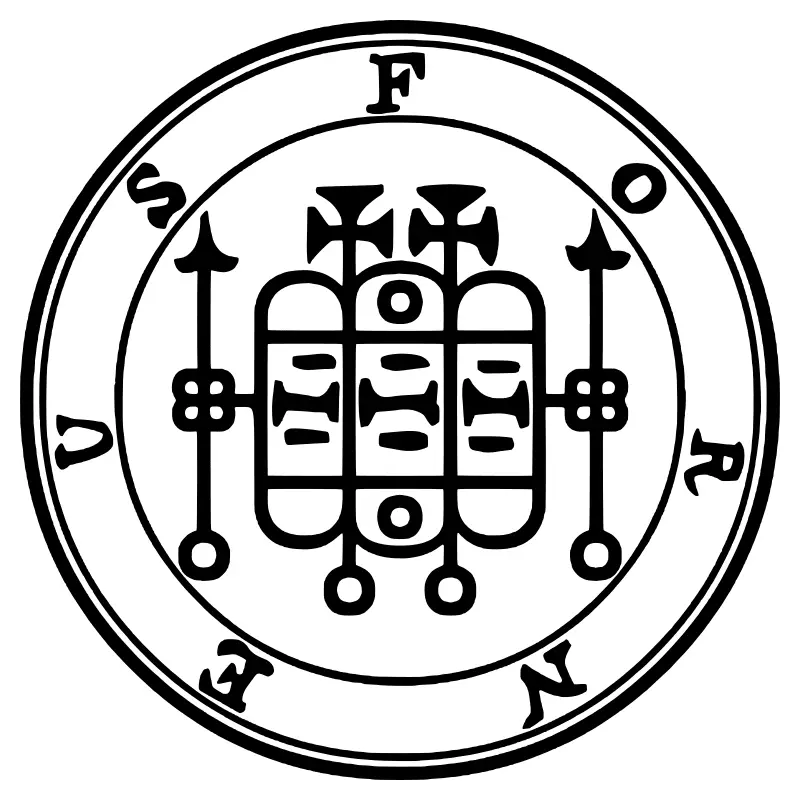
Forneus. The Thirtieth Spirit is Forneus. He is a Mighty and Great Marquis, and appeareth in the Form of a Great Sea-Monster. He teacheth, and maketh men wonderfully knowing in the Art of Rhetoric. He causeth men to have a Good Name, and to have the knowledge and understanding of Tongues. He maketh one to be beloved of his Foes as well as of his Friends. He governeth 29 Legions of Spirits, partly of the Order of Thrones, and partly of that of Angels. His Seal is this, which wear thou, etc.
Forneus is “a Mighty and Great Marquis” who appears as “a Great Sea-Monster”. He teaches and makes men “wonderfully knowing in the Art of Rhetoric”, gives “a Good Name” and the knowledge of tongues, and makes one beloved of foes and friends. His legions are “partly of the Order of Thrones, and partly of that of Angels”.
Appearance
Historical Forneus “appeareth in the Form of a Great Sea-Monster.”
Offices in the Ars Goetia
Historical The offices of Forneus, in the order the 1904 text gives them:
- Teaches and makes men “wonderfully knowing in the Art of Rhetoric.”
- Causes men to have a good name.
- Gives knowledge and understanding of tongues.
- Makes one beloved of foes as well as friends.
He governs 29 legions, “partly of the Order of Thrones, and partly of that of Angels.”
Source comparison: Weyer and Scot
Historical The Weyer catalog, as Scot renders it, gives “Forneus” as “a great marquesse, like unto a monster of the sea,” who “maketh men woonderfull in rhetorike,” adorns a man with a good name and knowledge of tongues, and makes him beloved of foes and friends.
There are nine and twenty legions “of the order partlie of thrones, and partlie of angels.” There are no significant differences.
Historical Weyer’s Latin is close: “similis monstro marino”, like a sea monster, who makes a man “in Rhetoricis admirabilem” and adorns him “optima fama”, with the best reputation. Weyer has no separate teaching verb; the Goetia’s “He teacheth” is an addition. (About Weyer and Scot.)
Name and etymology
Historical Forneus is sometimes linked to Latin fornax, “furnace”, or to a sea creature, but no source supports either link. Treat both as speculation.
Seal and images
Historical The seal above is Forneus’s as printed in 1904, and by the rules of the Observations it would be made in silver, the metal of his rank. Why seals were worn, why editions draw them differently and how to study one are explained in seals, circle and triangle.
Later tradition and modern practice
Modern The sea-monster has been drawn in modern art as a whale, a giant fish, a serpent, or a kraken-like creature. Modern practitioners often approach Forneus for skill in communication and reputation.
Lore about Forneus’s personality, likes or chosen people is modern, not grimoire material; modern approaches explains where such claims come from.
Beginner’s quick reference
| Item | What the sources say |
|---|---|
| Rank metal and hours (Goetia) | Marquis: silver; 3 p.m. to 9 p.m., and 9 p.m. to sunrise. |
| Planet (later tradition: Golden Dawn and Crowley’s 777) | Moon. |
| Decan and day or night spirit (later tradition: 777) | Capricorn, third decan (20 to 30 degrees); day spirit. 777 decan incense: “Cubel Pepper” (irritating smoke; not for beginners). Tarot card of the decan: Four of Pentacles. |
| Commonly reported color, incense, and plant (modern UPG; sources copy each other) | Color purple; incense jasmine; plant sunflower. |
| Associated symbols | Goetia image: a great sea monster. 777 Magical Image: the same image. Modern Demonolatry/UPG: the seal, used as an altar image. |
| Associated offerings | Modern practice, not in the Goetia manuscripts: most often listed, jasmine and sunflower. |
Before you burn or handle anything listed for Forneus, read incense, plants and offerings.
Practical notes
Forneus fits the beginner criteria well. He is a marquis whose offices center on rhetoric, languages, and good reputation. A question about how to communicate more clearly would suit a first contact.
His office of making one “beloved of his Foes” should not be turned into an attempt to influence particular people. A good reputation is built, in the end, by how you treat others.
In the directory, Forneus is one of the 30 spirits that fit the beginner criteria.
Try this: one question to study
Write down what a “Good Name” meant socially in the sixteenth century, and why it might sit next to rhetoric in one office.
What next
To compare Forneus with other spirits of his rank, read Ronove and Marchosias.
Later tradition In the Golden Dawn scheme of the decans, Forneus is the day spirit of the third decan of Capricorn, which belongs to the Four of Pentacles; the night spirit of the same decan is Cimejes (spirit 66).
Common questions
Is Forneus a good spirit for beginners?
He is counted among the 30 of the 72 that fit the three beginner criteria I use: not a king, at least one teaching office, and no central harm, deception or compulsion. Even so, read his whole entry first, because nearly every entry is mixed.
What does Forneus do in the Ars Goetia?
The 1904 text calls him a marquis ruling 29 legions. Its first office for him is this: Forneus teaches and makes men "wonderfully knowing in the Art of Rhetoric." The entry lists 4 offices in all.
Does looking at Forneus's seal call him?
No. Reading a name or looking at a seal does not call a spirit. The seal is a drawing from a 1904 book, and even the grimoire itself required long rituals for its own purposes.
Get the free Mini-Grimoire
A short printable starter guide to tarot and everyday witchcraft, plus my newsletter. Unsubscribe any time.
Opens Substack in a new tab to confirm. More about the newsletter · Privacy