


How to read the labels Historical what the old sources say. Later tradition what later writers added. Modern modern practice and my own notes.
| Number | 29 of 72 |
|---|---|
| Rank | Duke |
| Legions | 40 |
| Office (1904) | Gives true answers of things past, present, and to come. |
| Other spellings | Ashtaroth, Astarot |
Spirit 29 of the Ars Goetia is Astaroth. The 1904 edition by S. L. MacGregor Mathers and Aleister Crowley calls him a duke ruling 40 legions, and the first office it gives him is this: Astaroth gives true answers of things past, present, and to come.
His entry is one of the richest in the catalog, with a warning, a protective ring and an office that touches on the fall of the angels. Each part below carries a label for its layer, explained in how to read a spirit page.
At a glance
| Fact | In the entry |
|---|---|
| Number | 29 of 72, in the 1904 order. |
| Name and spellings | Astaroth in 1904; other spellings: Ashtaroth, Astarot. |
| Rank and legions | Duke, 40 legions. |
| Metal of his rank (Observations) | Copper. |
| Hours for dukes (Observations) | “From Sunrise till Noonday in Clear Weather.” |
| In Weyer’s catalog (1577) | Yes, as the source comparison below shows. |
The 1904 entry
Historical The full entry from the 1904 edition, with footnote numbers and the dash after the heading left out and the heading set in ordinary type:
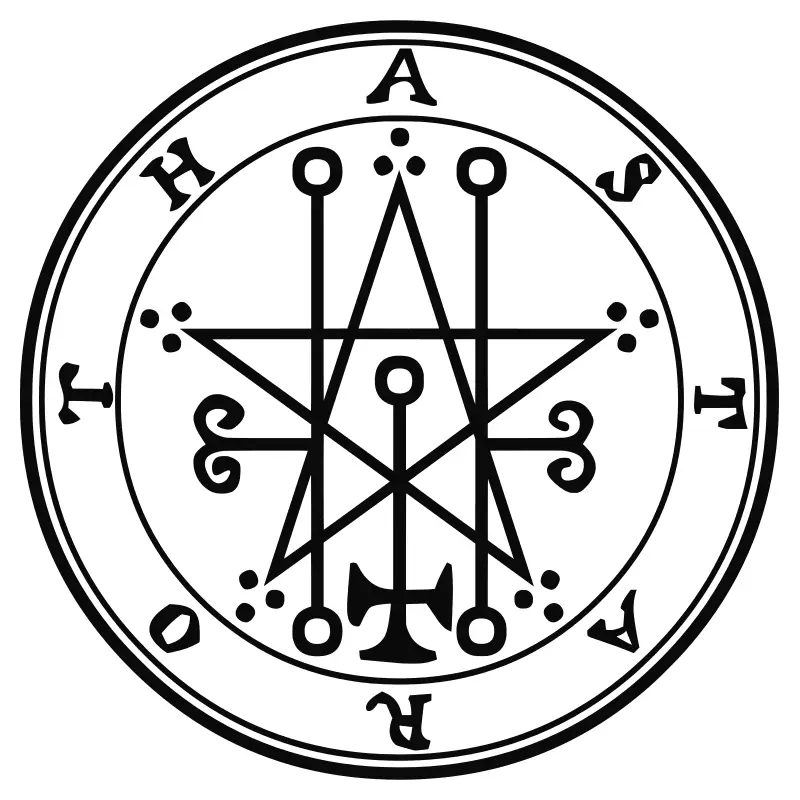
Astaroth. The Twenty-ninth Spirit is Astaroth. He is a Mighty, Strong Duke, and appeareth in the Form of an hurtful Angel riding on an Infernal Beast like a Dragon, and carrying in his right hand a Viper. Thou must in no wise let him approach too near unto thee, lest he do thee damage by his Noisome Breath. Wherefore the Magician must hold the Magical Ring near his face, and that will defend him. He giveth true answers of things Past, Present, and to Come, and can discover all Secrets. He will declare wittingly how the Spirits fell, if desired, and the reason of his own fall. He can make men wonderfully knowing in all Liberal Sciences. He ruleth 40 Legions of Spirits. His Seal is this, which wear thou as a Lamen before thee, or else he will not appear nor yet obey thee, etc.
Astaroth appears as “an hurtful Angel riding on an Infernal Beast like a Dragon” with a viper in his right hand. The magician must not let him come near “lest he do thee damage by his Noisome Breath”, and must hold the magical ring near the face. His offices are true answers, discovering secrets, telling “how the Spirits fell” and “the reason of his own fall”, and making men “wonderfully knowing in all Liberal Sciences”. He is one of the few spirits whose seal must be worn “or else he will not appear nor yet obey thee”.
Appearance
Historical Astaroth appears “in the Form of an hurtful Angel riding on an Infernal Beast like a Dragon, and carrying in his right hand a Viper.”
The text warns: “Thou must in no wise let him approach too near unto thee, lest he do thee damage by his Noisome Breath.” The magician must hold the magical ring near his face for protection.
Offices in the Ars Goetia
Historical The offices of Astaroth, in the order the 1904 text gives them:
- Gives true answers of things past, present, and to come.
- Can discover all secrets.
- Will declare “wittingly how the Spirits fell, if desired, and the reason of his own fall.” Reported as history; not taught here.
- Can make men “wonderfully knowing in all Liberal Sciences.”
He rules 40 legions. His seal must be worn “or else he will not appear nor yet obey thee.”
Source comparison: Weyer and Scot
Historical In Scot’s English, Weyer gives Astaroth as “a great and a strong duke, comming foorth in the shape of a fowle angell, sitting upon an infernall dragon, and carrieng on his right hand a viper.” Weyer has “foul,” the Goetia “hurtful.” Weyer adds that Astaroth “saith he fell not of his owne accord.” Both give 40 legions.
Historical Weyer’s Latin is “angelica specie turpissima”, in a most foul angelic form, and gives the reason for the ring plainly: “ob fœtorem intolerabilem”, because of the unbearable stench. The ring is “argenteum”, silver. Weyer adds that Astaroth says he did not fall of his own will, “se spontè non prolapsum esse dicit”. (About Weyer and Scot.)
Name and etymology
Historical The name is a form of Ashtoreth or Ashtaroth, discussed under later tradition below.
Seal and images
Historical The seal above is Astaroth’s as printed in 1904, and by the rules of the Observations it would be made in copper, the metal of his rank. Why seals were worn, why editions draw them differently and how to study one are explained in seals, circle and triangle.
Later tradition and modern practice
Later tradition The name comes from Ashtoreth, the Hebrew Bible’s form of Astarte, a major goddess of the ancient Levant. The plural form Ashtaroth appears in the Bible for her images or for goddesses in general. In Christian demonology, the goddess became a male demon.
In the Grand Grimoire (eighteenth century) and related texts, Astaroth is one of the three chief spirits of hell, with Lucifer and Beelzebub. Collin de Plancy shows Astaroth as a nude figure with wings and a crown, riding a dragon and holding a serpent.
Modern Some modern practitioners, especially in devotional and Pagan circles, reconnect Astaroth with Astarte and approach the spirit as female. That reconnection is modern.
Lore about Astaroth’s personality, likes or chosen people is modern, not grimoire material; modern approaches explains where such claims come from.
Beginner’s quick reference
| Item | What the sources say |
|---|---|
| Rank metal and hours (Goetia) | Duke: copper; sunrise to noon, in clear weather. |
| Planet (later tradition: Golden Dawn and Crowley’s 777) | Venus. |
| Decan and day or night spirit (later tradition: 777) | Capricorn, second decan (10 to 20 degrees); day spirit. 777 decan incense: “Colophonum.” Tarot card of the decan: Three of Pentacles. |
| Commonly reported color, incense, and plant (modern UPG; sources copy each other) | Color green; incense sandalwood; plant laurel (toxic to cats). |
| Associated symbols | Goetia image: a hurtful angel riding a dragon-like beast, a viper in his right hand; a noisome breath. 777 Magical Image: the same image. Le Breton engraving (1863): a winged figure holding a serpent, riding a beast. Modern Demonolatry/UPG: the seal, used as an altar image. |
| Associated offerings | Modern practice, not in the Goetia manuscripts: most often listed, sandalwood and bay laurel (toxic to cats: an unlit stick of sandalwood is a safe swap). |
Before you burn or handle anything listed for Astaroth, read incense, plants and offerings.
Practical notes
Astaroth is a duke with a teaching office, the liberal sciences, and an office of explaining the fall of the angels. But the text treats him as dangerous to approach, with special protections. Not a choice for a first contact under the beginner criteria. His history is one of the richest in the Directory and well worth study.
In the directory, Astaroth is not among the 30 spirits that fit the beginner criteria.
Try this: one question to study
Compare “an hurtful Angel” with Weyer’s “most foul angelic form” and note what each adjective emphasises.
What next
To compare Astaroth with other spirits of his rank, read Berith and Bune.
Later tradition In the Golden Dawn scheme of the decans, Astaroth is the day spirit of the second decan of Capricorn, which belongs to the Three of Pentacles; the night spirit of the same decan is Andrealphus (spirit 65).
Common questions
Is Astaroth a good spirit for beginners?
Not as a first choice. He does not meet all three beginner criteria I use: not a king, at least one teaching office, and no central harm, deception or compulsion. His entry is still worth reading as history.
What does Astaroth do in the Ars Goetia?
The 1904 text calls him a duke ruling 40 legions. Its first office for him is this: Astaroth gives true answers of things past, present, and to come. The entry lists 4 offices in all.
Does looking at Astaroth's seal call him?
No. Reading a name or looking at a seal does not call a spirit. The seal is a drawing from a 1904 book, and even the grimoire itself required long rituals for its own purposes.
Get the free Mini-Grimoire
A short printable starter guide to tarot and everyday witchcraft, plus my newsletter. Unsubscribe any time.
Opens Substack in a new tab to confirm. More about the newsletter · Privacy