


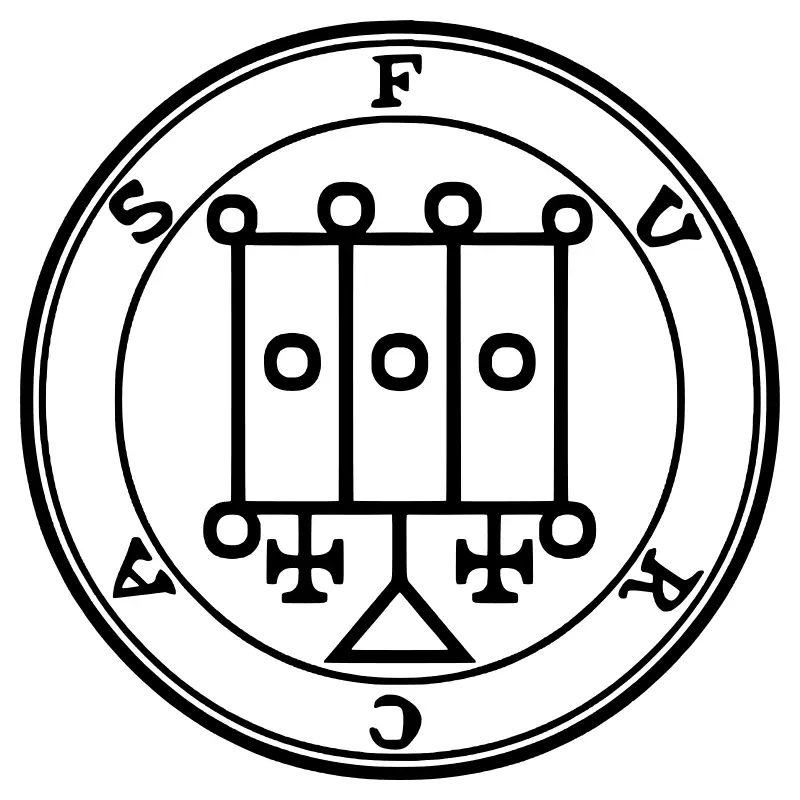
How to read the labels Historical what the old sources say. Later tradition what later writers added. Modern modern practice and my own notes.
| Number | 50 of 72 |
|---|---|
| Rank | Knight |
| Legions | 20 |
| Office (1904) | Teaches philosophy, astrology, rhetoric, logic, cheiromancy (palmistry), and pyromancy (divination by fire), "in all their parts, and perfectly." |
| Other spellings | Forcas (sometimes confused with Foras, 31) |
Spirit 50 of the Ars Goetia is Furcas. The 1904 edition by S. L. MacGregor Mathers and Aleister Crowley calls him a knight ruling 20 legions, and the first office it gives him is this: Furcas teaches philosophy, astrology, rhetoric, logic, cheiromancy (palmistry), and pyromancy (divination by fire), “in all their parts, and perfectly.”
He is the only knight among the 72, and his entry is a curriculum of learned and divinatory arts. Each part below carries a label for its layer, explained in how to read a spirit page.
At a glance
| Fact | In the entry |
|---|---|
| Number | 50 of 72, in the 1904 order. |
| Name and spellings | Furcas in 1904; other spellings: Forcas (sometimes confused with Foras, 31). |
| Rank and legions | Knight, 20 legions. |
| Metal of his rank (Observations) | Lead. |
| Hours for knights (Observations) | “From Dawning of Day till Sunrise, or from 4 o’clock till Sunset.” |
| In Weyer’s catalog (1577) | Yes, as the source comparison below shows. |
The 1904 entry
Historical The full entry from the 1904 edition, with footnote numbers and the dash after the heading left out and the heading set in ordinary type:
Furcas. The Fiftieth Spirit is Furcas. He is a Knight, and appeareth in the Form of a Cruel Old Man with a long Beard and a hoary Head, riding upon a pale-coloured Horse, with a Sharp Weapon in his hand. His Office is to teach the Arts of Philosophy, Astrology, Rhetoric, Logic, Cheiromancy, and Pyromancy, in all their parts, and perfectly. He hath under his Power 20 Legions of Spirits. His Seal, or Mark, is thus made, etc.
Furcas appears as “a Cruel Old Man with a long Beard and a hoary Head, riding upon a pale-coloured Horse, with a Sharp Weapon in his hand”. His office is a list: “Philosophy, Astrology, Rhetoric, Logic, Cheiromancy, and Pyromancy, in all their parts, and perfectly”. Cheiromancy is reading the hand, and pyromancy is divination by fire. The fearsome rider and the scholar’s syllabus belong to the same entry, a contrast the Goetia often makes.
Appearance
Historical Furcas “appeareth in the Form of a Cruel Old Man with a long Beard and a hoary Head, riding upon a pale-coloured Horse, with a Sharp Weapon in his hand.”
Offices in the Ars Goetia
Historical The offices of Furcas, in the order the 1904 text gives them:
- Teaches philosophy, astrology, rhetoric, logic, cheiromancy (palmistry), and pyromancy (divination by fire), “in all their parts, and perfectly.”
He has 20 legions. He is the only knight among the 72.
Source comparison: Weyer and Scot
Historical In Scot’s English, Weyer gives “Furcas” as “a knight,” “in the similitude of a cruell man, with a long beard and a hoarie head,” on a pale horse with a sharp weapon, who “perfectlie teacheth practike philosophie, rhetorike, logike, astronomie, chiromancie, pyromancie, and their parts.”
Weyer has astronomy, the Goetia astrology. In the early modern period the two words overlapped. Both give 20 legions.
Historical Weyer’s Latin calls him “miles”, soldier or knight, and “sævi hominis”, a cruel man, with “capillitio cano”, grey hair; the Goetia adds the word “Old”. The list of arts is longer: “practicam, philosophiam, rhetoricam, logicam, chiromantiam, astronomiam, piromantiam”. It opens with “practicam”, the practical part of philosophy, which the Goetia folds into philosophy. The weapon is “telum acutum”, a sharp weapon, the word Latin uses for spears and darts. (About Weyer and Scot.)
Name and etymology
Historical Furca is Latin for a fork, including the forked yoke used as a gallows, but no source links the word to the spirit. Weyer, Scot and the 1904 text all spell the name Furcas.
Seal and images
Historical The seal above is Furcas’s as printed in 1904, and by the rules of the Observations it would be made in lead, the metal of his rank. Why seals were worn, why editions draw them differently and how to study one are explained in seals, circle and triangle.
Later tradition and modern practice
Later tradition As the only knight, Furcas is the only spirit whose seal the Observations assign to lead (see Rank rules).
Modern Modern writers often connect him with Saturn and with discipline in study.
Lore about Furcas’s personality, likes or chosen people is modern, not grimoire material; modern approaches explains where such claims come from.
Beginner’s quick reference
| Item | What the sources say |
|---|---|
| Rank metal and hours (Goetia) | Knight: lead (toxic; never handle it); dawn to sunrise, or 4 p.m. to sunset. |
| Planet (later tradition: Golden Dawn and Crowley’s 777) | Venus. This differs from the rank rule and from 777’s usual pattern for a knight, which would give Saturn, the planet of lead. This is how the 1909 printing gives it. |
| Decan and day or night spirit (later tradition: 777) | Leo, second decan (10 to 20 degrees); night spirit. 777 decan incense: “Lyn Balsami” (unidentified). Tarot card of the decan: Six of Wands. |
| Commonly reported color, incense, and plant (modern UPG; sources copy each other) | Color black; incense myrrh; plant cinquefoil. |
| Associated symbols | Goetia image: a cruel old man with a long beard and white hair, on a pale horse, with a sharp weapon. 777 Magical Image: the same image. Modern Demonolatry/UPG: the seal, used as an altar image. |
| Associated offerings | Modern practice, not in the Goetia manuscripts: most often listed, cinquefoil and myrrh; one source lists tea, honey, salt, money, chocolate cake, and red wine. Chocolate and alcohol are toxic to pets, and alcohol is for adults only. |
Before you burn or handle anything listed for Furcas, read incense, plants and offerings.
Practical notes
Furcas fits the beginner criteria well. He is a knight, the lowest rank, and his offices are philosophy, rhetoric, logic, and forms of divination.
A question about how to study logic or philosophy would suit a first contact. If you practice pyromancy, watching flames, keep the flame in a safe holder, never leave it alone, and keep children and pets away.
In the directory, Furcas is one of the 30 spirits that fit the beginner criteria.
Try this: one question to study
Write the arts in Weyer’s list and in the 1904 list side by side, and mark the ones that changed or disappeared.
What next
To compare Furcas with other spirits of his rank, read Crocell and Haagenti.
Later tradition In the Golden Dawn scheme of the decans, Furcas is the night spirit of the second decan of Leo, which belongs to the Six of Wands; the day spirit of the same decan is Leraje (spirit 14).
Common questions
Is Furcas a good spirit for beginners?
He is counted among the 30 of the 72 that fit the three beginner criteria I use: not a king, at least one teaching office, and no central harm, deception or compulsion. Even so, read his whole entry first, because nearly every entry is mixed.
What does Furcas do in the Ars Goetia?
The 1904 text calls him a knight ruling 20 legions. Its first office for him is this: Furcas teaches philosophy, astrology, rhetoric, logic, cheiromancy (palmistry), and pyromancy (divination by fire), "in all their parts, and perfectly." The entry lists 1 office in all.
Does looking at Furcas's seal call him?
No. Reading a name or looking at a seal does not call a spirit. The seal is a drawing from a 1904 book, and even the grimoire itself required long rituals for its own purposes.
Get the free Mini-Grimoire
A short printable starter guide to tarot and everyday witchcraft, plus my newsletter. Unsubscribe any time.
Opens Substack in a new tab to confirm. More about the newsletter · Privacy