


| Arcana | Minor Arcana: Wands |
|---|---|
| Image | RWS 1909 (PD) |
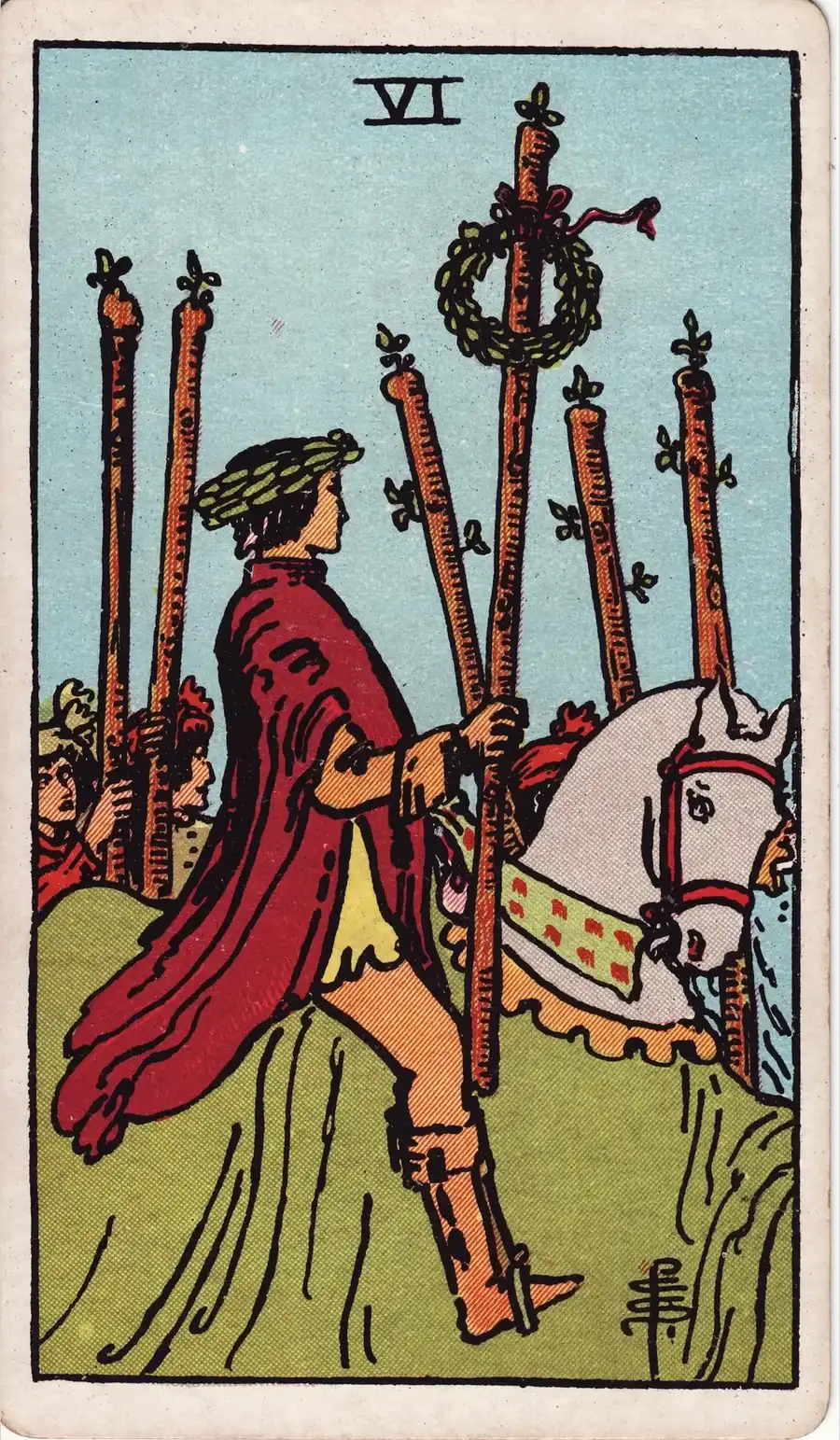
The Six of Wands is the victory parade of the Minor Arcana. A rider wearing a laurel crown sits on a white horse, holding a wand with a wreath on top, and people walk beside him cheering.
It is a card of success, recognition and public praise. Here is what the Six of Wands means upright and reversed, what the 1909 picture shows and how to use it in a reading.
Here is the Six of Wands at a glance.
| At a glance | This card |
|---|---|
| Upright keywords | success, recognition, victory |
| Reversed keywords | failure, ego, lack of recognition |
| Number | 6 in the suit of Wands |
| Golden Dawn title | Lord of Victory Later tradition |
| Astrology | Jupiter in Leo, second decan (10° to 20° Leo) Later tradition |
| Tree of Life | Tiphareth (6), Beauty Later tradition |
| Suit and element | Wands, Fire Later tradition |
| Yes or no | Yes Modern |
Book T names the Six of Wands the Lord of Victory and gives it Jupiter in Leo, the middle decan of the sign, on Tiphareth, the sixth sephira at the heart of the Tree. Jupiter’s generosity in the Sun’s sign fits the laurel crown and cheering crowd that Smith drew.
Later tradition The Golden Dawn also gave each decan two of the 72 Goetic spirits, one for the day and one for the night. For the second decan of Leo, and so for the Six of Wands, they are Leraje (spirit 14, day) and Furcas (spirit 50, night). Their pages read the old entries as history; see the spirit directory for all 72.
The card: what Pamela Colman Smith drew
Waite wrote: “A laurelled horseman bears one staff adorned with a laurel crown; footmen with staves are at his side.” Smith gave the scene a blue sky and a crowd we only partly see. The rider looks ahead calmly. He has won, and everybody knows it.
The laurel wreath. Since ancient Greece and Rome, a crown of laurel leaves has been the sign of a winner. He wears one, and another hangs on his wand. The win is visible and public.
The white horse. A white horse is a classic parade animal, a sign of honor and a clean victory. He rides above the crowd, which also hints at the risk of the card: success can lift you so high that you stop hearing people.
The people on foot. The figures walking beside him carry wands too. Nobody wins alone. The card asks you to remember the people who helped.
Upright meaning
Upright, the Six of Wands is public success. The rider wears a laurel wreath, and people walk beside him holding their staffs high. Something you worked for has been recognized: a win, a promotion, praise from people whose opinion matters, or simply the satisfaction of finishing first.
The card is about being seen. That can feel wonderful, and it can also feel exposing, so the Six of Wands asks you to carry the moment gracefully. Accept the praise without shrinking from it. Thank the people who helped. Visibility can open doors that effort alone cannot.
The horse is calm and dressed for a ceremony. Victory here is not just luck. It is the reward of steady progress through the earlier cards of the suit, and it shows that people trust you to lead.
Reversed meaning
Reversed, the Six of Wands may show success that comes without recognition, or recognition that goes to someone else. It can also show the other side of fame: arrogance, needing applause too much, or fear of falling from a height you have only just reached.
Some readers see delayed results here, a win that is coming but not yet. Ask whether you are doing this for the work or for the crowd. If the crowd matters, find a way to show your work. If the work matters, keep going whether anyone claps or not.
In love, work and spirituality
In love. Upright: Being proud of each other, or a relationship that others celebrate. Reversed: Jealousy of a partner’s success, or needing a partner to admire you all the time.
At work. Upright: A promotion, an award, good reviews or winning a contract. Reversed: Credit going to someone else, or a leader who stops listening after a win.
With money. Upright: A bonus, a raise or the reward for a project that paid off. Reversed: Spending to look successful rather than to be secure.
In spiritual practice. Upright: Confidence in your practice, or being recognized as a teacher in your community. Reversed: Spiritual pride, or practicing to be seen.
As feelings. Admiration and pride. They are proud to be with you or to know you.
As a person. A confident leader or recent winner who enjoys being in the spotlight.
As advice. Accept recognition with grace, and share the credit.
Reading the Six of Wands: positions and yes or no
In the past position: A success or a moment of recognition built your confidence. In the present position: You have done well. Let yourself be seen.
In the future position: Recognition, good news or a public win is ahead. As advice: Share the credit, then set your next goal.
In modern yes or no readings, the Six of Wands leans yes. It is a card of victory and good news.
What the Six means, and the history behind the card
Six brings harmony after the struggle of Five, and in Wands that harmony looks like a victory parade. The Golden Dawn put it on Tiphareth, the sephira of beauty and balance, which is a reminder that true victory is centered, not arrogant.
Here is how the Six looks across the four suits:
- Six of Wands (this card): success, recognition, victory
- Six of Cups: nostalgia, memories, reunion
- Six of Swords: transition, moving on, healing
- Six of Pentacles: generosity, charity, balance
When A. E. Waite published The Pictorial Key to the Tarot in 1910, he listed these divinatory meanings for the Six of Wands: “The card has been so designed that it can cover several significations; on the surface, it is a victor triumphing, but it is also great news, such as might be carried in state by the King’s courier.”
Reversed, he gave: “Apprehension, fear, as of a victorious enemy at the gate; treachery, disloyalty, as of gates being opened to the enemy; also indefinite delay.”
Common questions
Is the Six of Wands a yes or no card? Yes. It is one of the clearest success cards in the deck.
What does the Six of Wands mean for feelings? Pride and admiration. The person sees you, or the relationship, as something to be proud of.
What does the Six of Wands mean reversed? Success that feels hollow, ego getting in the way, or work that is not recognized. Look at what you need from the praise.
Try this
Try this small spread for the Six of Wands. Use it after a success, or when you are hoping for recognition.
| Card | Question | What it shows |
|---|---|---|
| 1 | What have I achieved? | The win to name honestly. |
| 2 | Who shares this success? | The people or support behind it. |
| 3 | Where do I ride next? | The next aim this success points to. |
Affirmation: I accept earned recognition and keep success in proportion.
Reversed affirmation: I measure my work fairly when applause is missing or inflated.
If you keep a tarot journal, take one of these questions to it: What win have I been playing down? Who helped me get here, and have I thanked them? How would I feel about this work if nobody praised it?
What next
Cards that sit close to this one are The Chariot (the Major Arcana card of victory through focus and will), Seven of Wands (what comes after the parade: defending your position) and Nine of Cups (personal satisfaction rather than public praise).
The Six of Wands is part of the lesson Wands in my free Tarot for Beginners course. To see the whole suit on one page, go to the suit of Wands. To keep walking the suit, read the card before it, Five of Wands or the card after it, Seven of Wands, or go back to all the card meanings.
For the suits and numbers in one place, see The Minor Arcana: suits and numbers made simple. For every card with keywords, affirmations and examples, see my book The Novice’s Guide to Tarot. If you would like a printable cheat sheet for all 78 cards, my 45-page Tarot Workbook is on Etsy.
Sources
- A. E. Waite, The Pictorial Key to the Tarot (London: Rider, 1910), Part III, sections 1 and 2.
- Pamela Colman Smith and A. E. Waite, the Rider-Waite-Smith tarot (London: Rider, 1909).
- Nicolas Conver, Tarot de Marseille (Marseille, 1760).
- Lauri Mukkala, The Novice’s Guide to Tarot, entry for the Six of Wands.
- Aleister Crowley, 777 (London: Walter Scott, 1909), columns of the decans, the Minor Arcana and the court cards.
- Israel Regardie, ed., The Golden Dawn (Chicago: Aries Press, 1937 to 1940), “Book T”, titles and attributions of the small cards and the court.
All 78 cards
Major Arcana
- The Fool
- The Magician
- The High Priestess
- The Empress
- The Emperor
- The Hierophant
- The Lovers
- The Chariot
- Strength
- The Hermit
- Wheel of Fortune
- Justice
- The Hanged Man
- Death
- Temperance
- The Devil
- The Tower
- The Star
- The Moon
- The Sun
- Judgement
- The World
Wands
- Ace of Wands
- Two of Wands
- Three of Wands
- Four of Wands
- Five of Wands
- Six of Wands
- Seven of Wands
- Eight of Wands
- Nine of Wands
- Ten of Wands
- Page of Wands
- Knight of Wands
- Queen of Wands
- King of Wands
Cups
- Ace of Cups
- Two of Cups
- Three of Cups
- Four of Cups
- Five of Cups
- Six of Cups
- Seven of Cups
- Eight of Cups
- Nine of Cups
- Ten of Cups
- Page of Cups
- Knight of Cups
- Queen of Cups
- King of Cups
Swords
- Ace of Swords
- Two of Swords
- Three of Swords
- Four of Swords
- Five of Swords
- Six of Swords
- Seven of Swords
- Eight of Swords
- Nine of Swords
- Ten of Swords
- Page of Swords
- Knight of Swords
- Queen of Swords
- King of Swords
Pentacles
Get the free Mini-Grimoire
A short printable starter guide to tarot and everyday witchcraft, plus my newsletter. Unsubscribe any time.
Opens Substack in a new tab to confirm. More about the newsletter · Privacy