


In this lesson: how to choose your first tarot deck, why Rider-Waite-Smith style decks are easiest and how to set up a tarot notebook.
Before we learn a single card, let us get your tools ready. There are only two: a deck and a notebook. This matters more than it sounds. The deck is what you will look at every day, so it should be one you enjoy. The notebook is where your real learning happens, because it is the only book about tarot that is written about your life.
Choosing your first deck
A tarot deck has 78 cards: 22 Major Arcana and 56 Minor Arcana in four suits. Almost every modern deck follows that structure. What differs is the art, and for a beginner the art is everything.
I recommend a deck based on the Rider-Waite-Smith images, first published in London in 1909 with pictures by the artist Pamela Colman Smith. There are two good reasons. First, every one of its 78 cards shows a scene, even the small number cards, so you can read the picture instead of memorizing lists. Older decks often show only five cups or seven coins on a plain ground. Second, most beginner books and websites, this one included, describe those pictures. When I write that the Hermit holds a lantern, your Hermit will hold one too.
You do not have to buy the original. Many modern decks keep the Rider-Waite-Smith scenes and redraw them in new styles, with more diverse people, softer colors or a different mood. Look at sample images before you buy and ask yourself one question: do I want to look at these pictures every day? If the answer is yes, that is your deck.
Myths about your first deck
You may hear that your first deck must be a gift. That custom can be lovely when it happens, but it is not a rule. Buying your own deck is normal and practical, and it is how most readers begin. You may also hear that nobody else should ever touch your cards. Some readers keep a deck private, and others share decks in classes. Neither choice makes the cards work or fail. Choose what feels right to you and do not worry about the rest.
If your deck is a little different
If your deck uses different names, match cards by name and image first. The Tower is still the Tower. Coins or Disks are Pentacles. Batons, Rods or Staves are Wands. Chalices are Cups. Some older decks number Strength and Justice the other way around, so read by the card’s title and you will be fine.
The notebook has a long history
Historical Keeping a personal notebook of things worth remembering is an old habit. In the Renaissance, students and scholars kept commonplace books, collections of quotations, ideas and notes arranged under headings. The philosopher John Locke published a method for indexing them, which appeared in English in 1706 as A New Method of Making Common-Place-Books. Your tarot notebook is a commonplace book for the cards: a place to gather meanings, pictures, questions and your own discoveries under headings you can find again.
A layout that grows with you
A simple structure works well. Keep the first four pages as an index. Then give each Major Arcana card one page, numbered 0 to XXI, and each suit about ten pages. Leave the second half of the notebook for your reading journal, which you will start in module 7. On each card page, write three things: what you see in the picture, a keyword you like, and space for later notes. Over months, those pages fill up with your own experiences, which become more useful than any guidebook.
Setting up your notebook
Books give you meanings, but your notes show you how the cards speak in your own life. That is why I call the notebook your real teacher. A simple tarot log needs only four things for each draw.
- The date.
- Your question, in one line.
- The card or cards you drew.
- One sentence about what you think the cards are saying.
Leave a little space under each entry. A few days or a week later, come back and add a line about what actually happened.
An example entry
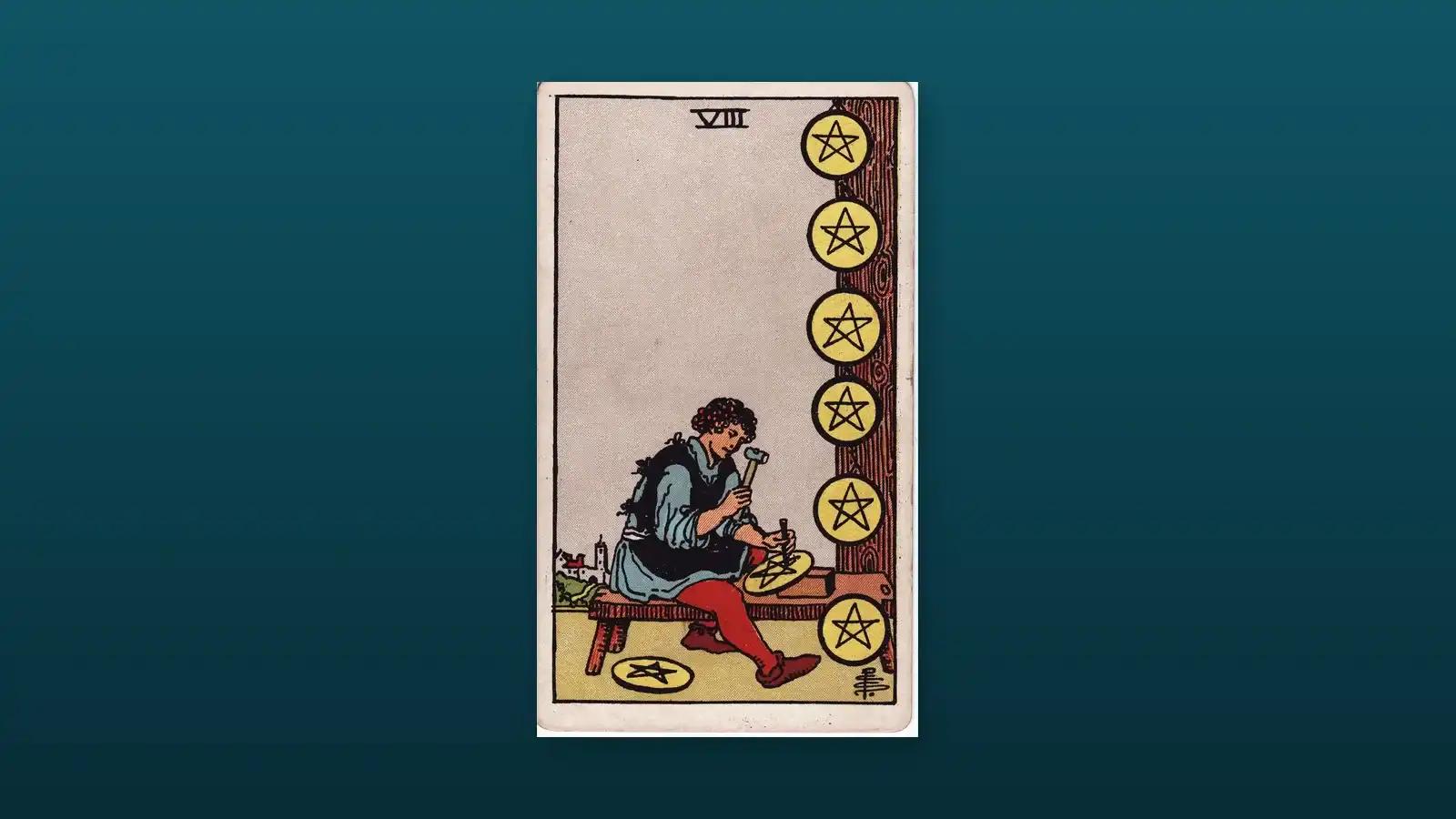
Here is what a first entry might look like. On a Tuesday morning, a beginner asks, “What do I need to remember at work today?” She draws the Eight of Pentacles: a craftsman bent over his bench, carving one coin after another. She writes: “Slow, careful work. Finish one thing properly before starting the next.”
On Friday she adds a line underneath: “I did finish the report before answering emails, and it was the calmest day of the week.” That is all a tarot log is. Small, honest notes like these teach you faster than rereading any theory, because each card becomes tied to a real moment you remember.
Getting to know your deck
Before your first reading, spend a few minutes just looking. Take the cards out and turn them over one at a time. Notice colors, faces, animals and the sky. You do not need to know any meanings yet. You are getting to know the pictures the way you would get to know a new neighborhood, by walking around it with your eyes open.
Choosing between common deck types
Most beginner decks fall into three families. Waite-Smith style decks, including the original 1909 deck and the many decks that follow its pictures, are the easiest to learn from because every card has a scene, and most books, including this course, use them. Marseille style decks have pictures on the Majors and courts but patterns of suit symbols on the number cards; lesson 8 teaches you to read them. Thoth style decks use Aleister Crowley’s names and art, which can confuse beginners. Many independent artists also make “Waite-Smith inspired” decks with new art but the same structure, which are fine for this course.
What Waite said about his own deck
Historical In The Pictorial Key to the Tarot (1910), A. E. Waite explained what was new about the deck he planned with Pamela Colman Smith. He called it “the rectified Tarot which illustrates the present handbook”, and wrote that in it all the numbered cards of the Lesser Arcana except the Aces “are furnished with figures or pictures to illustrate” their divinatory meanings, though “without exhausting” them. In most older decks those cards showed only a pattern of suit symbols, so this was a real change for learners.
The phrase “without exhausting” is worth keeping. Waite did not think the pictures held every possible meaning. They were a starting point, a scene you could enter. That is exactly how this course uses them: look first, then let the meanings you learn and the notes you keep fill in the rest.
The little white book
Most decks come with a small booklet, often called the “little white book” by readers. It usually gives a sentence or two for each card, upright and sometimes reversed. These booklets are handy, but they are short by design, and different decks can give quite different keywords for the same card. Treat yours as one voice among several. A good habit is to copy its keywords onto each card’s page in your notebook, then add your own observations underneath. Over time, your own lines will become longer than the booklet’s.
Second-hand decks
A question beginners ask: “Can I use a second-hand deck?” Yes. Used decks are a thrifty and kind choice, and out-of-print decks are often only available second-hand. Check that all 78 cards are there, plus any extra cards the deck includes. Count them face down into piles of ten to make it quick. If the deck smells of smoke or damp, airing it in a dry room for a few days usually helps. Some people like to shuffle a used deck thoroughly before their first reading, simply to make it feel like their own.
A notebook index that works
The index pages at the front of your notebook will save you time later. Each time you write a card’s page, add its name and page number to the index. When you start the reading journal, give each reading a short title, such as “career question, March”, and list that too. After a few months you can find every reading where a particular card appeared simply by searching the card’s page, which is where your own patterns begin to show.
Questions beginners ask
Is it bad luck to buy my own deck? No. That idea is a modern superstition. Most readers buy their own.
What if I do not like the art in the classic deck? Choose a Waite-Smith inspired deck with art you love; you will look at it every day.
Should I write in the guidebook? Yes, if you like. It is your tool.
Can I use a tarot app instead of a physical deck? Yes. Apps are good for daily draws, though many people find that handling real cards helps them focus.
Myths to drop: You do not need an expensive deck. Your first deck does not have to be your forever deck. And your notebook does not need to be beautiful; it needs to be used.
Try this
Look through your whole deck once, slowly, card by card. Write down the three cards that catch your eye most, and for each one write one thing you see in the picture. You are not interpreting yet, only noticing.
Recap
A tarot deck has 78 cards, and a Rider-Waite-Smith style deck is the easiest place to start because every card shows a scene and most books describe it. Buying your own deck is normal, and no rule about gifts or touching makes the cards work. Your notebook holds four things per draw: date, question, cards and one sentence, plus a follow-up line later. Looking at the pictures without meanings is the best first step.
What next
Press “Mark as done” and continue with Shuffling and caring for your deck. For more help choosing, read how to choose your first tarot deck and the story of the Rider-Waite-Smith deck.
Further reading: Lauri Mukkala, The Novice’s Guide to Tarot. John Locke’s A New Method of Making Common-Place-Books (1706) is free online and still a charming read.
Sources
- Lauri Mukkala, The Novice’s Guide to Tarot, “Using this book with another deck”.
- A. E. Waite, The Pictorial Key to the Tarot (London: Rider, 1910).
Quick check
Go deeper: The Novice's Guide to Tarot: Using this book with another deck
Get the free Mini-Grimoire
A short printable starter guide to tarot and everyday witchcraft, plus my newsletter. Unsubscribe any time.
Opens Substack in a new tab to confirm. More about the newsletter · Privacy
Comments
Questions and notes from readers. Anyone with a free account can comment, and I reply when I can. Please read the community guidelines.
Comments load from Google Firebase (EU) when you ask for them. Nothing is stored on your device. Privacy