


How to read the labels Historical what the old sources say. Later tradition what later writers added. Modern modern practice and my own notes.
When people start studying witchcraft, they often go looking for witches in art. They are there in huge numbers: on broomsticks, around cauldrons, in plays, in satires, in Victorian paintings. But here is the most important thing I can tell you before we start. Almost every one of these images was made by people who were not witches, for audiences who feared, mocked or enjoyed the idea of witches. They are a record of the witch in the imagination of artists and buyers, not a record of what real people did.
That does not make them less interesting. It makes them more interesting, because once you know how to read them, they show you how the idea of the witch was built, changed and sold over five hundred years. On this page I walk through that history in order, and I mark which layer each claim sits in.
| At a glance | |
|---|---|
| Period | About 1450 to about 1910 |
| Key media | Manuscripts, woodcuts, engravings, mezzotints, lithographs, oil paintings, folk objects |
| Key artists | Hans Baldung Grien, Albrecht Dürer, Pieter Bruegel the Elder, Henry Fuseli, Francisco de Goya, Eugène Delacroix, John William Waterhouse, José Guadalupe Posada |
| The big caution | These images show beliefs and fears about witches, not the lives of real practitioners |
| See them | My magic and witches gallery has fourteen open access works with full captions |
Three layers
I use the same three layers on all my esoteric art pages.
Historical What documents and objects show that artists and viewers at the time believed and did.
Later tradition What scholars, occultists and popular writers have since read into the works.
Modern How people today use the images in their own spiritual lives. That can be valuable, but it is not history.
The first broomsticks, 1450s
Witches flying on brooms are older than printing. One of the earliest known pictures comes from a manuscript of the poem Le Champion des Dames by Martin Le Franc, dated 1451 and now in the national library of France. In the margin, two women fly through the air, one on a broom and one on a stick. The poem defends women, and the passage is about the Vaudois, a name then used for heretics and, increasingly, for people accused of witchcraft.
Historical This tiny margin picture matters because it shows the idea of the flying witch already in place in the 1450s, in the same decades when the first large witch trials were taking place in the Alps.
German prints around 1500
Printing changed everything. Woodcuts and engravings could be made in hundreds of copies and sold cheaply, and witches became a popular subject in German prints around 1500.
The two most famous examples show nude figures, so I describe them here in words rather than showing them. Albrecht Dürer engraved a witch riding backward on a goat around 1500, surrounded by small winged children. Riding backward was an old sign of the world turned upside down. In 1510 Hans Baldung Grien, who had trained in Dürer’s workshop, made a chiaroscuro woodcut called The Witches, printed in two blocks to give a dramatic light and dark effect. It shows a group of naked women around a steaming pot in a forest, while one of them rides a goat through the sky.
Historical These images were made mostly by men, largely for male buyers. They mix eroticism, humor and moral warning. The steaming pot, the goat, the flight through the air, the bones and the sausages that turn up in these prints became the standard kit of the witch for centuries.
Later tradition Historians such as Charles Zika have shown how these prints helped fix a picture of the witch as a woman, often old or wildly sensual, working in a group, at night, outdoors. That picture overlapped with what the witch-hunting manuals of the period described.
For modern witches looking for their history in art, this is the important distinction. These images are evidence of the witch-hunting imagination. They are not portraits of anyone’s practice.
Satire and skepticism
Not every sixteenth-century image of a witch was meant to frighten. In 1559 the Antwerp publisher Hieronymus Cock printed an engraving after Pieter Bruegel the Elder called The Stone Operation, or the Witch of Mallegem. The “witch” here is a fraud healer cutting imaginary stones of folly out of people’s heads. It is a joke about gullibility, and you can see it in my gallery.
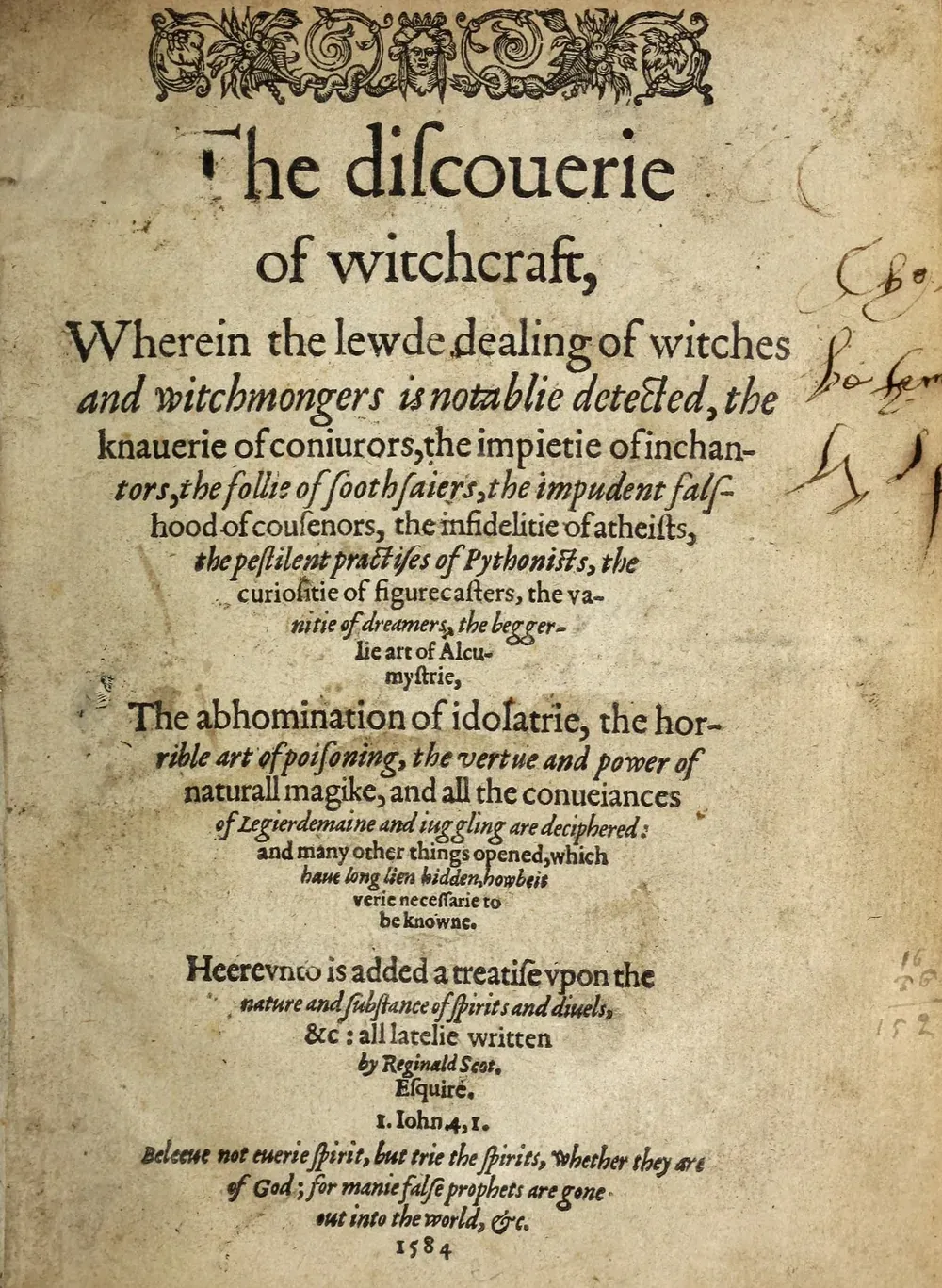
Title page of The Discoverie of Witchcraft by Reginald Scot, London, 1584. Image: Wikimedia Commons, public domain.
Books could argue back. In 1584 the English writer Reginald Scot published The Discoverie of Witchcraft, which argued that most accusations of witchcraft came from fraud, illness, fear and cruelty. Scot was a skeptic in a time of trials, and his book reminds us that people in the past did not all believe the same thing.
The witches of Macbeth
From the seventeenth century on, the theater gave artists a new kind of witch. Shakespeare’s Macbeth, first printed in 1623, opens with three witches on a heath in thunder and lightning. For the next two centuries, British and French artists returned to them again and again.
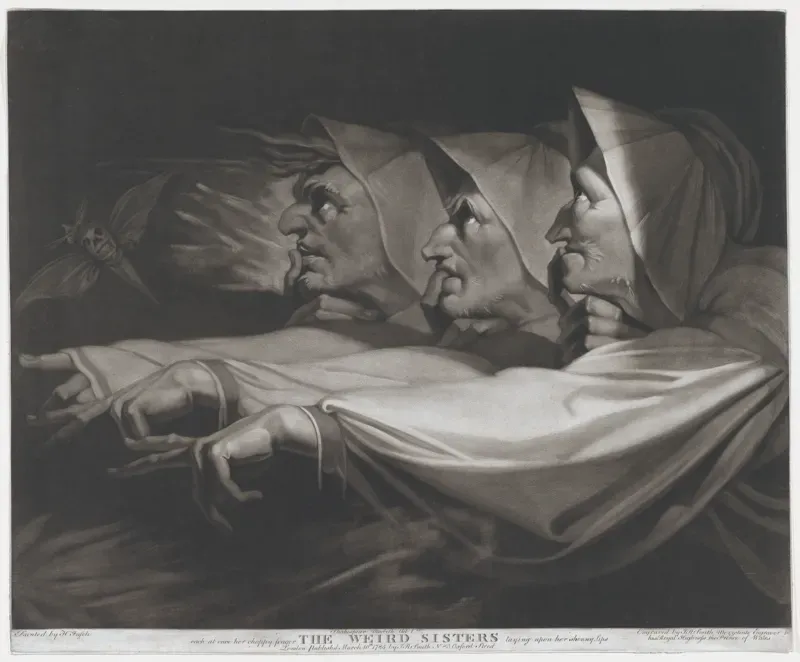
The Weird Sisters, John Raphael Smith after Henry Fuseli, 1785. Mezzotint, 45.8 × 55.5 cm. The Metropolitan Museum of Art, object 59.570.361. Public domain (CC0).
In 1785 John Raphael Smith made this mezzotint after a painting by Henry Fuseli, the Swiss-born artist who painted The Nightmare a few years earlier. The three witches line up in profile, each laying a finger on her lips, just as Banquo describes them in Act 1, Scene 3. Other artists made very different choices. William Woollett’s engraving after Francesco Zuccarelli (1770) shrinks the witches into a stormy landscape. Delacroix’s lithograph of 1825 crowds them around a steaming cauldron.
Historical These witches are characters in a play. When you see a cauldron, a heath or three women together in eighteenth or nineteenth-century art, Macbeth is often the source, not any real practice.
Goya: the witch as satire
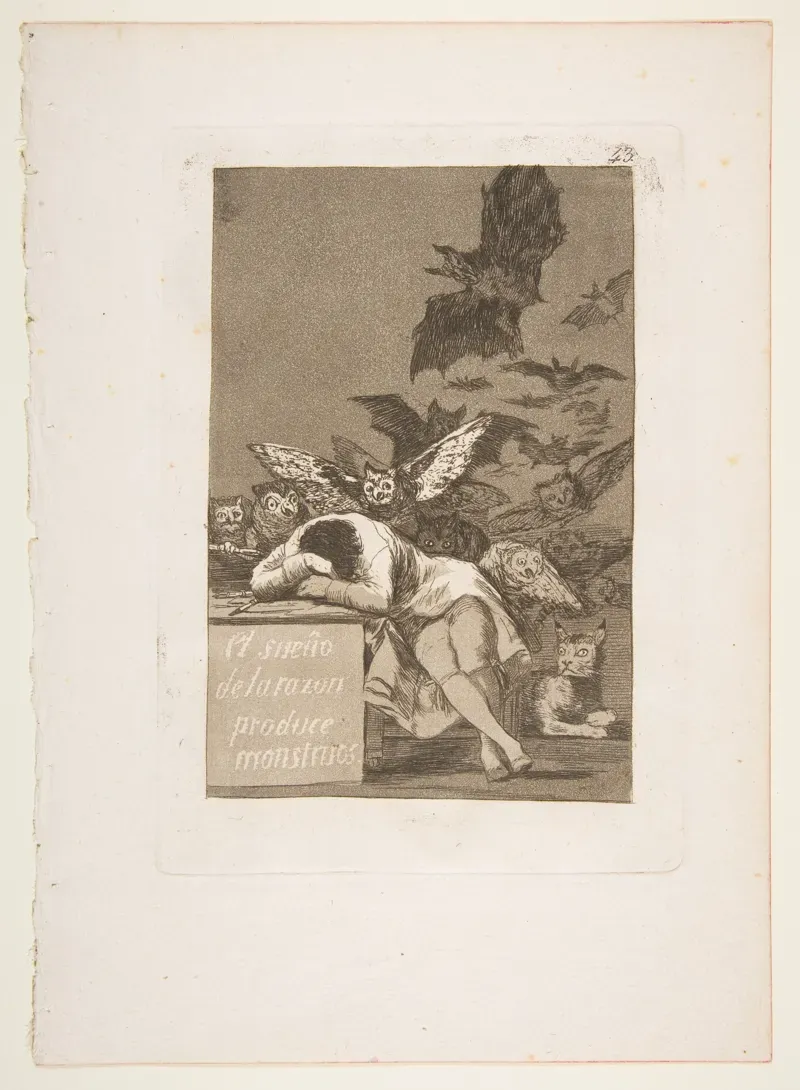
Plate 43 from Los Caprichos: The sleep of reason produces monsters, Francisco de Goya, 1799. Etching and aquatint, plate 21.2 × 15.1 cm. The Metropolitan Museum of Art, object 18.64(43). Public domain (CC0).
Francisco de Goya was court painter to the Spanish kings. In 1799 he published Los Caprichos, a series of eighty etchings satirizing superstition, ignorance, the corruption of the clergy and aristocracy, and the Inquisition. The most famous, plate 43, shows the artist asleep at his desk while owls and bats swarm behind him, over the words “The sleep of reason produces monsters.”
Many of the Caprichos show witches. Later, between 1819 and 1823, Goya painted the so-called Black Paintings on the walls of his own house, including a large witches’ sabbath now in the Prado, with a crowd gathered before a goat-like figure.
Historical For anyone interested in witchcraft, this is a key point: Goya’s witches are not sympathetic portraits from the inside. They are Enlightenment satire, aimed at the superstition and cruelty that witch belief and the Inquisition stood for. Popular stories say Goya went mad. His deafness, after an illness in 1792 to 1793, is documented, but claims of madness are speculation.
Romantic and Victorian enchantresses
In the nineteenth century the witch changed again. For Romantic and Victorian artists, she became an enchantress: beautiful, dangerous, often taken from myth or legend. Medea, Circe, Morgan le Fay and the Lady of Shalott all appear in paintings of the period.
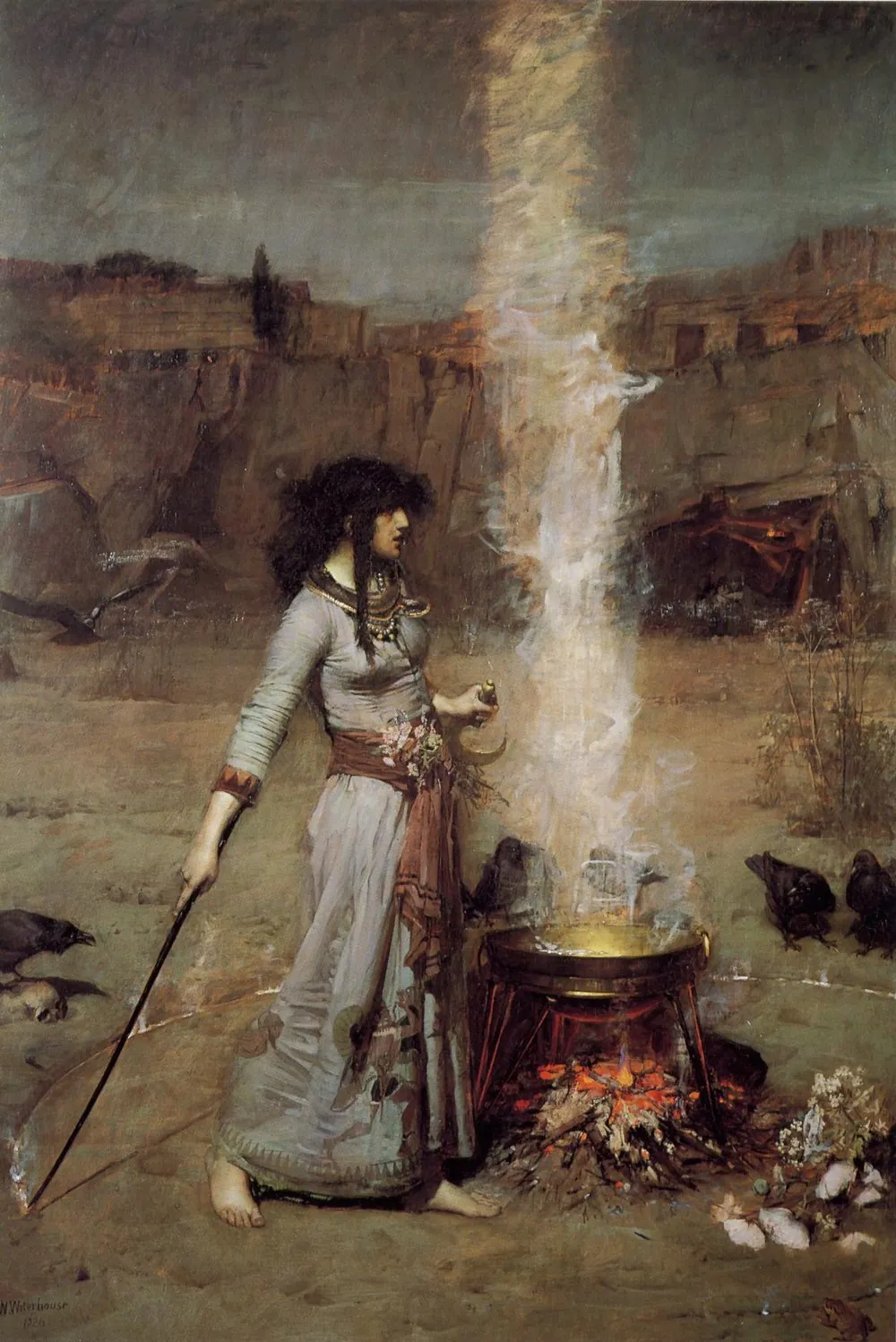
The Magic Circle, John William Waterhouse, 1886. Oil paint on canvas. Tate, N01572. Image: Wikimedia Commons, public domain.
John William Waterhouse’s The Magic Circle (1886) is the best known example, and I have written a full close reading of it. A woman in a long patterned robe draws a circle on the ground with a wand, around a steaming pot, while ravens wait outside the line. Unlike the prints of 1500, she works alone, with total concentration. Tate bought the painting for the nation in 1886, the year it was shown.
Later tradition Waterhouse never explained what the painting meant, and much of what has been written since is interpretation. It is still a big step from the witch as a figure of fear to the witch as a figure of power and mystery.
Witches on the street
At the other end of the art world were cheap prints for ordinary buyers.
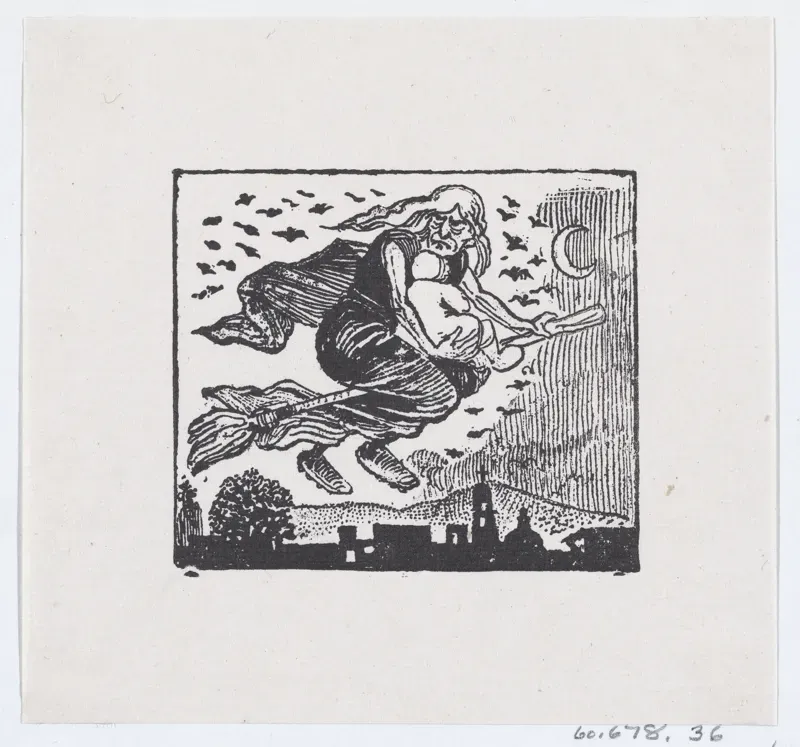
A witch carrying a child on her broom, José Guadalupe Posada, about 1880 to 1910 (later impression). Zincograph. The Metropolitan Museum of Art, object 60.678.36. Public domain (CC0).
In Mexico City, José Guadalupe Posada made thousands of images for the broadsheets and booklets published by Antonio Vanegas Arroyo. Witches flying with stolen children, brewing potions and telling fortunes sat alongside crime stories and songs. Here the witch is a thrill and a warning, sold for pennies.
Folk objects: closer to belief
Paintings and prints show what people imagined. Objects can bring us closer to what people did. Museums hold glass witch balls, hung in windows in English and American homes and said to keep ill wishing away, and knives kept in the Alps against the Drude, a night spirit often imagined as a witch. These are not images of witches but tools against them. They show that ordinary households took protection seriously, in their own way.
The esoteric angle
Historical Taken together, the evidence is clear: for most of history, the witch in art was a figure seen from outside. She was imagined by artists, buyers, theater audiences and satirists. The images can tell us a great deal about fear, gender, humor, religion and politics in each period.
Later tradition In the twentieth century, writers and artists began to read these images in new ways. Some see the Victorian enchantresses as early images of female power. Some modern pagan writers treated the old prints as evidence of a surviving witch religion, an idea historians such as Ronald Hutton have shown has no support in the sources.
Modern Many witches today collect old witch images for altars, journals and study. That can be a lovely practice, as long as we keep the caption with the picture. Knowing that a print is satire, theater or a witch-hunter’s fantasy does not spoil it. It lets us see how far the idea of the witch has traveled. If you want the history of real practice and real trials, my history of witchcraft page is the place to go next.
Try it yourself
Here are the worksheet questions I use for every close reading. Copy them into a notebook, open the image as large as your screen allows, and give yourself twenty minutes. Fill them in order and do not skip ahead to meaning.
- Basic information. Write down the title, artist, date, material, size and collection number from the At a glance box. Size matters: picture the real object on a wall or in your hand.
- First look, two minutes. Before you read anything else, write three words for your first reaction.
- Description. List at least fifteen things you can see, without explaining any of them. People, animals, objects, places, colors, marks, writing.
- What is going on here? Then ask: what do I see that makes me say that? What more can I find?
- Formal analysis. Where are the lightest and darkest areas? Where do the lines lead your eye? Is the space deep or shallow? What is the focal point?
- Meaning in three levels. What is shown (a woman, a dog, an old man)? What story or theme do those things stand for? What does the work tell you about the time and place that made it?
- Evidence check. Mark each statement you wrote with E for evidence you can see or document, I for an interpretation, and P for your personal response. For a witch image, add one more question: who made this, for whom, and were they afraid of witches, laughing at them, or admiring them?
If you want the full method with a worked example, my page on how to look at a painting walks through it step by step.
Questions
What is the oldest picture of a witch on a broomstick?
One of the earliest known is in a manuscript of Martin Le Franc's poem Le Champion des Dames from 1451, now in the national library of France, where two women ride through the air on a broom and a stick.
Why are witches in old prints often naked?
Around 1500 German printmakers such as Hans Baldung Grien made witch images that mixed eroticism, humor and moral warning, mostly by men for male buyers. The nudity tells us about those artists and buyers, not about what any real person did.
Are Goya's witches sympathetic?
No. Goya's witches in Los Caprichos (1799) are Enlightenment satire, aimed at superstition, ignorance and the Inquisition. They mock witch belief rather than show witchcraft from the inside.
Can modern witches use these images?
Many do, for altars, journals and study. I recommend keeping the context with the picture: these images are evidence of what people feared or imagined about witches, which is history worth knowing.
Get the free Mini-Grimoire
A short printable starter guide to tarot and everyday witchcraft, plus my newsletter. Unsubscribe any time.
Opens Substack in a new tab to confirm. More about the newsletter · Privacy