


How to read the labels Historical what the old sources say. Later tradition what later writers added. Modern modern practice and my own notes.
Witches have been one of the great subjects of Western art for five hundred years. They appear in satire, in plays, in the Bible, in Greek myth, in folk objects and in cheap street prints. This gallery brings together fourteen works from the Metropolitan Museum of Art in New York, all released as public domain images under the Met’s Open Access program. Each caption gives the artist, date, material, size and the museum’s object number, so you can look up the original yourself.
I have chosen works without nudity. Many of the most famous witch images, such as the woodcuts of Hans Baldung Grien, show nude figures, and I describe those in words on my page about witches in art rather than showing them here.
How to use this gallery
Go slowly. Pick one image and use the questions in the worksheet at the bottom before you read my notes. Then check the size in the caption: many of these are small prints you would have held in your hands, not paintings on a wall.
Later tradition Keep the layers in mind. These are pictures of what people believed or feared about witches, made by artists for their own audiences. They are evidence about those audiences, not portraits of real practitioners.
Folk magic and fear
The first three works are about magic in everyday life: a satire of fake healing, a decorative ball with a protective story attached, and a knife kept against a night spirit.
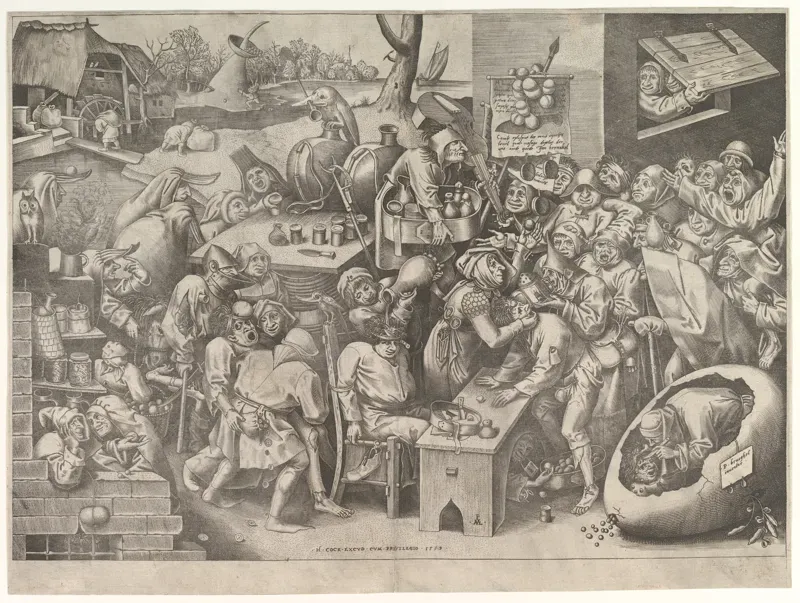
The Stone Operation or the Witch of Mallegem, Pieter van der Heyden, after Pieter Bruegel the Elder, 1559. Engraving; third state of five, 35.4 × 47.6 cm. The Metropolitan Museum of Art, object 30.54.33, Harris Brisbane Dick Fund, 1930. Public domain (CC0, Met Open Access).
This busy print is a joke, not a ritual. The old saying went that a foolish person had a stone in the head, and here a quack team cuts the stones out. The witch in the title is a fraud healer working the crowd. Look for the huge egg-shaped shell at lower right with a person inside it.
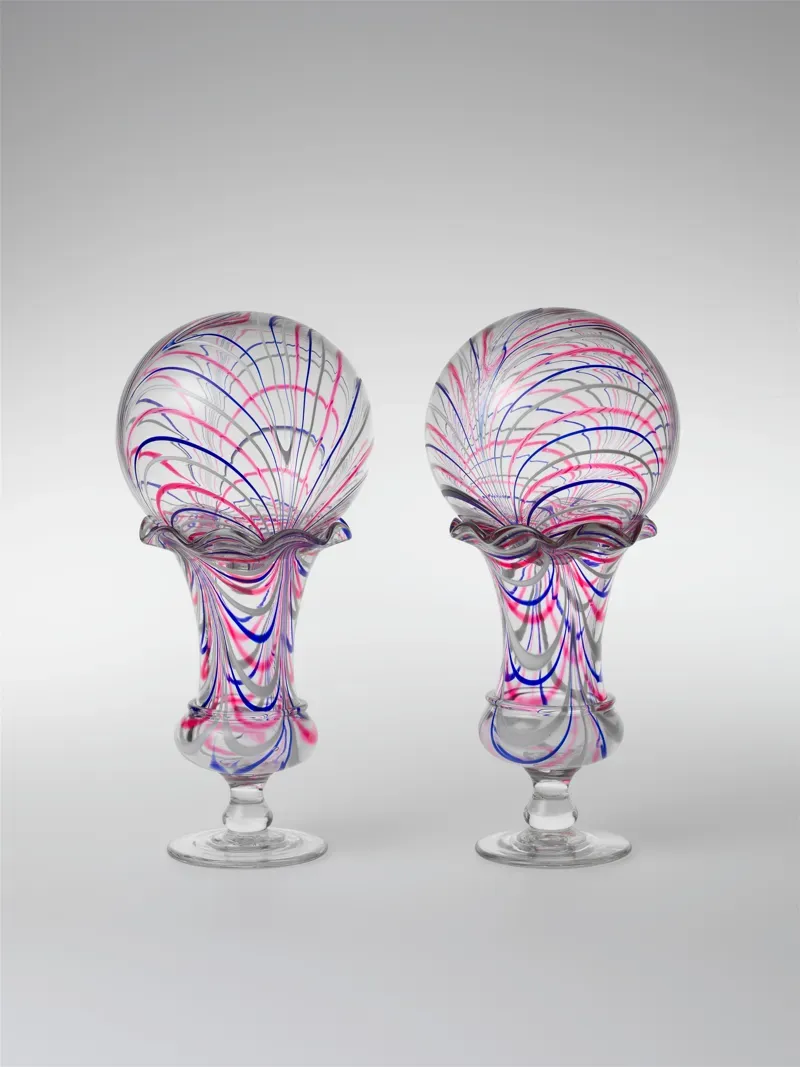
Vase with witch ball, probably the New England Glass Company, 1850-75. Blown glass, 34.3 cm. The Metropolitan Museum of Art, object 69.84.1a, b, Purchase, The Edgar J. Kaufmann Foundation Gift, 1969. Public domain (CC0, Met Open Access).
A witch ball is a hollow glass sphere. In English and American folk belief, a ball like this hung in a window was said to catch or turn away ill wishing. This one sits on a matching vase, so in this home it was also simply something pretty to display.
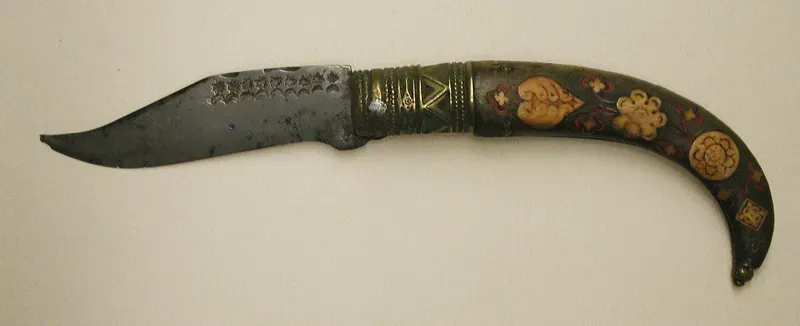
Witch Knife (Drudenmesser), Unknown maker, South Tyrol (Austria or Italy), 19th century. Steel, horn, bone, brass, pigment, 20 cm. The Metropolitan Museum of Art, object 93.13.81, Gift of Rutherfurd Stuyvesant, 1893. Public domain (CC0, Met Open Access).
In the folklore of the Alps, a Drude was a night spirit, often imagined as a witch, blamed for bad dreams and the feeling of a weight on your chest. Knives like this were kept for protection against her. Here the magic is in an everyday object, not in a picture.
The witches of Macbeth
Shakespeare’s three weird sisters may be the most often pictured witches of all. Seeing four versions together is the quickest way to learn that an artist always makes choices.
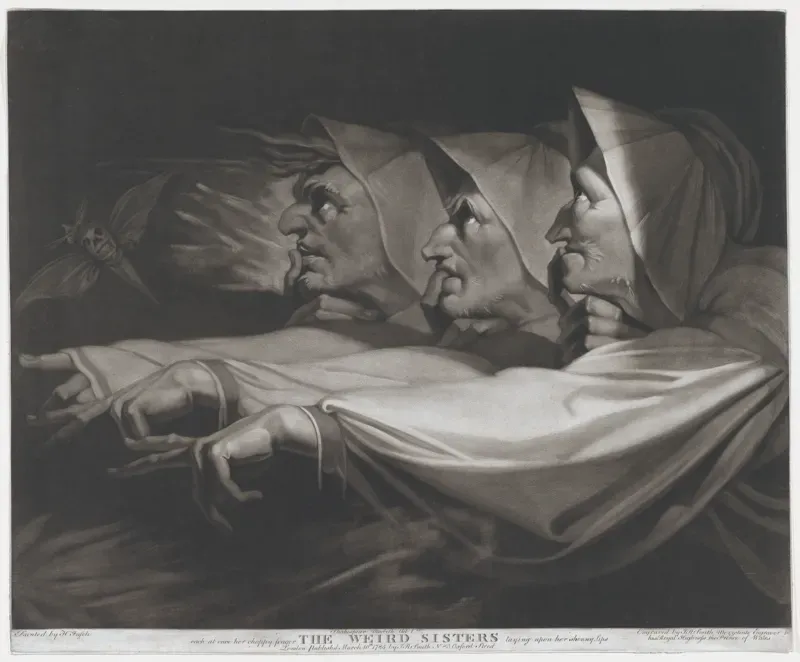
The Weird Sisters (Shakespeare, MacBeth, Act 1, Scene 3), John Raphael Smith, after Henry Fuseli, March 10, 1785. Mezzotint, 45.8 × 55.5 cm. The Metropolitan Museum of Art, object 59.570.361, The Elisha Whittelsey Collection, The Elisha Whittelsey Fund, 1959. Public domain (CC0, Met Open Access).
Smith copied a painting by Henry Fuseli, the artist of The Nightmare. The three faces line up like one figure repeated, and each sister holds a finger to her lips, as Banquo describes them in Act 1, Scene 3 of Macbeth. Notice how much of the mood comes from pure black.
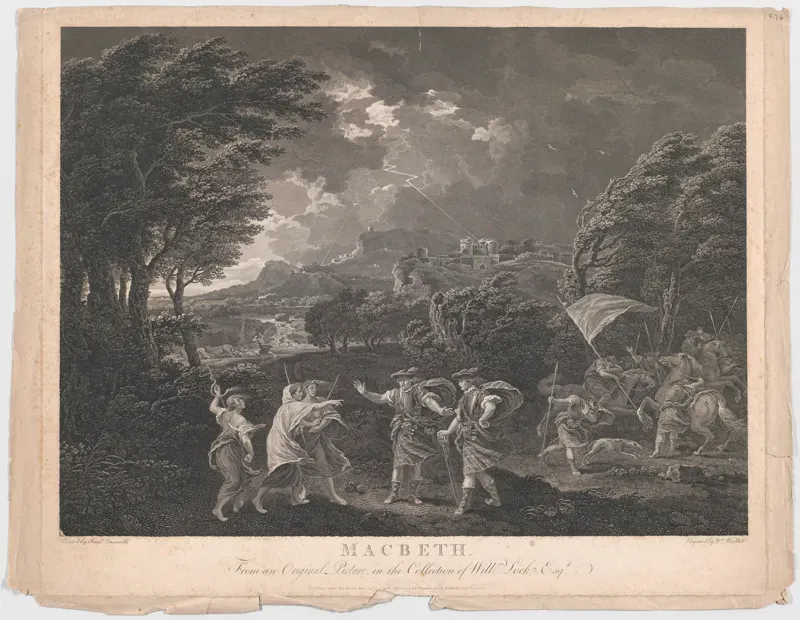
Macbeth and the Witches (Shakespeare, Macbeth, Act 1, Scene 1), William Woollett, after Francesco Zuccarelli, 1770. Etching and engraving; seventh state of seven, 44.8 × 55.4 cm. The Metropolitan Museum of Art, object 41.91.222, Gift of Harriet McDonald, 1941. Public domain (CC0, Met Open Access).
Here the witches are tiny, and the storm is the real subject. Woollett, one of the best known English engravers of his day, translated a painting by Francesco Zuccarelli into lines. Compare the scale with the Smith print above: the same play, a completely different idea of where the fear lives.
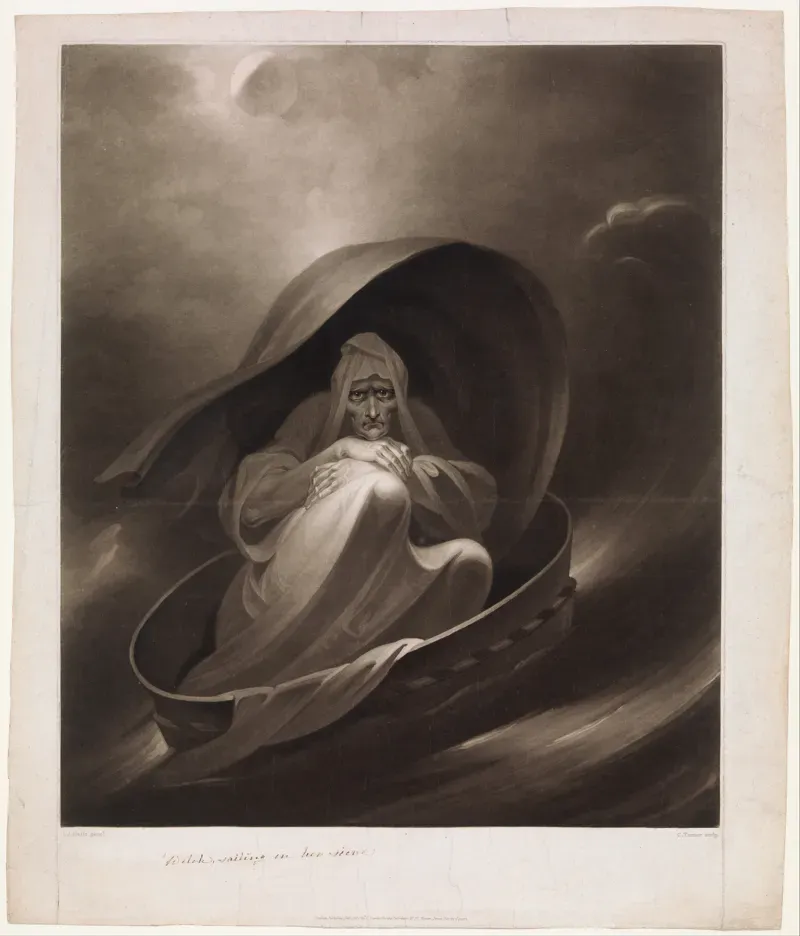
A Witch Sailing to Aleppo in a Sieve, Charles Turner, after John James Halls, December 1, 1807. Mezzotint, 61 × 45.7 cm. The Metropolitan Museum of Art, object 67.797.44, The Elisha Whittelsey Collection, The Elisha Whittelsey Fund, 1967. Public domain (CC0, Met Open Access).
In Act 1, Scene 3 of Macbeth, the first witch says she will sail to Aleppo in a sieve. Turner’s print, after a painting by John James Halls, takes the line literally. A sieve cannot float, and that impossibility is the point: this is a power that breaks the rules of nature.
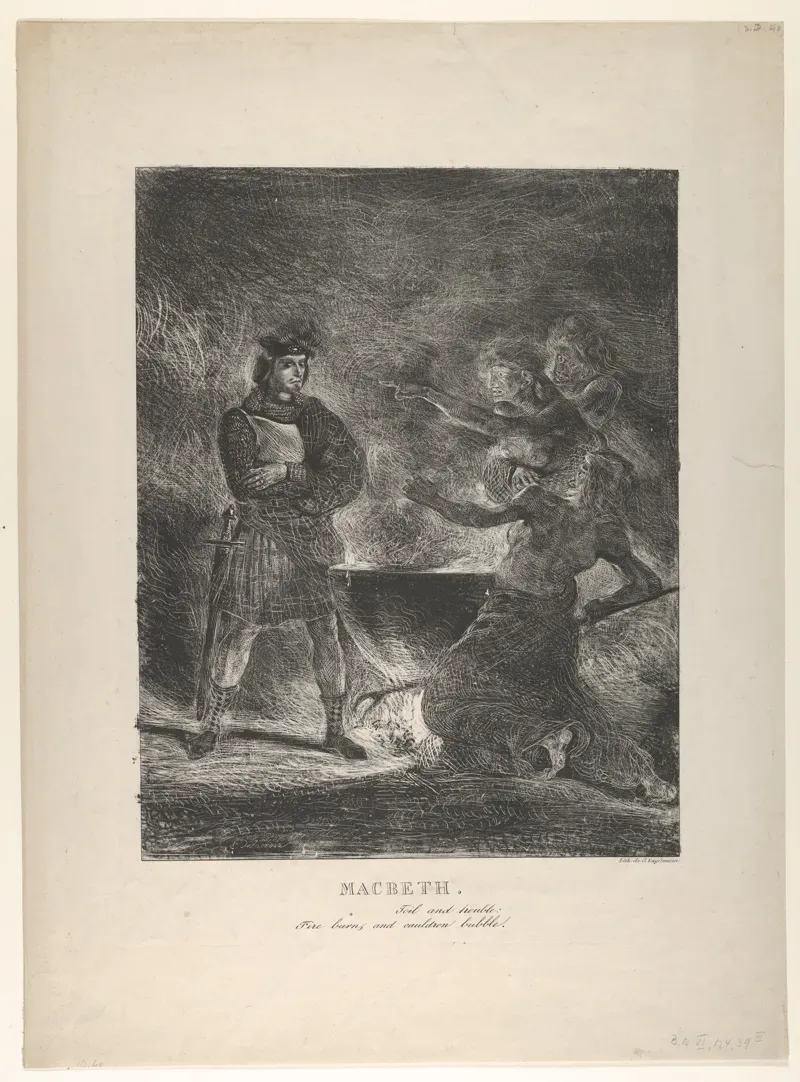
Macbeth Consulting the Witches, Eugène Delacroix, 1825. Lithograph; third state of five, 31.9 × 25.1 cm. The Metropolitan Museum of Art, object 22.63.19, Rogers Fund, 1922. Public domain (CC0, Met Open Access).
Delacroix was a leading French Romantic painter, and he returned to Shakespeare again and again. Lithography let him draw directly on stone with greasy crayon, so the marks stay loose and smoky. The cauldron scene comes from Act 4, when Macbeth goes back to the witches to demand answers.
Sorceresses of myth and scripture
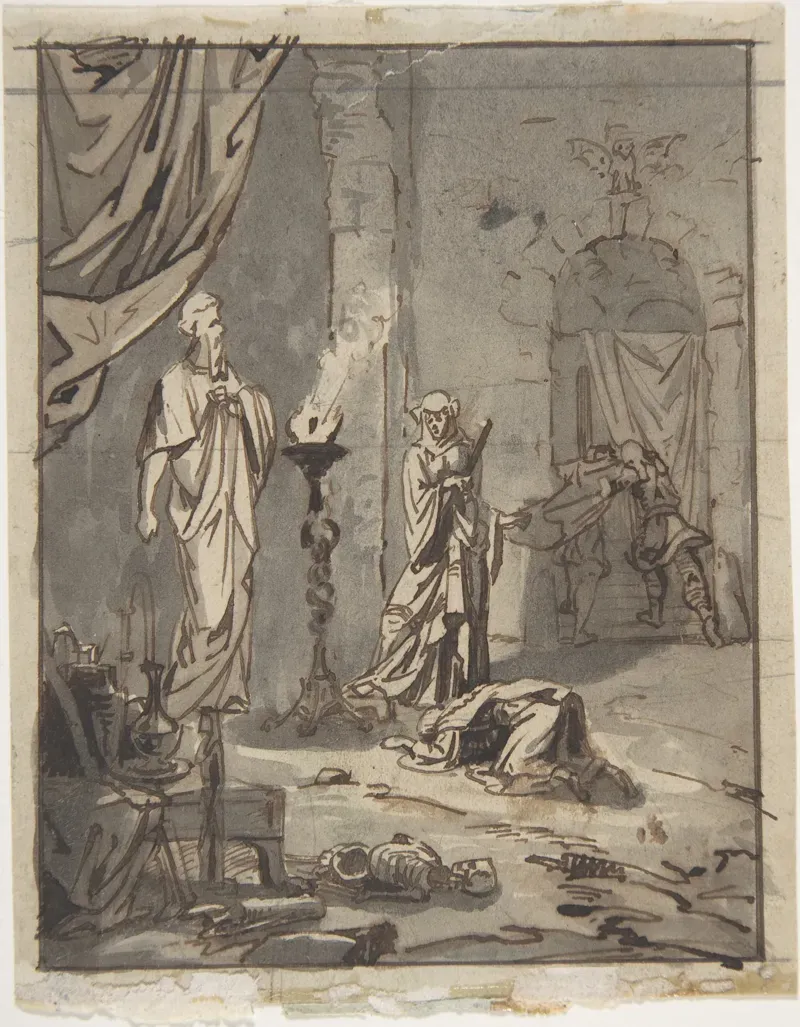
Witch of Endor, Ary Scheffer, 19th century. Pen and brown ink, brush and gray wash, graphite, 11.6 × 9.1 cm. The Metropolitan Museum of Art, object 47.100.1185, Harris Brisbane Dick Fund, 1947. Public domain (CC0, Met Open Access).
The story comes from 1 Samuel 28 in the Bible. King Saul, afraid before a battle, visits a woman at Endor who calls up the spirit of the prophet Samuel. This drawing is tiny, under twelve centimeters tall, so imagine holding it in your palm.
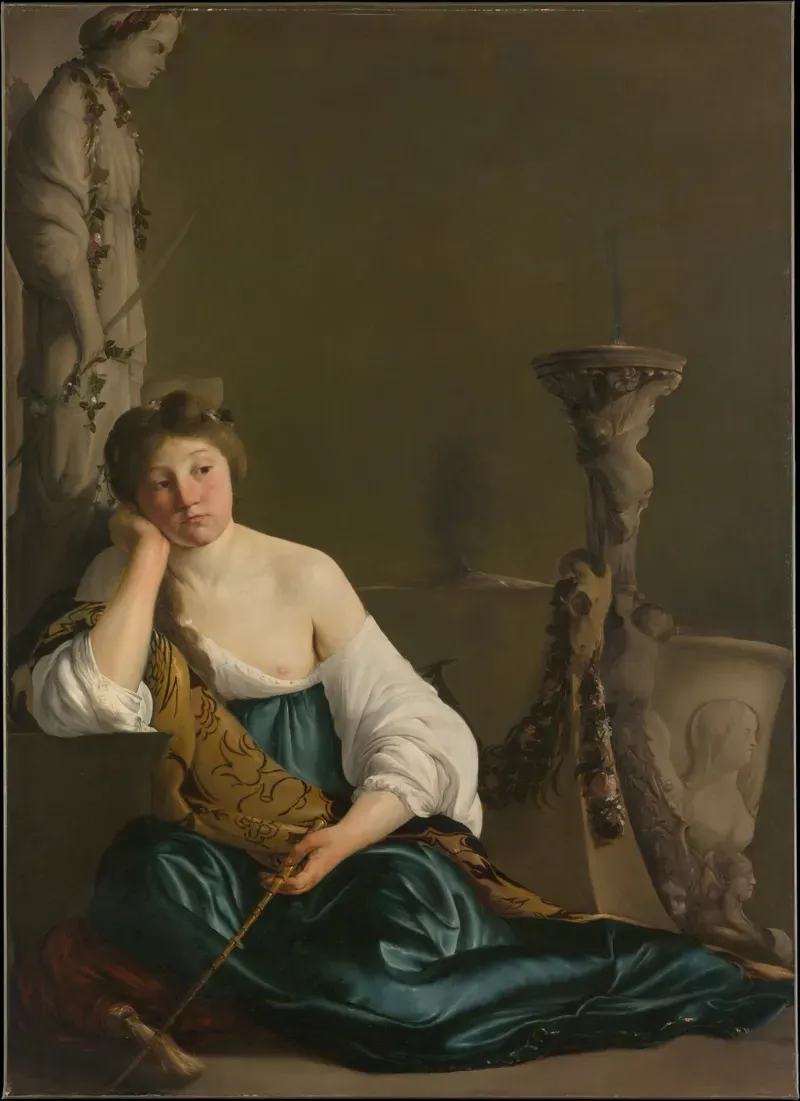
The Disillusioned Medea, Paulus Bor, ca. 1640. Oil on canvas, 155.6 × 112.4 cm. The Metropolitan Museum of Art, object 1972.261, Gift of Ben Heller, 1972. Public domain (CC0, Met Open Access).
Medea is the sorceress of Greek myth. Bor shows her not casting a spell but resting, almost bored, the rod lowered. The strange objects around her hint at her craft. It is a good picture for asking where the magic is when nothing seems to be happening.
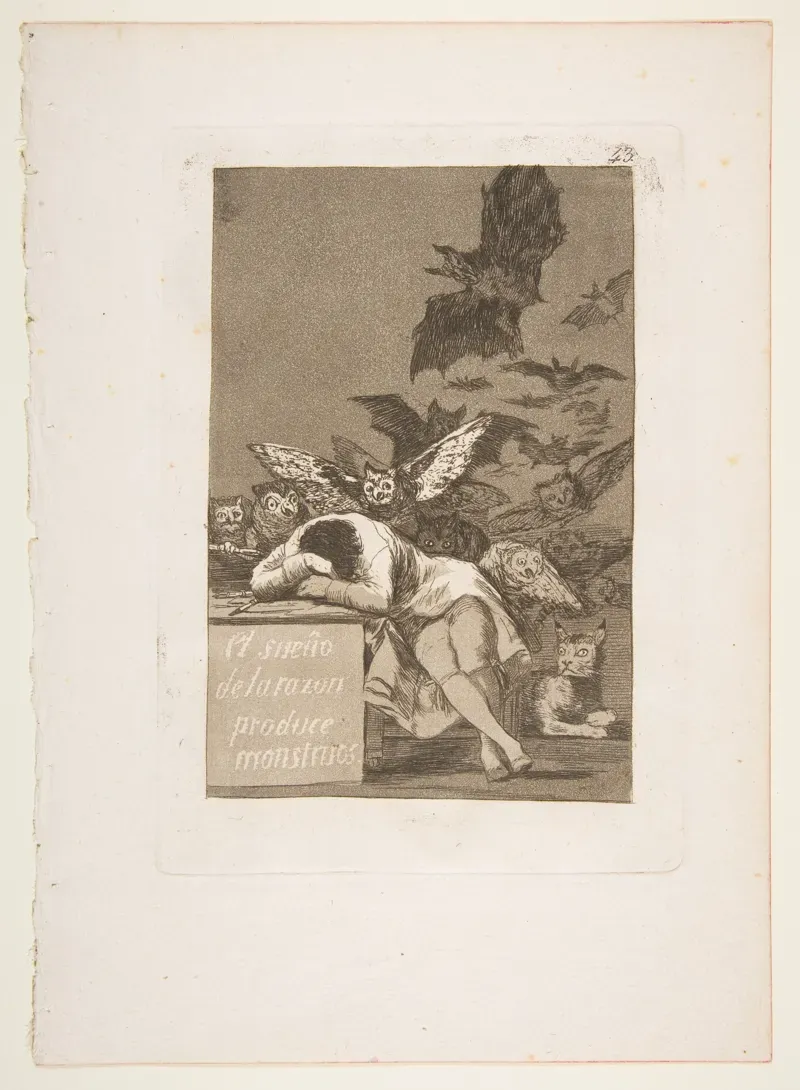
Plate 43 from “Los Caprichos”: The sleep of reason produces monsters (El sueño de la razon produce monstruos), Goya (Francisco de Goya y Lucientes), 1799. Etching, aquatint, 21.2 × 15.1 cm. The Metropolitan Museum of Art, object 18.64(43), Gift of M. Knoedler & Co., 1918. Public domain (CC0, Met Open Access).
This is plate 43 of Goya’s Los Caprichos, a set of eighty satirical prints. The words on the desk read: the sleep of reason produces monsters. Goya was mocking superstition and bad thinking in Spanish society, so the night creatures are what happens when reason switches off.
Witches on stage and on the street
By the nineteenth century witches were also entertainment, from the theater to the street press.
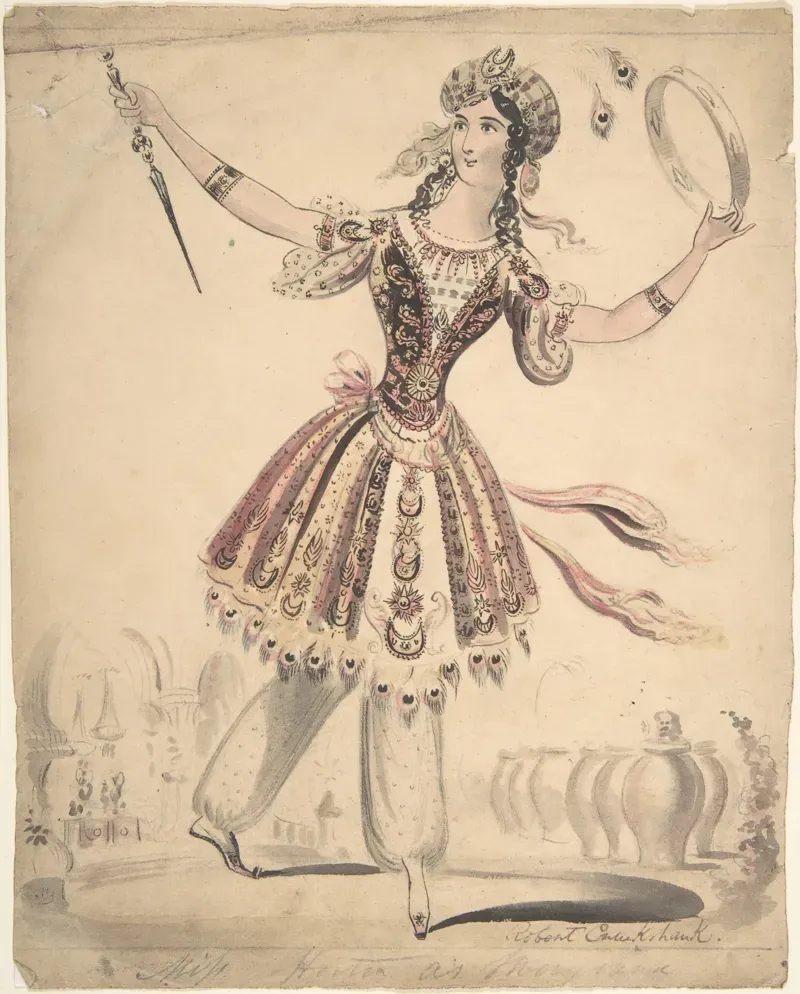
Miss Horton as Morgana, Isaac Robert Cruikshank, 1830-44. Watercolor, pen and black ink, over graphite, 21.8 × 17.3 cm. The Metropolitan Museum of Art, object 65.551.4(6), Purchase, Anne and Carl Stern Gift, 1965. Public domain (CC0, Met Open Access).
Not every sorceress in art is frightening. This is a stage portrait of the actress Priscilla Horton in the role of Morgana. Theater put magic in front of audiences every night, and prints and drawings like this one let fans take the costume home.
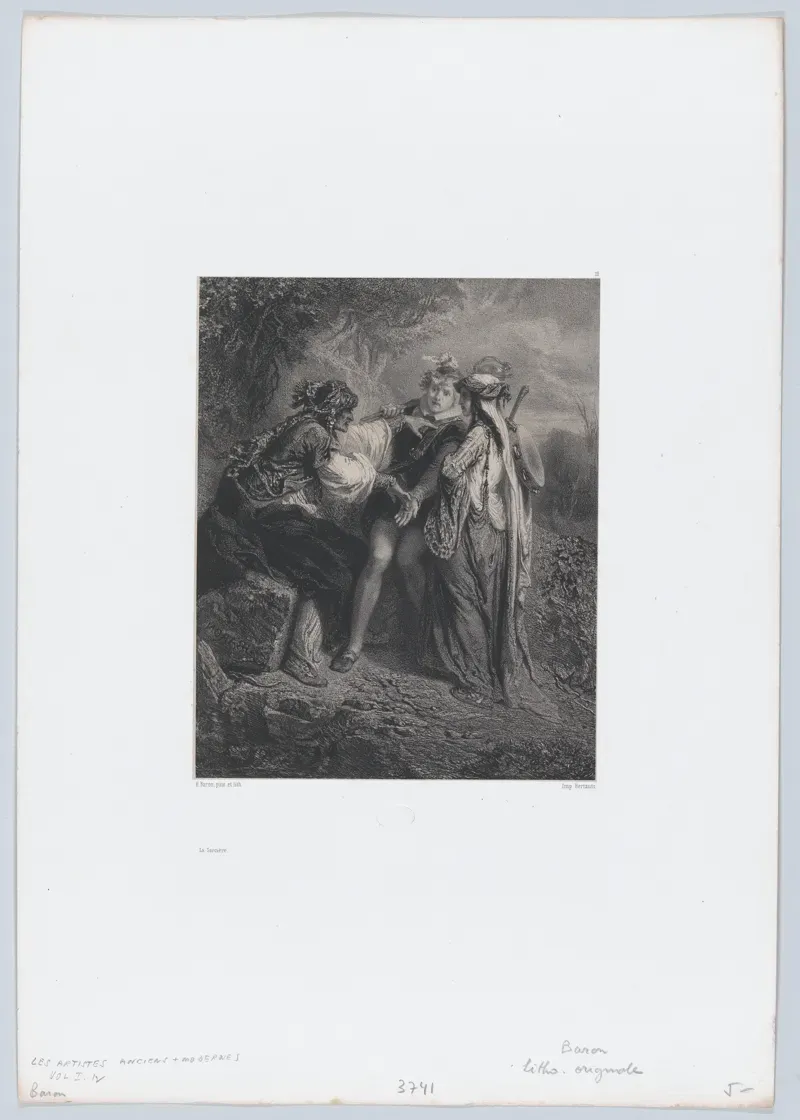
The Witch, Henri-Charles-Antoine Baron, 1850. Lithograph, 44.8 × 31.3 cm. The Metropolitan Museum of Art, object 63.625.187, The Elisha Whittelsey Fund, 1963. Public domain (CC0, Met Open Access).
By 1850 the witch had moved into romantic storybooks. Here she looks like a fortune teller meeting a young couple, more mysterious than evil. Notice how small the image is on its large sheet of paper.
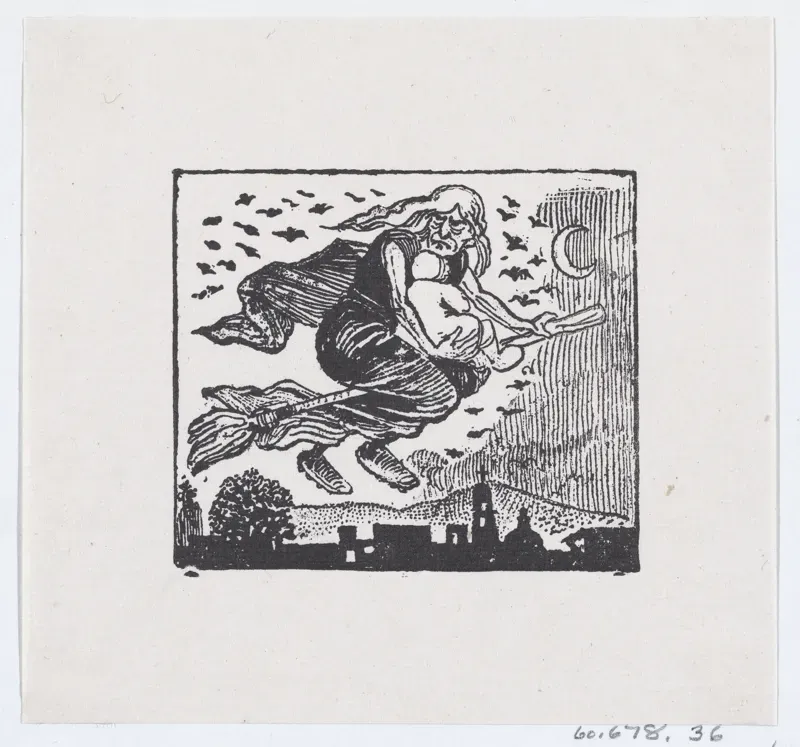
A witch carrying a child on her broom, José Guadalupe Posada, ca. 1880-1910 (a later impression). Zincograph, 10 × 11 cm. The Metropolitan Museum of Art, object 60.678.36, Gift of Roberto Berdecio, 1960. Public domain (CC0, Met Open Access).
José Guadalupe Posada made thousands of images for cheap printed sheets in Mexico City, sold on the street. A witch flying with a stolen child is a story of fear and warning. The print is only about seven centimeters wide.
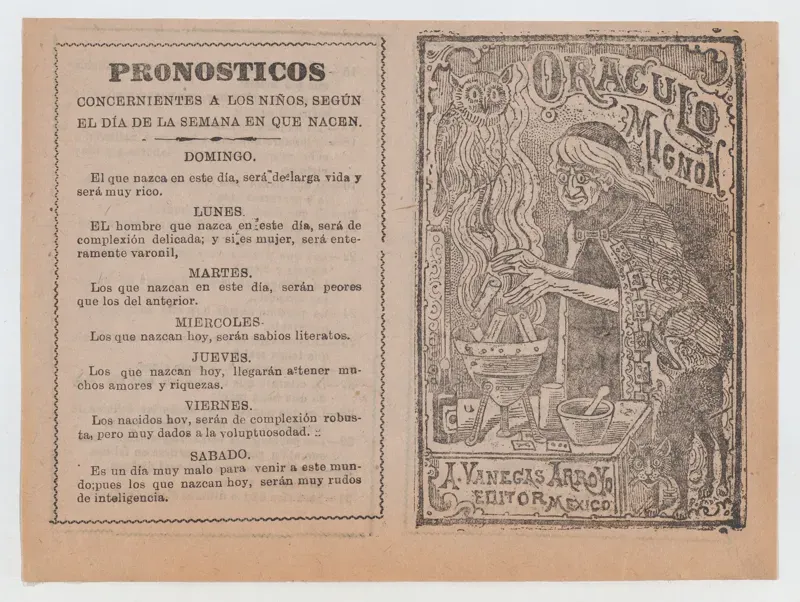
Cover for ‘Oraculo Mignon’, a witch brewing a potion in a cauldron, José Guadalupe Posada, ca. 1880-1910. Zincograph and letterpress on tan paper, 14.8 × 20 cm. The Metropolitan Museum of Art, object 46.46.235, The Elisha Whittelsey Collection, The Elisha Whittelsey Fund, 1946. Public domain (CC0, Met Open Access).
Oraculo means oracle. This cover, also by Posada, comes from the popular press of Antonio Vanegas Arroyo, and the printed page beside it carries predictions. It is a reminder that fortune telling and magic were also cheap entertainment for ordinary readers.
How to reuse these images
Every image in this gallery is public domain under the Met’s Open Access program (CC0). You can download, print and share them, even commercially, without asking permission. CC0 does not require credit, but I recommend keeping the caption with the image: the artist, the date, the museum and the object number. Before you reuse anything, open the source page from the caption and check the licence there yourself, because policies can change. My page on museums and open access explains how to check an image and where to find thousands more.
The esoteric angle
Historical Almost every image here was made by people who did not practice magic, for viewers who mostly feared it, laughed at it or enjoyed it as a story. That is the honest starting point.
Later tradition The folk objects are a little different. The witch ball and the Drude knife belonged to households that took protection seriously in their own way, so they bring us closer to lived belief than any painting.
Modern Today many witches collect images like these for altars and journals. If you do, I suggest keeping the caption with the picture. Knowing that a print is Shakespeare, satire or myth makes it richer, not weaker. If you want to know more about the real history behind the fear, my history of witchcraft page is the place to start.
Try it yourself
Here are the worksheet questions I use for every close reading. Copy them into a notebook, open the image as large as your screen allows, and give yourself twenty minutes. Fill them in order and do not skip ahead to meaning.
- Basic information. Write down the title, artist, date, material, size and collection number from the At a glance box. Size matters: picture the real object on a wall or in your hand.
- First look, two minutes. Before you read anything else, write three words for your first reaction.
- Description. List at least fifteen things you can see, without explaining any of them. People, animals, objects, places, colors, marks, writing.
- What is going on here? Then ask: what do I see that makes me say that? What more can I find?
- Formal analysis. Where are the lightest and darkest areas? Where do the lines lead your eye? Is the space deep or shallow? What is the focal point?
- Meaning in three levels. What is shown (a woman, a dog, an old man)? What story or theme do those things stand for? What does the work tell you about the time and place that made it?
- Evidence check. Mark each statement you wrote with E for evidence you can see or document, I for an interpretation, and P for your personal response. For this gallery, try one extra step: pick two of the Macbeth prints and list three differences in how each artist makes the witches frightening.
If you want the full method with a worked example, my page on how to look at a painting walks through it step by step.
Questions
Can I use these witch images myself?
Every image here is marked public domain by the Met under its Open Access program (CC0), so you can reuse it. I still recommend crediting the artist, the museum and the object number, as I do in each caption.
Why are there so many Macbeth pictures?
The three witches of Macbeth were one of the most popular witch subjects for British and French artists and printmakers in the eighteenth and nineteenth centuries, so they turn up again and again in print collections.
Are these pictures of real witches?
No. They show how artists imagined witches: as figures from plays, myths, the Bible, satire and folk belief. They tell us about the beliefs and fears of the time, not about a real practice.
Get the free Mini-Grimoire
A short printable starter guide to tarot and everyday witchcraft, plus my newsletter. Unsubscribe any time.
Opens Substack in a new tab to confirm. More about the newsletter · Privacy