


How to read the labels Historical what the old sources say. Later tradition what later writers added. Modern modern practice and my own notes.
| Number | 72 of 72 |
|---|---|
| Rank | Earl |
| Legions | 36 |
| Office (1904) | Brings back both a thief and the stolen goods. |
| Other spellings | none common |
Andromalius is spirit 72 of the 72 in the Ars Goetia, the first book of the Lesser Key of Solomon. The 1904 edition by S. L. MacGregor Mathers and Aleister Crowley calls him an earl ruling 36 legions, and the first office it gives him is this: Andromalius brings back both a thief and the stolen goods.
He closes the catalog as a thief-catcher, a role that magic manuscripts gave him long before the Goetia. Each part below carries a label for its layer, explained in how to read a spirit page.
At a glance
| Fact | In the entry |
|---|---|
| Number | 72 of 72, in the 1904 order. |
| Name and spellings | Andromalius in 1904; other spellings: none common. |
| Rank and legions | Earl, 36 legions. |
| Metal of his rank (Observations) | Copper and silver. |
| Hours for earls (Observations) | “Any hour of the Day, so it be in Woods, or in any other places whither men resort not, or where no noise is.” |
| In Weyer’s catalog (1577) | No. Andromalius is one of four Goetia spirits missing from Weyer; the others are Vassago, Seere and Dantalion. |
The 1904 entry
Historical The full entry from the 1904 edition, with footnote numbers and the dash after the heading left out and the heading set in ordinary type:
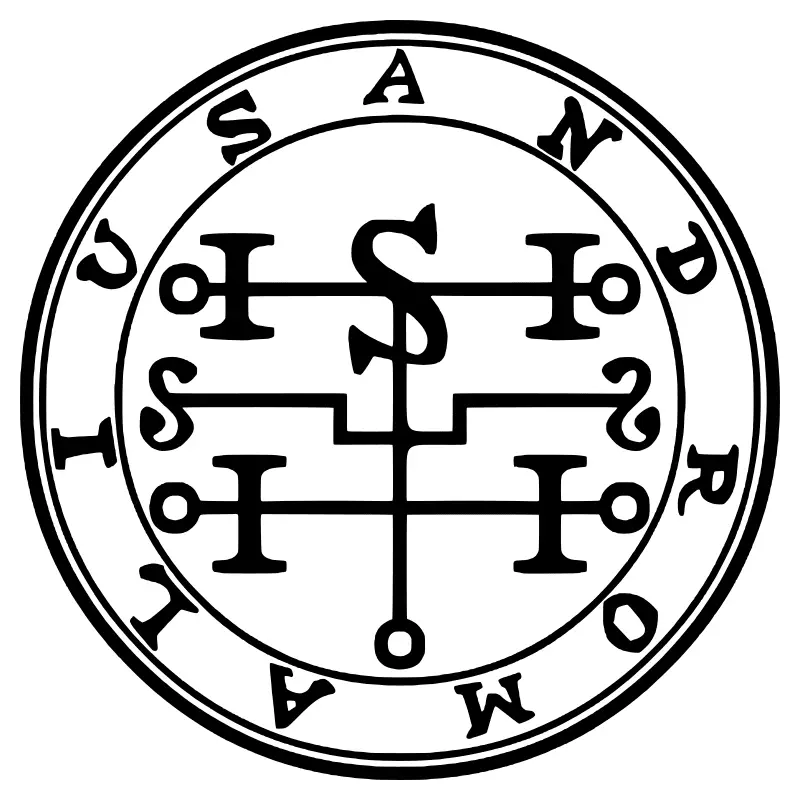
Andromalius. The Seventy-second Spirit in Order is named Andromalius. He is an Earl, Great and Mighty, appearing in the Form of a Man holding a Great Serpent in his Hand. His Office is to bring back both a Thief, and the Goods which be stolen; and to discover all Wickedness, and Underhand Dealing; and to punish all Thieves and other Wicked People; and also to discover Treasures that be Hid. He ruleth over 36 Legions of Spirits. His Seal is this, the which wear thou as aforesaid, etc.
Andromalius, “the Seventy-second Spirit in Order”, appears “in the Form of a Man holding a Great Serpent in his Hand”. His offices are those of a detective and judge: “to bring back both a Thief, and the Goods which be stolen; and to discover all Wickedness, and Underhand Dealing; and to punish all Thieves and other Wicked People; and also to discover Treasures that be Hid.” The entry is followed directly by the story of the brass vessel.
Appearance
Historical Andromalius appears “in the Form of a Man holding a Great Serpent in his Hand.”
Offices in the Ars Goetia
Historical The offices of Andromalius, in the order the 1904 text gives them:
- Brings back both a thief and the stolen goods.
- Discovers all wickedness and underhand dealing.
- Punishes all thieves and other wicked people. Reported as history; not taught here.
- Discovers hidden treasures.
Source comparison: Weyer and Scot
Historical Andromalius does not appear in Weyer’s catalog or Scot’s translation.
Historical With no Latin to compare, the best guide is the note by Joseph Peterson, the modern editor of the manuscripts. He calls the spirit “Often seen in stand-alone spells in magic mss., where he is employed for detecting a thief or discovering treasure”, usually spelled Andromalcus, and points to a longer version of the same offices in Sloane MS 3824. (About Weyer and Scot.)
Name and etymology
Historical Peterson records many manuscript spellings, among them Andromalcus, Andromalce and Andrea Malchus. The 1904 heading has Andromalius.
Seal and images
Historical The seal above is Andromalius’s as printed in 1904, and by the rules of the Observations it would be made in copper and silver, the metals of his rank. Why seals were worn, why editions draw them differently and how to study one are explained in seals, circle and triangle.
Later tradition and modern practice
Modern As the last spirit, Andromalius closes many modern lists. Some modern practitioners approach him for justice and for recovering stolen property.
Lore about Andromalius’s personality, likes or chosen people is modern, not grimoire material; modern approaches explains where such claims come from.
Beginner’s quick reference
| Item | What the sources say |
|---|---|
| Rank metal and hours (Goetia) | Earl: copper and silver; any hour of the day, in woods or other quiet places. |
| Planet (later tradition: Golden Dawn and Crowley’s 777) | Venus. This differs from 777’s usual pattern for an earl, which would give Mars. This is how the 1909 printing gives it. |
| Decan and day or night spirit (later tradition: 777) | Pisces, third decan (20 to 30 degrees); night spirit. 777 decan incense: “Santal Alb.” Tarot card of the decan: Ten of Cups. |
| Commonly reported color, incense, and plant (modern UPG; sources copy each other) | Color red; incense dragon’s blood; plant wormwood (reported in some sources; not verified as safe: do not burn, ingest, or handle). |
| Associated symbols | Goetia image: a man holding a great serpent. 777 Magical Image: the same image. Modern Demonolatry/UPG: the seal, used as an altar image. |
| Associated offerings | Modern practice, not in the Goetia manuscripts: most often listed, dragon’s blood resin; one source adds patchouli and seaweed. |
Before you burn or handle anything listed for Andromalius, read incense, plants and offerings.
Practical notes
Andromalius is an earl whose offices concern theft, wickedness, and punishment. I do not teach work to punish anyone. If you have been robbed, report it to the police. If you are interested in the history of how early modern people used magic against thieves, a common use of grimoires, Andromalius’s entry is a good starting point for study.
After the 72nd entry, the Goetia tells the story of the brass vessel (see seals, circle and triangle) and moves on to its Observations and ritual.
In the directory, Andromalius is not among the 30 spirits that fit the beginner criteria.
Try this: one question to study
Peterson calls thief-detection one of the commonest uses of spirits in magic manuscripts. List the spirits among the 72 who find thieves or stolen goods, starting with Seere (70).
What next
To compare Andromalius with other spirits of his rank, read Bifrons and Raum.
Later tradition In the Golden Dawn scheme of the decans, Andromalius is the night spirit of the third decan of Pisces, which belongs to the Ten of Cups; the day spirit of the same decan is Stolas (spirit 36).
Common questions
Is Andromalius a good spirit for beginners?
Not as a first choice. He does not meet all three beginner criteria I use: not a king, at least one teaching office, and no central harm, deception or compulsion. His entry is still worth reading as history.
What does Andromalius do in the Ars Goetia?
The 1904 text calls him an earl ruling 36 legions. Its first office for him is this: Andromalius brings back both a thief and the stolen goods. The entry lists 4 offices in all.
Does looking at Andromalius's seal call him?
No. Reading a name or looking at a seal does not call a spirit. The seal is a drawing from a 1904 book, and even the grimoire itself required long rituals for its own purposes.
Get the free Mini-Grimoire
A short printable starter guide to tarot and everyday witchcraft, plus my newsletter. Unsubscribe any time.
Opens Substack in a new tab to confirm. More about the newsletter · Privacy