


| Arcana | Minor Arcana: Cups |
|---|---|
| Image | RWS 1909 (PD) |
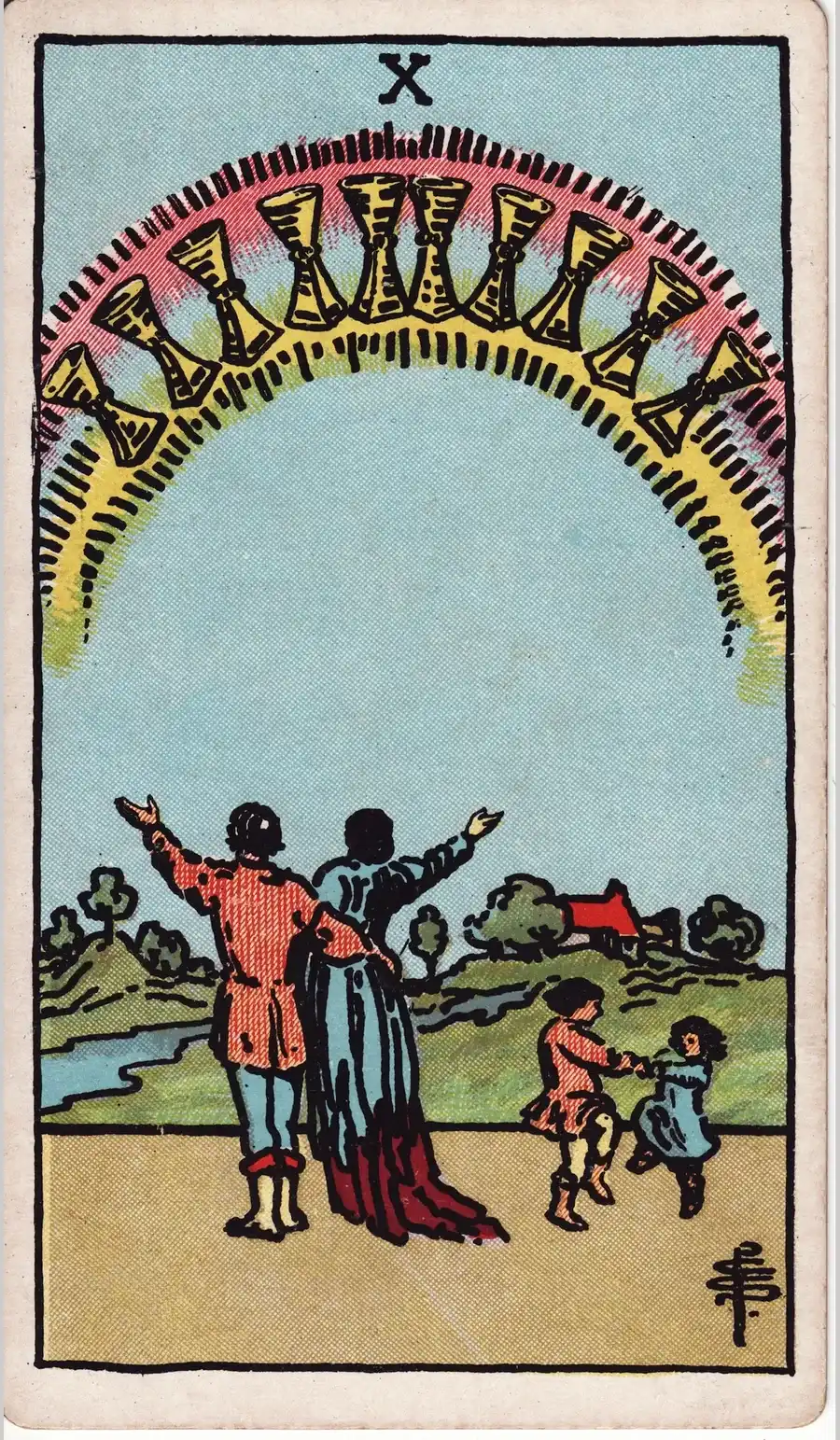
The Ten of Cups shows a couple with their arms around each other, raising their hands to a rainbow of ten cups, while two children dance beside them. A house stands by a river in the background.
It is a card of harmony, joy and shared belonging. Here is what the Ten of Cups means upright and reversed, the symbols in the 1909 card and a spread for family and home.
Here is the Ten of Cups at a glance.
| At a glance | This card |
|---|---|
| Upright keywords | harmony, joy, shared belonging |
| Reversed keywords | disconnection, shattered dreams, family trouble |
| Number | 10 in the suit of Cups |
| Golden Dawn title | Lord of Perfected Success Later tradition |
| Astrology | Mars in Pisces, third decan (20° to 30° Pisces) Later tradition |
| Tree of Life | Malkuth (10), the Kingdom Later tradition |
| Suit and element | Cups, Water Later tradition |
| Yes or no | Yes Modern |
Book T calls the Ten of Cups the Lord of Perfected Success and gives it Mars in Pisces, the last decan of the sign, on Malkuth. Mars is an odd guest in gentle Pisces, and Crowley later renamed the card Satiety in his Thoth deck, a hint that perfect success can tip into too much. Smith’s rainbow family is the gentler vision.
Later tradition The Golden Dawn also gave each decan two of the 72 Goetic spirits, one for the day and one for the night. For the third decan of Pisces, and so for the Ten of Cups, they are Stolas (spirit 36, day) and Andromalius (spirit 72, night). Their pages read the old entries as history; see the spirit directory for all 72.
The card: what Pamela Colman Smith drew
Waite wrote: “Appearance of Cups in a rainbow; it is contemplated in wonder and ecstasy by a man and woman below, evidently husband and wife.” He added that “the two children dancing near them have not observed the prodigy but are happy after their own manner. There is a home-scene beyond.”
The rainbow of cups. The cups arc across the sky in a rainbow, a sign of promise and good weather after rain. The happiness in this card feels almost miraculous.
The couple. They hold each other and raise their arms together. Waite called them husband and wife, but you can read them as any loving partnership or family.
The dancing children. The children have not even noticed the rainbow. They are simply happy. That is a lovely detail: everyday joy does not need a miracle.
Upright meaning
Upright, the Ten of Cups is shared happiness. A couple stands with their arms around each other, raising their hands toward a rainbow of ten cups, while two children dance nearby and a house stands by a river. The card speaks of harmony, family, peace and the kind of joy that grows over time.
It is often read as a happy home, a loving family, a fulfilling relationship or a community where you truly belong. Family here can mean chosen family. The important thing is the feeling of emotional completeness, of love that is shared and lasting.
The Ten of Cups also asks you to notice your blessings. The couple are looking up at the rainbow, not past it.
Reversed meaning
Reversed, the Ten of Cups shows disharmony at home, family conflict, or a dream of happiness that does not match reality. It can also show pressure to look happy, a family photo that hides tension.
Ask what happiness actually looks like for you, not for your family or for social media. A reversed Ten often invites honest conversation rather than more effort to appear perfect.
Next to the Five of Pentacles or the Ten of Wands, the reversed Ten often describes a household under outside pressure such as money, work or illness, rather than a lack of love. In that case the remedy is practical help, not a judgment on the family itself.
In love, work and spirituality
In love. Upright: A happy, committed relationship, or building a family together. Reversed: Tension at home, or unrealistic expectations of a perfect relationship.
At work. Upright: A workplace that feels like family, or work that supports your home life. Reversed: Work pressure straining family life.
With money. Upright: Financial security for the family. Reversed: Money disputes in the family.
In spiritual practice. Upright: Celebrating with family or community, or blessing the home. Reversed: Feeling disconnected from family traditions.
As feelings. Deep love and the wish to build a shared life with you.
As a person. A family-oriented, loving and content person.
As advice. Invest in the people who make your home.
Reading the Ten of Cups: positions and yes or no
In the past position: A happy home or a loving family gave you a strong base. In the present position: Shared happiness is here. Enjoy it.
In the future position: Harmony and belonging are ahead. As advice: Tend the small rituals that keep your home happy.
In modern yes or no readings, the Ten of Cups leans yes. It is one of the happiest cards in the deck.
What the Ten means, and the history behind the card
Ten completes the suit, and in Cups completion is shared joy. The Golden Dawn named it Perfected Success, though Smith’s rainbow says it in a way even a child can understand.
Here is how the Ten looks across the four suits:
- Ten of Wands: burden, responsibility, hard work
- Ten of Cups (this card): harmony, joy, shared belonging
- Ten of Swords: betrayal, painful endings, collapse
- Ten of Pentacles: legacy, inheritance, long-term success
When A. E. Waite published The Pictorial Key to the Tarot in 1910, he listed these divinatory meanings for the Ten of Cups: “Contentment, repose of the entire heart; the perfection of that state; also perfection of human love and friendship; if with several picture-cards, a person who is taking charge of the Querent’s interests; also the town, village or country inhabited by the Querent.”
Reversed, he gave: “Repose of the false heart, indignation, violence.”
Common questions
Is the Ten of Cups a yes or no card? Yes. It is one of the happiest cards in tarot.
What does the Ten of Cups mean in love? Long-term happiness, commitment and a shared future. Reversed, differing dreams.
Does the Ten of Cups mean family? Often, but it can mean any close group: chosen family, friends or community.
Try this
Try this small spread for the Ten of Cups. Use it to look at home and family.
| Card | Question | What it shows |
|---|---|---|
| 1 | What makes home feel like home? | The strength of my family or home. |
| 2 | What needs care? | Where harmony is under strain. |
| 3 | How do I add joy? | One shared ritual to try. |
Affirmation: I help build shared joy through care that people can feel.
Reversed affirmation: I face fractures in belonging without pretending they are fine.
If you keep a tarot journal, take one of these questions to it: Who are my family, by birth or by choice? What small ritual keeps us close? What does a happy home look like to me, not to others?
What next
Cards that sit close to this one are Nine of Cups (personal satisfaction before it becomes shared), Ten of Pentacles (family and legacy in the earth suit) and The Sun (the Major Arcana card of simple happiness).
The Ten of Cups is part of the lesson Cups in my free Tarot for Beginners course. To see the whole suit on one page, go to the suit of Cups. To keep walking the suit, read the card before it, Nine of Cups or the card after it, Page of Cups, or go back to all the card meanings.
For the suits and numbers in one place, see The Minor Arcana: suits and numbers made simple. For every card with keywords, affirmations and examples, see my book The Novice’s Guide to Tarot. If you would like a printable cheat sheet for all 78 cards, my 45-page Tarot Workbook is on Etsy.
Sources
- A. E. Waite, The Pictorial Key to the Tarot (London: Rider, 1910), Part III, sections 1 and 2.
- Pamela Colman Smith and A. E. Waite, the Rider-Waite-Smith tarot (London: Rider, 1909).
- Nicolas Conver, Tarot de Marseille (Marseille, 1760).
- Lauri Mukkala, The Novice’s Guide to Tarot, entry for the Ten of Cups.
- Aleister Crowley, 777 (London: Walter Scott, 1909), columns of the decans, the Minor Arcana and the court cards.
- Israel Regardie, ed., The Golden Dawn (Chicago: Aries Press, 1937 to 1940), “Book T”, titles and attributions of the small cards and the court.
All 78 cards
Major Arcana
- The Fool
- The Magician
- The High Priestess
- The Empress
- The Emperor
- The Hierophant
- The Lovers
- The Chariot
- Strength
- The Hermit
- Wheel of Fortune
- Justice
- The Hanged Man
- Death
- Temperance
- The Devil
- The Tower
- The Star
- The Moon
- The Sun
- Judgement
- The World
Wands
- Ace of Wands
- Two of Wands
- Three of Wands
- Four of Wands
- Five of Wands
- Six of Wands
- Seven of Wands
- Eight of Wands
- Nine of Wands
- Ten of Wands
- Page of Wands
- Knight of Wands
- Queen of Wands
- King of Wands
Cups
- Ace of Cups
- Two of Cups
- Three of Cups
- Four of Cups
- Five of Cups
- Six of Cups
- Seven of Cups
- Eight of Cups
- Nine of Cups
- Ten of Cups
- Page of Cups
- Knight of Cups
- Queen of Cups
- King of Cups
Swords
- Ace of Swords
- Two of Swords
- Three of Swords
- Four of Swords
- Five of Swords
- Six of Swords
- Seven of Swords
- Eight of Swords
- Nine of Swords
- Ten of Swords
- Page of Swords
- Knight of Swords
- Queen of Swords
- King of Swords
Pentacles
Get the free Mini-Grimoire
A short printable starter guide to tarot and everyday witchcraft, plus my newsletter. Unsubscribe any time.
Opens Substack in a new tab to confirm. More about the newsletter · Privacy