


How to read the labels Historical what the old sources say. Later tradition what later writers added. Modern modern practice and my own notes.
| Number | 46 of 72 |
|---|---|
| Rank | Earl |
| Legions | 6 |
| Office (1904) | Makes one knowing in astrology, geometry, and other arts and sciences. |
| Other spellings | Bifrous, Bifrovs (1904) |
Bifrons is number 46 in the catalog of 72 spirits that opens the Lesser Key of Solomon. The 1904 edition by S. L. MacGregor Mathers and Aleister Crowley calls him an earl ruling 6 legions, and the first office it gives him is this: Bifrons makes one knowing in astrology, geometry, and other arts and sciences.
His name means two-faced in Latin, and his entry joins the sciences of measure to strange work among the graves. Each part below carries a label for its layer, explained in how to read a spirit page.
At a glance
| Fact | In the entry |
|---|---|
| Number | 46 of 72, in the 1904 order. |
| Name and spellings | Bifrons in 1904; other spellings: Bifrous, Bifrovs (1904). |
| Rank and legions | Earl, 6 legions. |
| Metal of his rank (Observations) | Copper and silver. |
| Hours for earls (Observations) | “Any hour of the Day, so it be in Woods, or in any other places whither men resort not, or where no noise is.” |
| In Weyer’s catalog (1577) | Yes, as the source comparison below shows. |
The 1904 entry
Historical The full entry from the 1904 edition, with footnote numbers and the dash after the heading left out and the heading set in ordinary type:
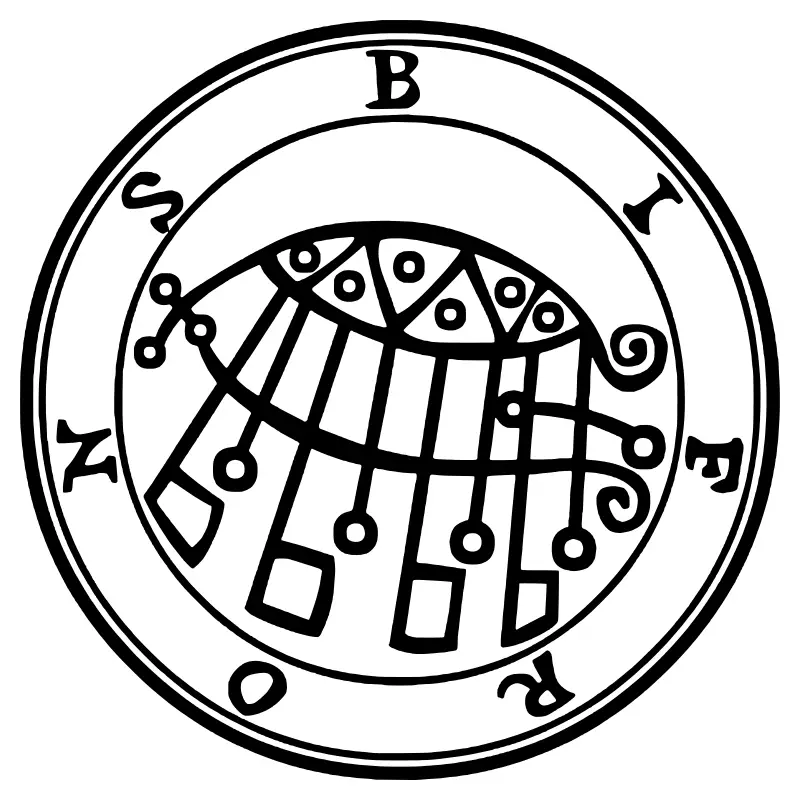
Bifrons. The Forty-sixth Spirit is called Bifrons, or Bifröus, or Bifrovs. He is an Earl, and appeareth in the Form of a Monster; but after a while, at the Command of the Exorcist, he putteth on the shape of a Man. His Office is to make one knowing in Astrology, Geometry, and other Arts and Sciences. He teacheth the Virtues of Precious Stones and Woods. He changeth Dead Bodies, and putteth them in another place; also he lighteth seeming Candles upon the Graves of the Dead. He hath under his Command 6 Legions of Spirits. His Seal is this, which he will own and submit unto, etc.
Bifrons appears “in the Form of a Monster” and then as a man. The teaching offices come first: astrology, geometry “and other Arts and Sciences”, and the virtues of “Precious Stones and Woods”. The offices of the dead follow: “He changeth Dead Bodies, and putteth them in another place; also he lighteth seeming Candles upon the Graves of the Dead.” “Seeming” matters: the candles only appear to burn. The seal clause, “which he will own and submit unto”, is unusual and makes the seal a sign the spirit acknowledges.
Appearance
Historical Bifrons “appeareth in the Form of a Monster,” but “after a while, at the Command of the Exorcist, he putteth on the shape of a Man.”
Offices in the Ars Goetia
Historical The offices of Bifrons, in the order the 1904 text gives them:
- Makes one knowing in astrology, geometry, and other arts and sciences.
- Teaches the virtues of precious stones and woods.
- Changes dead bodies and puts them in another place. Reported as history; not taught here.
- “Lighteth seeming Candles upon the Graves of the Dead.” Reported as history; not taught here.
He commands 6 legions, one of the smallest numbers in the catalog (Mathers notes that it “should probably be 60”).
Source comparison: Weyer and Scot
Historical The Weyer catalog, as Scot renders it, gives “Bifrons” as “seene in the similitude of a monster,” who in man’s image makes one “woonderfull cunning in astrologie, absolutelie declaring the mansions of the planets,” and in geometry, understands herbs, stones, and woods, moves dead bodies, and “seemeth to light candles” on graves.
The Goetia drops herbs. Scot gives 26 legions, the Goetia 6.
Historical Weyer’s Latin makes the astrology precise: he teaches “planetarum mansiones absolutè”, the mansions of the planets, completely, and also “Geometria, & mensuris alijs”, geometry and other measures. He understands the virtues of “herbarum, lapidum pretiosorum & lignorum”, herbs, precious stones and woods. The candles are “inflammare videtur”, he seems to light them. Weyer gives 26 legions, the Goetia 6, and Mathers noted that it “Should probably be 60 instead of 6.” (About Weyer and Scot.)
Name and etymology
Historical Bifrons is a Latin adjective meaning two-fronted or two-faced, the word Virgil uses for the god Janus. The 1904 text adds Bifröus and Bifrovs.
Seal and images
Historical The seal above is Bifrons’s as printed in 1904, and by the rules of the Observations it would be made in copper and silver, the metals of his rank. Why seals were worn, why editions draw them differently and how to study one are explained in seals, circle and triangle.
Later tradition Le Breton’s 1863 plate shows only a huge grinning head with no body, a monster in the text’s vague sense.
Later tradition and modern practice
Later tradition The name Bifrons, Latin for “two-faced,” recalls the Roman Janus but no source links them.
Modern The candles on graves have been compared in modern writing with will-o’-the-wisps and corpse lights of folklore. That comparison is modern.
Lore about Bifrons’s personality, likes or chosen people is modern, not grimoire material; modern approaches explains where such claims come from.
Beginner’s quick reference
| Item | What the sources say |
|---|---|
| Rank metal and hours (Goetia) | Earl: copper and silver; any hour of the day, in woods or other quiet places. |
| Planet (later tradition: Golden Dawn and Crowley’s 777) | Mars. For earls, 777 gives Mars, following the 1904 editor’s note, rather than the Venus and Moon of their copper and silver. |
| Decan and day or night spirit (later tradition: 777) | Cancer, first decan (0 to 10 degrees); night spirit. 777 decan incense: camphor (irritating smoke; not for beginners). Tarot card of the decan: Two of Cups. |
| Commonly reported color, incense, and plant (modern UPG; sources copy each other) | Color red; incense dragon’s blood; plant basil. |
| Associated symbols | Goetia image: a monster; later a man. 777 Magical Image: a monster. Le Breton engraving (1863): a grinning, bodiless face. Modern Demonolatry/UPG: the seal, used as an altar image. |
| Associated offerings | Modern practice, not in the Goetia manuscripts: most often listed, basil and dragon’s blood resin; one source adds caraway, pine resin, amethyst, and pearl. |
Before you burn or handle anything listed for Bifrons, read incense, plants and offerings.
Practical notes
Bifrons is an earl, and his offices of astrology, geometry, and the study of stones and woods match the teaching part of the beginner criteria. His offices concerning the dead are not ones I teach, and you should never disturb graves. A question about geometry or the study of woods would suit a first contact.
In the directory, Bifrons is one of the 30 spirits that fit the beginner criteria.
Try this: one question to study
Weyer gives Bifrons 26 legions, the 1904 text 6 and Mathers’s guess 60. Decide which error a copyist was most likely to make, and compare Ose (57), where the 1904 text prints 3.
What next
To compare Bifrons with other spirits of his rank, read Raum and Halphas.
Later tradition In the Golden Dawn scheme of the decans, Bifrons is the night spirit of the first decan of Cancer, which belongs to the Two of Cups; the day spirit of the same decan is Buer (spirit 10).
Common questions
Is Bifrons a good spirit for beginners?
He is counted among the 30 of the 72 that fit the three beginner criteria I use: not a king, at least one teaching office, and no central harm, deception or compulsion. His teaching offices are the reason; his offices concerning the dead are not ones I teach.
What does Bifrons do in the Ars Goetia?
The 1904 text calls him an earl ruling 6 legions. Its first office for him is this: Bifrons makes one knowing in astrology, geometry, and other arts and sciences. The entry lists 4 offices in all.
Does looking at Bifrons's seal call him?
No. Reading a name or looking at a seal does not call a spirit. The seal is a drawing from a 1904 book, and even the grimoire itself required long rituals for its own purposes.
Get the free Mini-Grimoire
A short printable starter guide to tarot and everyday witchcraft, plus my newsletter. Unsubscribe any time.
Opens Substack in a new tab to confirm. More about the newsletter · Privacy