


How to read the labels Historical what the old sources say. Later tradition what later writers added. Modern modern practice and my own notes.
| Number | 68 of 72 |
|---|---|
| Rank | King |
| Legions | 80 (50 in some reprints) |
| Office (1904) | Distributes presentations (preferments) and senatorships. |
| Other spellings | Beliall (Scot), Beliar |
Spirit 68 of the Ars Goetia is Belial. The 1904 edition by S. L. MacGregor Mathers and Aleister Crowley calls him a king ruling 80 legions, and the first office it gives him is this: Belial distributes presentations (preferments) and senatorships.
He is the last of the kings, and his name reaches back through the Dead Sea Scrolls to the Hebrew Bible. Each part below carries a label for its layer, explained in how to read a spirit page.
At a glance
| Fact | In the entry |
|---|---|
| Number | 68 of 72, in the 1904 order. |
| Name and spellings | Belial in 1904; other spellings: Beliall (Scot), Beliar. |
| Rank and legions | King, 80 legions in the 1904 printing, as in Weyer and Scot; 50 in the 1916 de Laurence reprint and online texts based on it. |
| Metal of his rank (Observations) | Gold. |
| Hours for kings (Observations) | “From 9 till 12 o’clock at Noon, and from 3 till Sunset.” |
| In Weyer’s catalog (1577) | Yes, as the source comparison below shows. |
The 1904 entry
Historical The full entry from the 1904 edition, with footnote numbers and the dash after the heading left out and the heading set in ordinary type:
Belial. The Sixty-eighth Spirit is Belial. He is a Mighty and a Powerful King, and was created next after Lucifer. He appeareth in the Form of Two Beautiful Angels sitting in a Chariot of Fire. He speaketh with a Comely Voice, and declareth that he fell first from among the worthier sort, that were before Michael, and other Heavenly Angels. His Office is to distribute Presentations and Senatorships, etc., and to cause favour of Friends and of Foes. He giveth excellent Familiars, and governeth 80 Legions of Spirits. Note well that this King Belial must have Offerings, Sacrifices and Gifts presented unto him by the Exorcist, or else he will not give True Answers unto his Demands. But then he tarrieth not one hour in the Truth, unless he be constrained by Divine Power. And his Seal is this, which is to be worn as aforesaid, etc.
Belial “was created next after Lucifer” and appears as “Two Beautiful Angels sitting in a Chariot of Fire”. He declares “that he fell first from among the worthier sort”. His offices are political: “Presentations and Senatorships” (appointments to church livings and high offices) and favour of friends and foes. The number of his legions is printed as 80 in the 1904 edition. Mathers added “Perhaps an error for 30”, and Crowley added “The actual number is 50; at least it was in 1898”. The 1916 de Laurence reprint then printed 50 in the text itself, so both 80 and 50 circulate: 80 in 1904 and Weyer, 50 in de Laurence and texts copied from it. The last sentences are a warning: he must have offerings, “But then he tarrieth not one hour in the Truth, unless he be constrained by Divine Power.”
Appearance
Historical Belial “appeareth in the Form of Two Beautiful Angels sitting in a Chariot of Fire.” He “speaketh with a Comely Voice.”
Offices in the Ars Goetia
Historical The offices of Belial, in the order the 1904 text gives them:
- Distributes presentations (preferments) and senatorships.
- Causes favor of friends and of foes.
- Gives excellent familiars.
He “was created next after Lucifer,” and “declareth that he fell first from among the worthier sort, that were before Michael, and other Heavenly Angels.” He governs 80 legions in the 1904 text and 50 in the 1916 de Laurence reprint; the notes behind the two numbers are quoted under the 1904 entry above.
He “must have Offerings, Sacrifices and Gifts presented unto him,” or he will not give true answers, “but then he tarrieth not one hour in the Truth, unless he be constrained by Divine Power.”
Source comparison: Weyer and Scot
Historical Weyer, in Scot’s English, gives a long entry. It says “some saie” Belial was created right after Lucifer, takes “the forme of a beautifull angell, sitting in a firie chariot,” and has rule over 80 legions.
The Goetia has two angels; the legions match. Weyer’s account of the vessel follows this entry, naming Belial second of the chiefs and suggesting that Solomon shut the spirits up “for the pride of this Beliall.”
Historical Weyer’s Latin entry is the longest in his catalog and gives 80 legions: “Imperium habet octoginta legionum, ex ordine partim Virtutum, partim Angelorum”, 80 legions, partly of the order of Virtues and partly of Angels. Weyer has one angel, “Angelicam assumit imaginem impensè pulchram, in igneo curru sedens”, an exceedingly beautiful angelic image seated in a fiery chariot. In his account of the vessel, Solomon shut the spirits “in vase vitreo”, in a glass vessel, which Scot made “brasen”; the first king was Bileth, the second Belial, then Asmoday. Weyer ends with the Babylonians breaking the vessel and Belial entering an image to give answers, “ut testatur Tocz”, as Tocz testifies. (About Weyer and Scot.)
Name and etymology
Historical Beside the usual reading of the Hebrew beliyya’al as “worthlessness”, discussed under later tradition below, an old rabbinic explanation splits the word as beli ’ol, “without a yoke”.
Seal and images
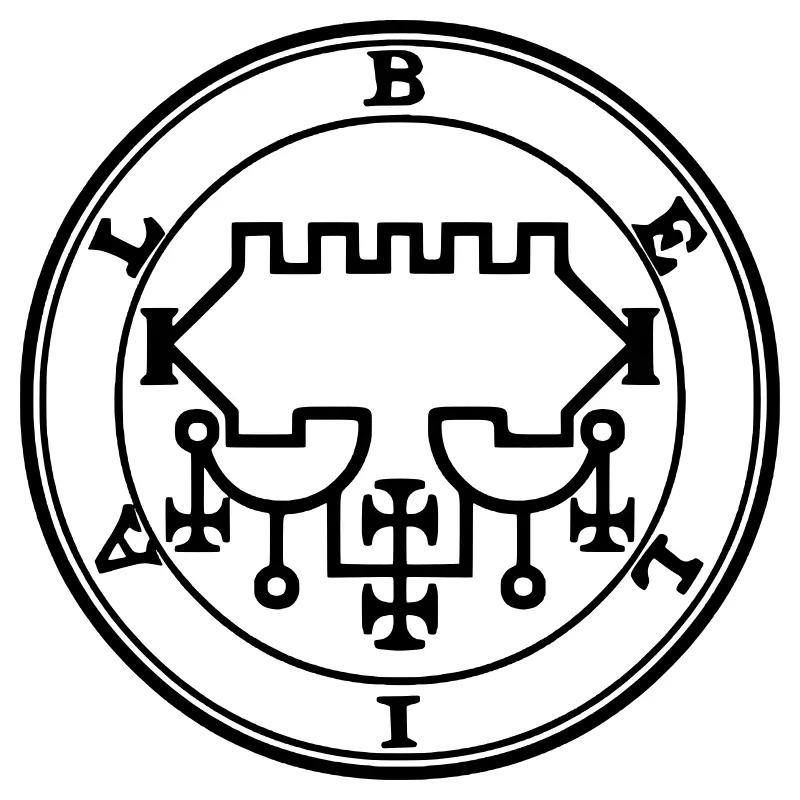
Historical The seal above is Belial’s as printed in 1904, and by the rules of the Observations it would be made in gold, the metal of his rank. Why seals were worn, why editions draw them differently and how to study one are explained in seals, circle and triangle.
Later tradition and modern practice
Later tradition The name comes from the Hebrew beliyya’al, usually read as “worthlessness.” In the Hebrew Bible, “sons of Belial” means worthless or wicked men. In the Dead Sea Scrolls, Belial is a leader of the forces of darkness.
Paul asks, “what concord hath Christ with Belial?” (2 Corinthians 6:15). In Milton’s Paradise Lost, Belial is a fallen angel of graceful speech and idle counsel. The Goetic Belial gathers this long history into one entry.
Modern Modern writers often present Belial as a spirit of independence and earthly power.
Lore about Belial’s personality, likes or chosen people is modern, not grimoire material; modern approaches explains where such claims come from.
Beginner’s quick reference
| Item | What the sources say |
|---|---|
| Rank metal and hours (Goetia) | King: gold; 9 a.m. to noon and 3 p.m. to sunset. |
| Planet (later tradition: Golden Dawn and Crowley’s 777) | Sun. |
| Decan and day or night spirit (later tradition: 777) | Aquarius, second decan (10 to 20 degrees); night spirit. 777 decan incense: “Stammonia” (unidentified; may refer to a toxic plant: do not burn it). Tarot card of the decan: Six of Swords. |
| Commonly reported color, incense, and plant (modern UPG; sources copy each other) | Color yellow; incense frankincense; plant mullein. |
| Associated symbols | Goetia image: two beautiful angels sitting in a chariot of fire; a pleasing voice. 777 Magical Image: the same image. Modern Demonolatry/UPG: the seal, used as an altar image. |
| Associated offerings | The Goetia says Belial “must have Offerings, Sacrifices and Gifts presented unto him,” but does not say what; I use no sacrifice. Modern practice, not in the Goetia manuscripts: most often listed, frankincense and mullein; one source adds cedar, sandalwood, vetiver, and patchouli. |
Before you burn or handle anything listed for Belial, read incense, plants and offerings.
Practical notes
Belial is a king who requires sacrifices and lies unless constrained. Not a first-contact choice under the beginner criteria. His history, from Hebrew word to Milton’s character to Goetic king, is a superb subject for study.
In the directory, Belial is not among the 30 spirits that fit the beginner criteria.
Try this: one question to study
Find Belial’s legions in four places: the 1904 text, Mathers’s note, Crowley’s note and Weyer’s Latin. Write the four numbers side by side and decide which a careful editor should print.
What next
To compare Belial with other spirits of his rank, read Zagan and Balam.
Later tradition In the Golden Dawn scheme of the decans, Belial is the night spirit of the second decan of Aquarius, which belongs to the Six of Swords; the day spirit of the same decan is Asmoday (spirit 32).
Common questions
Is Belial a good spirit for beginners?
Not as a first choice. He does not meet all three beginner criteria I use: not a king, at least one teaching office, and no central harm, deception or compulsion. His entry is still worth reading as history.
What does Belial do in the Ars Goetia?
The 1904 text calls him a king ruling 80 legions (some later reprints print 50). Its first office for him is this: Belial distributes presentations (preferments) and senatorships. The entry lists 3 offices in all.
Does looking at Belial's seal call him?
No. Reading a name or looking at a seal does not call a spirit. The seal is a drawing from a 1904 book, and even the grimoire itself required long rituals for its own purposes.
Get the free Mini-Grimoire
A short printable starter guide to tarot and everyday witchcraft, plus my newsletter. Unsubscribe any time.
Opens Substack in a new tab to confirm. More about the newsletter · Privacy