


| Arcana | Minor Arcana: Swords |
|---|---|
| Image | RWS 1909 (PD) |
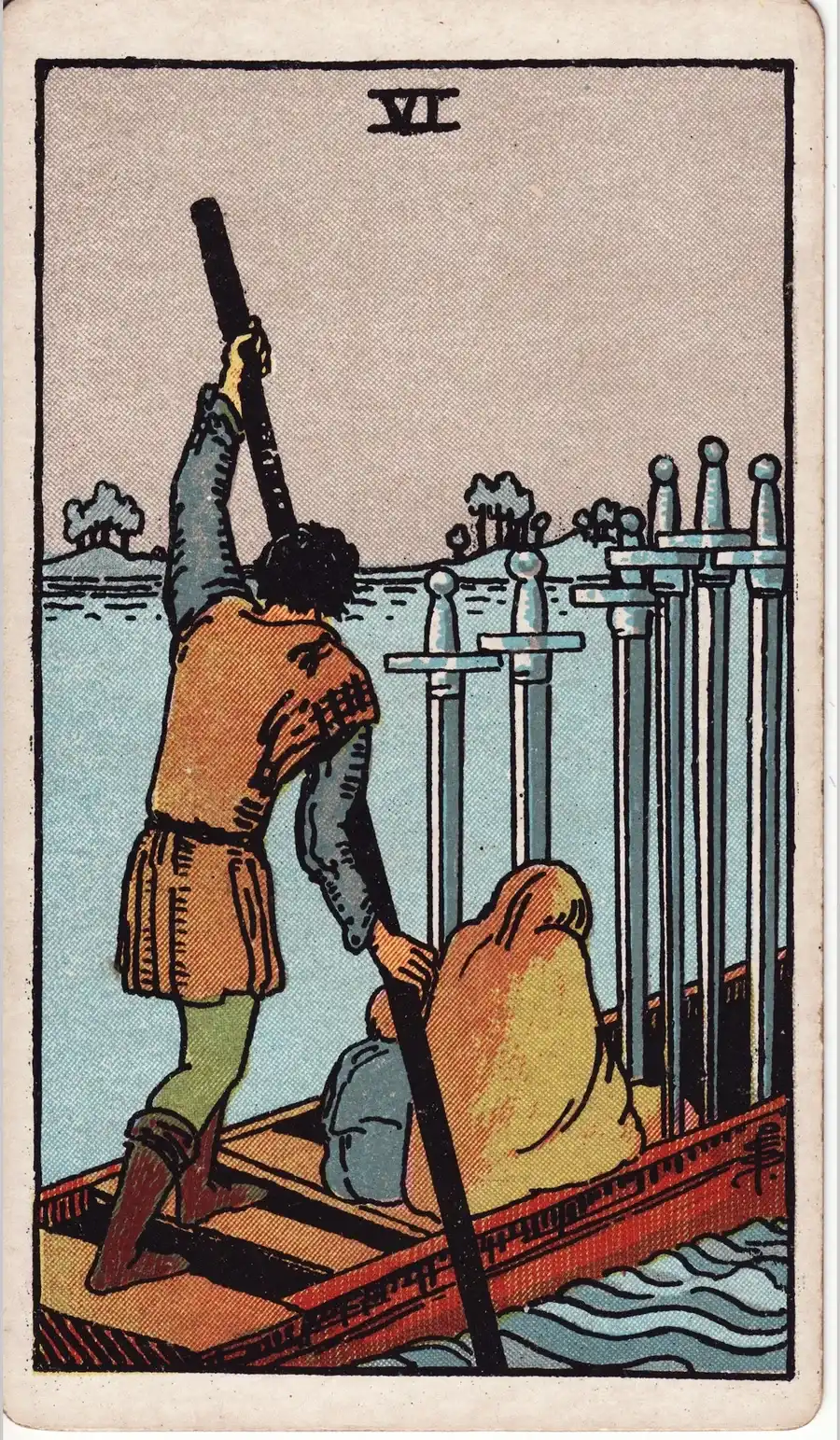
The Six of Swords shows a ferryman poling a small boat across the water toward a distant shore. A hooded woman and a child sit in the boat, with six swords standing upright in front of them.
It is a card of transition, moving on and slow healing. Here is what the Six of Swords means upright and reversed, the symbols Pamela Colman Smith drew and a spread for leaving troubled water.
Here is the Six of Swords at a glance.
| At a glance | This card |
|---|---|
| Upright keywords | transition, moving on, healing |
| Reversed keywords | resistance to change, emotional baggage, stalled transition |
| Number | 6 in the suit of Swords |
| Golden Dawn title | Lord of Earned Success Later tradition |
| Astrology | Mercury in Aquarius, second decan (10° to 20° Aquarius) Later tradition |
| Tree of Life | Tiphareth (6), Beauty Later tradition |
| Suit and element | Swords, Air Later tradition |
| Yes or no | Yes Modern |
The Golden Dawn named the Six of Swords the Lord of Earned Success and gave it Mercury in Aquarius, the middle decan of the sign, on Tiphareth. Mercury the traveler in the sign of the future suits a card about moving through the water toward a better shore.
Later tradition The Golden Dawn also gave each decan two of the 72 Goetic spirits, one for the day and one for the night. For the second decan of Aquarius, and so for the Six of Swords, they are Asmoday (spirit 32, day) and Belial (spirit 68, night). Their pages read the old entries as history; see the spirit directory for all 72.
The card: what Pamela Colman Smith drew
Waite wrote: “A ferryman carrying passengers in his punt to the further shore. The course is smooth, and seeing that the freight is light, it may be noted that the work is not beyond his strength.” Smith drew the water rough on one side of the boat and smooth on the other.
Rough and smooth water. The water near the boat is choppy on one side and calm on the other. They are leaving trouble behind.
The swords in the boat. The six swords travel with them. You carry your memories and lessons with you, even when you move on.
The ferryman. Someone else is steering. Healing in this card often comes with help: a friend, a counselor, a community.
Upright meaning
Upright, the Six of Swords is transition. A ferryman poles a small boat across the water toward a distant shore, carrying a hooded woman and a child. Six swords stand upright in the boat. The water on one side is rough and on the other side it is calm. The card speaks of moving on, leaving difficulty behind and traveling toward something better.
It can mean a literal journey or a move, but more often it is an inner passage, healing after a hard time. The swords come along, which means the memories travel with you. But the boat keeps moving, and the shore ahead looks quieter.
The Golden Dawn called it Earned Success. You have worked through something, and now you are allowed to leave it behind.
Reversed meaning
Reversed, the Six of Swords can show a transition that is stalled, resistance to leaving, or emotional baggage that makes the journey harder. You may be trying to move on while still holding on.
Ask what you need to leave on the old shore. A reversed Six often asks you to accept help, the ferryman, rather than trying to row alone.
Reversed, the Six can also be a return journey, going back to deal with something left unfinished on the old shore. That is not a failure to move on. Some passages must be made twice before the boat can stay on the far side.
In love, work and spirituality
In love. Upright: Moving past a difficult phase together, or healing after a breakup. Reversed: Carrying old baggage into a new relationship.
At work. Upright: A job change, relocation or moving to a better situation. Reversed: Resistance to change, or stalled plans.
With money. Upright: Gradual improvement after hardship. Reversed: Old debts following you.
In spiritual practice. Upright: A healing journey, or a gentle transition to a new path. Reversed: Holding on to old beliefs.
As feelings. Quiet relief, or a wish to move forward together.
As a person. Someone who has been through hard times and is moving on.
As advice. Move toward calmer waters, and accept help along the way.
Reading the Six of Swords: positions and yes or no
In the past position: You left a hard situation, and you are still healing. In the present position: You are moving toward calmer water. Keep going.
In the future position: A move or transition is ahead. As advice: Accept help on the crossing.
In modern yes or no readings, the Six of Swords leans yes. Moving on points to yes.
What the Six means, and the history behind the card
Six brings harmony after the conflict of Five. In Swords the harmony is movement away from trouble, toward a calmer shore.
Here is how the Six looks across the four suits:
- Six of Wands: success, recognition, victory
- Six of Cups: nostalgia, memories, reunion
- Six of Swords (this card): transition, moving on, healing
- Six of Pentacles: generosity, charity, balance
A ferryman punts a boat across the water, carrying a woman wrapped in a cloak and a small child. Six swords stand upright in the boat.
Many readers point out that the water on one side of the boat looks rough and the water on the other side looks smooth, as if the passengers are moving from trouble toward calmer ground.
The swords travel with them. The card is honest about that: you can leave a hard place and still carry some of it with you for a while.
When A. E. Waite published The Pictorial Key to the Tarot in 1910, he listed these divinatory meanings for the Six of Swords: “Journey by water, route, way, envoy, commissionary, expedient.” Reversed, he gave: “Declaration, confession, publicity; one account says that it is a proposal of love.”
Common questions
Is the Six of Swords a yes or no card? It leans yes. It shows moving toward something better.
Does the Six of Swords mean travel? It can, especially travel over water or a move. It often means an emotional transition, too.
What does the Six of Swords mean in love? Moving on from a hard time, together or apart.
Try this
Try this small spread for the Six of Swords. Use it when you are moving on from something hard.
| Card | Question | What it shows |
|---|---|---|
| 1 | What am I leaving? | The troubled water behind me. |
| 2 | What do I carry? | The lessons and weight in my boat. |
| 3 | What waits on the other shore? | The calmer place ahead. |
Affirmation: I cross toward calmer ground one practical step at a time.
Reversed affirmation: I loosen the baggage that keeps me from leaving.
If you keep a tarot journal, take one of these questions to it: What am I leaving behind? What am I carrying with me, and do I need it? Who is helping me cross?
What next
Cards that sit close to this one are Eight of Cups (another card of leaving), Death (the Major Arcana card of transition) and The Star (the Major Arcana card of healing after crisis).
The Six of Swords is part of the lesson Swords in my free Tarot for Beginners course. To see the whole suit on one page, go to the suit of Swords. To keep walking the suit, read the card before it, Five of Swords or the card after it, Seven of Swords, or go back to all the card meanings.
For the suits and numbers in one place, see The Minor Arcana: suits and numbers made simple. For every card with keywords, affirmations and examples, see my book The Novice’s Guide to Tarot. If you would like a printable cheat sheet for all 78 cards, my 45-page Tarot Workbook is on Etsy.
Sources
- A. E. Waite, The Pictorial Key to the Tarot (London: Rider, 1910), Part III, sections 1 and 2.
- Pamela Colman Smith and A. E. Waite, the Rider-Waite-Smith tarot (London: Rider, 1909).
- Nicolas Conver, Tarot de Marseille (Marseille, 1760).
- Lauri Mukkala, The Novice’s Guide to Tarot, entry for the Six of Swords.
- Aleister Crowley, 777 (London: Walter Scott, 1909), columns of the decans, the Minor Arcana and the court cards.
- Israel Regardie, ed., The Golden Dawn (Chicago: Aries Press, 1937 to 1940), “Book T”, titles and attributions of the small cards and the court.
All 78 cards
Major Arcana
- The Fool
- The Magician
- The High Priestess
- The Empress
- The Emperor
- The Hierophant
- The Lovers
- The Chariot
- Strength
- The Hermit
- Wheel of Fortune
- Justice
- The Hanged Man
- Death
- Temperance
- The Devil
- The Tower
- The Star
- The Moon
- The Sun
- Judgement
- The World
Wands
- Ace of Wands
- Two of Wands
- Three of Wands
- Four of Wands
- Five of Wands
- Six of Wands
- Seven of Wands
- Eight of Wands
- Nine of Wands
- Ten of Wands
- Page of Wands
- Knight of Wands
- Queen of Wands
- King of Wands
Cups
- Ace of Cups
- Two of Cups
- Three of Cups
- Four of Cups
- Five of Cups
- Six of Cups
- Seven of Cups
- Eight of Cups
- Nine of Cups
- Ten of Cups
- Page of Cups
- Knight of Cups
- Queen of Cups
- King of Cups
Swords
- Ace of Swords
- Two of Swords
- Three of Swords
- Four of Swords
- Five of Swords
- Six of Swords
- Seven of Swords
- Eight of Swords
- Nine of Swords
- Ten of Swords
- Page of Swords
- Knight of Swords
- Queen of Swords
- King of Swords
Pentacles
Get the free Mini-Grimoire
A short printable starter guide to tarot and everyday witchcraft, plus my newsletter. Unsubscribe any time.
Opens Substack in a new tab to confirm. More about the newsletter · Privacy